
HSE-323 · Lesson 10 of 12 · 29 min
Coolant and fluid hazards
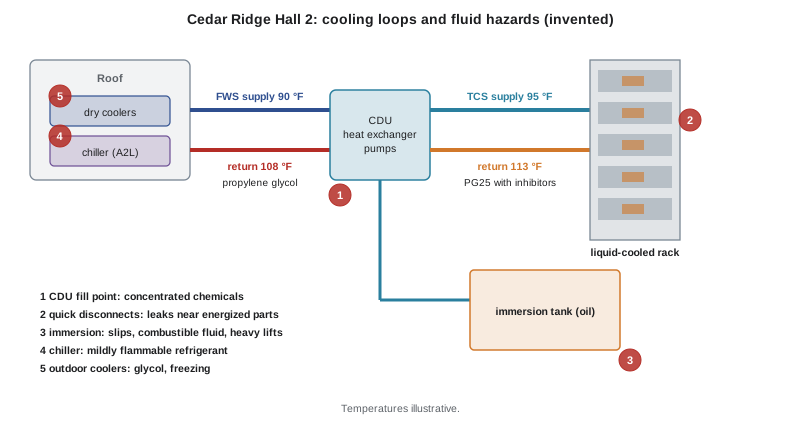
Liquid cooling puts chemicals into the white space. Water-based coolants carry glycols, corrosion inhibitors and biocides; immersion systems hold hundreds or thousands of liters of oils or engineered fluids; two-phase systems use fluids that boil at room temperature; and chillers and some cooling units contain refrigerants that are changing to new, mildly flammable types. Each has hazards for the people who fill, top up, sample, drain, clean up and work near it. This lesson describes those hazards and the controls for them, starting with the most common coolants and moving to the less common ones.
HSE-102, WHMIS Awareness, and HSE-312, Chemical Handling and Storage, cover the general rules for hazardous products, labels, safety data sheets and storage, and HSE-251, Spill Response and Environmental Protection, covers spills in general. This lesson applies them to cooling fluids. As always, the safety data sheet for the specific product is the authority on its hazards and precautions; the descriptions here are general.
Water-based coolants
Most technology cooling systems use treated water or a mixture of water and propylene glycol, commonly about 25 percent glycol by volume (often called PG25). The glycol lowers the freezing point and inhibits microbial growth; the water does most of the heat transfer. Corrosion inhibitors protect the metals in the loop, typically copper cold plates, stainless steel, brass fittings and sometimes aluminum, and many formulations include a biocide. Facility water loops may use ethylene or propylene glycol, especially where piping runs outdoors.
| Ingredient | Purpose | Main hazards to people |
|---|---|---|
| Propylene glycol | Freeze protection, some microbial control | Low toxicity; eye irritation; slippery spills |
| Ethylene glycol | Freeze protection (mainly facility loops) | Toxic if swallowed, potentially fatal; sweet taste attracts children and animals; eye irritation |
| Azole inhibitors (for example tolyltriazole) | Protect copper and brass | Irritant in concentrate; harmful to aquatic life |
| Other inhibitors (molybdate, nitrite, silicate, organic acids) | Protect steel and other metals | Varies; some irritant or corrosive in concentrate |
| Biocides (for example isothiazolinones, glutaraldehyde) | Prevent bacteria and fungi | Skin sensitizers, irritants or corrosive in concentrate |
| pH buffers | Hold pH in the target range | Some corrosive in concentrate |
Propylene glycol is used in data center technology cooling loops largely because of its low toxicity; it is used in foods, cosmetics and medicines. Ethylene glycol transfers heat slightly better but is toxic if swallowed: a relatively small amount can cause kidney failure and death, and its sweet taste is a danger to children and animals. Facility teams should know which glycol is in each loop, label it, and never store either in food or drink containers.
The diluted coolant in a running loop is usually much less hazardous than the concentrates used to make it up. Workers who mix, fill or treat a loop handle concentrated glycol, inhibitor packages and biocides, which may be irritant, sensitizing or corrosive. The controls are the familiar ones: read the safety data sheet, wear chemical splash goggles and suitable gloves (nitrile is common, but the safety data sheet decides), use a face shield and apron when pouring concentrates, have an eyewash station within reach, work with good ventilation and keep products in labeled original containers. Biocides deserve particular care because some cause allergic skin reactions that worsen with each exposure.
Microbes, fouling and Legionella
A closed technology cooling loop that is properly treated should not grow much biology, but loops that are poorly filled, contaminated or left stagnant can grow bacteria and fungi that form biofilms, clog the fine channels in cold plates and accelerate corrosion. Sampling and testing coolant, keeping filters clean and maintaining inhibitor and biocide levels are part of the operator's routine, and sampling involves opening the loop, so it follows the same precautions as any other loop work.
Open evaporative cooling towers, used in some data center heat rejection plants, are a different matter. They can grow Legionella bacteria and spread them in aerosols, causing Legionnaires' disease, a serious pneumonia. Following a deadly outbreak in the South Bronx in 2015, New York City passed a law requiring registration, inspection and testing of cooling towers, and other cities and states have their own requirements. ASHRAE Standard 188 sets out a framework for water management programs for building water systems. Workers who maintain cooling towers need respiratory protection and procedures for disinfection, as HSE-240 and HSE-245 describe.
Dielectric oils for single-phase immersion
Single-phase immersion tanks are filled with dielectric fluids, most often synthetic hydrocarbons such as polyalphaolefins, highly refined mineral oils or synthetic esters. They are chosen because they do not conduct electricity, have good heat transfer and are compatible with server components. They have low acute toxicity, but they bring four hazards to the white space.
- Combustibility. These fluids burn. Most immersion fluids have flash points well above the temperatures reached in normal operation, commonly above 300 °F (about 150 °C) for many products, which places them among the higher-flash-point combustible liquids in fire codes. A tank of fluid is nonetheless a significant fuel load in a data hall, and a fire in or near a tank could involve hundreds of liters of burning oil. Fire codes, the authority having jurisdiction and the insurer may require specific protection, such as tank lids that close automatically, fluid temperature and level monitoring, sprinkler or other protection over the tanks, spill containment and limits on quantities.
- Slips. Even a thin film of oil makes floors extremely slippery, and it spreads easily on shoes and carts. Spills near tanks, drips from removed servers and fluid carried on footwear are constant problems.
- Skin and eye contact. Prolonged skin contact with oils can remove the skin's natural oils and cause dermatitis; fluid in the eyes is irritating. Low-viscosity hydrocarbon fluids can also carry an aspiration hazard: if swallowed and then vomited, they can enter the lungs and cause severe damage. Safety data sheets for such fluids carry the corresponding hazard statement.
- Mist. If fluid sprays from a failed fitting or is splashed during maintenance, it can form a mist that can be inhaled and that is more easily ignited than the bulk liquid.
Fluorinated fluids for two-phase systems
Two-phase immersion and some two-phase direct-to-chip systems use fluorinated fluids with boiling points typically in the range of 86 to 140 °F (about 30 to 60 °C), so that they boil at the chips and condense on a cooler coil. These fluids are non-flammable and of low acute toxicity, but they have three special hazards.
- Vapor. The vapor is several times heavier than air. In a properly sealed tank, little escapes, but opening a tank, overfilling, a failed condenser or a leak can release vapor that collects in low areas such as trenches, pits or sumps, displacing oxygen in a poorly ventilated space.
- Thermal decomposition. At high temperatures, such as in a fire or on an overheating component in a failure, fluorinated fluids can decompose to toxic products, including hydrogen fluoride. The safety data sheet states the decomposition temperature and products.
- PFAS. Many of these fluids are per- and polyfluoroalkyl substances. 3M, a major producer, stopped manufacturing PFAS by the end of 2025, including fluids widely used in two-phase cooling. In the United States, EPA's reporting rule for PFAS under the Toxic Substances Control Act had its reporting deadline pushed to early 2027 after several extensions, as of mid-2026, and several states have PFAS reporting or restriction laws; Canada has moved to manage PFAS as a class under the Canadian Environmental Protection Act; and the European Union has been considering a broad PFAS restriction. Some manufacturers have introduced alternative fluids for two-phase cooling, and some vendors have announced moves away from PFAS. For people on site, the implications are careful containment, recovery and disposal, and attention to which fluid is actually in each system.
Refrigerants
Chillers, computer room air conditioners and two-phase direct-to-chip systems contain refrigerants. ASHRAE Standard 34 classifies them by toxicity (A for lower toxicity, B for higher) and flammability (1 for no flame propagation, 2L for mildly flammable, 2 for flammable and 3 for highly flammable). For years most data center equipment used A1 refrigerants, which are non-flammable but heavier than air and can displace oxygen in machinery rooms, where people have died after large leaks. The phase-down of high global warming potential HFCs is moving new equipment to refrigerants with lower global warming potential, many of them in the A2L class, such as R-32, R-454B and R-1234ze.
A2L refrigerants are hard to ignite and burn slowly, but they can burn, and in a fire they decompose to hydrogen fluoride. Installations follow ASHRAE 15, the mechanical code and the manufacturer's requirements, which may include refrigerant detectors, ventilation, limits on charge size per room and the elimination of ignition sources near equipment. Under the EPA technology transitions rule, new cooling equipment for information technology is limited to refrigerants with a global warming potential below 700 from January 1, 2027, as EPA's fact sheet shows, subject to later amendments. Technicians must be certified under EPA Section 608 to handle refrigerants and should be trained in the handling of A2L refrigerants, including leak checking, recovery and the use of tools rated for them.
Handling immersion fluid and servers
Immersion systems turn routine server maintenance into a fluid-handling task. A server lifted out of a tank carries fluid on its surfaces and drips it for some time; it may weigh 44 to 88 lb (20 to 40 kg) dry, plus retained fluid, and must be lifted vertically from a tank whose rim is at waist or chest height. That combination of weight, awkward posture, slippery hands and gloves and a dripping load is a recipe for back injuries, dropped servers and spills. Manufacturers provide service lifts or overhead hoists and drip trays for exactly this reason. Tanks themselves are heavy: a tank holding several hundred liters of fluid plus servers can weigh well over a metric ton, so floor loading must be checked before tanks are installed or moved, as HSE-320 Lesson 4 described for racks.
The program below estimates the mass of the Cedar Ridge immersion pilot tanks and their floor loading, the mass of a server as lifted, and compares the lift with a common ergonomic reference value. All product values are invented and illustrative; real values come from the manufacturer.
# Teaching estimates for an invented single-phase immersion tank.
g = 9.81
fluid_L, fluid_density = 900, 0.82      # L and kg/L (synthetic hydrocarbon)
tank_empty_kg, servers, server_kg = 450, 24, 32
footprint_m2 = 1.3 * 0.9                # tank base, m2
fluid_kg = fluid_L * fluid_density
total = tank_empty_kg + fluid_kg + servers * server_kg
load_kpa = total * g / footprint_m2 / 1000
print(f"Fluid {fluid_kg:.0f} kg; tank total {total:.0f} kg ({total*2.2046:,.0f} lb)")
print(f"Floor loading under tank about {load_kpa:.1f} kPa ({load_kpa*20.885:.0f} lb/ft2)")
# Server as lifted: dry mass plus retained fluid film (illustrative 1.5 kg)
lifted = server_kg + 1.5
reference = 23.0   # kg, a common ergonomic reference for ideal two-handed lifts
print(f"Server as lifted about {lifted:.1f} kg vs {reference:.0f} kg reference under ideal conditions")
print("Lift is from a tank rim, vertical, with slippery gloves: use the service hoist.")
# Flash point margin for the fluid (illustrative values)
flash_c, max_fluid_c = 170, 55
print(f"Flash point {flash_c} C vs maximum operating fluid temperature {max_fluid_c} C: "
f"margin {flash_c - max_fluid_c} C in normal operation")Fluid 738 kg; tank total 1956 kg (4,312 lb) Floor loading under tank about 16.4 kPa (343 lb/ft2) Server as lifted about 33.5 kg vs 23 kg reference under ideal conditions Lift is from a tank rim, vertical, with slippery gloves: use the service hoist. Flash point 170 C vs maximum operating fluid temperature 55 C: margin 115 C in normal operation
The tank in the example weighs nearly 2 metric tons and loads the floor beneath it at 340 lb/ft² (about 16 kPa), well above the uniform load rating of many raised floors, which is one reason immersion tanks are usually placed on slab floors. The server as lifted exceeds the ideal-conditions reference mass before considering the poor posture and grip, so a service hoist is the right control. The large margin between operating temperature and flash point shows why immersion fluids rarely ignite in normal operation; the fire concern is an external fire or an electrical failure that heats the fluid locally, not normal running.
Personal protective equipment and hygiene
Typical personal protective equipment for work on liquid cooling systems includes safety glasses or chemical splash goggles, chemical-resistant gloves selected from the safety data sheet, slip-resistant footwear, and aprons or coveralls for immersion work and for handling concentrates. Face shields are added when pouring concentrates or working on pressurized connections. Hand washing after handling fluids, keeping food and drink out of the white space, and promptly cleaning spills are simple but important controls. Eyewash stations should be available where concentrated coolant chemicals are handled, and portable eyewash bottles do not replace a plumbed or self-contained eyewash that meets the standard.
Worked problem
Topping up a CDU
A Cedar Ridge cooling technician must top up a Hall 2 CDU with PG25 coolant from a 200-liter drum and add a corrosion inhibitor package, because the coolant level has fallen. What should the technician check and do?
Show solution
- Find out why the level fell before adding coolant: a falling level means a leak somewhere, and topping up hides it. Check leak detection history and inspect manifolds and couplings.
- Read the safety data sheets for the PG25 and the inhibitor; confirm the correct products for this loop, because mixing incompatible coolants can cause corrosion or precipitation.
- Wear splash goggles, the gloves specified on the safety data sheet and an apron; confirm the eyewash location; place spill containment and absorbents under the fill point.
- Use the CDU's fill connection and pump as the manufacturer specifies, adding inhibitor at the correct dose; do not open pressurized parts of the loop.
- Record the volume added, take a coolant sample for analysis if required, clean up, label any partly used drum and return it to chemical storage.
Answer: Investigate the cause of the loss first, use the correct products after reading their safety data sheets, wear eye and hand protection with an eyewash available, contain spills, fill through the proper connection, and record and sample as required.
Common mistakes
MistakeTreating all glycol coolants as equally safe.
InsteadKnow which glycol is in each loop; ethylene glycol is toxic if swallowed, propylene glycol much less so.
MistakeHandling inhibitor and biocide concentrates with only ordinary work gloves.
InsteadRead the safety data sheet and use splash goggles, specified gloves and an apron, with an eyewash nearby.
MistakeAssuming immersion oils cannot burn because they are used around electronics.
InsteadRecognize that they are combustible liquids and a fuel load, even with high flash points.
MistakeLifting immersion servers out of tanks by hand.
InsteadUse the service hoist and drip trays; the lift is heavy, awkward and slippery.
MistakeTopping up a coolant loop repeatedly without finding the leak.
InsteadInvestigate any loss of coolant before topping up.
Summary and key terms
- Water-based coolants contain glycol, inhibitors and biocides; concentrates are more hazardous than filled loops.
- Propylene glycol has low toxicity; ethylene glycol is toxic if swallowed and must be clearly labeled.
- Closed loops need water treatment and sampling; open cooling towers need Legionella water management programs.
- Single-phase immersion oils are combustible, slippery, irritant and can form mists; tanks add significant fuel load.
- Two-phase fluorinated fluids give heavy vapor and toxic decomposition products, and many are PFAS facing regulation and supply changes.
- New refrigerants are often mildly flammable (A2L); they need detection, ventilation, charge limits and certified technicians.
- Immersion server lifts and tank weights need hoists, drip trays and floor loading checks.
- A2L refrigerant
- A refrigerant of lower toxicity that is mildly flammable under ASHRAE 34.
- Biocide
- A chemical added to coolant to prevent the growth of bacteria and fungi.
- Corrosion inhibitor
- A chemical added to coolant to protect metals in the loop.
- Flash point
- The lowest temperature at which a liquid gives off enough vapor to ignite in air near its surface.
- Legionella
- Bacteria that can grow in water systems and cause Legionnaires’ disease when inhaled in aerosols.
- PFAS
- Per- and polyfluoroalkyl substances, a large class of persistent fluorinated chemicals.
- PG25
- A coolant of about 25 percent propylene glycol in water, often with inhibitors.
Practice problems
Work each problem on paper first, then reveal the answer to check.
Why is propylene glycol usually preferred over ethylene glycol in technology cooling loops?
Show answer
It has much lower toxicity.
Why are concentrates more hazardous than the coolant in a running loop?
Show answer
They contain glycol, inhibitors and biocides at much higher concentrations.
What health effect makes some biocides especially concerning?
Show answer
Skin sensitization, which causes allergic reactions that worsen with repeated exposure.
What disease can cooling towers spread, and how?
Show answer
Legionnaires’ disease, through aerosols containing Legionella bacteria.
Name four hazards of single-phase immersion oils.
Show answer
Combustibility, slips, skin and eye contact (including aspiration hazard if swallowed) and mist.
Why can two-phase fluid vapor be hazardous in trenches or pits?
Show answer
It is several times heavier than air and can collect there, displacing oxygen.
What happened to 3M production of PFAS fluids used in two-phase cooling?
Show answer
3M stopped manufacturing PFAS by the end of 2025.
What does the refrigerant class A2L mean?
Show answer
Lower toxicity (A) and mildly flammable (2L).
Why are immersion tanks usually placed on slab floors?
Show answer
They are very heavy and can exceed the load ratings of raised floors.
What should be done before topping up a coolant loop whose level has fallen?
Show answer
Find the cause of the loss, which usually means a leak.
Lesson quiz · 5 questions
Score 60% or more to complete this lesson.
Create a free account to save your progress, take quizzes and earn a certificate.