
HSE-323 · Lesson 4 of 12 · 30 min
Clean agent systems: types and how they work
Clean agent systems fill a room with a gas that puts out fire without leaving water, powder or residue on the equipment. They protect the rooms where a sprinkler discharge would be most damaging or where restoring service quickly matters most: meet-me rooms, network rooms, tape libraries, control rooms and some electrical rooms. To work with them safely, you need to understand what the agents are, how they extinguish fire, how they are stored and released, and why each family has different hazards for the people in the room. This lesson covers those basics; Lesson 5 covers the hazards of discharge and Lesson 6 the effects of pressure and noise.
System design, including agent quantity calculations, nozzle placement and pipe sizing, is covered in DCE-440 Lesson 4. This lesson uses simple calculations only to show why agent quantities and concentrations matter for safety.
What 'clean agent' means
NFPA 2001 defines a clean agent as an electrically non-conducting, volatile or gaseous fire extinguishant that does not leave a residue on evaporation. That definition covers two quite different families. Inert gas agents are mixtures of nitrogen, argon and sometimes a little carbon dioxide; they put out fire mainly by lowering the oxygen in the room. Halogenated agents, often called halocarbons, are manufactured chemicals containing fluorine; they put out fire mainly by absorbing heat from the flame, with some chemical interference in the combustion reactions. Carbon dioxide is not classed as a clean agent under NFPA 2001, which excludes it, and has its own standard, NFPA 12, because it is lethal at the concentrations needed to extinguish fire.
Total flooding
Almost all clean agent systems in data centers are total flooding systems. The agent is discharged into an enclosed room until it reaches a design concentration throughout the room, and the room must then hold that concentration long enough for the fire to go out and for hot surfaces to cool so the fire does not reignite. Total flooding depends on the room: the volume must be known, openings must be closed and the walls, floor and ceiling must be tight enough to hold the agent. That is why clean agent rooms have door closers, damper shutdowns and enclosure integrity tests, discussed in Lesson 6.
The design concentration starts from the extinguishing concentration found in standard fire tests for the agent and adds a safety factor, at least 1.2 for ordinary combustibles in NFPA 2001 and more for some hazards. The amount of agent needed then depends on the room volume, the expected temperature and the agent's properties. For people, the crucial question is how the design concentration compares with the concentration at which the agent, or the reduced oxygen, starts to harm health.
Inert gas agents
Inert gas agents are named with the prefix IG and a number that describes the mixture. IG-541 is a blend of 52 percent nitrogen, 40 percent argon and 8 percent carbon dioxide. IG-55 is a 50:50 blend of nitrogen and argon. IG-100 is nitrogen alone, and IG-01 is argon alone. These gases occur naturally in air, have no ozone depletion potential and no global warming potential from their use, and are not affected by the rules phasing down halocarbons.
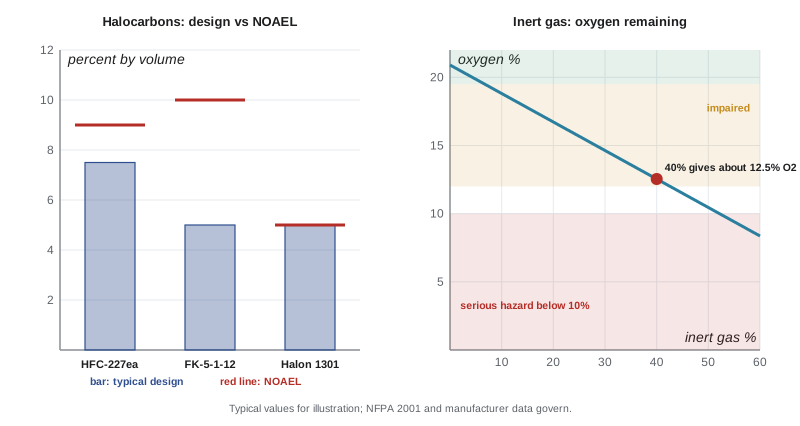
Inert gases extinguish fire by dilution. Discharging the agent into the room displaces part of the air through pressure relief vents, so the oxygen concentration falls. Most flaming fires in ordinary materials cannot continue below an oxygen concentration of roughly 12 to 15 percent, and inert gas design concentrations of roughly 35 to 50 percent bring the oxygen in the room down to roughly 10 to 14 percent. That is well below the 19.5 percent often used as the lower limit for a safe atmosphere in confined space rules, which is why inert gas systems require careful control of human exposure. The small amount of carbon dioxide in IG-541 is there to stimulate breathing, which helps people maintain oxygen uptake in the reduced-oxygen atmosphere for a short time.
Because the room must take in a large volume of gas, inert gas agents are stored as compressed gas in high-pressure cylinders, commonly at about 2,200 to 4,400 psi (roughly 150 to 300 bar). They need many cylinders and a lot of floor space, and their discharge pushes a large volume of air out of the room, so the room needs properly sized pressure relief venting. Discharge takes longer than for halocarbons, typically about 60 seconds and up to about 120 seconds for some applications, depending on the standard edition and the system design.
Halocarbon agents
Halocarbon clean agents are manufactured chemicals, stored as liquids in cylinders pressurized with nitrogen, commonly at about 25 or 42 bar (about 360 or 600 psi), so that they discharge quickly through the pipes and nozzles. They vaporize as they leave the nozzle and mix with the room air. Their design concentrations are much lower than for inert gases, typically in the range of about 4 to 9 percent by volume, so they need fewer cylinders and much less venting. They must discharge quickly, usually within 10 seconds, to limit the production of decomposition products in a fire and to mix well.
Two halocarbon agents dominate the data center market today. HFC-227ea (heptafluoropropane) has been widely used since the 1990s as a replacement for halon. It is a hydrofluorocarbon with a high global warming potential, so it falls within the HFC phase-down, and future supply and servicing costs are uncertain. FK-5-1-12 is a fluorinated ketone that is a liquid at room temperature, boiling at 120 °F (about 49 °C), with a very short atmospheric life and a global warming potential close to 1. It became widely used in the 2010s as a lower-climate-impact alternative.
The supply of FK-5-1-12 changed in the mid-2020s. Its best-known brand was made by 3M, which announced in December 2022 that it would stop manufacturing per- and polyfluoroalkyl substances (PFAS), including this agent, by the end of 2025. Other manufacturers produce FK-5-1-12 and suppression companies market it under their own names, so existing systems can generally continue to be serviced and refilled, but owners have had to confirm their supply arrangements. Because FK-5-1-12 is fluorinated, it falls within some broad definitions of PFAS, and regulation of PFAS continues to develop in both countries and internationally. For people on site, the practical effects are that agent names on cylinders and in documents may change, and any change of agent supplier must go through the manufacturer's listing and the site's management of change, because agents and system components are tested and listed together.
Halon 1301: the legacy agent
Halon 1301 (bromotrifluoromethane) was the standard data center agent for decades. It is very effective at low concentrations, about 5 percent, because the bromine interrupts the chemical chain reactions of combustion. It is also a powerful ozone-depleting substance, and its production ended in developed countries in 1994 under the Montreal Protocol. Some older systems remain in service in both countries, supplied from recycled halon banks, and some critical uses such as aviation still depend on recycled halon. If you work at a site with a halon system, the same safety principles apply as for other halocarbons, with additional environmental controls on any servicing, discharge or decommissioning.
| Agent | Family | How it extinguishes | Typical design concentration | Storage | Discharge time |
|---|---|---|---|---|---|
| IG-541, IG-55, IG-100, IG-01 | Inert gas | Lowers oxygen | About 35 to 50 percent by volume | High-pressure gas | About 60 to 120 s |
| HFC-227ea | Halocarbon (HFC) | Heat absorption, some chemical action | About 7 to 9 percent | Liquid under nitrogen | About 10 s |
| FK-5-1-12 | Halocarbon (fluoroketone) | Heat absorption | About 4 to 6 percent | Liquid under nitrogen | About 10 s |
| Halon 1301 (legacy) | Halon | Chemical chain interruption | About 5 percent | Liquid under nitrogen | About 10 s |
| Carbon dioxide (not a clean agent) | Inert gas | Lowers oxygen; toxic | About 34 percent or more | Liquefied gas | About 1 min for surface fires |
Safety margins for people
For halocarbon agents, NFPA 2001 uses toxicological reference values to decide whether a system may be used in a normally occupied space and for how long people may be exposed. The no observed adverse effect level (NOAEL) is the highest concentration at which no adverse effect was observed in testing; the lowest observed adverse effect level (LOAEL) is the lowest at which an effect was observed. For the halocarbons, the effect of concern is cardiac sensitization, an increased sensitivity of the heart to adrenaline that can cause dangerous arrhythmias, especially in a frightened person. NFPA 2001 also uses physiologically based models of how the agent builds up in the blood to set safe exposure times for concentrations above the NOAEL.
As a rule of thumb, HFC-227ea has a NOAEL of about 9 percent, so typical design concentrations of 7 to 8.5 percent sit just below it, with a narrow margin. FK-5-1-12 has a NOAEL of about 10 percent, so typical design concentrations of 4 to 6 percent sit well below it, with a wide margin. That margin is one reason FK-5-1-12 became popular for occupied rooms. Margins matter because real concentrations can exceed design: a system designed for a room may be installed in a smaller room after a renovation, the room volume may have been calculated wrongly, temperatures may differ from design, or several zones may discharge into connected spaces.
For inert gases, the concern is reduced oxygen rather than toxicity. NFPA 2001 sets permitted exposure times based on the oxygen concentration that results: generally, short exposures of up to about 5 minutes are permitted down to about 12 percent oxygen, shorter exposures down to about 10 percent, and below 10 percent exposure is permitted only where people can leave within about 30 seconds or where the space is normally unoccupied. These figures are summaries for teaching; the standard and its tables govern. Lesson 5 explains what reduced oxygen does to the body.
How much agent, and why it matters
The quantity of agent in a total flooding system is calculated from the volume of the room, the design concentration and the agent's specific vapor volume at the design temperature. For halocarbons, the NFPA 2001 flooding equation is W = (V / S) × C / (100 − C), where W is the mass of agent, V the protected volume, S the specific vapor volume of the agent at the room temperature, and C the design concentration in percent. The specific volume is approximated by a straight line in temperature, S = k1 + k2 × T. For inert gases, the corresponding formula gives a volume of agent per volume of room that grows with the natural logarithm of 100 / (100 − C), because the agent flows out through the vents as it mixes.
The program below applies these formulas to the two clean agent rooms at Cedar Ridge. The room sizes are invented, and the specific volume constants are approximate values of the kind published in the standard, used here only to illustrate. Real quantities are calculated by the system designer with listed software, including adjustments for altitude and other factors.
import math
# ILLUSTRATIVE clean agent quantities for the two invented Cedar Ridge rooms.
# Constants are approximate published-style values; real designs use listed data.
agents = {  # specific volume S = k1 + k2*T (m3/kg, T in degC)
    "FK-5-1-12": (0.0664, 0.000274),
    "HFC-227ea": (0.1269, 0.000513),
}
def halocarbon_mass(V, C, T, agent):
    k1, k2 = agents[agent]
    S = k1 + k2 * T
    return (V / S) * C / (100 - C)

mmr_V, mmr_T = 14 * 10 * 3.6, 20.0          # meet-me room, m3 and degC
for agent, C in (("FK-5-1-12", 5.0), ("HFC-227ea", 7.5)):
    W = halocarbon_mass(mmr_V, C, mmr_T, agent)
    print(f"Meet-me room {mmr_V:.0f} m3, {agent} at {C}%: about {W:.0f} kg ({W*2.2046:.0f} lb)")

# Inert gas: agent volume per room volume = ln(100/(100-C)) at reference conditions.
net_V, C = 260.0, 40.0                        # Hall 2 network room, m3; IG-541 design %
x = math.log(100 / (100 - C))
o2 = 20.9 * (1 - C / 100)
print(f"Network room {net_V:.0f} m3, IG-541 at {C}%: about {x*net_V:.0f} m3 of agent "
      f"({x:.2f} m3 per m3 of room); oxygen falls to about {o2:.1f}%")
# What if the halocarbon system ends up in a room 25% smaller after a renovation?
W = halocarbon_mass(mmr_V, 7.5, mmr_T, "HFC-227ea")
k1, k2 = agents["HFC-227ea"]; S = k1 + k2 * mmr_T
V2 = 0.75 * mmr_V
C2 = 100 * (W * S / V2) / (1 + W * S / V2)
print(f"Same HFC-227ea charge in a room 25% smaller: about {C2:.1f}% (NOAEL about 9%)")Meet-me room 504 m3, FK-5-1-12 at 5.0%: about 369 kg (814 lb) Meet-me room 504 m3, HFC-227ea at 7.5%: about 298 kg (657 lb) Network room 260 m3, IG-541 at 40.0%: about 133 m3 of agent (0.51 m3 per m3 of room); oxygen falls to about 12.5% Same HFC-227ea charge in a room 25% smaller: about 9.8% (NOAEL about 9%)
The last line shows why changes to a protected room are a safety matter, not just a design detail. The same charge of HFC-227ea that gives 7.5 percent in the original room would give about 9.8 percent in a room a quarter smaller, above the NOAEL of about 9 percent. Partitioning a protected room, building a cage inside it, or adding a raised floor or ceiling plenum without telling the fire protection engineer can change the concentration people would be exposed to if the system discharged. Lesson 6 returns to this point.
The parts of a clean agent system
Whatever the agent, a clean agent system has the same main parts, and people working nearby should recognize them.
- Agent cylinders, often in a cylinder room or closet next to the protected space, each with a valve, a release device (electric actuator or pneumatic actuator) and a pressure gauge or a monitoring switch.
- A manifold and distribution piping, which carry the agent to nozzles in the room, often including nozzles below raised floors and above ceilings if those spaces are protected.
- A releasing panel, often part of or connected to the fire alarm system, which processes detection signals and fires the release devices.
- Detection devices, alarms and signs: smoke detectors in two zones, horns and strobes, abort and manual release stations, and warning signs at every entrance.
- Interlocks with the building: air handling shutdown, damper closure, door releases and, in some designs, power shutdown.
- Pressure relief vents in the room walls, sized for the agent discharge, and enclosure features that keep the agent in the room.
Worked problem
Reading the signs at a protected room
A customer technician at Cedar Ridge stops at the door of the Hall 2 network room, which is protected by IG-541, and asks what the sign on the door means and whether she should be concerned about entering. What should the escort explain?
Show solution
- The sign says the room is protected by an inert gas clean agent system and gives instructions: leave immediately when the alarm sounds, do not enter after discharge until the room has been ventilated and declared safe.
- The agent is a mixture of nitrogen, argon and a little carbon dioxide that puts out fire by lowering the oxygen in the room to roughly 12 to 13 percent.
- The system is designed so that people have time to leave: it is cross-zoned, it sounds a pre-discharge alarm and it has a time delay before discharge.
- She should note the exit, the abort and manual release stations, and not touch either control.
- Entering normally is safe; the hazard arises only if the system discharges while she is inside, and the alarms and delay are there to make sure she can leave first.
Answer: The escort should explain what the agent is and does, the alarms and time delay that protect occupants, the controls not to touch, and the rules for leaving on alarm and not re-entering after a discharge.
Common mistakes
MistakeCalling carbon dioxide a clean agent.
InsteadKnow that carbon dioxide is covered by NFPA 12, not NFPA 2001, because it is lethal at extinguishing concentrations.
MistakeAssuming all clean agents work the same way.
InsteadDistinguish inert gases, which lower oxygen, from halocarbons, which mainly absorb heat and have toxicological limits.
MistakePartitioning or shrinking a protected room without telling the fire protection engineer.
InsteadTreat any change to a protected enclosure as a change requiring review, because concentrations can exceed safe limits.
MistakeChanging agent supplier without checking the listing.
InsteadUse only agents and components listed together for the system, and manage the change formally.
MistakeAssuming an inert gas atmosphere is breathable for as long as you like because the gases are natural.
InsteadRecognize that reduced oxygen limits safe exposure time and that people must leave on alarm.
Summary and key terms
- Clean agents are non-conducting gases that leave no residue; NFPA 2001 covers them, while carbon dioxide has its own standard.
- Total flooding systems fill an enclosed room to a design concentration and hold it long enough to extinguish and cool.
- Inert gases lower oxygen to roughly 10 to 14 percent, are stored at high pressure and need pressure relief venting.
- Halocarbons such as HFC-227ea and FK-5-1-12 absorb heat at concentrations of about 4 to 9 percent and discharge within about 10 seconds.
- HFC-227ea faces the HFC phase-down; 3M stopped making FK-5-1-12 at the end of 2025, but other makers supply it.
- NOAEL and LOAEL values set safety margins for halocarbons; oxygen levels set exposure limits for inert gases.
- Changing the size of a protected room can push the concentration above safe limits.
- Design concentration
- The agent concentration a system is designed to achieve, including a safety factor above the extinguishing concentration.
- FK-5-1-12
- A fluorinated ketone clean agent with a low global warming potential.
- HFC-227ea
- Heptafluoropropane, a hydrofluorocarbon clean agent.
- IG-541
- An inert gas agent of 52 percent nitrogen, 40 percent argon and 8 percent carbon dioxide.
- LOAEL
- Lowest observed adverse effect level: the lowest concentration at which an adverse effect was observed.
- NOAEL
- No observed adverse effect level: the highest concentration at which no adverse effect was observed.
- Total flooding
- Discharging an agent to achieve a uniform concentration throughout an enclosed space.
Practice problems
Work each problem on paper first, then reveal the answer to check.
What are the two families of clean agents, and how does each extinguish fire?
Show answer
Inert gases, which lower oxygen; halocarbons, which mainly absorb heat with some chemical action.
What is the composition of IG-541?
Show answer
52 percent nitrogen, 40 percent argon and 8 percent carbon dioxide.
Why does IG-541 contain carbon dioxide?
Show answer
To stimulate breathing and help people maintain oxygen uptake briefly in the reduced-oxygen atmosphere.
Roughly what oxygen concentration results from an inert gas design concentration of 40 percent?
Show answer
About 12.5 percent.
Why must halocarbon agents discharge within about 10 seconds?
Show answer
To limit decomposition products and to mix well in the room.
What health effect sets the NOAEL for halocarbon agents?
Show answer
Cardiac sensitization.
Which has a wider safety margin in typical designs, HFC-227ea or FK-5-1-12?
Show answer
FK-5-1-12, with design around 4 to 6 percent and a NOAEL around 10 percent.
What happened to 3M production of FK-5-1-12?
Show answer
3M stopped manufacturing PFAS, including this agent, by the end of 2025; other manufacturers supply it.
What is the halocarbon flooding equation?
Show answer
W = (V / S) × C / (100 − C), with S = k1 + k2 × T.
Why can partitioning a protected room create a hazard?
Show answer
The same agent charge in a smaller volume gives a higher concentration, which can exceed safe exposure limits.
Lesson quiz · 5 questions
Score 60% or more to complete this lesson.
Create a free account to save your progress, take quizzes and earn a certificate.