
HSE-322 · Lesson 9 of 12 · 27 min
Suppression, separation and design limits
Detection and ventilation aim to catch a failure early and stop gas from accumulating. Suppression, separation and limits on stored energy deal with what happens if a failure becomes a fire. This lesson explains what fire suppression systems can and cannot do against battery fires, how separation and fire-rated construction contain a fire, how codes limit the energy in a space, and why these design limits matter to the people who operate and maintain battery rooms. HSE-323, Fire Suppression and Liquid Cooling Hazards, covers the suppression systems themselves, including clean agent discharge hazards and pre-action sprinklers; this lesson focuses on their role and limits for batteries.
What suppression can and cannot do
Fire suppression for batteries has two different goals that are easy to confuse. The first is to extinguish or control burning materials: plastics, cables, packaging and the gases and electrolyte released by cells. The second is to stop thermal runaway from propagating to more cells. Most suppression systems are good at the first goal and poor at the second.
Clean agent systems, which flood a room with a gaseous agent such as a halocarbon or an inert gas, are common in data centers because they leave no residue and do not damage electronics. They can extinguish flames from burning vent gas and surrounding materials. They do not remove heat from cells in runaway, and they do not prevent cells from venting more flammable gas. Testing and incident investigations, including the McMicken analysis, have shown that a clean agent can put out visible flames while thermal runaway continues to spread inside the modules, and that the unburned gas can then accumulate to an explosive concentration. Extinguishing the flames without stopping the gas can make the explosion hazard worse. The agent concentration also decays over time as it leaks from the room, while runaway can continue for hours.
Water is the most effective agent for cooling cells and slowing propagation, because of its high heat capacity and heat of vaporization. Sprinklers, water mist and deluge systems can cool exposed modules and surrounding materials and prevent a fire from spreading beyond the battery. Water has limitations too: it reaches cells inside steel modules and cabinets poorly, it can cause electrical shorts in batteries and other equipment, large volumes may be needed for long periods, and the run-off can be contaminated. Despite these drawbacks, NFPA 855 and fire codes generally require automatic sprinkler protection or an approved alternative for battery rooms, and fire services typically use water to cool battery fires.
| System | Extinguishes flames | Cools cells and limits propagation | Main limitations for batteries |
|---|---|---|---|
| Clean agent (halocarbon or inert gas) | Yes, for surface fires | Little or none | No cooling; agent decays; gas may accumulate unburned |
| Sprinklers (wet or pre-action) | Controls fire spread | Partial, for exposed modules | Poor penetration into cabinets; water damage |
| Water mist | Controls fire | Some cooling | Depends on design and testing for the product |
| Integrated module or rack cooling or injection | Varies | Can be good if designed and tested | Product-specific; must be listed and maintained |
| Aerosol systems | Yes, for surface fires | Little or none | Similar to clean agents; residue |
| Fire service hose streams | Yes | Good for accessible batteries | Requires safe access; long duration; run-off |
Because no suppression system reliably stops thermal runaway in sealed modules, the design relies heavily on preventing propagation within the battery (Lesson 7), on detection and isolation (Lesson 8) and on separation and fire-rated construction to contain whatever fire does develop. The 2022 Pangyo investigation recommended exactly these measures: suppression suitable for lithium-ion fires and separation of batteries from other electrical equipment.
Separation and fire-rated construction
Separation keeps a battery fire from spreading to other batteries, to other equipment and to the rest of the building. It works at several scales.
- Within a room, groups of battery racks or cabinets are separated by spacing or by barriers so that a fire in one group does not spread to the next. Fire codes and NFPA 855 have historically limited the energy in each group and required minimum spacing between groups, unless large-scale fire testing shows that closer spacing is acceptable.
- At the room level, battery rooms are separated from the rest of the building by fire-rated walls, floors and ceilings, typically with fire-rated doors and with penetrations for cables and ducts fire-stopped to maintain the rating.
- At the building level, the location of battery rooms matters: on an exterior wall for venting and fire service access, away from exits and from critical spaces such as other halls, network rooms or the opposite side of a 2N power system.
- Outdoors, BESS containers are separated from buildings, property lines, each other and exits by distances set by the code or justified by testing.
For a data center, separation has a reliability purpose as well as a safety one. A battery fire that spreads to the UPS modules, switchgear or opposite-side batteries can take down both power paths, as the Pangyo and Daejeon fires did to the services they supported. Locating A-side and B-side batteries in separate fire compartments is a basic resilience measure.
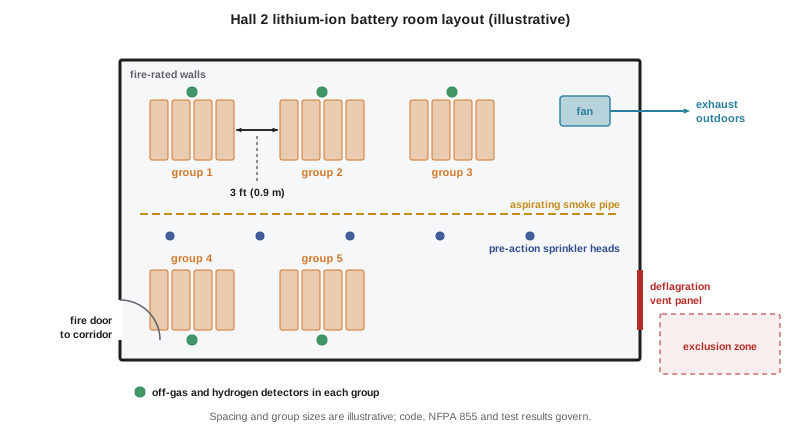
Limits on stored energy
Fire codes and NFPA 855 limit how much energy can be stored in a single fire area or room, and they set threshold quantities below which the energy storage provisions do not apply. Recent editions of the International Fire Code, for example, set a maximum stored energy for lithium-ion systems in a fire area (600 kWh in the 2021 and 2024 editions) and permit larger quantities when large-scale fire testing and the fire code official approve them. NFPA 855 has similar provisions. Limits are expressed in kilowatt-hours and differ by chemistry and by occupancy.
These limits matter to operations as well as to design. Adding cabinets to an existing battery room to increase runtime, replacing lead-acid batteries with lithium-ion in the same room, or storing spare modules in the room can push the stored energy past the limit or change the hazard the room was designed for. Each of these is a change that needs review under management of change, including the fire protection engineer and, where required, the authority having jurisdiction.
The program below is a simple check of a proposed battery room layout against illustrative limits for energy per group, spacing between groups and total energy in the room. The values are for teaching only and do not represent any particular code edition; real compliance is determined by the adopted code, NFPA 855, the test data and the authority having jurisdiction.
# Teaching check of a battery room layout against ILLUSTRATIVE limits.
# Real limits come from the adopted fire code, NFPA 855, test data and the AHJ.
GROUP_LIMIT_KWH = 50       # illustrative energy per group without LSFT approval
MIN_SPACING_M = 0.9        # illustrative spacing between groups
ROOM_LIMIT_KWH = 600       # illustrative maximum energy in the fire area

groups = [  # (name, kWh, spacing to next group in m)
    ("G1", 48, 1.0), ("G2", 48, 1.0), ("G3", 52, 0.6), ("G4", 48, None),
]
total = 0
for name, kwh, gap in groups:
    total += kwh
    issues = []
    if kwh > GROUP_LIMIT_KWH:
        issues.append(f"group energy {kwh} kWh exceeds {GROUP_LIMIT_KWH} kWh")
    if gap is not None and gap < MIN_SPACING_M:
        issues.append(f"spacing {gap} m below {MIN_SPACING_M} m")
    print(f"{name}: {kwh} kWh " + ("OK" if not issues else "REVIEW: " + "; ".join(issues)))
print(f"Total {total} kWh: " + ("within" if total <= ROOM_LIMIT_KWH else "over") + " room limit")
spare_modules = 4 * 5.1
print(f"Storing {spare_modules:.1f} kWh of spare modules in the room raises the total to {total + spare_modules:.1f} kWh")G1: 48 kWh OK G2: 48 kWh OK G3: 52 kWh REVIEW: group energy 52 kWh exceeds 50 kWh; spacing 0.6 m below 0.9 m G4: 48 kWh OK Total 196 kWh: within room limit Storing 20.4 kWh of spare modules in the room raises the total to 216.4 kWh
The check flags group G3, which is slightly above the illustrative group limit and too close to its neighbor, and it shows how storing spare modules in the room adds to the total. In practice, a review would ask whether large-scale fire test results support the proposed arrangement and would keep spares in a separate, appropriate storage area.
Large-scale fire testing and closer spacing
Large-scale fire testing, now explicitly required by NFPA 855 (2026) and included in the sixth edition of UL 9540A, tests a complete battery unit by forcing an internal failure and observing whether fire spreads to adjacent units placed at the intended spacing. If testing shows that fire does not spread, the authority having jurisdiction may approve closer spacing or larger groups than the prescriptive limits. For data centers, where floor space is valuable, this is an important path. It also means that the as-installed arrangement must match the tested arrangement: changing cabinet spacing, adding units, removing barriers or mixing products can invalidate the basis of approval.
Limits on location
Codes also restrict where battery rooms may be located: limits on height above grade and depth below grade, because fire service access and smoke removal are harder there, requirements for exterior wall access for some systems, and restrictions near exits. The Pangyo fire started in a battery room on the third basement level, where firefighting access was difficult and the fire affected power equipment in the same room. Battery rooms in basements or high in a building may be allowed with additional protection, but the location affects how the fire service can respond.
Design limits and the people who work there
Design limits are written into drawings and fire protection reports, but they are kept or broken by day-to-day decisions on site. The table below lists common ways operations can undermine a battery room's design basis.
| Action on site | Design basis affected | Better practice |
|---|---|---|
| Storing spare modules, packaging or tools in the battery room | Stored energy limit, fire load | Keep spares in a designated storage area; keep the room clear |
| Wedging the fire-rated door open for cable work | Compartmentation, clean agent concentration | Use a door hold-open on the fire alarm or keep the door closed; plan impairments |
| Leaving penetrations open after cable work | Fire rating of walls | Fire-stop penetrations immediately and inspect |
| Adding cabinets for more runtime | Group size, spacing, total energy, ventilation | Treat as a change; engineering and AHJ review |
| Switching suppression to manual and forgetting to restore it | Suppression layer | Impairment procedure with restoration check |
| Changing product or firmware | Tested configuration, UL 9540A basis | Manufacturer and engineering approval |
Worked problem
Reviewing a request to add capacity
The Hall 2 customer at Cedar Ridge asks for longer battery runtime, and the UPS vendor proposes adding two lithium-ion cabinets (about 50 kWh each) to the existing Hall 2 battery room, placing them in the space currently used for spare module storage, with 0.5 m between the new and existing cabinets. What should the review consider?
Show solution
- Stored energy: will the room's total, including the new cabinets, stay within the limit in the adopted code and NFPA 855, and within the energy assumed in the hazard mitigation analysis?
- Spacing and group size: does the proposed 0.5 m spacing meet the code or, if not, do large-scale fire test results for this product support it?
- Ventilation and explosion control: is the exhaust system still sized for the release assumption, and do the new cabinets have off-gas detection integrated with the room controls?
- Suppression and detection: do sprinkler and aspirating smoke coverage extend to the new location?
- Where will the spare modules go? They need an appropriate storage location, not another corner of the battery room.
- Approval: the change needs the fire protection engineer's review, the manufacturer's agreement and, where required, the authority having jurisdiction's approval before installation.
Answer: Adding cabinets is a significant change that can affect stored energy limits, spacing, ventilation, detection, suppression and the approved design basis. It must go through management of change and the necessary approvals, and the spares must be relocated properly.
Common mistakes
MistakeBelieving a clean agent system will stop a lithium-ion battery fire.
InsteadRecognize that clean agents may extinguish flames but do not stop thermal runaway or gas release.
MistakeTreating water as unusable on battery fires because batteries are electrical.
InsteadUnderstand that water is the most effective cooling agent and is commonly used by fire services and sprinkler systems for battery rooms.
MistakeAdding battery cabinets to a room without checking energy limits and spacing.
InsteadTreat added capacity as a change requiring engineering and AHJ review.
MistakeLeaving fire-rated doors wedged open or penetrations unsealed.
InsteadMaintain compartmentation and fire-stop penetrations immediately after work.
MistakePlacing A-side and B-side batteries in the same fire compartment.
InsteadSeparate redundant battery systems so one fire cannot take down both power paths.
Summary and key terms
- Suppression can extinguish or control burning materials but generally cannot stop thermal runaway in sealed modules.
- Clean agents may extinguish flames while runaway and gas release continue, which can increase the explosion hazard.
- Water is the most effective agent for cooling and limiting propagation, despite its drawbacks.
- Separation within rooms, fire-rated construction and careful location contain battery fires and protect redundancy.
- Codes limit stored energy per group and per fire area and set spacing unless large-scale fire testing supports alternatives.
- The installed arrangement must match the tested and approved arrangement; changes need management of change.
- Day-to-day actions such as storing spares, wedging doors and leaving penetrations open can undermine the design.
- Clean agent
- A gaseous fire suppression agent that leaves no residue, such as a halocarbon or inert gas.
- Compartmentation
- Division of a building into fire-rated compartments to contain fire and smoke.
- Fire area
- An area of a building separated from others by fire-rated construction, used for code limits.
- Fire-stopping
- Sealing of penetrations through fire-rated walls and floors to maintain their rating.
- Group (of batteries)
- A set of battery racks or cabinets treated as one unit for code limits on energy and spacing.
- Stored energy limit
- The maximum battery energy permitted in a group, room or fire area by code or approval.
- Management of change
- A process for reviewing and approving changes so that their safety effects are understood before they are made.
Practice problems
Work each problem on paper first, then reveal the answer to check.
What are the two goals of battery fire suppression, and which is harder to achieve?
Show answer
Extinguishing or controlling burning materials, and stopping propagation of thermal runaway; stopping propagation is harder.
Why can extinguishing flames with a clean agent increase the explosion hazard?
Show answer
Because unburned vent gas can then accumulate to an explosive concentration while runaway continues.
Why is water effective against battery fires?
Show answer
Its high heat capacity and heat of vaporization remove heat and slow propagation.
Name three scales at which separation works.
Show answer
Within a room between groups, at the room level with fire-rated construction, and at the building or site level by location and distance.
Why should A-side and B-side batteries be in separate fire compartments?
Show answer
So a single battery fire cannot take down both power paths.
What can large-scale fire testing allow?
Show answer
Closer spacing or larger groups than prescriptive limits, if fire does not spread to adjacent units and the AHJ approves.
Why must the installed arrangement match the tested arrangement?
Show answer
Because approval is based on the test; changes can invalidate the basis of approval.
Why should spare modules not be stored in the battery room?
Show answer
They add stored energy and fire load beyond the design basis.
What did the Pangyo investigation recommend about battery location?
Show answer
Separating batteries from other electrical equipment, together with suppression suitable for lithium-ion fires.
Give two actions on site that undermine compartmentation.
Show answer
Wedging fire-rated doors open and leaving penetrations unsealed.
Lesson quiz · 5 questions
Score 60% or more to complete this lesson.
Create a free account to save your progress, take quizzes and earn a certificate.