
HSE-322 · Lesson 4 of 12 · 28 min
Chemical hazards: electrolytes, acid and gases
Inside every battery is a chemical system, and when a battery is damaged, overcharged, overheated or simply aging, its chemicals can reach the people around it. Lead-acid batteries contain sulfuric acid and produce hydrogen. Lithium-ion batteries contain a flammable organic electrolyte with a fluorine-containing salt, and when they fail they release a mixture of flammable and toxic gases. Nickel-cadmium batteries contain a caustic alkaline electrolyte and toxic cadmium. This lesson covers those chemical hazards, how workers can be exposed, the exposure limits that apply and the first response to spills and contact.
HSE-102 covers hazard communication, and HSE-312 covers chemical handling and storage, including corrosives and eyewash stations in depth. This lesson applies those courses to batteries; hydrogen and ventilation in lead-acid rooms are covered separately in Lesson 5, and the gases from lithium-ion thermal runaway are revisited in Lessons 7 and 8.
Lead-acid electrolyte
The electrolyte in a lead-acid battery is a solution of sulfuric acid in water, typically around 30 to 40 percent acid by mass when fully charged, with a specific gravity of about 1.215 to 1.300 depending on the design. It is a corrosive liquid that causes severe burns to skin and eyes, and it can cause permanent eye damage within seconds. It also attacks clothing, metal and concrete. During charging, and especially when a cell is overcharged, fine acid mist can be carried out of vented cells with the gas, which irritates the eyes, nose, throat and lungs.
In flooded batteries the electrolyte is free liquid, so a cracked jar, a dropped cell, overfilling during watering or a tipped container of spare electrolyte can release liters of acid. VRLA batteries hold the electrolyte in an absorbent glass mat or gel, so free liquid is much less likely, but a damaged or severely overheated VRLA block can still leak acid, and the case may swell or crack. In both types, white or blue crystalline deposits around terminals and posts are corrosion products that may contain acid residues and lead compounds; they should be cleaned only with the right PPE and neutralizing agent.
Lead itself is a toxic metal. Normal battery maintenance involves little lead exposure, but cutting, grinding or handling corroded terminals, and recycling or breaking batteries, can release lead dust. Workers must not eat, drink or smoke in battery rooms and should wash their hands after battery work.
Lithium-ion electrolyte
The electrolyte in a lithium-ion cell is a lithium salt, most commonly lithium hexafluorophosphate (LiPF6), dissolved in a mixture of organic carbonate solvents such as ethylene carbonate, dimethyl carbonate and ethyl methyl carbonate. The quantity in each cell is small, typically a few grams to tens of grams, and it is sealed inside the cell, so routine work involves no exposure. The hazards arise when cells are damaged, vent or burn.
The carbonate solvents are flammable, with low flash points for some components, and their vapor forms ignitable mixtures with air. LiPF6 decomposes when exposed to moisture or heat, producing hydrogen fluoride (HF) and other fluorine compounds such as phosphoryl fluoride. HF is extremely toxic and corrosive; it penetrates the skin and binds calcium in the body, causing deep tissue damage and, in serious exposures, dangerous disturbances of heart rhythm. Even a small leak from a damaged cell can produce a sweet, solvent-like smell and irritating vapor, and it should be treated as a warning sign of a possible failure.
Nickel-cadmium electrolyte
Nickel-cadmium batteries use a potassium hydroxide electrolyte, a strong alkali that causes severe burns, especially to the eyes, where alkalis can penetrate faster and do more lasting damage than acids. Cadmium is a toxic metal and a human carcinogen. Ni-Cd batteries are less common in data centers today, mainly found in older switchgear control and some generator starting systems, but where they exist they need their own spill kits and procedures, because the neutralizing agent for an alkali is different from the one for acid.
| Chemistry | Electrolyte | Main chemical hazards | Normal exposure risk |
|---|---|---|---|
| Flooded lead-acid | Sulfuric acid solution (free liquid) | Acid burns, acid mist, hydrogen, lead | Moderate during watering, testing and spills |
| VRLA lead-acid | Sulfuric acid in glass mat or gel | Acid from damaged blocks, hydrogen under fault conditions | Low in normal service |
| Lithium-ion (LFP, NMC) | LiPF6 in organic carbonates | Flammable vapor, HF and fluorine compounds, toxic off-gas | Very low unless cells are damaged or vent |
| Nickel-cadmium | Potassium hydroxide solution | Alkali burns, cadmium toxicity, hydrogen | Moderate during maintenance |
Gases from battery failures
Lead-acid batteries produce mainly hydrogen and oxygen by electrolysis of water during charging, together with traces of other gases. When a lead-acid battery fails by overheating and dries out, hydrogen sulfide and sulfur dioxide can also be produced, recognizable by a rotten-egg or sharp smell. Lesson 5 covers hydrogen in detail.
Lithium-ion batteries in thermal runaway release a large volume of gas in a short time. Published test data, such as gas analyses from UL 9540A cell tests and research by test laboratories and universities, show that the vent gas typically contains hydrogen, carbon monoxide, carbon dioxide, methane, ethylene and other hydrocarbons, together with vaporized electrolyte solvents and smaller amounts of hydrogen fluoride and other toxic compounds. The proportions vary with chemistry, state of charge and test conditions. Many published analyses report hydrogen and carbon dioxide as major components and carbon monoxide at substantial concentrations, which means the gas is both flammable and toxic.
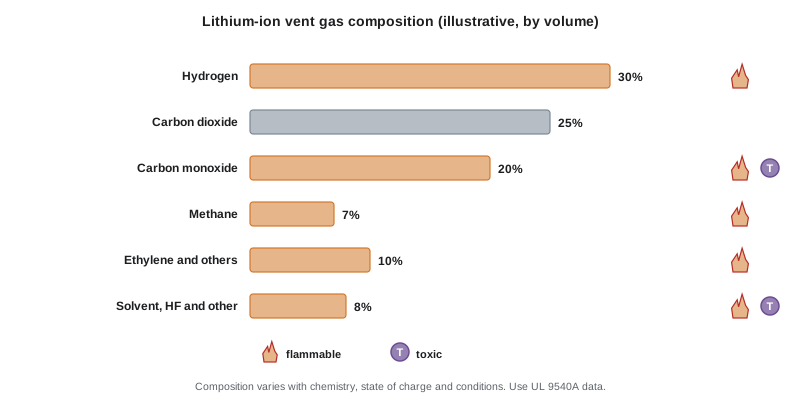
The vent gas is often released before any flame appears. In a closed room or cabinet it can accumulate to a flammable concentration and then ignite, causing a deflagration. This is what happened at the McMicken battery energy storage site in Arizona in 2019, discussed in Lesson 12. The same gas is also a toxic atmosphere: carbon monoxide at a few thousand parts per million can incapacitate within minutes, and HF is dangerous at a few parts per million.
Exposure limits
Occupational exposure limits in the United States are set by OSHA permissible exposure limits (PELs), many of which date from 1971, while NIOSH recommended exposure limits (RELs) and ACGIH threshold limit values (TLVs) are often lower and widely used as good practice. Some state plans set their own limits. The values below are indicative and are given to show the scale of the hazard.
| Substance | Typical limit (indicative) | Immediately dangerous level (NIOSH IDLH) | Notes |
|---|---|---|---|
| Carbon monoxide | OSHA PEL 50 ppm TWA; ACGIH TLV 25 ppm | 1,200 ppm | Odorless; binds to hemoglobin |
| Hydrogen fluoride | OSHA PEL 3 ppm TWA; ACGIH TLV 0.5 ppm TWA and 2 ppm ceiling | 30 ppm | Penetrates skin; systemic toxicity |
| Sulfuric acid mist | OSHA PEL 1 mg/m³; ACGIH TLV 0.2 mg/m³ thoracic | 15 mg/m³ | Eye and respiratory irritant |
| Hydrogen sulfide | OSHA ceiling 20 ppm; ACGIH TLV 1 ppm TWA and 5 ppm STEL | 100 ppm | Smell fades at high concentration |
| Hydrogen | Simple asphyxiant; flammability governs | Not applicable | Lower flammable limit 4 percent by volume |
The scale is what matters. A single large lithium-ion cell can release tens to hundreds of liters of gas in thermal runaway; a module or rack can release many cubic meters. Even if the gas never ignites, the carbon monoxide alone can make a small room immediately dangerous. The program below estimates the CO concentration in a closed battery room after an off-gas event, using illustrative values.
# Illustrative estimate of carbon monoxide in a closed room after cell venting.
# Assumes uniform mixing and no ventilation (a simplification). Values are illustrative.
room_m3 = 6.0 * 8.0 * 3.5          # battery room volume, m3
gas_per_cell_l = 60.0              # vent gas per cell, L (illustrative)
co_fraction = 0.20                 # carbon monoxide fraction of vent gas (illustrative)
IDLH_PPM = 1200

for cells in (1, 5, 20, 80):
    co_m3 = cells * gas_per_cell_l / 1000 * co_fraction
    ppm = co_m3 / room_m3 * 1e6
    flag = "above IDLH" if ppm > IDLH_PPM else "below IDLH"
print(f"{cells:3d} cells vent: CO about {ppm:7.0f} ppm ({flag})")1 cells vent: CO about 71 ppm (below IDLH) 5 cells vent: CO about 357 ppm (below IDLH) 20 cells vent: CO about 1429 ppm (above IDLH) 80 cells vent: CO about 5714 ppm (above IDLH)
Even the venting of a handful of cells in a closed room can raise carbon monoxide well above occupational limits, and a module-level event of a few dozen cells can exceed the immediately dangerous level. Real rooms have ventilation and leakage, and the gas does not mix uniformly, so concentrations near the source can be much higher. This is why the response to a suspected lithium-ion off-gas event is to leave and let detection and ventilation work, not to investigate, as Lesson 11 explains.
Eyewash and emergency showers
Where workers can be exposed to battery electrolyte, OSHA requires suitable facilities for quick drenching or flushing of the eyes and body (1910.151(c) and, in construction, 1926.441). ANSI/ISEA Z358.1 is widely used to meet the requirement; it specifies flow rates, water temperature (tepid), activation and location, including reaching the unit within about 10 seconds and flushing for at least 15 minutes. HSE-312 Lesson 10 covers eyewash and showers in depth. In battery rooms, plumbed eyewash stations are preferred; self-contained units need regular fluid changes. Every unit must be inspected and activated weekly.
Spill response for acid
An acid spill from a flooded battery or a damaged VRLA block is controlled by containing it, neutralizing it and cleaning up the residue. Battery rooms with flooded batteries need spill containment under the racks, and every battery room needs a spill kit matched to the electrolyte. For sulfuric acid the usual neutralizing agent is sodium bicarbonate (baking soda) or a commercial acid neutralizer with a color indicator. The reaction produces carbon dioxide, which fizzes, and water; when the fizzing stops and the indicator shows neutral, the residue can be absorbed and disposed of as hazardous waste under local rules.
The amount of neutralizer needed follows from the reaction \(\mathrm{H_2SO_4 + 2\,NaHCO_3 \to Na_2SO_4 + 2\,H_2O + 2\,CO_2}\). Each mole of sulfuric acid needs two moles of sodium bicarbonate. The program below estimates the bicarbonate needed for spills of different sizes.
# Sodium bicarbonate needed to neutralize a battery acid spill (illustrative values).
M_H2SO4 = 98.08     # g/mol
M_NAHCO3 = 84.01    # g/mol
density = 1.28      # g/mL, typical charged electrolyte (illustrative)
mass_fraction = 0.37  # acid by mass (illustrative)

for spill_l in (0.5, 2.0, 10.0):
    acid_g = spill_l * 1000 * density * mass_fraction
    mol_acid = acid_g / M_H2SO4
    bicarb_kg = 2 * mol_acid * M_NAHCO3 / 1000
    co2_l = 2 * mol_acid * 24.5          # L of CO2 at about 25 C
    print(f"{spill_l:5.1f} L spill: {acid_g/1000:5.2f} kg acid, "
f"needs about {bicarb_kg:5.2f} kg NaHCO3, releases about {co2_l:5.0f} L CO2")0.5 L spill: 0.24 kg acid, needs about 0.41 kg NaHCO3, releases about 118 L CO2 2.0 L spill: 0.95 kg acid, needs about 1.62 kg NaHCO3, releases about 473 L CO2 10.0 L spill: 4.74 kg acid, needs about 8.11 kg NaHCO3, releases about 2366 L CO2
The numbers explain why spill kits hold several kilograms of neutralizer and why spills are neutralized gradually: a 10-liter spill releases over a thousand liters of carbon dioxide and can froth violently. Workers wear splash goggles and a face shield, chemical-resistant gloves and apron, and boots, and work from the edge of the spill inward. A spill of potassium hydroxide from a Ni-Cd battery needs a different agent, such as a weak acid neutralizer (boric acid or a commercial alkali neutralizer), never sodium bicarbonate.
First aid for battery chemicals
For acid or alkali in the eyes, flush immediately with tepid water for at least 15 minutes, holding the eyelids open, and get medical help. For skin contact, remove contaminated clothing and flush with water for at least 15 minutes. For inhalation of acid mist or failure gases, move to fresh air if it is safe to do so and get medical attention.
Possible hydrogen fluoride exposure from a lithium-ion electrolyte leak or fire residue needs special attention. After flushing with water, calcium gluconate gel is commonly applied to skin exposures as directed by the SDS, the site's medical protocol or a physician, because it binds fluoride ions; it is not a substitute for medical care, and anyone with a suspected HF exposure should be assessed by a medical professional promptly. Sites with lithium-ion batteries should decide in advance, with occupational health advice, whether to stock calcium gluconate gel and train first aiders to use it. HSE-110 covers first aid awareness more generally.
Worked problem
Responding to a leaking VRLA block
During a weekly inspection of the Hall 1 VRLA battery room at Cedar Ridge, a technician finds a swollen 12 V block on string 3 with a damp patch and white deposits around one terminal, and a faint sharp smell. What should the technician do?
Show solution
- Treat it as a possible thermal and chemical problem: a swollen, leaking VRLA block may be overheating or overcharged.
- Do not touch the block. Check the battery monitoring system for string 3 temperature, float current and cell voltages, and report immediately to the site supervisor and the battery contractor.
- Confirm the room ventilation is running and check the hydrogen detector reading.
- Keep others out of the room except those needed for the response, and make the eyewash and spill kit ready.
- Under the supervisor's direction and with the right PPE, the contractor isolates string 3, contains and neutralizes any liquid with the acid spill kit and plans replacement of the block.
Answer: A swollen, leaking block is a warning sign. The technician should report it, check monitoring and ventilation and keep people clear, leaving isolation and clean-up to trained people with the right PPE and spill kit.
Common mistakes
MistakeUsing sodium bicarbonate on a potassium hydroxide spill from a Ni-Cd battery.
InsteadMatch the neutralizer to the electrolyte: a base such as sodium bicarbonate for acid, a weak acid neutralizer for alkali.
MistakeInvestigating a sweet solvent smell near a lithium-ion battery without protection.
InsteadTreat the smell as a possible off-gas warning, leave the area and report it.
MistakeFlushing an acid splash in the eyes for only a minute or two.
InsteadFlush for at least 15 minutes and get medical help.
MistakeCleaning terminal corrosion with bare hands.
InsteadWear chemical-resistant gloves and eye protection and use a neutralizing agent.
MistakeAssuming HF exposure is minor because it does not hurt immediately.
InsteadTreat suspected HF exposure as serious, flush, apply calcium gluconate per protocol and get medical assessment.
Summary and key terms
- Lead-acid electrolyte is a corrosive sulfuric acid solution; flooded batteries carry the greatest spill risk.
- Lithium-ion electrolyte is flammable and contains LiPF6, which can produce hydrogen fluoride when exposed to moisture or heat.
- Nickel-cadmium electrolyte is a strong alkali, and cadmium is toxic.
- Lithium-ion vent gas is flammable and toxic, typically containing hydrogen, carbon monoxide, carbon dioxide, hydrocarbons and electrolyte vapor.
- Eyewash and emergency shower facilities are required where electrolyte contact is possible.
- Acid spills are neutralized with sodium bicarbonate or a commercial neutralizer; alkali spills need a different agent.
- Suspected HF exposure needs immediate flushing and prompt medical assessment.
- Electrolyte
- The conductive medium inside a cell through which ions move between the electrodes.
- Sulfuric acid
- The acid used in lead-acid battery electrolyte; corrosive to skin, eyes and materials.
- Lithium hexafluorophosphate (LiPF6)
- The lithium salt most commonly used in lithium-ion electrolyte, which can decompose to hydrogen fluoride.
- Hydrogen fluoride (HF)
- A highly toxic, corrosive gas that penetrates the skin and binds calcium in the body.
- Vent gas
- The gas released by a battery cell when it vents, typically during thermal runaway.
- IDLH
- Immediately dangerous to life or health; a concentration that could cause death or irreversible effects or prevent escape.
- Neutralizer
- A chemical used to bring a spilled acid or alkali toward neutral pH before clean-up.
- Calcium gluconate
- A compound applied to skin after HF exposure to bind fluoride ions, under a medical protocol.
Practice problems
Work each problem on paper first, then reveal the answer to check.
What is the electrolyte in a lead-acid battery, and what are its hazards?
Show answer
A sulfuric acid solution; it causes severe burns to eyes and skin and acid mist can irritate the respiratory system.
What toxic gas can form when LiPF6 is exposed to moisture or heat?
Show answer
Hydrogen fluoride.
Name four common components of lithium-ion vent gas.
Show answer
Any four of hydrogen, carbon monoxide, carbon dioxide, methane, ethylene and other hydrocarbons, electrolyte vapor and hydrogen fluoride.
Why is lithium-ion vent gas a double hazard?
Show answer
It is both flammable and toxic.
What neutralizer is used for a sulfuric acid spill, and what gas does the reaction release?
Show answer
Sodium bicarbonate or a commercial acid neutralizer; carbon dioxide.
How long should eyes be flushed after an electrolyte splash?
Show answer
At least 15 minutes, with medical help sought.
Why must a Ni-Cd spill kit differ from a lead-acid spill kit?
Show answer
Ni-Cd electrolyte is an alkali and needs a weak acid neutralizer rather than a base.
What does calcium gluconate do after HF skin exposure?
Show answer
It binds fluoride ions; it is applied after flushing under a medical protocol, with prompt medical assessment.
Why should a sweet solvent smell near a lithium-ion battery be treated seriously?
Show answer
It may indicate electrolyte leakage or venting, a warning sign of possible failure.
How much sodium bicarbonate is needed per mole of sulfuric acid?
Show answer
Two moles.
Lesson quiz · 5 questions
Score 60% or more to complete this lesson.
Create a free account to save your progress, take quizzes and earn a certificate.