
HSE-322 · Lesson 8 of 12 · 28 min
Detection, ventilation and explosion control
The previous lessons showed that battery failures develop over time: a lead-acid battery gasses before a room becomes flammable, and a lithium-ion cell usually vents before it burns. Detection systems aim to find these failures early enough to act. Ventilation and explosion control aim to keep the gases that are released from reaching dangerous concentrations, or to limit the damage if they ignite. Together with the BMS and with suppression, covered in Lesson 9, they form layers of protection. This lesson explains each layer, how the layers work together and what site staff need to know to keep them working.
Layers of protection
No single safeguard is enough for a lithium-ion battery room. The approach used by NFPA 855 and by most hazard mitigation analyses is to provide several independent layers, so that if one fails, another acts. A typical arrangement is shown below.
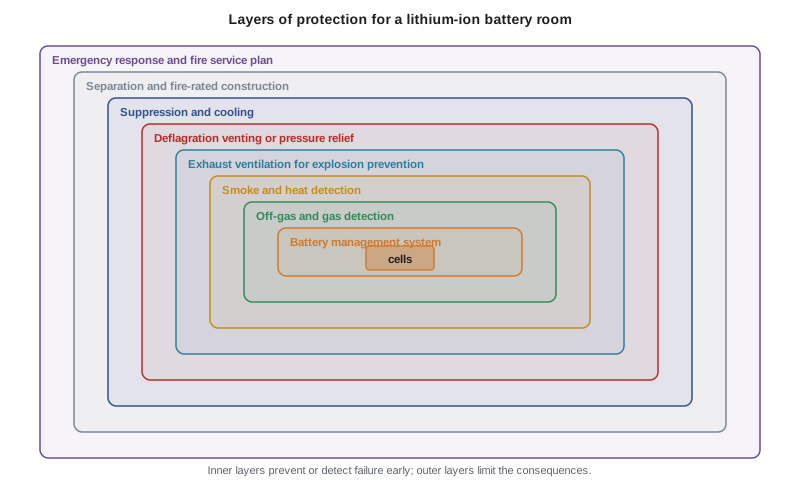
The inner layers aim to prevent failure or catch it early; the outer layers aim to limit consequences. Design and approval of these layers is engineering work. Site staff need to know which layers exist, what their alarms mean, how they are tested and what must not be done to them, such as covering detectors, wedging doors open against a pressure relief design or switching off exhaust fans during maintenance without compensating measures.
Battery monitoring as detection
The first layer of detection is the battery's own monitoring. For lithium-ion, the BMS described in Lesson 6 measures every cell's voltage and temperature and flags abnormal behavior. For lead-acid, battery monitoring systems measure string and block voltages, temperatures and sometimes internal resistance or ohmic values, and can flag weak or overheating blocks. Monitoring is the earliest possible warning, often weeks or months before a failure, but it depends on the failing cell showing a measurable change and on someone acting on the information. The 2022 Pangyo fire, in which the monitoring system reportedly showed no abnormality beforehand, is a reminder that monitoring cannot be the only layer.
Off-gas detection
Off-gas detectors are designed to detect the electrolyte vapor or gases released when a lithium-ion cell begins to vent, before it enters full thermal runaway. Several sensing technologies are used, some aimed at the volatile organic compounds of the electrolyte solvents and others at hydrogen or carbon monoxide. Tests by manufacturers and independent laboratories have shown that off-gas detection can alarm minutes before smoke detection in some cell venting scenarios, giving time to isolate the affected rack, increase ventilation and evacuate. Response time depends on the sensor type, its location relative to the venting cell and the airflow in the room or cabinet.
Off-gas detection is not a single product type, and claims vary. When an off-gas system is proposed, the questions to ask are what gas or vapor it detects, at what concentration, how quickly it responds in tests representative of the actual installation, where the sensors will be placed (in each cabinet or rack, or at room level) and what action an alarm triggers. Typical actions include an alarm to the operations center, a signal to the BMS or UPS to stop charging and open contactors, and starting or boosting exhaust ventilation.
Gas detection for hydrogen and carbon monoxide
Hydrogen detection, described in Lesson 5 for lead-acid rooms, is also used in lithium-ion rooms because hydrogen is a major component of vent gas and is the component that most affects the lower flammable limit of the mixture. Hydrogen detectors are typically placed high, where hydrogen collects. Carbon monoxide detection helps assess the toxic hazard of an off-gas event and can inform the decision on whether it is safe for anyone to approach. Some systems combine several gases in one detector head.
Smoke, heat and flame detection
Conventional fire detection remains essential. Very early warning aspirating smoke detection (VESDA and similar systems), which draws air through sampling pipes to a sensitive detector, is common in data centers and can detect the smoke or aerosols from overheating cells earlier than spot detectors. Spot smoke detectors and heat detectors are used for the fire alarm and to trigger suppression systems, often in a cross-zoned arrangement that requires two detectors to alarm before release. HSE-323 covers fire detection and suppression systems in depth; this lesson's concern is that smoke and heat detection respond later in a thermal runaway sequence than off-gas detection, as the figure in Lesson 7 showed.
| Detection type | What it senses | Stage of failure detected | Typical action |
|---|---|---|---|
| BMS or battery monitoring | Cell or block voltage, temperature, resistance | Early degradation, abnormal behavior | Alarm, reduce current, open contactors |
| Off-gas detection | Electrolyte vapor, hydrogen or other vent gases | Venting, before full runaway | Alarm, isolate rack, boost exhaust |
| Hydrogen detection | Hydrogen | Lead-acid gassing; lithium-ion venting | Staged alarms, exhaust, stop charging |
| Carbon monoxide detection | CO | Venting and combustion | Toxic hazard alarm; informs entry decisions |
| Aspirating smoke detection | Smoke and aerosol particles | Overheating, early combustion | Early alarm; may pre-signal suppression |
| Spot smoke and heat detection | Smoke; fixed temperature or rate of rise | Fire | Fire alarm; suppression release |
Exhaust ventilation for explosion prevention
Ventilation that keeps flammable gas below its lower flammable limit is the main way to prevent an explosion. For lead-acid rooms, Lesson 5 described continuous ventilation sized for hydrogen. For lithium-ion, the challenge is different: the gas is released suddenly and in large volumes during a failure rather than continuously in small amounts. NFPA 69 describes explosion prevention systems, and NFPA 855 accepts mechanical exhaust ventilation designed to keep the concentration of flammable gas below 25 percent of the lower flammable limit of the mixture during a thermal runaway event, typically activated by gas detection, as one means of explosion control.
The design starts from data. UL 9540A cell testing reports the volume and composition of the gas released by a cell in thermal runaway. From the composition, an engineer calculates the lower flammable limit of the mixture; from the volume and the assumed number of cells failing, the amount of gas that could be released; and from the room or enclosure volume, the exhaust rate needed to keep the concentration below 25 percent of the LFL. The lower flammable limit of a mixture of flammable gases can be estimated with Le Chatelier's rule, which combines the limits of the individual components weighted by their fractions.
Le Chatelier's rule can be written as \(LFL_{mix} = \frac{1}{\sum_i x_i / LFL_i}\), where \(x_i\) is the fraction of each flammable component in the flammable part of the mixture and \(LFL_i\) is its lower flammable limit. Inert components such as carbon dioxide are excluded from the sum and then accounted for by scaling, since they dilute the mixture. The program below applies the rule to an illustrative vent gas composition and estimates how much gas a room can hold before reaching 25 percent of the LFL, and the exhaust needed to dilute a given release rate.
# Illustrative: lower flammable limit of a vent gas mixture by Le Chatelier's rule,
# and dilution needed. Composition and release rates are illustrative only.
LFL = {"H2": 4.0, "CO": 12.5, "CH4": 5.0, "C2H4": 2.7, "solvent": 1.5}   # percent by volume
comp = {"H2": 0.30, "CO2": 0.25, "CO": 0.20, "CH4": 0.07, "C2H4": 0.10, "solvent": 0.08}

flammable = {g: f for g, f in comp.items() if g in LFL}
f_total = sum(flammable.values())
lfl_flam = 1 / sum((f / f_total) / LFL[g] for g, f in flammable.items())
lfl_mix = lfl_flam / f_total          # account for the inert CO2 in the vent gas
print(f"LFL of flammable part about {lfl_flam:.2f}%, of whole vent gas about {lfl_mix:.2f}%")

room_m3 = 7.0 * 10.0 * 3.6
limit = 0.25 * lfl_mix / 100
print(f"Room holds about {room_m3 * limit:.1f} m3 of vent gas before reaching 25% of LFL")

for cells_per_min in (1, 4, 16):
    release_m3_min = cells_per_min * 0.06     # 60 L of gas per cell (illustrative)
    exhaust = release_m3_min / limit
    print(f"{cells_per_min:2d} cells venting per minute -> exhaust about {exhaust:6.1f} m3/min "
f"({exhaust * 35.31:7.0f} cfm)")LFL of flammable part about 3.84%, of whole vent gas about 5.12% Room holds about 3.2 m3 of vent gas before reaching 25% of LFL 1 cells venting per minute -> exhaust about 4.7 m3/min ( 166 cfm) 4 cells venting per minute -> exhaust about 18.8 m3/min ( 662 cfm) 16 cells venting per minute -> exhaust about 75.0 m3/min ( 2649 cfm)
The results show that even with a good exhaust system, the design depends on an assumption about how many cells fail and how fast. If propagation is limited by module design, the release rate stays within what a practical exhaust system can handle. If many cells fail together, the release can overwhelm any reasonable ventilation, which is why exhaust is combined with propagation limits and with deflagration venting or other explosion protection.
Exhaust systems for lithium-ion explosion prevention share several practical requirements with hydrogen ventilation: intakes at the high points where lighter gases collect, and sometimes low points for heavier components; discharge to a safe outdoor location; fans and motors suitable for the gas; activation by gas detection with supervision of fan operation; and power from a reliable source. They must not be disabled during maintenance without a plan for alternative protection.
Deflagration venting and pressure relief
If gas does accumulate and ignite, deflagration venting limits the damage. NFPA 68 describes deflagration vents: panels or doors designed to open at a low pressure and release the expanding combustion gases to a safe area, so that the pressure inside the room or enclosure stays below what its structure can withstand. Many containerized BESS units and some battery cabinets have deflagration vent panels in their roofs. For indoor rooms, deflagration venting requires an exterior wall or roof to vent through and a safe discharge area, which is often difficult in a data center building.
Deflagration venting protects the structure but not the people near the vent. A vent opening releases flame and hot gas, so the discharge area must be kept clear, and nobody should stand near a battery enclosure's vent panels during an event. Pressure relief also affects what responders should do: opening a door on an enclosure that has been accumulating gas may admit air and create the conditions for a deflagration, with the open door acting as an unplanned vent toward the people who opened it. This was a central lesson of the McMicken explosion.
Combining detection, ventilation and explosion control
In a well-designed battery room, the layers work in sequence. The BMS watches the cells and acts on abnormal readings. If a cell vents, off-gas or hydrogen detection alarms, the BMS or UPS opens the affected rack's contactors, and exhaust ventilation starts or boosts to dilute the gas. If the event grows, smoke detection raises the fire alarm and may trigger suppression. If gas accumulates despite ventilation, deflagration vents or the room's construction limit the pressure. Throughout, the emergency response plan described in Lesson 11 directs people away from the room and gives the fire service the information it needs.
| Test or inspection | Typical purpose | Who usually performs it |
|---|---|---|
| Gas detector bump test and calibration | Confirm sensors respond and read correctly | Trained technician per manufacturer interval |
| Exhaust fan functional test, including activation by detector | Confirm the fan starts on alarm and airflow is proven | Facility technician with controls contractor |
| Off-gas system functional test | Confirm alarms and outputs to BMS, UPS and BMS integration | Manufacturer or integrator |
| Aspirating smoke detector test | Confirm transport time and sensitivity | Fire alarm contractor |
| Deflagration vent inspection | Confirm panels are unobstructed and undamaged | Facility technician |
| BMS alarm and trip test | Confirm protective outputs operate | Battery manufacturer or service provider |
Worked problem
Checking that the layers work together
The hazard mitigation analysis for the Hall 2 lithium-ion battery room at Cedar Ridge relies on off-gas detection in each cabinet to open the rack contactors and start the exhaust fan, which is sized to keep vent gas below 25 percent of its LFL for the failure of one module. During a contractor's maintenance visit, the exhaust fan is found switched to manual off, apparently left that way after a filter change two weeks earlier. What does this mean, and what should be done?
Show solution
- The explosion prevention layer has been out of service for two weeks without anyone knowing. The room has been relying on detection and module design alone.
- Restore the fan to automatic and test its activation from an off-gas detector input, with airflow proven.
- Report the condition as an impairment through the site's incident or near-miss system, because a safety system was disabled without compensating measures.
- Find out why: was there a procedure for the filter change that required returning the fan to automatic and confirming it? Was the fan's manual-off state alarmed to the operations center?
- Fix the system weaknesses: add supervision so a fan in manual or off raises an alarm, and add a step to the maintenance procedure requiring the layer to be restored and verified.
Answer: A disabled exhaust fan removes a layer of protection the room's safety case depends on. Restore and test it, treat the episode as an impairment and a near miss, and add supervision and procedure steps so it cannot happen silently again.
Common mistakes
MistakeRelying on battery monitoring alone to detect failures.
InsteadProvide independent layers: off-gas, gas, smoke and heat detection as well as monitoring.
MistakeAccepting an off-gas detection product without asking what it detects and how fast.
InsteadAsk for test data representative of the installation, sensor placement and the actions an alarm triggers.
MistakeSwitching off battery room exhaust fans for maintenance without compensating measures.
InsteadPlan any impairment, provide alternative protection and verify restoration.
MistakeStanding near a battery enclosure’s deflagration vent panels during an event.
InsteadKeep the vent discharge area clear of people at all times.
MistakeAssuming ventilation can handle any failure.
InsteadRecognize that ventilation is sized for a specific release assumption and must be combined with propagation limits and explosion protection.
Summary and key terms
- Battery rooms need independent layers of protection, from cell design and the BMS to detection, ventilation, explosion control, suppression and emergency response.
- Off-gas detection can alarm at cell venting, often before smoke detection, and can trigger isolation and exhaust.
- Hydrogen and carbon monoxide detection help assess flammable and toxic hazards.
- Exhaust ventilation for explosion prevention keeps vent gas below 25 percent of its LFL, based on UL 9540A gas data and a release assumption.
- Le Chatelier’s rule estimates the LFL of a gas mixture from its flammable components.
- Deflagration venting protects structures but releases flame and gas into the discharge area; opening doors on accumulating gas is dangerous.
- Every layer must be inspected, tested and kept in service; impairments need planning and compensating measures.
- Layers of protection
- Independent safeguards arranged so that the failure of one does not lead to an incident.
- Off-gas detection
- Detection of the vapor or gas released by a venting lithium-ion cell, aimed at early warning.
- Aspirating smoke detection
- A system that draws air through sampling pipes to a sensitive detector for very early smoke warning.
- Le Chatelier’s rule
- A method for estimating the lower flammable limit of a mixture of flammable gases.
- Explosion prevention system
- A system, such as exhaust ventilation, that keeps flammable gas below a safe fraction of its LFL.
- Deflagration vent
- A panel or opening designed to release the pressure of a deflagration to a safe area.
- Impairment
- A condition in which a fire protection or safety system is out of service.
- Cross-zoning
- Requiring two separate detectors to alarm before a suppression system releases.
Practice problems
Work each problem on paper first, then reveal the answer to check.
Why are several independent layers of protection needed for lithium-ion battery rooms?
Show answer
Because any single safeguard can fail; independent layers ensure another acts if one fails.
What stage of failure does off-gas detection aim to detect?
Show answer
Cell venting, before full thermal runaway.
Name three questions to ask about a proposed off-gas detection system.
Show answer
What it detects and at what concentration, how fast it responds in representative tests, where sensors go and what actions an alarm triggers.
What target does exhaust ventilation for explosion prevention typically aim for?
Show answer
Keeping flammable gas below 25 percent of the LFL of the mixture.
Where does the gas volume and composition data for the design come from?
Show answer
UL 9540A cell test results for the specific product.
What does Le Chatelier’s rule estimate?
Show answer
The lower flammable limit of a mixture of flammable gases.
What does deflagration venting protect, and what does it not protect?
Show answer
It protects the structure from overpressure but releases flame and gas into the discharge area, so it does not protect people there.
Why must exhaust fans not be left in manual off after maintenance?
Show answer
Because the explosion prevention layer is lost, often without anyone knowing.
Why is carbon monoxide detection useful in a lithium-ion battery room?
Show answer
It indicates the toxic hazard and informs decisions about approaching the room.
What is an impairment?
Show answer
A condition in which a fire protection or safety system is out of service.
Lesson quiz · 5 questions
Score 60% or more to complete this lesson.
Create a free account to save your progress, take quizzes and earn a certificate.