
HSE-322 · Lesson 3 of 12 · 28 min
Electrical hazards of battery systems
A battery string is a DC source that is always on. HSE-321 Lesson 7 treated the battery as one of the sources to isolate before working on a UPS, and showed why stored energy in the UPS DC bus capacitors must be discharged and verified. This lesson looks at the battery from the other side: the electrical hazards of working on, in or near the battery itself, where isolation is never complete. It covers DC shock, DC arc flash and short circuits, the specific hazards of tiers, shelves and intercell connections, and the work practices and tools that control them.
DC shock
Electric shock from DC differs from AC in a few ways, but it is no less dangerous at the voltages found in UPS batteries. Direct current does not cause the same let-go problem as 60 Hz alternating current at low levels, and the threshold for ventricular fibrillation is higher for DC than for AC. At several hundred volts, however, the current through a body can easily exceed those thresholds, and DC causes deep burns at entry and exit points and can still stop the heart. A UPS battery string at 480 to 600 V DC must be treated as a lethal shock hazard, with the same approach boundaries and protective equipment as AC equipment at similar voltages.
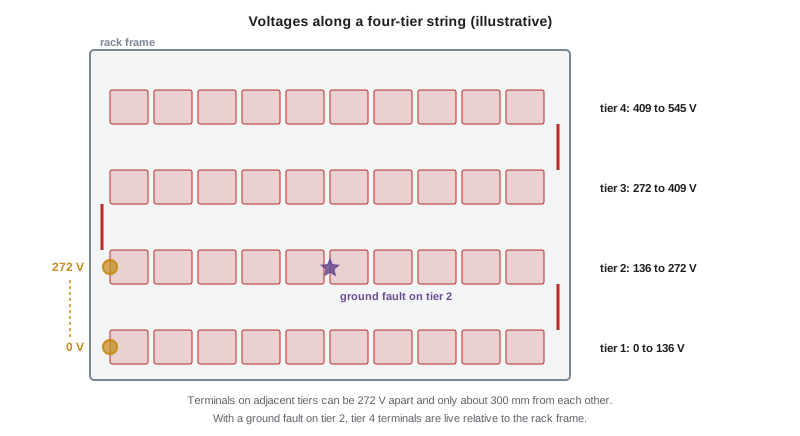
The voltage that matters is not always the full string voltage. A worker touching two points on the same string is exposed to the voltage between those points, which depends on how many cells lie between them. Touching the two terminals of one 12 V monobloc is not a shock hazard, but touching the positive end of tier one and the negative end of tier four may expose a worker to the full string. Because racks are built in tiers with the string snaking from one shelf to the next, terminals at very different potentials can sit only a short reach apart. This is one reason battery racks have terminal covers and why work rules restrict how many tiers can be exposed at once.
Ground faults add a second path. Most UPS battery systems are ungrounded or high-resistance grounded so that a single ground fault does not trip the system. A ground fault on one part of the string can then put a dangerous voltage between another part of the string and the grounded rack frame, even though nothing seems wrong. Ground fault detection on the battery bus, regular checks and treating the rack frame as potentially energized until tested are all part of the control.
DC arc flash
When a conductive object bridges battery terminals or a fault develops in DC cabling, a DC arc can form. DC arcs differ from AC arcs in an important way: alternating current passes through zero 120 times a second, which helps an AC arc extinguish, while a DC arc has no current zero and can sustain itself once established. A battery can also supply its full fault current for as long as the fault lasts, limited only by the internal resistance of the cells and the connections and by any fuse or breaker that clears the fault.
Battery fault currents are high. A large lead-acid or lithium-ion string can deliver several thousand to tens of thousands of amperes into a bolted short circuit. The resulting arc releases heat, molten metal, pressure and light in the same way as an AC arc, and it can ignite hydrogen in a lead-acid room or damage cells and start thermal runaway in a lithium-ion system.
Arc flash incident energy for DC systems is estimated differently from AC systems. IEEE 1584 addresses AC systems only. For DC, NFPA 70E includes informative methods in its annexes, one of which is based on the maximum power transfer principle: it assumes the arc current is half the bolted fault current and calculates the energy delivered at that maximum power. This method is deliberately conservative. Other published methods model the arc more closely and usually give lower results. As with AC systems, a qualified engineer should perform the study, and the label on the battery equipment governs.
For teaching purposes, the maximum power method can be written as \(E = 0.01 \, V \, I_{arc} \, t / D^2\), where \(E\) is the incident energy in cal/cm², \(V\) is the system voltage in volts, \(I_{arc}\) is the arc current in amperes (taken as half the bolted fault current), \(t\) is the arc duration in seconds and \(D\) is the working distance in centimeters. The bolted fault current of a battery is roughly the open-circuit voltage divided by the total internal resistance of the string, including connectors.
# Teaching estimate of DC arc flash incident energy using the maximum power method.
# NOT a substitute for an engineering study. All values are illustrative.
def dc_incident_energy(v_sys, i_bolted, t_s, d_cm):
    i_arc = 0.5 * i_bolted                      # maximum power assumption
    return 0.01 * v_sys * i_arc * t_s / d_cm ** 2  # cal/cm2

v_string = 545.0                 # VRLA string at float, volts
r_cell_mohm = 0.45               # internal resistance per 2 V cell, milliohms (illustrative)
cells = 240
r_links_mohm = 20.0              # connectors and cables, milliohms (illustrative)
r_total = (cells * r_cell_mohm + r_links_mohm) / 1000
i_bolted = v_string / r_total
print(f"Bolted fault current about {i_bolted:,.0f} A")

for t in (0.05, 0.5, 2.0):       # fuse or breaker clearing time, seconds
    e = dc_incident_energy(v_string, i_bolted, t, 45.7)
print(f"Clearing time {t:4.2f} s at 45.7 cm: about {e:5.1f} cal/cm2")Bolted fault current about 4,258 A Clearing time 0.05 s at 45.7 cm: about 0.3 cal/cm2 Clearing time 0.50 s at 45.7 cm: about 2.8 cal/cm2 Clearing time 2.00 s at 45.7 cm: about 11.1 cal/cm2
The results show how strongly clearing time drives the hazard. In this example a fast-acting fuse at the battery terminals keeps the estimate below 1 cal/cm², while a fault that lasts two seconds exceeds 10 cal/cm², and a fault that is not cleared at all, because it lies between the cells and the first protective device, can last much longer. A fault on the battery side of the disconnect has no upstream protection except the battery's own internal resistance, which is why work on battery terminals and intercell connections deserves special care.
Where protection is missing
In an AC system there is almost always a protective device upstream of the work. In a battery string there is not. The cells themselves are the source, and a short circuit across a few cells in the middle of a string is protected by nothing at all until the conductor melts or the arc self-extinguishes. String fuses or breakers protect the cables between the battery and the UPS but not the cells and connections inside the string. Some battery designs include fuses between tiers or within modules to divide the string into smaller sections; lithium-ion modules often have internal fuses and contactors controlled by the battery management system. Workers must know where the protection is and assume there is none at the point where they are working.
| Location of fault | Protection that operates | Hazard |
|---|---|---|
| DC cable between battery breaker and UPS | Battery breaker or string fuse | Arc flash limited by clearing time |
| Battery side of the breaker, at string terminals | None, or a terminal fuse if fitted | Potentially very high incident energy |
| Across several cells within a tier | None, unless inter-tier fuses fitted | Sustained arc, molten metal, possible fire or hydrogen ignition |
| Inside a lithium-ion module | Module fuse or BMS-controlled contactor, if fitted | Cell damage, possible thermal runaway |
| Between string and rack frame (ground fault) | Ground fault detection alarm only | Shock between string and frame; second fault creates a short |
Hazardous tasks
Most battery work involves exposure to energized terminals. The tasks with the greatest electrical hazard are those where tools or conductors come close to terminals at different potentials.
- Torquing intercell connections, where a wrench can bridge two terminals or slip onto an adjacent cell.
- Replacing a monobloc or module within a live string, which requires breaking connections under the string voltage.
- Measuring cell voltages and impedance, where test leads and probes approach many terminals in turn.
- Removing and replacing terminal covers and tier barriers.
- Connecting and disconnecting strings during installation and removal.
- Working on DC cables and busbars between the battery and the UPS.
Before any of these tasks, the work should be planned with a risk assessment covering shock, arc flash and chemical hazards, and the battery should be separated into the smallest practical sections. Many battery systems provide inter-tier disconnects or link bars that can be removed to break the string into sections of a lower voltage. Opening the string at the right points can reduce both the shock hazard and the available fault current for the work, and is an example of the hierarchy of controls applied to an energy source that cannot be eliminated.
Tools and personal protective equipment
Insulated tools rated for the voltage are essential for battery work. Wrenches and socket sets with insulated handles and only the working end exposed prevent a tool from bridging terminals. Torque wrenches should be insulated or used with insulated extensions. Test leads should be rated for the voltage and the measurement category, with shrouded tips. Metal objects that are not part of the task, such as watches, rings, bracelets, necklaces, metal pens and keys, must be removed: a ring bridging two battery terminals can heat to a glowing state in seconds and cause a severe burn.
Personal protective equipment for battery work combines electrical and chemical protection. Arc-rated clothing and face protection are selected from the label or the risk assessment. Rubber insulating gloves of the right class protect against shock; leather protectors over them protect against cuts and arc exposure, though some battery tasks call for chemical-resistant gloves instead or as well. For flooded batteries and any task where electrolyte contact is possible, splash goggles or a face shield, a chemical-resistant apron and chemical-resistant gloves are required. HSE-321 Lesson 10 covered arc-rated PPE and glove classes; HSE-240 covers respiratory protection, which is relevant during off-gas events rather than routine work.
Worked problem
Planning an intercell connection retorque on a live string
A battery contractor at Cedar Ridge is to retorque the intercell connections on string 2 of the Hall 1 VRLA battery, a four-tier string of 40 monoblocs (240 cells) floating at about 545 V DC. The UPS will remain online with the other three strings. How should the electrical hazards be controlled?
Show solution
- Open the string 2 battery breaker so the string is isolated from the UPS DC bus, apply a lock and tag under the site lockout procedure and verify that the string is disconnected at the breaker terminals. The string itself remains energized.
- Remove the inter-tier link bars specified by the manufacturer to split the string into four tiers of about 136 V each, using insulated tools and the required PPE, and verify the tier voltages.
- Work on one tier at a time with all other tier covers in place, keeping the exposed area as small as possible.
- Use an insulated torque wrench set to the manufacturer's value, remove all jewelry and metal objects, and wear arc-rated face protection and rubber insulating gloves with protectors as the risk assessment requires.
- Reinstall the link bars, check string voltage and polarity, and close the breaker only after the contractor and the site representative confirm that all covers are back in place.
Answer: Isolate the string from the UPS, divide it into sections to reduce voltage and fault current, expose only one tier at a time, use insulated tools and the right PPE, and verify before reconnecting. The cells remain energized throughout, so the controls reduce rather than remove the hazard.
Signs, labels and boundaries
Battery rooms and cabinets must carry signs that identify the hazards: the electrical hazard, with the nominal voltage and, where required, the arc flash label information; the chemical hazard of the electrolyte; for lead-acid rooms, the presence of hydrogen and the prohibition of open flames and sparks; and for lithium-ion, the emergency response information agreed with the fire service. The electrical code requires energy storage systems to be marked with the maximum voltage and available fault current, and the arc flash label tells workers the incident energy or PPE category and the boundaries. Approach boundaries for battery terminals are set by the same tables used for AC equipment at the equivalent DC voltage, as HSE-321 Lesson 5 explained.
DC systems at lower voltage
Not every battery hazard involves hundreds of volts. Telecom DC plants at 48 V and rack-level battery shelves at around 50 V have low shock hazard, but they can deliver thousands of amperes into a short circuit. Dropping a wrench across a 48 V busbar can produce a violent arc, molten metal and a serious burn. The same rules apply: insulated tools, no jewelry, eye and face protection, and covers kept in place.
Common mistakes
MistakeAssuming the shock hazard is limited to one monobloc because only one is being touched.
InsteadConsider every terminal within reach; terminals at very different potentials can sit close together across tiers.
MistakeTreating the battery rack frame as safe because the system is ungrounded.
InsteadTest for ground faults and treat the frame as potentially energized relative to the string until tested.
MistakeRelying on the battery breaker to protect against faults at the cell terminals.
InsteadRecognize that faults on the battery side of the breaker and within the string have little or no upstream protection.
MistakeWearing a wedding ring or a watch while working on batteries.
InsteadRemove all jewelry and metal objects before battery work.
MistakeTreating 48 V DC plants as harmless because the shock hazard is low.
InsteadControl the high short-circuit current with insulated tools, covers and eye and face protection.
Summary and key terms
- UPS battery strings at 480 to 600 V DC are a lethal shock hazard, and terminals at very different potentials can be within easy reach.
- Ungrounded battery systems can hide a ground fault that energizes the rack frame relative to the string.
- DC arcs have no current zero and can be sustained; battery fault currents can reach thousands to tens of thousands of amperes.
- DC arc flash is estimated with methods in the annexes of the workplace electrical safety standard, such as the conservative maximum power method; clearing time strongly affects the result.
- Faults within the string or on the battery side of the disconnect have little or no upstream protection.
- Dividing the string into sections, using insulated tools, removing jewelry and wearing the right PPE are key controls.
- Bolted fault current
- The current that flows through a short circuit of negligible resistance.
- Internal resistance
- The resistance inside a cell that limits the current it can deliver into a fault.
- Maximum power method
- A conservative DC arc flash estimation method that assumes the arc current is half the bolted fault current.
- Inter-tier link
- A removable connection between tiers of a battery rack that can be opened to divide the string into lower-voltage sections.
- Ungrounded battery system
- A battery system with no intentional connection to ground, in which a single ground fault does not cause a trip.
- Insulated tool
- A tool with insulation rated for the working voltage, leaving only the working end exposed.
- Terminal cover
- A guard placed over battery terminals and connectors to prevent accidental contact.
Practice problems
Work each problem on paper first, then reveal the answer to check.
Why can a DC arc be more persistent than an AC arc?
Show answer
Because DC current has no natural zero crossing to help extinguish the arc.
What determines the shock voltage when a worker touches two points on a string?
Show answer
The number of cells between the two points, and thus the voltage difference between them.
Why is a ground fault on an ungrounded battery system dangerous even though nothing trips?
Show answer
It can create a dangerous voltage between parts of the string and the rack frame, and a second fault can cause a short circuit.
Using the maximum power method, what arc current is assumed?
Show answer
Half the bolted fault current.
Why are faults within a string particularly hazardous?
Show answer
There is little or no protective device to clear them, so the arc can be sustained until something melts.
How can a string be divided to reduce the hazard for maintenance?
Show answer
By opening inter-tier links or disconnects specified by the manufacturer to create lower-voltage sections.
Why must rings and watches be removed for battery work?
Show answer
They can bridge terminals, carry very high current and cause severe burns.
What chemical PPE is needed for work on flooded batteries?
Show answer
Splash goggles or a face shield, a chemical-resistant apron and chemical-resistant gloves.
What markings does the electrical code require on energy storage systems?
Show answer
The maximum voltage and the available fault current, among others.
What is the main hazard of a 48 V DC plant?
Show answer
High short-circuit current causing arcs, molten metal and burns.
Lesson quiz · 5 questions
Score 60% or more to complete this lesson.
Create a free account to save your progress, take quizzes and earn a certificate.