
HSE-322 · Lesson 2 of 12 · 27 min
Law, codes and standards for battery systems
Battery systems sit where several bodies of rules overlap. Occupational health and safety law protects the people who work on and near them. Electrical codes govern how they are installed and connected. Fire codes and building codes limit how much stored energy can be placed in a space and what protection it needs. Product standards test the batteries and their enclosures. Hazard communication rules cover the chemicals inside. Transport rules apply when batteries are moved. Consensus standards fill in the details of safe work and maintenance. This lesson maps those rules so that you know where each requirement comes from and who enforces it.
HSE-321 Lesson 2 mapped the electrical safety framework for critical facilities, including the electrical code and the workplace electrical safety standard. This lesson does not repeat that map; it adds the parts specific to batteries and energy storage. As always, the rules in force at a given site depend on the edition adopted by the jurisdiction, so the editions named here are those current or newly published as of 2026, and you must check what your authority having jurisdiction has actually adopted.
Layers of rules
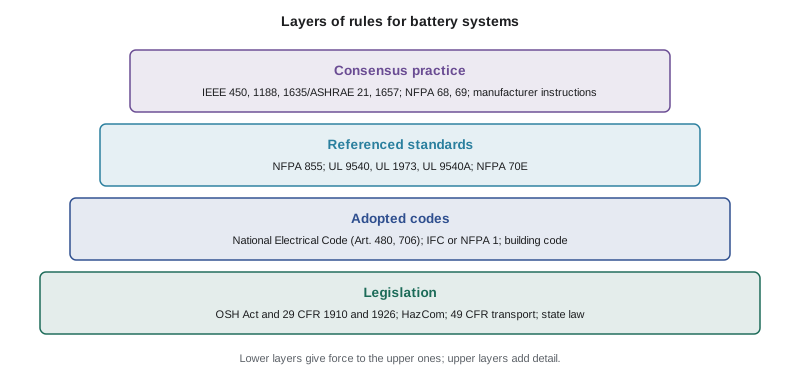
It helps to think of the rules in layers. At the base is legislation: the occupational health and safety statute and regulations, which bind employers and workers, and the fire and building legislation that adopts codes. Above that are the codes adopted by law, such as the electrical code and the fire code. Codes in turn reference product standards and installation standards, which become mandatory when a code calls them up. Finally, there are consensus standards and guidelines that are not law in themselves but define good practice and are often referenced in contracts, insurer requirements and enforcement decisions.
Occupational health and safety law
In the United States, the Occupational Safety and Health Act and the standards issued under it apply to most private-sector data centers, with state plans covering some states. The general duty clause requires employers to keep the workplace free of recognized hazards likely to cause death or serious physical harm. Specific standards apply to batteries: the general industry electrical standard in 29 CFR 1910 Subpart S requires that storage battery installations have provision for sufficient diffusion and ventilation of gases to prevent accumulation of an explosive mixture (1910.305(j)(7)); the construction standard 29 CFR 1926.441 sets requirements for batteries and battery charging, including ventilation, face shields, aprons and gloves for handling acid, and facilities for quick drenching of the eyes and body; and 1910.151(c) requires suitable facilities for quick drenching or flushing where corrosive materials may contact the eyes or body. The electrical safe work practices in 1910.331 to 1910.335 apply to battery work as to other electrical work.
Electrical codes
The National Electrical Code (NFPA 70) governs the installation of battery systems wherever a state or locality adopts it. Article 480 covers storage batteries, including ventilation, working space, terminals and disconnecting means, and Article 706 covers energy storage systems, including listing, disconnects and labeling of maximum voltage and available fault current. The 2026 edition has been published, but many jurisdictions still enforce the 2020 or 2023 edition, so the version that applies depends on the location. Equipment must be listed by a nationally recognized testing laboratory, typically to UL 9540 for systems and UL 1973 for batteries.
Fire and building codes
In the United States, the International Fire Code (IFC) and NFPA 1, Fire Code, are the model fire codes. The IFC addresses electrical energy storage systems in Section 1207 of the 2021 and 2024 editions, with thresholds above which the requirements apply (for example, 20 kWh for lithium-ion and 70 kWh for lead-acid in those editions), limits on stored energy per fire area, separation between groups and requirements for listing, detection, suppression and explosion control. In July 2026 the International Code Council published an early release of new battery provisions planned for the 2027 IFC, covering battery manufacturing, storage, micromobility devices, detection and protection, and first responder safety. Local adoption varies widely, and many jurisdictions also adopt NFPA 855 directly.
NFPA 855
NFPA 855, Standard for the Installation of Stationary Energy Storage Systems, is the central installation standard for energy storage systems in North America. It applies above threshold quantities that depend on the chemistry and sets requirements for hazard mitigation analysis, large-scale fire testing, separation, location, ventilation, explosion control, fire detection and suppression, signage, commissioning, operation and maintenance, decommissioning and emergency planning. It is referenced by fire codes and adopted directly by many authorities.
The 2026 edition made several changes that matter for data centers. As reported in industry analyses in 2026, it makes a hazard mitigation analysis the default for most installations rather than only those that exceed prescriptive limits, with exceptions for some long-established chemistries such as lead-acid. It explicitly requires large-scale fire testing alongside UL 9540A testing, conducted or witnessed by an approved laboratory, to show that a fire in one unit will not spread to an adjacent unit, and it requires further unit-level testing when cell or module tests release flammable gas. It also adds a section setting minimum requirements for emergency response plans and training, with annual review and refresher training arranged with the authority having jurisdiction. Lesson 11 returns to those requirements.
Product standards: UL 1973, UL 9540 and UL 9540A
Three product standards appear on almost every battery submittal. UL 1973 covers batteries for stationary and motive applications, testing cells and modules for electrical, mechanical and environmental safety. UL 9540 covers complete energy storage systems and equipment, including the battery, the power conversion equipment, the controls and the enclosure. Both are published as harmonized ANSI/CAN/UL standards for Canada and the United States.
UL 9540A is not a certification standard but a test method for evaluating thermal runaway fire propagation. It tests at four levels: cell, module, unit and installation. At the cell level it measures how a cell enters thermal runaway and the volume and composition of the gas it releases. At the module and unit levels it measures whether runaway spreads from one cell or module to others and whether flames or gas escape. The results are used by designers and authorities to decide spacing, ventilation, explosion control and suppression. The sixth edition, released in early 2026, formally adds large-scale fire testing of complete systems, with pass and fail criteria that rule out units where fire propagation to adjacent units is observed, and it requires certified products to be built exactly as tested.
| Standard | What it covers | Why it matters on site |
|---|---|---|
| UL 1973 | Safety of battery cells and modules | Confirms the battery has passed electrical, mechanical and environmental tests |
| UL 9540 | Complete energy storage systems and equipment | Listing that codes require for ESS installations |
| UL 9540A | Test method for thermal runaway propagation (cell, module, unit, installation) | Gas volume and composition, propagation results; basis for spacing and explosion control |
| NFPA 855 | Installation of stationary ESS | Thresholds, HMA, separation, explosion control, emergency plans |
| NFPA 68 and NFPA 69 | Deflagration venting; explosion prevention systems | Methods for protecting rooms and enclosures from off-gas explosions |
| IEEE 1635 / ASHRAE Guideline 21 | Ventilation and thermal management of stationary batteries | Calculating hydrogen generation and ventilation needs |
| IEEE 450, IEEE 1188, IEEE 1657 | Maintenance and testing of vented and VRLA batteries; battery personnel qualification | Maintenance intervals, tests and competence of battery technicians |
Electrical safety standards for battery work
NFPA 70E, Standard for Electrical Safety in the Workplace, has an article dedicated to safety requirements related to batteries and battery rooms. It covers the battery risk assessment, which considers the shock hazard from the string voltage, the arc flash hazard from DC faults and the chemical hazard from the electrolyte; personal protective equipment for working with electrolyte; tools and equipment; alerting signs; and eyewash. The 2024 edition is current as of 2026, with the next edition expected in 2027. Its informative annexes include methods for estimating DC arc flash incident energy, introduced in Lesson 3.
Hazard communication
Battery electrolytes and the products of battery failures are hazardous chemicals. OSHA's Hazard Communication Standard (29 CFR 1910.1200), aligned with the Globally Harmonized System, requires manufacturers and importers to provide labels and safety data sheets and employers to maintain a written program, labels, SDS access and training. OSHA's 2024 update aligned the standard with a later revision of the GHS; its compliance dates were extended by four months by a rule published in January 2026, so that, for example, manufacturers must update SDSs for substances by May 19, 2026 and employers must update labeling, programs and training for substances by November 20, 2026. HSE-102 covers hazard communication in full. Note that articles such as sealed batteries in normal use may be exempt from some requirements, but the electrolyte, spare acid and spill residues are not.
Transport and waste rules
Moving batteries to or from a site brings in transport law. In the United States, the Hazardous Materials Regulations in 49 CFR classify lithium-ion batteries as Class 9 hazardous materials (with specific requirements in 49 CFR 173.185) and wet lead-acid batteries as Class 8 corrosives, with packaging, marking and documentation requirements. End-of-life batteries are often managed under the universal waste rules in 40 CFR Part 273, along with state requirements. Lesson 10 covers both.
Putting the map to work
The value of the map is in knowing where to look. When a contractor proposes to install a new lithium-ion battery room, the questions start with the fire code and NFPA 855: is the stored energy above the threshold, is a hazard mitigation analysis required, what do the UL 9540A results show, what explosion control and suppression are proposed? The electrical code then governs the installation, the workplace electrical safety standard governs the work, OHS law governs training, eyewash and PPE, and hazard communication governs the electrolyte and any spill residues.
The short program below shows how a site might keep a simple applicability register, recording which rule layers are triggered by each battery system. It is a teaching sketch; real registers are maintained in compliance management systems and reviewed with the authority having jurisdiction.
# Teaching sketch: which rule layers apply to each battery system at a site.
# Thresholds are illustrative; check the edition adopted by your jurisdiction.
THRESHOLD_KWH = {"lithium-ion": 20, "lead-acid": 70, "nickel-cadmium": 70}

systems = [
    ("Hall 1 VRLA room", "lead-acid", 384),
    ("Hall 2 Li-ion room", "lithium-ion", 410),
    ("Generator start batteries", "lead-acid", 6),
    ("NOC rack DC plant", "lithium-ion", 15),
]

for name, chem, kwh in systems:
    layers = ["OHS law", "electrical code", "workplace electrical safety", "hazard communication"]
    if kwh > THRESHOLD_KWH[chem]:
        layers += ["fire code ESS rules", "NFPA 855"]
        if chem == "lithium-ion":
            layers += ["UL 9540A data", "hazard mitigation analysis"]
print(f"{name:26s} {kwh:4d} kWh -> {', '.join(layers)}")Hall 1 VRLA room 384 kWh -> OHS law, electrical code, workplace electrical safety, hazard communication, fire code ESS rules, NFPA 855 Hall 2 Li-ion room 410 kWh -> OHS law, electrical code, workplace electrical safety, hazard communication, fire code ESS rules, NFPA 855, UL 9540A data, hazard mitigation analysis Generator start batteries 6 kWh -> OHS law, electrical code, workplace electrical safety, hazard communication NOC rack DC plant 15 kWh -> OHS law, electrical code, workplace electrical safety, hazard communication
The register makes clear that even small batteries carry electrical, OHS and hazard communication duties, while the fire code energy storage rules are triggered by size and chemistry.
Worked problem
Mapping the rules for a new lithium-ion battery room
Cedar Ridge plans to replace the VRLA batteries serving Hall 1 with a lithium-ion battery room storing about 400 kWh. The site is in Ohio. List the main rule layers the project must address and the question each answers.
Show solution
- Fire code as adopted locally, with NFPA 855: Is the room permitted, how much energy may be in it, what separation, detection, suppression and explosion control are needed?
- Product standards: Is the system listed to UL 9540 with UL 1973 batteries, and what do the UL 9540A test results show about gas release and propagation?
- National Electrical Code as adopted locally, especially Articles 480 and 706: How must the batteries, disconnects and DC wiring be installed, and what working space is needed?
- OSHA standards, NFPA 70E and HazCom: How will workers be protected during installation and maintenance, what PPE, eyewash and training are needed, and how is the electrolyte communicated?
- DOT hazardous materials and EPA universal waste rules: How will the new batteries arrive and the old lead-acid batteries be removed and recycled?
Answer: Several layers apply at once. The fire code and NFPA 855 decide whether and how the room may be built, product standards prove the equipment, the electrical code governs installation, OHS law and the electrical safety standard govern the work, and transport and waste rules govern the batteries arriving and leaving.
Common mistakes
MistakeAssuming the latest edition of a code or standard applies on site.
InsteadCheck the edition adopted by the authority having jurisdiction and referenced in contracts.
MistakeTreating a UL 9540A test report as a certification that the system is safe.
InsteadUse UL 9540A results as data for spacing, ventilation, explosion control and suppression decisions; UL 9540 is the listing standard.
MistakeApplying fire code energy storage rules only to lithium-ion batteries.
InsteadCheck thresholds for every chemistry; large lead-acid rooms can also trigger requirements.
MistakeForgetting hazard communication because batteries are sealed articles.
InsteadProvide SDSs and training for electrolytes, spare acid and spill residues.
MistakeRelying on a summary of provincial or state rules without reading the regulation.
InsteadConsult the current text of the regulation for your jurisdiction.
Summary and key terms
- Battery systems are governed by layers of rules: OHS law, adopted codes, referenced standards and consensus practice.
- Electrical codes govern installation; fire and building codes govern stored energy, separation and protection.
- NFPA 855 is the central installation standard for stationary energy storage; its 2026 edition makes hazard mitigation analysis the default for most systems, requires large-scale fire testing and adds emergency response plan requirements.
- UL 1973 and UL 9540 are certification standards; UL 9540A is a test method for thermal runaway propagation, whose sixth edition (2026) adds large-scale fire testing with pass and fail criteria.
- The workplace electrical safety standard has specific requirements for battery risk assessment, PPE, tools and eyewash.
- Hazard communication, transport and waste rules apply to electrolytes and to batteries in transit and at end of life.
- Authority having jurisdiction (AHJ)
- The organization or official responsible for enforcing a code or standard and approving installations.
- NFPA 855
- The standard for the installation of stationary energy storage systems.
- UL 9540
- The safety standard for energy storage systems and equipment.
- UL 9540A
- The test method for evaluating thermal runaway fire propagation in battery energy storage systems.
- UL 1973
- The safety standard for batteries used in stationary and motive applications.
- Hazard mitigation analysis (HMA)
- A structured analysis of failure modes and their consequences used to show that an energy storage installation is adequately protected.
- Large-scale fire testing (LSFT)
- A test of a complete energy storage unit to show whether fire spreads to adjacent units.
- Threshold quantity
- The stored energy above which fire code energy storage requirements apply.
Practice problems
Work each problem on paper first, then reveal the answer to check.
Name the four layers of rules for battery systems.
Show answer
Legislation, adopted codes, referenced product and installation standards, and consensus practice standards.
What is the difference between UL 9540 and UL 9540A?
Show answer
UL 9540 is a safety standard for listing energy storage systems; UL 9540A is a test method for thermal runaway propagation.
Name three changes in the 2026 edition of NFPA 855.
Show answer
Hazard mitigation analysis as the default for most systems, explicit large-scale fire testing, and new emergency response plan and training requirements.
At what four levels does UL 9540A test?
Show answer
Cell, module, unit and installation.
Why must you check which edition of a code applies on site?
Show answer
Because jurisdictions adopt editions at different times, often with amendments, and the adopted edition is the one enforced.
What does the workplace electrical safety standard require a battery risk assessment to consider?
Show answer
The shock hazard, the DC arc flash hazard and the chemical hazard from the electrolyte.
Why do hazard communication rules still apply to sealed batteries?
Show answer
Because electrolytes, spare acid and spill residues are hazardous products or chemicals that workers may contact.
What transport class applies to lithium-ion batteries?
Show answer
Class 9 dangerous goods or hazardous materials.
What standard provides a method for calculating hydrogen generation and battery room ventilation?
Show answer
IEEE 1635 / ASHRAE Guideline 21.
What does the sixth edition of UL 9540A require of certified products?
Show answer
That they are built exactly as tested; any change in components or design requires retesting.
Lesson quiz · 5 questions
Score 60% or more to complete this lesson.
Create a free account to save your progress, take quizzes and earn a certificate.