
HSE-312 · Lesson 6 of 12 · 25 min
Flammable and combustible liquids
Flammable and combustible liquids are the most common hazardous chemicals in workplaces. Gasoline, diesel, solvents, thinners, paints, adhesives, alcohols, degreasers and many cleaning products fall into this group. Because they are so familiar, people forget how much energy they hold: a single liter of gasoline vapor mixed with air can level a room. This lesson explains how these liquids are classified, why the classification systems differ between hazard communication and fire codes, how quantity limits work, and how to keep ignition sources and vapors apart. Basic fire chemistry, such as the fire triangle and flash point, is covered in HSE-250 and is only reviewed briefly here.
Flash point, vapor and the flammable range
A liquid does not burn; its vapor does. The flash point is the lowest temperature at which a liquid gives off enough vapor to form an ignitable mixture with air near its surface. A liquid stored above its flash point is always producing a flammable vapor layer. Gasoline has a flash point of about −43 °C (−45 °F), so it is above its flash point in any climate where people work. Diesel fuel has a flash point of about 52 °C (126 °F) or higher, so at normal room temperature it gives off little vapor, but it will burn readily once heated or sprayed as a mist.
Vapor will only ignite when its concentration in air is between the lower flammable limit (LFL, also called the lower explosive limit or LEL) and the upper flammable limit (UFL). For many common solvents the LFL is around 1 to 2 percent by volume, which is a very small amount: a 1 L spill of acetone that evaporates completely in a small closet can easily produce a flammable atmosphere. Most solvent vapors are heavier than air and spread along the floor, collecting in pits, drains and low areas, and they can travel a long way to an ignition source and flash back to the container.
| Liquid | Approx. flash point | Approx. LFL (% by volume) | Vapor heavier than air? |
|---|---|---|---|
| Gasoline | −43 °C (−45 °F) | 1.4 | Yes |
| Acetone | −20 °C (−4 °F) | 2.5 | Yes |
| Isopropyl alcohol | 12 °C (53 °F) | 2.0 | Yes |
| Ethanol | 13 °C (55 °F) | 3.3 | Yes |
| Toluene | 4 °C (40 °F) | 1.1 | Yes |
| Mineral spirits | about 40 °C (104 °F) | about 0.8 | Yes |
| Diesel fuel | 52 °C (126 °F) or higher | about 0.6 | Yes |
Two classification systems
Flammable liquids are classified in two different ways, and storage work needs both. Hazard communication law (WHMIS in Canada and the OSHA Hazard Communication Standard in the United States) uses the GHS categories, which appear on labels and in SDS section 2. Fire codes use an older system of classes based on flash point and boiling point. The two systems use different cut-off temperatures, so a product's GHS category does not always map neatly onto a fire-code class.
| GHS category (OSHA) | GHS criteria | NFPA 30 class | NFPA 30 criteria |
|---|---|---|---|
| Category 1 | Flash point below 73.4 °F (23 °C) and initial boiling point at or below 95 °F (35 °C) | Class IA | Flash point below 73 °F and boiling point below 100 °F |
| Category 2 | Flash point below 73.4 °F and initial boiling point above 95 °F | Class IB | Flash point below 73 °F and boiling point at or above 100 °F |
| Category 3 | Flash point 73.4 °F to 140 °F (23 °C to 60 °C) | Class IC and Class II | IC: 73 °F to below 100 °F; II: 100 °F to below 140 °F |
| Category 4 | Flash point above 140 °F to 199.4 °F (60 °C to 93 °C) | Class IIIA | 140 °F to below 200 °F |
| Not classified | Flash point above 199.4 °F | Class IIIB | 200 °F or above |
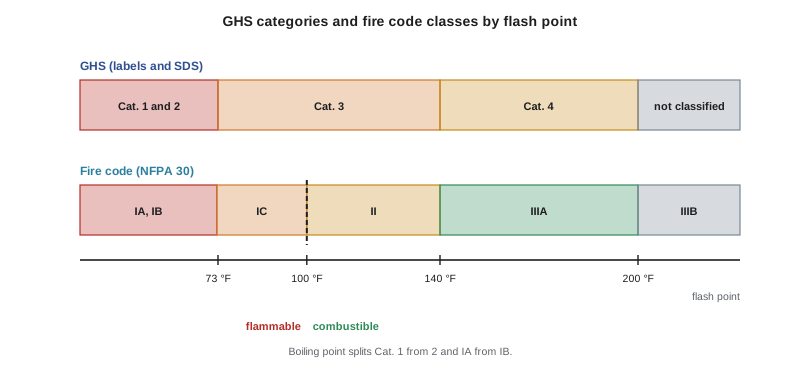
In practice, find the flash point and boiling point in SDS section 9, then classify the product under both systems. GHS Category 3 is the tricky one: it covers liquids with flash points from 23 °C to 60 °C (73 °F to 140 °F), which straddles the fire-code line between flammable Class IC and combustible Class II. A product with a flash point of 30 °C (86 °F) is a Class IC flammable liquid under the fire code; one with a flash point of 45 °C (113 °F) is a Class II combustible liquid. Both are GHS Category 3.
In the United States, OSHA 29 CFR 1910.106 now uses the GHS categories directly, while NFPA 30, the International Fire Code and NFPA 1 still use the class system. Many quantity limits in fire codes are written in terms of classes, so you will often need both.
How quantity limits work
Fire codes limit how much flammable and combustible liquid can be stored in a given area, because the more fuel there is, the faster a fire grows and the harder it is to control. The limits depend on the class of liquid, the type of occupancy (an office, a school, a factory, a warehouse, a laboratory), whether the area is sprinklered, and whether the liquid is in cabinets, safety cans or a storage room. Limits are often expressed as a maximum allowable quantity per control area or fire compartment, with increases allowed for sprinklers and for storage in approved cabinets.
Container type also matters. Codes set maximum container sizes for each class, with smaller limits for glass than for metal or approved safety cans. A safety can is a metal or approved plastic container with a spring-closing lid, a spout cover and a flame arrester screen that stops a flame from traveling into the can. For dispensing small amounts of Class I liquids, safety cans are much safer than glass bottles or open containers.
The code tables are long and differ between jurisdictions and editions, so this course does not reproduce them. Instead, it gives a method: list what you store by class, total it by area, compare it with the limits in the code that applies, and reduce or relocate stock until you are within the limits with a margin.
# Tally flammable and combustible liquid stock by fire-code class for one area.
# Invented inventory for a small college shop and lab. Volumes in L.
L_PER_GAL = 3.785
stock = [
    ("acetone",          "IB",   4 * 4.0),
    ("gasoline",         "IB",   2 * 20.0),
    ("isopropyl alcohol", "IB",  6 * 4.0),
    ("toluene",          "IB",   2 * 4.0),
    ("ethanol 95%",      "IB",   4 * 4.0),
    ("mineral spirits",  "II",   4 * 20.0),
    ("diesel",           "II",   1 * 20.0),
    ("hydraulic oil",    "IIIB", 4 * 20.0),
]
totals = {}
for name, cls, vol in stock:
    group = "Class I (flammable)" if cls in ("IA", "IB", "IC") else ("Class II" if cls == "II" else "Class III")
    totals[group] = totals.get(group, 0) + vol
for g, v in totals.items():
    print(f"{g:22s} {v:6.0f} L  ({v / L_PER_GAL:5.1f} gal)")
flam = totals["Class I (flammable)"]
print(f"Class I in safety cans or cabinet? {flam:.0f} L must be checked against the code limit")Class I (flammable) 104 L ( 27.5 gal) Class II 100 L ( 26.4 gal) Class III 80 L ( 21.1 gal) Class I in safety cans or cabinet? 104 L must be checked against the code limit
The tally shows that this invented area holds about 104 L (about 27 gal) of Class I flammable liquids, 100 L (26 gal) of Class II combustibles, and 80 L (21 gal) of Class IIIB oils. The next step would be to compare each total with the limit for the occupancy and sprinkler status in the code that applies, and to move the gasoline to an outdoor storage location or a cabinet, since it is the most hazardous product and the one least needed indoors.
Controlling ignition sources
The second half of flammable liquid safety is keeping vapors away from ignition. Common ignition sources in workplaces include open flames (torches, pilot lights, space heaters), hot surfaces (engines, ovens, steam pipes, light bulbs), electrical sparks from switches, motors and extension cords, static electricity discharges, friction and grinding sparks, and smoking. Inside storage rooms and around dispensing, electrical equipment must be suitable for the hazardous location, which is classified under the Canadian Electrical Code or the US National Electrical Code. Static electricity and bonding are covered in lesson 9.
Keep containers closed when not in use. An open container of a Class I liquid is a continuous vapor source. Store rags soaked with solvents or oils in an approved self-closing oily waste can, emptied daily, because oily rags, especially those with linseed oil or oil-based stains, can heat up and ignite by themselves.
Worked problem
A maintenance shop clean-up
A building maintenance shop has a 5 gal jerry can of gasoline, three open 1 gal cans of lacquer thinner, a box of solvent-soaked rags, and a propane torch, all on a workbench near the furnace room. What should change?
Show solution
- Close the thinner cans and move them into a flammable cabinet away from the furnace room.
- Move the gasoline to an approved safety can and store it outdoors or in the flammable cabinet, within the cabinet limits.
- Put the rags in a self-closing oily waste can and empty it daily into a suitable waste container.
- Store the propane torch and its cylinder away from the flammable liquids, and never light it near open containers.
- Post a no-smoking, no-open-flame sign at the cabinet and check that the furnace room door closes.
Answer: Close and cabinet the liquids, use safety cans, contain the rags and separate ignition sources from the storage.
Fires involving flammable liquids
Flammable liquid fires spread fast and can flow across floors and down drains. Water from a hose can spread a liquid fire. Portable extinguishers rated for Class B fires (dry chemical, carbon dioxide or foam) are the right tools for small fires, and only for people trained to use them. For larger storage, foam suppression or specially designed sprinklers may be required by the fire code. The best fire protection is prevention: small quantities, closed containers, good ventilation and strict control of ignition sources.
Aerosols
Aerosol cans of paints, lubricants, brake cleaners and adhesives are easy to overlook in a flammable liquid inventory, but most contain flammable propellants such as propane and butane as well as flammable solvents. In a fire, aerosol cans can rupture and rocket across a room, spreading fire well beyond the original area. Fire codes classify aerosol products by their heat of combustion into levels and set separate quantity limits and storage rules for them. Store aerosols in a flammable cabinet or in a wire-mesh aerosol cage, away from heat, and count them in your inventory. Punctured or empty cans may still contain propellant and solvent, so dispose of them through the waste program rather than in general trash, unless your local rules say otherwise.
Common mistakes
MistakeTreating diesel and gasoline the same because both are fuel.
InsteadClassify each using its SDS: gasoline is a Class IB flammable, diesel is usually a Class II combustible.
MistakeAssuming GHS Category 3 always means combustible.
InsteadCheck the flash point: Category 3 spans fire-code Class IC (flammable) and Class II (combustible).
MistakeDispensing gasoline from a glass jar.
InsteadUse an approved safety can with a flame arrester and self-closing lid.
MistakeLeaving oily rags in an open bin or cardboard box.
InsteadUse a self-closing oily waste can and empty it daily.
MistakeUsing an extension cord and fan near open solvent.
InsteadUse equipment rated for the hazardous location and keep containers closed.
Summary and key terms
- Liquids burn through their vapor; a liquid above its flash point produces a flammable vapor layer.
- Vapors ignite between the lower and upper flammable limits, often around 1 to 2 percent for solvents, and most are heavier than air.
- Hazard communication uses GHS categories 1 to 4; fire codes use classes IA to IIIB.
- GHS Category 3 spans fire-code flammable Class IC and combustible Class II.
- Fire codes limit quantity by class, occupancy, sprinklers and storage method; tally stock by class and compare.
- Safety cans, closed containers and self-closing oily waste cans reduce vapor and fire risk.
- Control ignition sources and use electrical equipment suitable for the hazardous location.
- Flash point
- The lowest temperature at which a liquid gives off enough vapor to ignite near its surface.
- Lower flammable limit
- The lowest concentration of vapor in air that can ignite.
- Upper flammable limit
- The highest concentration of vapor in air that can ignite.
- Flammable liquid (fire code)
- A liquid with a flash point below 37.8 °C (100 °F).
- Combustible liquid (fire code)
- A liquid with a flash point at or above 37.8 °C (100 °F).
- Safety can
- An approved container with a self-closing lid and flame arrester.
- Flame arrester
- A screen that stops a flame from passing into a container.
- Maximum allowable quantity
- The most of a hazard class a code allows in a control area.
- Hazardous location
- An area where flammable vapors may be present, requiring suitable electrical equipment.
- Oily waste can
- A self-closing metal can for rags soaked in oil or solvent.
Practice problems
Work each problem on paper first, then reveal the answer to check.
What is a flash point?
Show answer
The lowest temperature at which a liquid gives off enough vapor to form an ignitable mixture near its surface.
Why do flammable vapors collect in pits and drains?
Show answer
Most are heavier than air.
What GHS category is a liquid with a flash point of 10 °C (50 °F) and a boiling point of 80 °C (176 °F)?
Show answer
Category 2.
What fire-code class is a liquid with a flash point of 45 °C (113 °F)?
Show answer
Class II combustible.
Which GHS category straddles the flammable and combustible line in fire codes?
Show answer
Category 3.
What makes a safety can safer than a glass bottle?
Show answer
A self-closing lid, a spout cover and a flame arrester.
Why must oily rags go in a self-closing can?
Show answer
They can heat up and ignite by themselves.
What should you compare your stock totals against?
Show answer
The maximum allowable quantities in the fire code for the occupancy and sprinkler status.
What extinguisher rating suits a small flammable liquid fire?
Show answer
Class B.
Name four ignition sources found in maintenance shops.
Show answer
Any four of: open flames, hot surfaces, electrical sparks, static, grinding sparks, smoking.
Lesson quiz · 5 questions
Score 60% or more to complete this lesson.
Create a free account to save your progress, take quizzes and earn a certificate.