
HSE-312 · Lesson 12 of 12 · 27 min
Waste chemicals, inventory management and capstone: a chemical storage plan
Every chemical that enters a workplace eventually leaves, either inside a product, into the air or water as an emission, or as waste. Waste chemicals are often more hazardous than the products they came from: they may be mixtures of unknown composition, contaminated, in damaged containers, or simply forgotten. This final lesson covers how to store and manage waste chemicals, how inventory management ties the whole storage program together, and then brings everything from the course into a capstone exercise: a chemical storage plan for an invented college shop and laboratory.
Waste chemicals are still chemicals
Waste chemicals must be stored with the same care as products: in compatible, closed, labeled containers, segregated by hazard, in secondary containment, and away from ignition sources and drains. In addition, waste storage is regulated by environmental law, which adds rules about how long waste may be kept, how much may accumulate, how containers are labeled, who may transport the waste, and where it may go. Mixing wastes is a common cause of incidents: pouring an acid waste into a container that once held cyanide, or a solvent waste into a container with oxidizer residue, can cause a fire, explosion or toxic release in the waste room.
| Rule for waste storage | Reason |
|---|---|
| Use compatible containers in good condition | Waste can attack the container or react with residues |
| Keep containers closed except when adding waste | Prevents vapor release and spills |
| Label each container as waste with its contents and hazards | Allows safe handling and correct disposal |
| Never mix incompatible wastes | Mixing can cause fire, explosion or toxic gas |
| Segregate waste containers like products | A leak must not bring incompatibles together |
| Use secondary containment | Catches leaks from aging containers |
| Do not pour chemicals down drains unless clearly permitted | Drains connect to sewers, and vapors can build up in them |
| Track accumulation dates and quantities | Environmental rules limit storage time and amount |
Waste regulation
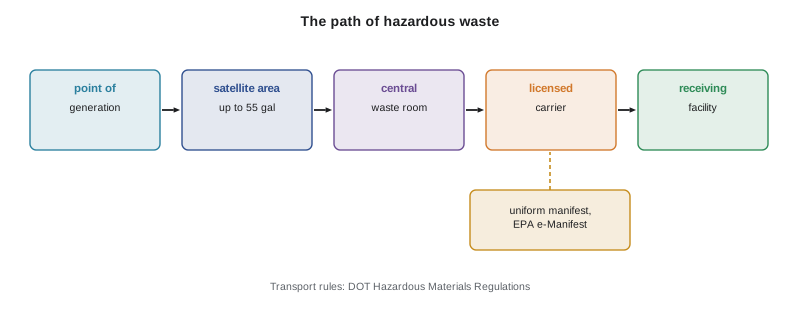
In the United States, hazardous waste is regulated under the Resource Conservation and Recovery Act (RCRA) by the Environmental Protection Agency, with many states running authorized programs that may be stricter. Generators are categorized by the amount of hazardous waste they generate per calendar month: very small quantity generators (VSQG) generate 100 kg or less, small quantity generators (SQG) more than 100 kg but less than 1,000 kg, and large quantity generators (LQG) 1,000 kg or more (or more than 1 kg of acute hazardous waste). Satellite accumulation areas at or near the point of generation may hold up to 55 gallons of hazardous waste or 1 quart of liquid acute hazardous waste. Shipments use the uniform hazardous waste manifest, increasingly through the EPA e-Manifest system, and must follow the DOT Hazardous Materials Regulations (checked October 2026).
Waste minimization
The best waste is waste that is never made. Buying smaller quantities, substituting less hazardous products, using up stock before it expires, sharing surplus through redistribution programs, and designing processes and experiments to use less all reduce waste. They also reduce the amount of hazardous material in storage, which makes every other part of the storage program easier. Waste minimization is the end point of the cycle described in lesson 1: buy, receive, store, use, and dispose.
Inventory management
A chemical inventory is the record that ties the whole storage program together. A useful inventory lists, for each container or product: name, supplier, hazard classes and storage group, quantity, location, date received, date opened (for peroxide formers and other time-sensitive products), expiry date, owner or responsible person, and a link to the current SDS. It supports almost every storage task: checking compatibility, tallying quantities against code limits, scheduling peroxide tests, planning disposal, informing emergency responders, and meeting reporting obligations.
In the United States, facilities that store hazardous chemicals above threshold quantities may need to report them annually under the Emergency Planning and Community Right-to-Know Act (EPCRA) Tier II program, to the state and local emergency planning committees and the fire department. Local fire codes may also require hazardous materials inventory statements and management plans.
Capstone: a chemical storage plan
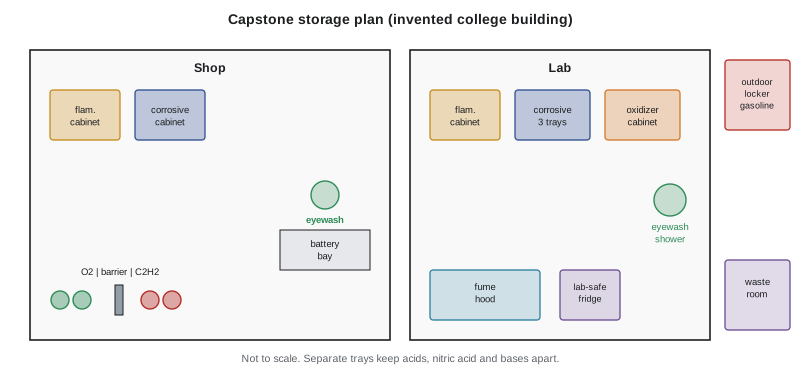
The capstone brings together everything in the course. You are the new health and safety coordinator for an invented technical college building that contains an automotive and welding shop and a small chemistry teaching laboratory. Your task is to produce a chemical storage plan. The plan below shows one way to do it, step by step. Use it as a model for your own workplace.
| Area | Products found | Storage group |
|---|---|---|
| Shop | Gasoline, brake cleaner aerosols, mineral spirits, motor oil, antifreeze | Flammables, combustibles, toxics |
| Shop | Battery acid, rust remover (phosphoric acid) | Inorganic acids |
| Shop | Caustic degreaser (sodium hydroxide) | Bases |
| Shop | Oxygen, acetylene, argon and CO2 cylinders | Compressed gases: oxidizer, flammable, inert |
| Lab | Acetone, ethanol, diethyl ether, hexane | Flammables (ether is a peroxide former) |
| Lab | Hydrochloric, sulfuric and nitric acid | Inorganic and oxidizing acids |
| Lab | Sodium hydroxide, ammonia solution | Bases |
| Lab | Potassium permanganate, hydrogen peroxide 30% | Oxidizers |
| Lab | Liquid nitrogen dewar | Cryogen |
# Capstone: assign storage locations for an invented college shop and lab,
# then check segregation and flag time-sensitive items.
from datetime import date
today = date(2026, 10, 19)
LOC = {   # storage group -> assigned location
    "flammable": "flammable cabinet",
    "acid": "corrosive cabinet - acid tray",
    "oxid_acid": "corrosive cabinet - nitric acid tray",
    "base": "corrosive cabinet - base tray",
    "oxidizer": "oxidizer cabinet",
    "toxic": "locked toxics shelf",
}
ISOLATE = {frozenset(p) for p in [("flammable", "oxidizer"), ("flammable", "oxid_acid")]}
inv = [
    ("acetone 4 L", "flammable", None), ("ethanol 4 L", "flammable", None),
    ("diethyl ether 1 L", "flammable", date(2025, 8, 1)), ("hexane 4 L", "flammable", None),
    ("HCl 2.5 L", "acid", None), ("H2SO4 2.5 L", "acid", None), ("HNO3 2.5 L", "oxid_acid", None),
    ("NaOH 1 kg", "base", None), ("ammonia 2.5 L", "base", None),
    ("KMnO4 500 g", "oxidizer", None), ("H2O2 30% 1 L", "oxidizer", None),
]
by_loc = {}
for name, grp, opened in inv:
    by_loc.setdefault(LOC[grp].split(" - ")[0], set()).add(grp)
    if opened and (today - opened).days > 365:
        print(f"PEROXIDE CHECK: {name} opened {(today - opened).days} days ago - arrange disposal")
for loc, groups in by_loc.items():
    bad = [tuple(sorted(p)) for p in ISOLATE if p <= groups]
print(f"{loc:18s} {sorted(groups)} {'CONFLICT ' + str(bad) if bad else 'ok'}")PEROXIDE CHECK: diethyl ether 1 L opened 444 days ago - arrange disposal flammable cabinet ['flammable'] ok corrosive cabinet ['acid', 'base', 'oxid_acid'] ok oxidizer cabinet ['oxidizer'] ok
The check confirms that no isolated pairs share a cabinet in the proposed layout, with acids, nitric acid and bases sharing a corrosive cabinet only in separate trays. It flags the diethyl ether, opened more than a year ago, for assessment and disposal. The full plan for the building then follows from the lessons of the course.
- Inventory: record every product with quantity, location, storage group, dates and SDS link; remove orphan, expired and unneeded stock first (lessons 1 and 3).
- Framework: confirm which fire code, OHS regulations and environmental rules apply, and record the edition (lesson 2).
- Segregation: assign each product to a group and location using a compatibility table; post the plan (lesson 4).
- Storage areas: provide a flammable cabinet in the shop and one in the lab, corrosive cabinets with separate acid, nitric acid and base trays, an oxidizer cabinet, sturdy shelving with lips, and secondary containment sized by rule (lesson 5).
- Flammables: tally Class I, II and III liquids by area, compare with code limits, move gasoline to an outdoor storage locker, and use safety cans and oily waste cans (lesson 6).
- Special groups: keep permanganate and peroxide away from organics, date and test the ether, and keep acids away from bases (lesson 7).
- Gases: chain cylinders upright in a ventilated area, separate oxygen from acetylene by distance or barrier, and keep the liquid nitrogen dewar in a ventilated room with an oxygen monitor if the room is small (lesson 8).
- Transfers: provide a bonded and grounded dispensing point for solvents, drum pumps and spill pallets, and label all secondary containers (lesson 9).
- Emergency equipment: install compliant eyewash and shower units within 10 seconds of battery charging and acid handling, test weekly, and choose gloves by chemical (lesson 10).
- Lab: use compatibility grouping, keep hoods clear and tested, and use a laboratory-safe refrigerator (lesson 11).
- Waste: set up labeled, segregated waste containers, track accumulation, and use licensed carriers and the required registry or manifest system (this lesson).
Worked problem
Reviewing the plan after a change
Six months after the plan is in place, the lab begins a new course that uses 20 L of ethyl acetate and small amounts of sodium metal. What should the coordinator do?
Show solution
- Add both products to the inventory with SDSs, quantities and locations.
- Ethyl acetate is a flammable liquid; check that the lab's flammable cabinet and area totals stay within code limits, and order in smaller containers if needed.
- Sodium metal is water-reactive; store it under oil in a dedicated, labeled cabinet away from water, sprinklers and all other groups, and inform the fire department.
- Update the segregation plan, the posted floor sketch and the training for the new course.
- Add sodium metal and its waste to the waste plan, since it needs special handling.
Answer: Update the inventory, check flammable totals, isolate the sodium, revise the posted plan and training, and plan for the new waste.
Unknowns and legacy waste
Almost every older facility has a few containers whose contents nobody knows: faded labels, products from companies that no longer exist, or jars of liquid with only a handwritten initial on the lid. These unknowns cannot be stored or disposed of safely until they are identified. Waste contractors can characterize them, usually by sampling and testing, but this is expensive, which is one more reason to label everything and keep the inventory current. Until unknowns are characterized, store them on their own in secondary containment, away from other groups, and do not open them if there is any sign of crystals, bulging or corrosion.
Legacy waste projects are a good time to fix the system that produced the problem. After a clean-out, set a rule that no container enters the building without being logged, that every secondary container is labeled, and that every departure triggers a review of the person's chemicals. These rules cost little and keep the next clean-out small.
Worked problem
Budgeting a legacy clean-out
A college finds 60 legacy containers in an old storeroom: 40 with readable labels and 20 unknowns. The contractor quotes a disposal fee per labeled container and a much higher fee per unknown for characterization. How should the college approach it?
Show solution
- Separate the labeled containers by storage group and record them, so they can be packed and shipped at the lower rate.
- Check old purchasing records and talk to long-serving staff to identify some of the unknowns before the contractor arrives.
- Store the remaining unknowns on their own in containment until characterization.
- After the clean-out, introduce labeling, logging and departure rules so unknowns do not build up again.
Answer: Sort and record the labeled items, reduce the unknowns through records and interviews, contain the rest, and fix the system afterwards.
Common mistakes
MistakePouring all lab waste into one solvent waste drum.
InsteadKeep incompatible wastes separate and label each container with its contents.
MistakeLeaving waste containers open with a funnel in them.
InsteadKeep waste containers closed except when adding waste.
MistakeTreating the inventory as a one-time project.
InsteadUpdate it at every receipt, use and disposal, and reconcile it physically each year.
MistakeWriting the storage plan and filing it away.
InsteadPost it, train on it and review it when products or processes change.
MistakeUsing an unlicensed hauler because it is cheaper.
InsteadUse licensed carriers and the required registry or manifest system.
Summary and key terms
- Waste chemicals need the same storage care as products, plus environmental rules on time, quantity, labeling and transport.
- Under RCRA, generators are VSQG, SQG or LQG by monthly quantity, and satellite accumulation areas may hold up to 55 gallons.
- Never mix incompatible wastes, and keep waste containers closed and labeled.
- Waste minimization through smaller purchases, substitution and redistribution reduces both waste and stored hazard.
- An accurate, current inventory supports compatibility checks, code limits, dating, disposal, emergency response and reporting.
- A chemical storage plan combines inventory, framework, segregation, storage areas, special groups, gases, transfers, emergency equipment and waste.
- The plan must be posted, trained and reviewed whenever products or processes change.
- Hazardous waste
- Waste that is regulated because of its hazardous properties.
- Generator
- A person or business that produces hazardous waste.
- Manifest
- A shipping document that tracks hazardous waste from generator to receiver.
- Satellite accumulation area
- A US term for a waste collection point at or near where waste is generated.
- RPRA
- Ontario’s Resource Productivity and Recovery Authority, which runs the hazardous waste registry.
- RCRA
- The US Resource Conservation and Recovery Act, which regulates hazardous waste.
- Waste minimization
- Reducing the amount and hazard of waste produced.
- Chemical inventory
- A record of every chemical product on site with key details.
- Chemical storage plan
- A document that sets out how chemicals in a facility are stored and controlled.
- Tier II report
- A US annual report of hazardous chemicals stored above thresholds.
Practice problems
Work each problem on paper first, then reveal the answer to check.
Why can waste chemicals be more hazardous than products?
Show answer
They may be unknown mixtures, contaminated, in damaged containers or forgotten.
When should waste containers be open?
Show answer
Only when waste is being added.
What can happen if acid waste is poured into a container with cyanide residue?
Show answer
Hydrogen cyanide gas can be released.
What are the three RCRA generator categories?
Show answer
Very small quantity (100 kg or less per month), small quantity (more than 100 and less than 1,000 kg), and large quantity (1,000 kg or more).
Name three ways to minimize chemical waste.
Show answer
Buy smaller quantities, substitute less hazardous products, share surplus through redistribution.
List six details a chemical inventory should record.
Show answer
Any six of: name, supplier, hazard and storage group, quantity, location, dates received and opened, expiry, owner, SDS link.
What did the capstone check flag?
Show answer
The diethyl ether opened more than a year ago.
Where should gasoline go in the capstone plan?
Show answer
An outdoor storage locker.
What must be done when a new product is introduced?
Show answer
Add it to the inventory, assign a group and location, update the plan and training.
How should sodium metal be stored?
Show answer
Under oil in a dedicated cabinet away from water and other groups, with the fire department informed.
Lesson quiz · 5 questions
Score 60% or more to complete this lesson.
Create a free account to save your progress, take quizzes and earn a certificate.