
HSE-312 · Lesson 1 of 12 · 29 min
Why chemical storage incidents happen
Most workplaces that use chemicals spend far more time storing them than using them. A drum of solvent may sit on a shelf for months, a cylinder of acetylene may wait in a cage for a year, and a bottle of ether may be forgotten at the back of a cupboard for a decade. While the chemical waits, it is still hazardous. Containers corrode, labels fade, caps loosen, incompatible products end up side by side, and the people who knew why something was bought move on. This course is about the quiet part of the chemical life cycle: receiving, storing, moving, dispensing and disposing of chemicals safely. HSE-102 covered how to read labels and safety data sheets. HSE-311 covered process safety in plants that react and refine chemicals on a large scale. This course sits between them. It is for the maintenance shop, the warehouse, the school and college laboratory, the cleaning supply room, the water treatment plant and the small manufacturer that keeps dozens or hundreds of different products on hand.
The chemical life cycle
Every chemical a workplace holds passes through the same stages. It is selected and purchased, received and inspected, stored, moved to where it is needed, dispensed or transferred into smaller containers, used, and finally returned to storage or disposed of as waste. Each stage has its own failure points. A purchasing decision that buys a 20 L pail when a 1 L bottle would do creates years of extra storage risk. A receiving dock that accepts a leaking drum spreads the problem into the building. A storeroom with no plan for segregation lets an oxidizer sit beside a flammable liquid. A transfer without bonding can ignite solvent vapor with a static spark. Waste that is poured into the wrong container can react and pressurize it. The good news is that almost every one of these failures is predictable and preventable with simple controls.
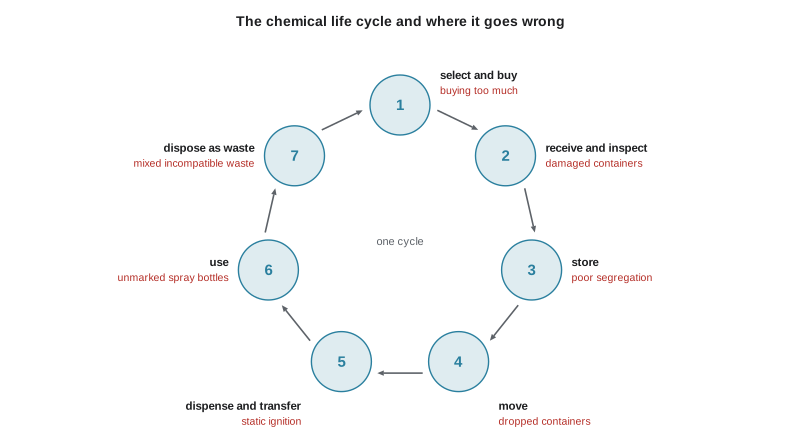
How storage incidents unfold
Storage incidents tend to follow a handful of patterns. Understanding the patterns helps you see the controls that matter most.
The first pattern is incompatible materials coming into contact. Two products that are safe on their own can react violently when mixed. A leaking bottle of nitric acid can ignite wood shelving or rags. Bleach mixed with an acid releases chlorine gas, and bleach mixed with ammonia-based cleaners releases chloramine vapors. Water-reactive metals such as sodium or calcium carbide release flammable gases when a sprinkler activates or a roof leaks. Most incompatibility incidents happen because products were stored alphabetically, stored wherever there was space, or poured into the same waste container.
The second pattern is a fire that grows because of what is stored nearby. Flammable liquids stored in the open, in glass, in large containers or in quantities beyond the code limits turn a small fire into a large one. Oxidizers such as pool chlorine, nitrates and peroxides feed fires with their own oxygen. Compressed gas cylinders heated by a fire can fail violently. Many building fires involving chemicals did not start in the chemical store but spread into it.
The third pattern is degradation over time. Some chemicals become more dangerous as they age. Ethers and some other solvents form explosive peroxides after exposure to air. Picric acid becomes shock-sensitive when it dries out. Containers of corrosives eat through their own caps or through metal shelving. Cylinder valves seize. Labels peel off, and an unidentified container becomes a disposal problem that costs far more than the original product.
The fourth pattern is a release during handling. Bottles are dropped while being carried by the neck. Drums are tipped while being moved by hand. Solvent is splashed while being poured through a funnel with no catch tray. A worker opens a corrosive container at face height. These incidents are usually smaller, but they are frequent, and they cause many of the chemical burns and eye injuries reported each year.
The fifth pattern is a failure of first response. An eyewash that has not been run for months delivers rusty water or none at all. A spill kit is missing the neutralizer. Nobody knows what is in the store because the inventory is out of date, so firefighters must treat the room as unknown.
| Pattern | Typical trigger | Key controls |
|---|---|---|
| Incompatible contact | Leaking container, mixed waste, alphabetical storage | Segregation plan, secondary containment, waste compatibility rules |
| Fire growth | Ignition near flammables, oxidizers feeding fire | Quantity limits, cabinets and rooms, ignition control, sprinklers |
| Degradation over time | Peroxide formation, drying out, corrosion | Date labeling, shelf-life rules, inspections, disposal of old stock |
| Handling release | Dropped or tipped containers, splashes | Carriers and carts, pumps, trays, PPE, training |
| Failed first response | Dead eyewash, empty spill kit, no inventory | Weekly tests, kit checks, accurate inventory, emergency plan |
Lessons from incidents
Some of the worst industrial disasters of the past decade began as storage problems. In August 2015, explosions at a hazardous goods warehouse in the port of Tianjin, China, killed 173 people, most of them firefighters. Investigators found that the warehouse held far more dangerous goods than its permit allowed, including nitrocellulose that had dried out and self-heated, and large amounts of ammonium nitrate and sodium cyanide stored close together. In August 2020, about 2,750 metric tons of ammonium nitrate that had been stored for years in a port warehouse in Beirut exploded after a fire, killing more than 200 people. HSE-311 discussed these as process safety events; here the point is simpler. In both cases the chemical sat in storage, unmanaged, while the risk grew.
Smaller incidents teach the same lessons on a human scale. In December 2008, a 23-year-old research assistant at the University of California, Los Angeles, Sheri Sangji, suffered fatal burns when a syringe of tert-butyllithium, a chemical that ignites on contact with air, came apart and the liquid caught fire. She was not wearing a lab coat, and her synthetic sweater melted. The case led to criminal charges against the university and the principal investigator, which were later resolved by agreements, and it changed how many North American universities train researchers and enforce protective clothing. In January 2010, a graduate student at Texas Tech University lost three fingers and injured an eye when he scaled up the preparation of an energetic compound far beyond the amount approved. The US Chemical Safety and Hazard Investigation Board (CSB) investigated and concluded that academic laboratories often lacked the hazard evaluation and oversight that industry uses. Lesson 11 returns to laboratories.
In the United States, the CSB has investigated many incidents involving storage and handling, from dust and solvent fires in small manufacturers to reactive chemical incidents in warehouses. Its videos and reports are free and widely used for training. OSHA's enforcement data show that hazard communication and respiratory protection are among the most frequently cited standards each year, a reminder that chemical hazards are common in ordinary workplaces.
Why small users are at risk
Large chemical plants usually have process safety engineers, industrial hygienists and dedicated storage facilities. Small users often do not. A maintenance supervisor may be responsible for the paint store, the fuel shed, the cylinder cage and the pool chemicals on top of everything else. A science teacher may inherit a storeroom stocked by several predecessors. A cleaning contractor may carry concentrated products from site to site in a van. These workplaces have many different chemicals in small quantities, little specialist support, and high staff turnover. The controls in this course are designed to be practical for them.
Worked problem
Spotting storage hazards on a walk-through
During a walk-through of a vehicle maintenance shop you see: a 20 L pail of brake cleaner beside the parts washer; three oxygen and two acetylene cylinders standing unsecured in a corner; a pool chlorine bucket stored under a bench with oily rags; an unlabeled spray bottle of blue liquid; and an eyewash bottle with a cracked seal dated three years ago. Which incident patterns do these represent?
Show solution
- The brake cleaner pail is a fire-growth hazard: a flammable aerosol or liquid stored in a large container outside a cabinet near a work area.
- The unsecured cylinders are a handling and fire hazard: they can fall and damage valves, and oxygen is stored too close to the fuel gas.
- Pool chlorine (calcium hypochlorite) is an oxidizer stored with oily rags, an incompatible combination that can start a fire on its own.
- The unlabeled spray bottle is a degradation and first-response problem: nobody can tell what it is or how to treat an exposure.
- The expired, damaged eyewash bottle is a first-response failure: it may not be sterile and cannot deliver 15 minutes of flushing anyway.
Answer: Fire growth, handling, incompatible contact, degradation and failed first response: all five patterns in one shop.
The hierarchy of controls for storage
The hierarchy of controls that HSE-103 introduced applies directly to chemical storage. Elimination comes first: dispose of chemicals that are no longer needed. Substitution comes next: replace a flammable solvent cleaner with a water-based one, buy a less concentrated product, or choose a gel instead of a liquid. Engineering controls follow: cabinets, ventilated rooms, secondary containment, bonding and grounding, fume hoods, sprinklers and gas detection. Administrative controls include segregation plans, quantity limits, inspections, inventories, training and labeling. Personal protective equipment is the last line: gloves chosen for the chemical, splash goggles, face shields and chemical aprons.
The single most effective storage control is to keep less. Every liter you do not store is a liter that cannot leak, burn or react. Many organizations find that half or more of their chemical inventory has not been touched in years. A clean-out, followed by a rule that new purchases need a reason and a home, reduces risk and cost at the same time.
# Estimate how much stock a shop could remove in a clean-out.
# Illustrative inventory: (product, containers, size in L, months since last use)
inventory = [
    ("degreaser A", 4, 20, 2), ("degreaser B", 2, 20, 30), ("paint thinner", 6, 4, 18),
    ("brake cleaner", 24, 0.5, 1), ("old varnish", 5, 4, 60), ("antifreeze", 3, 20, 4),
    ("acetone", 2, 4, 26), ("rust remover", 3, 4, 40),
]
total = sum(n * size for _, n, size, _ in inventory)
idle = [(p, n * size) for p, n, size, months in inventory if months >= 24]
removable = sum(v for _, v in idle)
print(f"Total stock: {total:.0f} L")
for p, v in idle:
    print(f"  unused 2+ years: {p:15s} {v:5.0f} L")
print(f"Removable in a clean-out: {removable:.0f} L ({100 * removable / total:.0f}% of stock)")Total stock: 256 L unused 2+ years: degreaser B 40 L unused 2+ years: old varnish 20 L unused 2+ years: acetone 8 L unused 2+ years: rust remover 12 L Removable in a clean-out: 80 L (31% of stock)
In this invented example, almost a third of the stock has not been used in two years. Removing it shrinks the fire load in the shop, frees space in the cabinets so that the products still in use can be stored properly, and reduces the number of containers that need inspection.
Worked problem
Choosing controls for a cleaning supply room
A school's cleaning supply room holds concentrated bleach, an acidic toilet bowl cleaner, an ammonia-based glass cleaner and a solvent floor stripper, all on one open shelf. Custodians dilute products in buckets on the floor. Suggest controls at each level of the hierarchy.
Show solution
- Elimination and substitution: switch to a pre-diluted or dispensing-system product line, and replace the solvent stripper with a water-based one if it works for the floors.
- Engineering: install a wall-mounted dilution station so concentrates are not poured by hand, and provide separate tubs or shelves with lips so bleach cannot meet the acid or ammonia products.
- Administrative: post a simple segregation chart, label every secondary container, train custodians never to mix products, and keep a current inventory with safety data sheets.
- PPE and first response: splash goggles and chemical gloves at the dilution station, and an eyewash that meets the standard within reach.
Answer: Substitute and pre-dilute, separate incompatibles physically, use a dilution station, label and train, and provide goggles, gloves and an eyewash.
What this course covers
Lesson 2 sets out the legal and fire-code framework in your country. Lesson 3 shows how to pull storage information from safety data sheets and hazard classes. Lesson 4 is the heart of the course: chemical compatibility and segregation. Lesson 5 covers storage areas, rooms and cabinets, and lesson 6 the special rules for flammable and combustible liquids. Lessons 7 and 8 deal with corrosives, oxidizers, reactives, peroxide formers, compressed gases and cryogenic liquids. Lesson 9 covers transferring and dispensing. Lesson 10 is about eyewashes, showers and first response. Lesson 11 addresses laboratories and other small-quantity users, and lesson 12 covers waste chemicals and inventory management before a capstone storage plan for an invented college shop and laboratory.
Spills are covered in HSE-251, transport in HSE-250, respirators in HSE-240 and process safety in HSE-311. This course refers to them rather than repeating them.
Common mistakes
MistakeStoring chemicals alphabetically because it makes them easy to find.
InsteadStore by hazard class and compatibility, then alphabetically within each compatible group.
MistakeBuying the largest container because the unit price is lower.
InsteadBuy the smallest quantity that meets the need; storage risk and disposal cost often outweigh the saving.
MistakeAssuming that a chemical in a sealed container cannot cause problems.
InsteadInspect stored chemicals; containers corrode, labels fade and some chemicals become more dangerous with age.
MistakeTreating the storeroom as the place where unwanted chemicals go to be forgotten.
InsteadRun regular clean-outs and dispose of chemicals that are no longer needed.
MistakeLeaving eyewash checks and spill kit restocking until after an incident.
InsteadTest first response equipment on a schedule so it works the day it is needed.
Summary and key terms
- Chemicals spend most of their time in storage, and the hazard remains while they wait.
- The chemical life cycle runs from purchase through storage, transfer and use to disposal, with predictable failure points at each stage.
- Most storage incidents follow five patterns: incompatible contact, fire growth, degradation over time, handling releases and failed first response.
- Tianjin and Beirut show how unmanaged storage can grow into catastrophe; UCLA and Texas Tech show how small-scale handling can kill or maim.
- Small users face high risk because they hold many chemicals with little specialist support.
- The hierarchy of controls applies to storage, and keeping less is the most effective single control.
- Spills, transport, respirators and process safety are covered in their own courses.
- Chemical life cycle
- The stages a chemical passes through, from purchase to disposal.
- Incompatible chemicals
- Chemicals that react dangerously when they come into contact.
- Segregation
- Physically separating incompatible chemicals in storage.
- Secondary container
- A smaller container into which a chemical is transferred from its original packaging.
- Secondary containment
- A tray, bund or sump that catches leaks from primary containers.
- Peroxide former
- A chemical that forms explosive peroxides when exposed to air over time.
- Pyrophoric
- Igniting spontaneously on contact with air.
- Fire load
- The total amount of combustible material in an area.
- Clean-out
- A planned removal of unneeded, expired or unidentified chemicals.
- Hierarchy of controls
- The ranked order of controls from elimination to personal protective equipment.
Practice problems
Work each problem on paper first, then reveal the answer to check.
List the stages of the chemical life cycle.
Show answer
Select and buy, receive, store, move, dispense or transfer, use, dispose.
Name the five patterns of storage incidents.
Show answer
Incompatible contact, fire growth, degradation over time, handling releases, failed first response.
Why is alphabetical storage dangerous?
Show answer
It places incompatible chemicals side by side, for example acetic acid near acetaldehyde or nitric acid near nitrobenzene.
Give two examples of chemicals that become more dangerous as they age.
Show answer
Peroxide-forming ethers and picric acid that dries out.
What storage lesson do the Tianjin and Beirut explosions share?
Show answer
Hazardous chemicals were stored for long periods in quantities and conditions nobody was actively managing.
What changed after the 2008 UCLA laboratory fire?
Show answer
Many institutions strengthened training, oversight and enforcement of protective clothing for pyrophoric work.
What is the most effective single storage control?
Show answer
Keeping less, by eliminating unneeded stock and buying smaller quantities.
Give an engineering control and an administrative control for a solvent store.
Show answer
Engineering: flammable storage cabinet or ventilated room. Administrative: quantity limits, segregation plan, inspections.
Why are small users at particular risk?
Show answer
They hold many different chemicals with little specialist support and often high staff turnover.
Which other courses cover spills, transport and respirators?
Show answer
HSE-251 for spills, HSE-250 for transport and HSE-240 for respirators.
Lesson quiz · 5 questions
Score 60% or more to complete this lesson.
Create a free account to save your progress, take quizzes and earn a certificate.