
HSE-312 · Lesson 5 of 12 · 26 min
Storage areas, rooms and cabinets
Once you know which chemicals you have and which groups must be kept apart, the next question is where they will physically live. This lesson covers the options from the bottom up: shelving and secondary containment, storage cabinets for flammable and corrosive products, dedicated storage rooms, and outdoor storage. It also covers the features every storage area needs regardless of size: ventilation, lighting, signs, spill control and access control. Exact quantity limits for flammable liquids are covered in lesson 6; this lesson focuses on the design and upkeep of the storage spaces themselves.
Principles for any storage location
A good chemical storage location has a few properties no matter what it holds. It is dedicated to storage rather than doubling as a lunchroom, office or general corridor. It is away from exits, stairs and escape routes, so that a fire or spill in the store does not trap people. It is protected from temperature extremes, direct sunlight and heat sources such as furnaces and steam pipes. It has adequate general ventilation so vapors from small leaks do not build up. It is well lit so labels can be read. It has a floor that is impervious to the chemicals stored and, ideally, slopes or is curbed to contain spills. And access is limited to trained people.
| Feature | Why it matters | What good looks like |
|---|---|---|
| Location | A fire or spill must not block escape | Away from exits, stairs and corridors |
| Temperature | Heat raises vapor pressure and speeds decomposition | Cool, dry, out of sunlight and away from heaters |
| Ventilation | Vapors from small leaks must not accumulate | Mechanical exhaust where flammables or toxics are kept |
| Lighting | Labels must be readable | Bright enough to read small print on labels |
| Floor and containment | Spills must not spread or reach drains | Impervious floor, curbs or trays, no floor drains to sewer |
| Shelving | Containers must not fall | Sturdy, chemically resistant, with lips or restraints |
| Access | Untrained people cause mix-ups | Locked or controlled, with a list of authorized users |
| Signs | Responders need to know the hazards | Hazard signs on doors, posted plan, emergency numbers |
Shelving and secondary containment
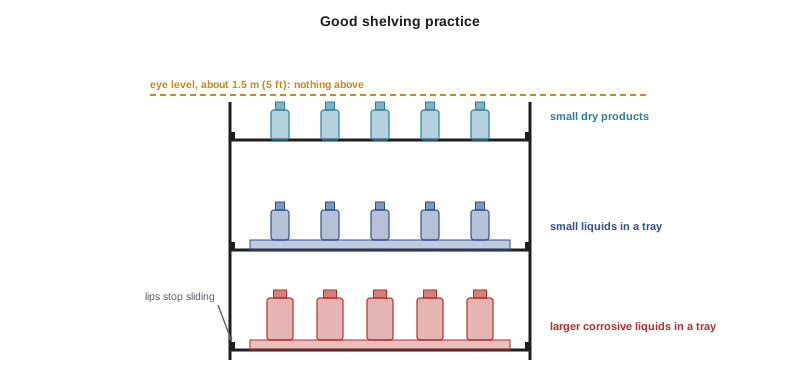
Most small users store chemicals on open shelves. Shelving should be sturdy and securely anchored to the wall or floor, especially in earthquake-prone areas such as coastal British Columbia and California, where shelves need restraints or lips to stop containers sliding off during shaking. Shelves should be made of a material that resists the chemicals stored; untreated wood absorbs spills, and bare steel corrodes under acid fumes. Coated steel, stainless steel or chemically resistant plastic shelving are common choices.
Keep large and heavy containers, and liquids in general, on lower shelves. A good rule of thumb is to store nothing above eye level (about 1.5 m or 5 ft) and to keep corrosive liquids below shoulder height, so that a container dropped while being lifted down does not splash the face. Do not store chemicals on the floor where they can be kicked or struck by carts, except for drums and pails on proper containment.
Secondary containment is a tray, pan, bund or pallet that catches leaks from the primary container. It should be made of a material compatible with the chemical and should be large enough to hold the contents of the largest container. Many jurisdictions and guides use a common rule for spill pallets and bunded areas: hold 110 percent of the largest container, or 10 percent of the total volume stored, whichever is greater, although the exact rule depends on the jurisdiction and the code being applied. Incompatible groups need separate containment so that a leak from one cannot reach the other.
# Size secondary containment using the common "110% of largest or 10% of total" rule.
# Volumes in L; illustrative containers for one spill pallet.
containers = {"drum A": 205, "drum B": 205, "pail C": 20, "pail D": 20}
largest = max(containers.values())
total = sum(containers.values())
need = max(1.10 * largest, 0.10 * total)
print(f"Largest container: {largest} L, total stored: {total} L")
print(f"110% of largest: {1.10 * largest:.1f} L")
print(f"10% of total:    {0.10 * total:.1f} L")
print(f"Containment needed: {need:.1f} L")
for name, cap in {"2-drum pallet (250 L sump)": 250, "4-drum pallet (240 L sump)": 240}.items():
print(f"{name}: {'OK' if cap >= need else 'too small'}")Largest container: 205 L, total stored: 450 L 110% of largest: 225.5 L 10% of total: 45.0 L Containment needed: 225.5 L 2-drum pallet (250 L sump): OK 4-drum pallet (240 L sump): OK
The check shows that for two 205 L drums and two 20 L pails, the largest container drives the requirement. A sump of about 226 L is needed, so a pallet with a 250 L sump works and one with a 240 L sump also works. If the same pallet held eight drums, the 10 percent of total rule would start to matter. Always confirm the rule that applies in your jurisdiction and to your type of facility; some environmental regulations for bulk storage use different percentages.
Flammable liquid storage cabinets
A flammable storage cabinet is a double-walled steel (or sometimes wooden) cabinet designed to keep its contents below their ignition temperature for a period during a fire in the room, typically 10 minutes in the standard fire test, so that people have time to escape and firefighters have time to arrive. Cabinets have self-closing or manually closing doors (self-closing doors are required in many jurisdictions and for many uses), a raised sill or leak-proof bottom that holds a few centimeters of spilled liquid, and a label reading FLAMMABLE – KEEP FIRE AWAY or similar. They are commonly yellow, although color is not a requirement in all codes.
In the United States, OSHA 29 CFR 1910.106(d)(3) limits a single cabinet to 60 gallons of Category 1, 2 or 3 flammable liquids or 120 gallons of Category 4 flammable liquids, and generally allows no more than three cabinets in a single fire area unless the area is sprinklered or meets other conditions. NFPA 30 sets similar limits and construction requirements, and local fire codes based on the International Fire Code or NFPA 1 may add further conditions. Check the code adopted in your jurisdiction for exact figures.
Cabinets are not designed to be vented, and venting can reduce their fire performance. Most codes do not require venting, and many manufacturers recommend keeping the vent bungs closed. If a cabinet is vented, for example to control odors from solvents, the vent must be ducted to the outside with suitable metal ductwork and must not compromise the fire rating. Never store oxidizers, corrosives or incompatible products in a flammable cabinet, and never store paper, cardboard boxes or rags in it.
Corrosive and other cabinets
Corrosive storage cabinets are usually made of polyethylene or coated steel with plastic shelves and trays, so that acid fumes do not rust the cabinet. They are commonly blue for acids or bases, though this varies by manufacturer. Keep acids and bases in separate cabinets, or at least in separate trays on different shelves, and keep oxidizing acids such as nitric acid in their own cabinet or a dedicated tray. Corrosive cabinets are not fire-rated, so flammable corrosives such as glacial acetic acid may belong in a flammable cabinet with its own tray.
Other specialized cabinets include pesticide cabinets (often green), cabinets for toxic and poisonous materials with locks, and gas cylinder cabinets with exhaust ventilation for toxic or pyrophoric gases. Cabinets under fume hoods are common in laboratories; some are ventilated, some are flammable-rated, and some are only general storage. Check the label on the cabinet to see what it is rated for.
Dedicated storage rooms
When quantities exceed what cabinets can hold, a dedicated storage room may be needed. Fire codes call these flammable liquid storage rooms or inside storage rooms, and set requirements for fire-resistance-rated walls and doors, spill containment such as raised sills or sloped floors, mechanical ventilation, explosion-proof or suitable electrical equipment, and sprinklers. The exact requirements depend on the quantity, the hazard class, whether the room is on an outside wall, and the code edition in force.
A dedicated room is also the right answer when a facility stores several incompatible groups in significant quantities and needs real isolation between them. The room can be divided by fire-rated partitions or arranged with spill-contained bays separated by distance. Doors should open outward and be self-closing. A room for flammables should have no ignition sources, a bonded and grounded dispensing area if transfers happen there, and an exhaust that removes vapor near the floor, because most flammable vapors are heavier than air.
Worked problem
Choosing between cabinets and a room
A small manufacturing plant uses about 320 gal of solvent-based paints, thinners and degreasers. All are flammable liquids. How should it approach storage?
Show solution
- List the products with their quantities and flammable categories from SDS section 2 and flash points from section 9.
- Reduce the stock if possible by ordering smaller quantities more often; much of the 320 gal may be months of supply.
- Compare the quantity with the cabinet limits in OSHA 1910.106 and the local fire code. At 60 gal of Category 1 to 3 liquids per cabinet, 320 gal would need six cabinets, more than the typical limit of three per fire area.
- If stock cannot be reduced, consider an inside storage room designed to NFPA 30 and the local fire code, or an outdoor storage building, rather than adding cabinets.
- Involve the local fire department and the building owner, and document the decision in the storage plan.
Answer: First reduce stock; if large quantities are still needed, use a code-compliant storage room or outdoor building rather than piling up cabinets.
Outdoor storage and storage buildings
Drums, totes and cylinders are often stored outdoors in prefabricated storage buildings or on spill-contained pads with roofs. Outdoor storage keeps large quantities away from occupied buildings and is often the simplest way to meet code limits. It needs protection from weather and direct sun, spill containment that keeps rain out or can be drained safely, separation from buildings, property lines and each other as set by the fire code, security against theft and vandalism, and signs. In cold climates, water-based products and some chemicals must be protected from freezing, and drums can crack or bulge.
Signs, spill kits and access
Every storage area should have signs on the door showing the main hazards, often with GHS-style pictograms, the NFPA 704 diamond in the United States, or the hazard symbols required by the local fire code. Responders use these signs to decide how to approach a fire. The posted segregation plan, an emergency contact list and the location of the nearest eyewash, shower and spill kit should be visible inside or at the entrance.
A spill kit sized for the largest container likely to be dropped should be nearby, with absorbents suitable for the chemicals stored. Universal absorbents work for most liquids; acid and base neutralizers and absorbents for hydrofluoric acid or mercury may be needed for specific products. Lesson 10 covers emergency equipment, and spill response in detail is the subject of HSE-104.
Access control prevents the most common cause of segregation drift: untrained people putting things in the wrong place. A locked storeroom with a short list of authorized users, a sign-out log for hazardous products, or a supervised issue counter are all reasonable approaches depending on the size of the operation.
Common mistakes
MistakeStoring chemicals on top of a flammable cabinet.
InsteadKeep the top clear; store products inside the right cabinet or on proper shelving.
MistakeVenting a flammable cabinet into the room or with plastic tubing.
InsteadKeep vents closed unless required, and if venting, duct to outside with suitable metal ductwork.
MistakeStoring corrosive liquids on high shelves.
InsteadKeep corrosive liquids below shoulder height in compatible trays.
MistakeUsing a storeroom as a lunchroom or break area.
InsteadKeep storage areas dedicated and keep food and drink out.
MistakeAdding more and more cabinets as stock grows.
InsteadReduce stock first, then use a code-compliant storage room or outdoor building if needed.
Summary and key terms
- Storage locations should be dedicated, away from exits, cool, ventilated, well lit, contained, signed and access-controlled.
- Shelving should be sturdy, anchored, chemically resistant, with lips; liquids and heavy items go low, nothing above eye level.
- Secondary containment is often sized at 110 percent of the largest container or 10 percent of the total, whichever is greater, subject to local rules.
- Flammable cabinets protect contents for a short time in a fire; OSHA 1910.106 and NFPA 30 limit quantity per cabinet and cabinets per fire area.
- Corrosive cabinets resist fumes but are not fire-rated; acids and bases need separate cabinets or trays.
- Large quantities call for a code-compliant storage room or outdoor storage building.
- Signs, spill kits and access control complete the storage area.
- Secondary containment
- A tray, pallet, bund or curb that catches leaks from a primary container.
- Flammable storage cabinet
- A cabinet designed to protect flammable liquids from a room fire for a limited time.
- Fire compartment
- An area enclosed by fire separations, used to limit fire spread.
- Inside storage room
- A room built to fire-code requirements for storing larger quantities of flammable liquids.
- Corrosive cabinet
- A cabinet made of materials that resist acid and base fumes.
- Spill pallet
- A pallet with a built-in sump that holds drums and catches leaks.
- Sill
- A raised lip at the bottom of a cabinet or door that holds spilled liquid.
- Seismic restraint
- A lip, bar or strap that stops containers falling from shelves in an earthquake.
- NFPA 704
- A US diamond-shaped sign showing health, flammability and instability ratings.
- Access control
- Measures that limit who can enter a storage area.
Practice problems
Work each problem on paper first, then reveal the answer to check.
List four features every chemical storage location needs.
Show answer
Any four of: dedicated use, away from exits, cool and dry, ventilation, lighting, impervious floor or containment, sturdy shelving, access control, signs.
What is the highest a container should usually be stored?
Show answer
No higher than eye level, about 1.5 m or 5 ft, with corrosive liquids below shoulder height.
How much should a spill pallet hold under the common rule?
Show answer
110 percent of the largest container or 10 percent of the total, whichever is greater, subject to local rules.
What does a flammable cabinet do in a fire?
Show answer
It keeps the contents below ignition temperature for a limited time, giving people time to escape.
What is the per-cabinet limit in OSHA 1910.106?
Show answer
60 gallons of Category 1 to 3 flammable liquids or 120 gallons of Category 4, with generally no more than three cabinets per fire area.
Should flammable cabinets be vented?
Show answer
Usually not; if vented, the vent must be ducted outside with suitable metal ductwork without reducing the fire rating.
Why should a flammable storage room exhaust near the floor?
Show answer
Most flammable vapors are heavier than air.
What should be posted at a storage area entrance?
Show answer
Hazard signs, the segregation plan, emergency contacts and locations of eyewash, shower and spill kit.
What is the first step when flammable stock exceeds cabinet limits?
Show answer
Reduce stock by ordering smaller quantities more often.
Why do outdoor drums need protection in cold climates?
Show answer
Freezing can damage some products and crack or bulge containers.
Lesson quiz · 5 questions
Score 60% or more to complete this lesson.
Create a free account to save your progress, take quizzes and earn a certificate.