
HSE-312 · Lesson 2 of 12 · 27 min
The legal and fire-code framework
Chemical storage in the United States is governed by several overlapping layers of law and code. OSHA standards protect workers. Fire codes, adopted by states and local governments, protect buildings and the people in them. EPA rules protect soil, water and air, and control hazardous waste. OSHA's Hazard Communication Standard sets how chemicals are classified and labeled. Transport rules cover chemicals on the road. A workplace that stores chemicals usually has to meet requirements from all of these at once. This lesson maps the layers so you know which rulebook answers which question. It does not replace the regulations that apply where you work, and the details change, so always check the current edition adopted in your state and locality.
Four questions, four rulebooks
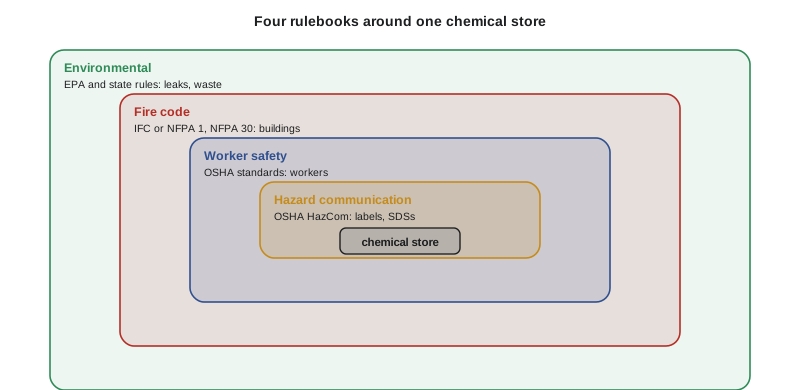
A useful way to keep the framework straight is to ask four questions. Is the chemical identified and communicated properly? That is hazard communication law. Are workers protected while they store and handle it? That is occupational health and safety law. Is the building safe if the chemical burns or reacts? That is the fire code. Is the environment protected from leaks and waste? That is environmental law. Transport adds a fifth question when chemicals leave the site, covered in HSE-250.
Hazard communication
OSHA's Hazard Communication Standard (29 CFR 1910.1200) requires manufacturers and importers to classify chemicals using the GHS, apply labels and provide 16-section safety data sheets. The 2024 update aligned the standard with GHS Revision 7, with compliance dates running into 2026 and 2027 for different groups. Employers must keep containers labeled, keep safety data sheets readily accessible and train workers. HSE-102 covers this in detail. For storage, the key points are that every container must stay identified and that the safety data sheet is the first source of storage information.
Occupational health and safety
OSHA's general industry standards in 29 CFR Part 1910 contain several rules that apply directly to storage. Section 1910.106 covers flammable liquids, including storage cabinets and inside storage rooms; it was revised in 2012 to use the GHS flammable liquid categories. Section 1910.101 covers compressed gases and refers to the Compressed Gas Association's pamphlet P-1. Section 1910.253 covers oxygen-fuel gas welding and cutting, including cylinder storage. Section 1910.1450, the Laboratory Standard, requires a chemical hygiene plan in laboratories. Section 1910.151(c) requires suitable facilities for quick drenching or flushing of the eyes and body where corrosive materials are used. The General Duty Clause in section 5(a)(1) of the OSH Act covers serious recognized hazards that no standard addresses. About half of the states run their own OSHA-approved state plans, which must be at least as effective as federal OSHA and sometimes go further.
| Topic | Where to look |
|---|---|
| General duty to protect workers | OSH Act General Duty Clause; state plan laws |
| Labels, SDSs and training | OSHA Hazard Communication, 29 CFR 1910.1200 |
| Exposure limits | OSHA permissible exposure limits (Z tables); state plan limits |
| Flammable liquid storage | OSHA 1910.106; NFPA 30 and the International Fire Code as adopted locally |
| Eyewashes and showers | OSHA 1910.151(c); ANSI/ISEA Z358.1 as the technical reference |
| Hazardous waste | EPA RCRA rules in 40 CFR Parts 260 to 273; state programs |
| Community right-to-know | EPA EPCRA reporting (Tier II inventories) |
Fire codes
Fire codes in the United States are adopted by states, counties and cities. Most adopt the International Fire Code (IFC), published by the International Code Council, sometimes with local amendments; a few use NFPA 1, the Fire Code published by the National Fire Protection Association. Both draw on NFPA standards for technical detail. NFPA 30, the Flammable and Combustible Liquids Code, covers containers, cabinets, inside storage rooms and warehouses. NFPA 400 covers hazardous materials such as oxidizers, organic peroxides and toxic materials. NFPA 45 covers fire protection for laboratories. NFPA 55 covers compressed gases and cryogenic fluids. The IFC limits the maximum allowable quantity (MAQ) of each hazard class in a control area; above it, the building needs special construction as a high-hazard occupancy. The local fire marshal is the authority having jurisdiction and decides how the code applies.
The phrase authority having jurisdiction appears throughout fire codes and standards. It means the organization or official responsible for enforcing the code at a particular site, usually the fire marshal or fire chief, sometimes a building official or an insurer. When a code is ambiguous, the authority having jurisdiction decides. Building a good working relationship with your local fire prevention office pays off when you plan a new storage room or change what you store.
Environmental law
Environmental law deals with chemicals that escape storage or reach the end of their life. The Resource Conservation and Recovery Act (RCRA) controls hazardous waste from generation to disposal, and states run their own authorized programs. The Clean Water Act and EPA's Spill Prevention, Control and Countermeasure rule require plans at facilities with more than 1,320 US gallons of oil in aboveground containers. The Emergency Planning and Community Right-to-Know Act (EPCRA) requires facilities storing hazardous chemicals above threshold quantities to submit annual Tier II inventories to state and local emergency planners and the fire department. The Department of Homeland Security's Chemical Facility Anti-Terrorism Standards (CFATS) program, which covered high-risk chemical facilities, lapsed in July 2023 when Congress did not reauthorize it; check its current status. HSE-251 covers spills and reporting; lesson 12 covers waste.
Standards and guidance
Beyond legislation, several standards and guidance documents are widely used. NIOSH publishes the Pocket Guide to Chemical Hazards. The National Academies' Prudent Practices in the Laboratory is the standard reference for laboratory chemical management. ANSI/ISEA Z358.1 covers eyewashes and showers, ANSI/ASSP Z9.5 covers laboratory ventilation, and UL standards cover listed storage cabinets. Insurers, such as FM Global through its data sheets, often impose their own requirements, which can be stricter than the code.
Worked problem
Finding the right rulebook
A small manufacturer in Ohio wants to store 150 US gallons of a flammable cleaning solvent, add a cylinder cage, and dispose of used solvent. Which layers of the framework apply to each part?
Show solution
- The solvent storage falls under OSHA 1910.106 (cabinets, storage rooms, ignition control) and the locally adopted fire code, which will draw on NFPA 30 and set maximum allowable quantities.
- The solvent must have an OSHA HazCom label and safety data sheet; any decanted containers need workplace labels.
- The cylinder cage falls under OSHA 1910.101 and 1910.253 and the fire code's compressed gas rules (NFPA 55 as adopted).
- Used solvent is likely RCRA hazardous waste (ignitable), so the company must determine its generator category and use manifests and permitted facilities; if it stores enough, Tier II reporting also applies.
Answer: OSHA and the local fire code for storage; HazCom for identification; OSHA and fire code for cylinders; RCRA (and possibly EPCRA) for waste and reporting.
Due diligence
In US enforcement, OSHA can issue citations classified as serious, willful, repeat or other-than-serious, with penalties adjusted for inflation each year. Employers defend themselves by showing that they had compliant programs and enforced them, or that a violation was unforeseeable employee misconduct despite a good program. For chemical storage, that means a written plan, a current inventory, segregation and quantity controls that match the code, inspections with records, training with records and corrective actions that are followed up. The paperwork matters because it is the evidence that the precautions existed before the incident.
# A simple compliance tracker: which storage controls have current records?
# Illustrative entries: (control, last record date as months ago, required interval in months)
controls = [
    ("Chemical inventory review", 14, 12),
    ("Storeroom inspection", 1, 1),
    ("Eyewash weekly activation", 0, 0.25),
    ("Cabinet self-closing door test", 7, 6),
    ("Worker hazard communication training", 20, 12),
    ("Spill kit check", 2, 3),
]
for name, ago, interval in controls:
    status = "OK" if ago <= interval else "OVERDUE"
    print(f"{name:40s} last {ago:>4} mo, every {interval:>4} mo -> {status}")
overdue = sum(1 for _, ago, i in controls if ago > i)
print(f"Overdue controls: {overdue} of {len(controls)}")Chemical inventory review last 14 mo, every 12 mo -> OVERDUE Storeroom inspection last 1 mo, every 1 mo -> OK Eyewash weekly activation last 0 mo, every 0.25 mo -> OK Cabinet self-closing door test last 7 mo, every 6 mo -> OVERDUE Worker hazard communication training last 20 mo, every 12 mo -> OVERDUE Spill kit check last 2 mo, every 3 mo -> OK Overdue controls: 3 of 6
A tracker like this, kept in a spreadsheet or maintenance system, turns a list of good intentions into evidence. Three overdue items in this invented example would be the first things an inspector or an investigator would ask about.
Who enforces what
Knowing which rulebook applies is only half the job; you also need to know who will check it. Different inspectors look at the same storeroom through different lenses, and a storage area can satisfy one and fail another. A fire inspector will look at quantities, cabinets, exits, sprinklers and ignition sources. An occupational health and safety inspector will look at labels, SDSs, training, ventilation, eyewash stations and PPE. An environmental officer will look at containment, drains, waste labels, accumulation times and manifests. A transport inspector will look at how products are packaged, marked and documented when they leave the site.
| Inspector | Typical focus in a storage area | Main rulebook |
|---|---|---|
| Fire marshal or fire inspector | Quantities, cabinets, storage rooms, exits, ignition sources | Local fire code (IFC or NFPA 1) and NFPA 30 |
| OSHA compliance officer | Labels, SDSs, training, ventilation, eyewash, PPE, 1910.106 | OSH Act and 29 CFR 1910, or a state plan |
| EPA or state environmental inspector | Spill containment, waste storage, manifests | RCRA and state rules |
| DOT inspector | Packaging, marks, documents for shipments | Hazardous Materials Regulations (49 CFR) |
A useful habit is to walk your own storage area once a year wearing each of these hats in turn, using a short checklist for each. The walk-through takes an hour or two and usually finds problems that a single-focus inspection would miss, such as a fire-compliant cabinet that holds unlabeled decanted bottles, or a well-labeled waste area with a floor drain that leads straight to the storm sewer.
Worked problem
One storeroom, four inspectors
A municipal works yard keeps paints, solvents, pool chemicals and waste oil in one garage bay. Which inspectors could find problems, and what would each look for?
Show solution
- Fire: total flammable liquid quantity, use of cabinets, the space heater in the bay, and whether the exit is clear.
- Occupational health and safety: labels on decanted containers, SDS availability, training records, ventilation and the nearest eyewash.
- Environmental: containment for the waste oil drums, the floor drain, and records for waste oil pickups.
- Transport: how the crew carries pool chemicals and fuel in trucks to the pools and parks.
Answer: All four could find problems, so the storage plan should be checked against each rulebook, not just the fire code.
Common mistakes
MistakeAssuming one rulebook covers everything about chemical storage.
InsteadCheck hazard communication, OHS, fire code and environmental requirements separately.
MistakeUsing the latest model fire code without checking what your jurisdiction has adopted.
InsteadConfirm the edition and local amendments with the authority having jurisdiction.
MistakeTreating voluntary standards such as ANSI Z358.1 as irrelevant.
InsteadUse them as the technical reference regulators, courts and insurers expect.
MistakeKeeping no records because the precautions were in place.
InsteadRecord inspections, training and corrective actions; records are the evidence of diligence.
MistakeIgnoring environmental law because the store is indoors.
InsteadPlan for leaks, drains and waste; environmental rules apply as soon as a chemical escapes or becomes waste.
Summary and key terms
- Chemical storage is governed by overlapping layers: hazard communication, occupational health and safety, fire codes and environmental law, plus transport.
- OSHA HazCom sets labeling and SDS rules; other OSHA standards set storage-specific duties.
- The International Fire Code and NFPA standards are models; states and localities adopt them.
- The authority having jurisdiction interprets and enforces the fire code at a site.
- RCRA, the SPCC rule and EPCRA cover waste, oil storage and community right-to-know.
- Voluntary standards and insurer requirements fill technical gaps and are widely relied on.
- Documented, enforced programs are the main defense to OSHA citations.
- Authority having jurisdiction
- The organization or official responsible for enforcing a code at a site.
- Model code
- A code published for adoption that has no legal force until adopted by a government.
- General duty
- A broad legal duty to protect workers from hazards, beyond specific rules.
- Safety data sheet
- The 16-section document describing a hazardous product and how to handle it safely.
- Maximum allowable quantity
- The most of a hazard class a fire code permits in an area without special construction.
- Generator
- A business that produces hazardous waste.
- Due diligence
- Taking every reasonable precaution in the circumstances to prevent harm.
- Strict liability
- An offense where intent need not be proven but a due diligence defense is available.
- GHS
- The Globally Harmonized System of Classification and Labeling of Chemicals.
- Environmental emergency plan
- A plan for preventing, preparing for and responding to releases of listed substances.
Practice problems
Work each problem on paper first, then reveal the answer to check.
Name the four main layers of law that apply to chemical storage.
Show answer
Hazard communication, occupational health and safety, fire codes and environmental law.
Which OSHA standard sets labeling and SDS rules?
Show answer
The Hazard Communication Standard, 29 CFR 1910.1200.
What does "authority having jurisdiction" mean?
Show answer
The organization or official responsible for enforcing a code at a site, usually the fire marshal.
Why must you check which fire code edition applies?
Show answer
Model codes have no force until adopted, and jurisdictions adopt different editions with local amendments.
Which NFPA code covers flammable and combustible liquids?
Show answer
NFPA 30.
What does EPCRA Tier II reporting require?
Show answer
Annual inventories of hazardous chemicals above thresholds, sent to state and local planners and the fire department.
Give two pieces of evidence of diligent chemical storage management.
Show answer
Current inventory, inspection records, training records, corrective action logs, written storage plan.
Why might an insurer require more than the fire code?
Show answer
Insurers protect property and business continuity and may set stricter limits or protection requirements.
Which course covers transport of chemicals off site?
Show answer
HSE-250.
In the compliance tracker example, how many controls were overdue?
Show answer
Three: the inventory review, the cabinet door test and training.
Lesson quiz · 5 questions
Score 60% or more to complete this lesson.
Create a free account to save your progress, take quizzes and earn a certificate.