
HSE-311 · Lesson 6 of 12 · 27 min
Hazard identification: checklists, what-if and HAZOP
You cannot control a hazard you have not found. Process hazard analysis (PHA) is the structured search for what could go wrong in a process, what the consequences would be, and whether the safeguards are good enough. This lesson covers the main PHA methods, from simple checklists to the hazard and operability study (HAZOP), and works through a HAZOP of part of an invented batch reactor that we will use for the rest of the course. Lesson 7 then shows how to judge whether the safeguards found in a PHA reduce risk enough.
The running example: reactor R-101
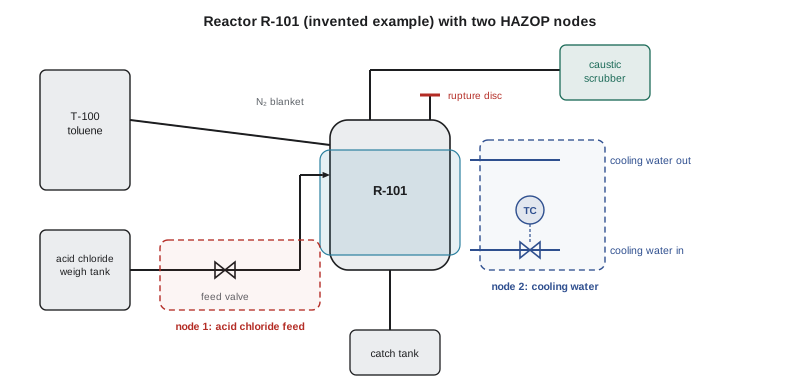
Larchmont Specialty Chemicals is an invented small plant that makes a speciality ester in a 10 m³ glass-lined batch reactor, R-101. Toluene is charged as a solvent, then an alcohol and a catalyst, and an acid chloride is fed slowly from a weigh tank over about four hours. The reaction is exothermic. Heat is removed by cooling water through the reactor jacket, and the batch is held at 60 °C. The hydrogen chloride gas produced is sent through a vent line to a caustic scrubber. Safeguards include a temperature controller on the jacket, a high-temperature alarm, a high-temperature trip that closes the acid chloride feed valve, a rupture disc and relief line to a catch tank, and a nitrogen blanket. Toluene is stored in a 30 m³ tank, T-100, in a diked area outside the building.
Choosing a method
Different PHA methods suit different stages of a project and different levels of complexity. The OSHA PSM standard lists acceptable methods: what-if, checklist, what-if/checklist, HAZOP, failure modes and effects analysis (FMEA), fault tree analysis, or an appropriate equivalent. CSA Z767 and the CSChE guide expect a similar range. The method should match the complexity of the process and the severity of its hazards.
| Method | How it works | Best suited to |
|---|---|---|
| Checklist | Compare the process against a list of known issues and code requirements | Standard equipment, simple processes, quick reviews |
| What-if | A team asks "what if…?" questions and records answers | Early design, small changes, procedures |
| What-if/checklist | What-if questions organized by checklist categories | Small to medium processes; more thorough than either alone |
| HAZOP | Guidewords applied to design intent at each node | Complex continuous or batch processes; detailed design |
| FMEA | Each component failure mode and its effects | Equipment items, instrument systems, machinery |
| Fault tree | Logic diagram working back from a top event to its causes | Specific high-consequence events needing quantification |
Checklists
A checklist captures experience: lessons from past incidents, code requirements, and company standards. Typical questions include: is every pressure vessel protected by a relief device sized for the worst credible case? Are relief discharges routed to a safe location? Are flammable liquid storage areas diked and bonded? Is electrical equipment classified for the area? Checklists are fast and consistent, and they are good at catching known issues. Their weakness is that they find only what is on the list. An unusual chemistry or a new type of equipment may have hazards that no checklist mentions.
What-if analysis
In a what-if review, a team walks through the process or a procedure and asks questions such as: what if the wrong material is charged? What if cooling water fails? What if the operator is called away during a transfer? For each question the team records the consequences, the existing safeguards and any recommendations. What-if is flexible and works well for procedures and small changes. Its quality depends heavily on the experience and imagination of the team, and it can miss hazards if questions are not asked systematically.
HAZOP: the hazard and operability study
HAZOP was developed at ICI in the United Kingdom in the 1960s and is now the most widely used method for detailed process designs. The team divides the process into nodes, sections of piping or equipment with a defined design intent, such as "deliver acid chloride to R-101 at 0.5 m³/h". For each node, the team combines guidewords with process parameters to generate deviations from the design intent, such as no flow, more flow or higher temperature. For each credible deviation, the team identifies causes, consequences and existing safeguards, and decides whether more protection is needed. The standard reference is IEC 61882, Hazard and operability studies (HAZOP studies) – Application guide.
| Guideword | Meaning | Example deviation |
|---|---|---|
| No (not, none) | Complete negation of the intent | No cooling water flow |
| More | Quantitative increase | More acid chloride flow; higher temperature |
| Less | Quantitative decrease | Less agitation; lower nitrogen pressure |
| As well as | Something in addition | Water as well as toluene in the charge |
| Part of | Only part of the intent achieved | Catalyst charged without solvent |
| Reverse | Opposite of the intent | Reverse flow from scrubber into the vent line |
| Other than | Complete substitution | Wrong material charged; maintenance mode |
| Early, late, before, after | Timing and sequence (useful for batch steps) | Acid chloride fed before the batch reaches temperature |
Guidewords are combined with parameters such as flow, pressure, temperature, level, composition, agitation, time and sequence. Not every combination is meaningful; part of the skill is recognizing which deviations are credible for the node. The code below generates the candidate list that a HAZOP scribe might start from.
# Generate candidate HAZOP deviations for a node from guidewords and parameters.
guidewords = ["No", "More", "Less", "Reverse", "As well as", "Other than"]
parameters = {
    "flow":        {"No", "More", "Less", "Reverse", "As well as", "Other than"},
    "temperature": {"More", "Less"},
    "pressure":    {"More", "Less"},
    "level":       {"More", "Less", "No"},
    "agitation":   {"No", "Less"},
}
devs = [f"{g} {p}" for p in parameters for g in guidewords if g in parameters[p]]
print(f"{len(devs)} meaningful deviations for node 2 (cooling water to jacket):")
for i in range(0, len(devs), 4):
print(" " + " | ".join(devs[i:i + 4]))15 meaningful deviations for node 2 (cooling water to jacket): No flow | More flow | Less flow | Reverse flow As well as flow | Other than flow | More temperature | Less temperature More pressure | Less pressure | No level | More level Less level | No agitation | Less agitation
Running a HAZOP session
A HAZOP team usually has a trained facilitator, a scribe who records the worksheet, and people who know the process well: a process engineer, an experienced operator, an instrument or control engineer, a maintenance or mechanical engineer, and specialists as needed, such as a chemist for reactive hazards. Operators are essential: they know how the plant is really run, which instruments are unreliable and which shortcuts people take at three in the morning. The team needs current piping and instrumentation diagrams (P&IDs), process safety information, operating procedures and incident history. Sessions are tiring, so most facilitators limit them to a few hours a day.
Worked problem
HAZOP of node 2: cooling water to the reactor jacket
Design intent: supply cooling water to the R-101 jacket at up to 25 m³/h to hold the batch at 60 °C during acid chloride addition. Work through the deviation 'no flow'.
Show solution
- Causes: cooling water pump trips; control valve fails closed or controller fails; strainer blocked; isolation valve left closed after maintenance; loss of plant cooling water supply.
- Consequences: heat of reaction is not removed while acid chloride is still being fed; temperature rises; the reaction accelerates; toluene boils (111 °C) and pressure rises; potential runaway, rupture disc bursts, release of toluene and HCl to the catch tank; if relief is inadequate, vessel failure and fire.
- Existing safeguards: high-temperature alarm (operator stops feed manually); high-temperature trip closes the acid chloride feed valve; rupture disc and catch tank.
- Questions raised: Is the trip independent of the temperature controller, or do they share the same sensor? Was the rupture disc sized for the runaway case with two-phase flow, or only for fire? Is there low cooling-water flow indication?
- Recommendations: provide a separate temperature sensor for the trip; add a low cooling water flow alarm and interlock on the feed; confirm relief sizing for runaway; review whether the feed rate limits the amount of unreacted acid chloride that can accumulate.
Answer: Loss of cooling during feed is a high-consequence deviation; the team should confirm the trip is independent, add low-flow detection and confirm the relief design for the runaway case.
| Deviation | Causes | Consequences | Safeguards | Recommendations |
|---|---|---|---|---|
| No flow | Pump trip; valve fails closed; isolation left shut | Loss of cooling during feed; runaway; overpressure | TAH; TSHH closes feed; rupture disc | Independent trip sensor; low-flow alarm; check relief sizing |
| More flow | Valve fails open | Batch cools below 50 °C; reactant accumulates unreacted | Temperature controller; TAL | Add low-temperature interlock on feed (accumulation hazard) |
| Reverse flow | Supply pressure lost while jacket pressurized | Contamination of cooling water if jacket leaks | Check valve on return | Confirm check valve in test program |
| Higher temperature | Cooling water supply warm in summer | Reduced cooling margin | Temperature controller | Check design at maximum summer water temperature |
The 'more flow' line shows why HAZOP finds hazards that intuition misses. Too much cooling sounds safe, but if the batch gets too cold, the acid chloride added during that time may not react and can accumulate. When the temperature recovers, the accumulated reactant reacts all at once and releases far more heat than the cooling system can remove. Several serious reactive incidents, including the explosion at T2 Laboratories in Jacksonville, Florida, in 2007, which killed four people, involved runaway reactions in batch reactors where cooling could not keep up.
Ranking the findings
Most PHAs rank each scenario on a risk matrix so that recommendations can be prioritized. Severity and likelihood are each scored on a scale, usually from 1 to 4 or 1 to 5, and the product or the matrix cell gives a risk category. Matrices are simple and quick, but they are coarse, and different teams can score the same scenario differently. High-risk scenarios are often taken forward to the more rigorous layer of protection analysis described in Lesson 7.
# Rank HAZOP scenarios on a 5 x 5 risk matrix (company-specific categories, illustrative).
def category(sev, like):
    score = sev * like
    if score >= 15: return "High - act now"
    if score >= 8:  return "Medium - reduce risk"
    return "Low - manage by procedures"

scenarios = [   # description, severity (1-5), likelihood (1-5)
    ("No cooling flow during feed -> runaway", 5, 3),
    ("More cooling -> reactant accumulation", 4, 3),
    ("Reverse flow into cooling water", 2, 2),
    ("Wrong drum charged (water in solvent)", 4, 2),
]
for desc, s, l in sorted(scenarios, key=lambda r: -r[1] * r[2]):
print(f"S{s} x L{l} = {s * l:>2} {category(s, l):<26} {desc}")S5 x L3 = 15 High - act now No cooling flow during feed -> runaway S4 x L3 = 12 Medium - reduce risk More cooling -> reactant accumulation S4 x L2 = 8 Medium - reduce risk Wrong drum charged (water in solvent) S2 x L2 = 4 Low - manage by procedures Reverse flow into cooling water
Inherently safer design
The best time to find a hazard is before the plant is built, and the best response is often to remove or reduce the hazard rather than add safeguards. Trevor Kletz, who worked at ICI and wrote widely on process safety, summarized inherently safer design in a few words: what you don't have can't leak. Inherently safer strategies are usually grouped as minimize, substitute, moderate and simplify. Many PHAs now include a structured inherent safety review, and the 2024 EPA rule required some sectors to evaluate safer technology (Lesson 5).
| Strategy | Meaning | Example for reactor R-101 |
|---|---|---|
| Minimize | Use smaller quantities | Feed acid chloride from a small day tank instead of the full weigh tank |
| Substitute | Use a less hazardous material | Replace toluene with a higher flash point solvent if the chemistry allows |
| Moderate | Use less hazardous conditions | Run more dilute or at lower temperature so the adiabatic rise stays below the solvent boiling point |
| Simplify | Design out opportunities for error | Use dedicated hose connections that cannot fit the wrong drum |
After the PHA
A PHA is only valuable if its recommendations are acted on. Each recommendation needs an owner, a due date and a documented resolution: implemented, or rejected with a recorded justification approved by management. OSHA PSM requires the employer to resolve recommendations promptly, document the resolution and communicate actions to affected workers. Lessons 5 and 12 note that long lists of open PHA recommendations are a common warning sign. PHAs must also be kept current: OSHA requires revalidation at least every five years, and CSA Z767 and good practice expect revalidation when significant changes or incidents occur.
Common mistakes
MistakeRunning a HAZOP without experienced operators.
InsteadInclude people who know how the plant is actually operated and maintained.
MistakeUsing outdated drawings for the PHA.
InsteadField-verify P&IDs and process safety information before the study.
MistakeAssuming more cooling or more nitrogen is always safer.
InsteadExamine every deviation; too much cooling can cause dangerous accumulation of reactants.
MistakeCounting a safeguard that shares a sensor with the cause.
InsteadCheck independence: a trip on the same failed sensor provides no protection.
MistakeFiling PHA recommendations without owners and dates.
InsteadTrack every recommendation to a documented resolution and communicate it to workers.
Summary and key terms
- Process hazard analysis systematically identifies what could go wrong, its consequences and its safeguards.
- Methods include checklists, what-if, what-if/checklist, HAZOP, FMEA and fault trees; the choice depends on complexity and severity.
- HAZOP applies guidewords to process parameters at each node to generate deviations from design intent.
- A HAZOP team needs a facilitator, scribe, operators and engineers working from current drawings.
- Findings are ranked, often with a risk matrix, and high-risk scenarios may go on to LOPA.
- Inherently safer design aims to minimize, substitute, moderate and simplify.
- PHA recommendations must be resolved, documented and communicated, and PHAs revalidated regularly.
- Process hazard analysis
- A systematic study of the hazards of a process and the adequacy of its safeguards.
- HAZOP
- Hazard and operability study using guidewords to find deviations from design intent.
- Node
- A section of a process with a defined design intent studied as a unit in a HAZOP.
- Design intent
- What a node is supposed to do, including flows, pressures and temperatures.
- Guideword
- A word such as no, more, less or reverse used to generate deviations.
- Deviation
- A departure from design intent, formed by a guideword and a parameter.
- What-if analysis
- A brainstorming review using what-if questions to find hazards.
- Risk matrix
- A grid combining severity and likelihood categories to rank risk.
- Inherently safer design
- Reducing hazards by minimizing, substituting, moderating and simplifying.
- Reactant accumulation
- Build-up of unreacted material that can react suddenly and release heat.
Practice problems
Work each problem on paper first, then reveal the answer to check.
Name four PHA methods.
Show answer
Checklist, what-if, what-if/checklist, HAZOP, FMEA, fault tree.
What is the main weakness of a checklist?
Show answer
It finds only the issues on the list and may miss new or unusual hazards.
Form three deviations for the parameter level.
Show answer
No level, more (high) level, less (low) level.
Why must operators be on a HAZOP team?
Show answer
They know how the plant really runs, which instruments are unreliable and what shortcuts occur.
Explain why too much cooling can be hazardous in a semi-batch reactor.
Show answer
Feed added while too cold may not react and can accumulate, then react all at once.
A scenario scores severity 4 and likelihood 4 on a 5 × 5 matrix where 15 or more is high. What category is it?
Show answer
16, high.
What does the inherently safer strategy "moderate" mean?
Show answer
Use less hazardous conditions, such as lower temperature or more dilute solutions.
What must happen to each PHA recommendation?
Show answer
Assign an owner and date, resolve and document it, and communicate actions to affected workers.
How often must an OSHA PSM PHA be revalidated?
Show answer
At least every five years.
What is the purpose of dividing a process into nodes?
Show answer
To study manageable sections, each with a clear design intent.
Lesson quiz · 5 questions
Score 60% or more to complete this lesson.
Create a free account to save your progress, take quizzes and earn a certificate.