
HSE-311 · Lesson 5 of 12 · 27 min
Process safety management systems and the law
Good engineering alone does not keep a plant safe for decades. Equipment ages, people change jobs, procedures drift, modifications pile up and lessons are forgotten. Process safety management (PSM) is the set of management system elements that keeps hazards understood and safeguards working throughout the life of a facility. This lesson describes the main PSM frameworks, then explains how the law requires them in Canada and the United States. Later lessons go deeper into individual elements such as hazard analysis, management of change and mechanical integrity.
What a PSM system does
A PSM system answers a handful of questions continuously. Do we know what our hazards are and what could go wrong? Do we have the information, procedures and trained people to operate safely? Are our safeguards designed properly and still working? Do we control changes so that they do not create new hazards? Do we learn from incidents and near misses? Are we checking that all of this actually happens? Each element of a PSM framework addresses one or more of these questions, and the elements depend on each other. A hazard analysis is only as good as the process safety information it uses; management of change is only useful if the drawings and procedures are updated afterwards.
The main frameworks
Several frameworks describe PSM elements. They overlap heavily and use different names for the same ideas.
| Framework | Origin | Structure |
|---|---|---|
| CCPS guidelines (1989) | Center for Chemical Process Safety, after Bhopal | 12 elements; the basis for the CSChE guide in Canada |
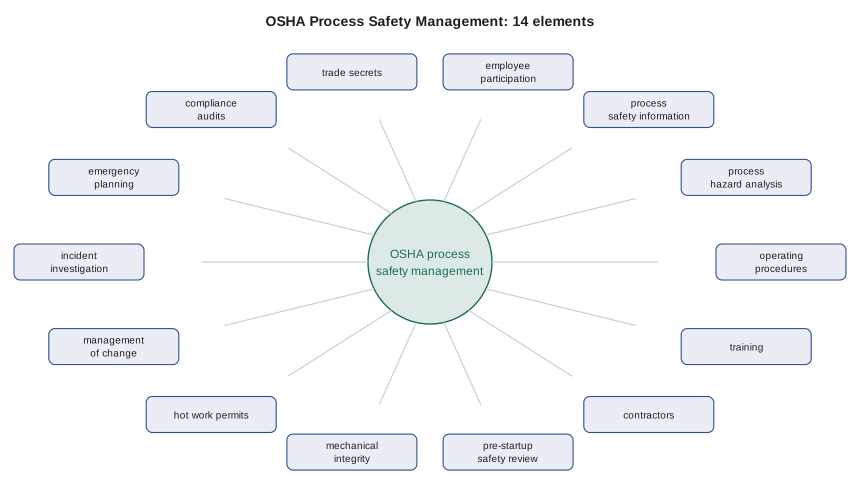
| OSHA PSM standard (1992) | US Occupational Safety and Health Administration, 29 CFR 1910.119 | 14 elements, legally required for covered processes |
| EPA Risk Management Program (1996) | US Environmental Protection Agency, 40 CFR Part 68 | Prevention program similar to OSHA PSM plus hazard assessment, emergency response and a public plan |
| CCPS Risk Based Process Safety (2007) | Center for Chemical Process Safety | 20 elements in four pillars, scaled to the level of risk |
| CSA Z767 (2017, revised 2024) | CSA Group, National Standard of Canada | A management system standard for PSM, voluntary unless adopted by law or contract |
| Seveso III and COMAH | European Union directive and UK regulations | Major accident prevention policies, safety reports, land-use planning |
CCPS's Risk Based Process Safety groups its 20 elements under four pillars: commit to process safety, understand hazards and risk, manage risk, and learn from experience. That structure is a useful way to see what any PSM system is trying to do, whichever legal framework applies.
| Pillar | Example elements |
|---|---|
| Commit to process safety | Process safety culture, compliance with standards, competence, workforce involvement, stakeholder outreach |
| Understand hazards and risk | Process knowledge management, hazard identification and risk analysis |
| Manage risk | Operating procedures, safe work practices, asset integrity, contractor management, training, management of change, operational readiness, conduct of operations, emergency management |
| Learn from experience | Incident investigation, measurement and metrics, auditing, management review and continuous improvement |
The law in the United States
In the United States, two federal rules require formal process safety management. OSHA's Process Safety Management of Highly Hazardous Chemicals standard (29 CFR 1910.119), adopted in 1992 under the Clean Air Act Amendments of 1990, protects workers at facilities with processes that contain listed highly hazardous chemicals above threshold quantities or 10,000 pounds or more of flammable liquids or gases in one location, with some exemptions such as retail facilities, oil and gas well drilling and servicing, and normally unoccupied remote facilities. EPA's Risk Management Program rule (40 CFR Part 68) protects the public and the environment at facilities holding listed toxic or flammable substances above threshold quantities.
OSHA PSM requires employers to compile process safety information, perform a process hazard analysis and revalidate it at least every five years, write and certify operating procedures, train workers with refresher training at least every three years, manage contractors, conduct pre-startup safety reviews, maintain mechanical integrity, control hot work, manage change, begin incident investigations within 48 hours, plan emergency response, audit compliance at least every three years and involve employees throughout. OSHA held stakeholder meetings in 2022 on possible updates to the standard, but no revised rule had been proposed at the time of writing.
EPA's Risk Management Program sorts covered processes into Program 1, 2 or 3 based on their accident history, potential offsite consequences and industry; Program 3, which covers many chemical plants and refineries, has a prevention program closely aligned with OSHA PSM. Facilities must submit a risk management plan to EPA and update it at least every five years. A 2024 rule, Safer Communities by Chemical Accident Prevention, added requirements such as safer technology and alternatives analysis for some sectors, third-party compliance audits after certain accidents, and more information for the public. In February 2026 EPA proposed to rescind or revise many of these additions; check the current status before relying on either version. States such as California, New Jersey and Delaware have their own process safety programs, and California's refinery PSM rule (2017) is among the most demanding.
Is my facility covered?
Coverage decisions start with an inventory of hazardous materials, compared with the thresholds in each applicable rule. The quantity that counts is usually the maximum intended inventory in a process, including connected vessels and interconnected piping, not the average amount on site. The example below uses a few US federal threshold quantities to show the logic; Canadian facilities follow the same steps using the substance lists and thresholds of the Environmental Emergency Regulations and any provincial rules.
# Checking a facility's maximum intended inventories against US federal threshold
# quantities (pounds) for OSHA PSM and EPA RMP. Simplified illustration only.
thresholds = {          # substance: (OSHA PSM TQ, EPA RMP TQ), lb
    "chlorine":           (1500, 2500),
    "anhydrous ammonia":  (10000, 10000),
    "flammable mixture":  (10000, 10000),
}
site = {                # maximum intended inventory in one process, lb
    "chlorine": 1800,
    "anhydrous ammonia": 6500,
    "flammable mixture": 42000,
}
for sub, qty in site.items():
    psm, rmp = thresholds[sub]
    print(f"{sub:<18} {qty:>6} lb | OSHA PSM: {'covered' if qty >= psm else 'not covered':<11} "
f"| EPA RMP: {'covered' if qty > rmp else 'not covered'}")chlorine 1800 lb | OSHA PSM: covered | EPA RMP: not covered anhydrous ammonia 6500 lb | OSHA PSM: not covered | EPA RMP: not covered flammable mixture 42000 lb | OSHA PSM: covered | EPA RMP: covered
In this illustration the chlorine process is covered by OSHA PSM but not by EPA RMP, the ammonia system is below both thresholds, and the flammable mixture is covered by both. Real coverage decisions involve exemptions, mixture rules and definitions that need careful reading of the regulations. Falling below a threshold does not mean the hazard can be ignored: the general duty clauses in both countries still apply, and the ammonia system in this example still needs good process safety practices.
Worked problem
Building a PSM gap list for a small plant
A small specialty chemical plant with one batch reactor and two solvent tanks has never had a formal PSM program. The new plant manager wants to know where to start. What should the first steps be?
Show solution
- Confirm which laws and standards apply by comparing maximum inventories with the thresholds in each rule, and record the result.
- Compile process safety information: chemical hazard data, process chemistry, safe operating limits, piping and instrumentation diagrams, relief system design basis, electrical classification.
- Carry out a process hazard analysis of the reactor and tank farm (Lesson 6).
- Compare existing practice with each PSM element, for example using CSA Z767 or the OSHA elements as a checklist, and list the gaps.
- Prioritize gaps by risk: a missing relief system design basis or untested trip comes before a formatting problem in a procedure.
- Assign owners and dates, and report progress to leadership regularly.
Answer: Start with applicability, process safety information and a hazard analysis, then do a structured gap assessment against a recognized PSM framework and close gaps in order of risk.
Making PSM real rather than paper
A common failure is a PSM system that exists mainly as binders and software records. Audits find every element documented, yet hazard analysis recommendations sit open for years, procedures do not match how the plant is run, and changes are approved by people who never look at the equipment. The CSB has found this pattern in many investigations. A working PSM system has a few signs: open actions are tracked and closed on time, operators help write and review procedures, management of change reviews include people who know the process, incidents and near misses are reported and investigated without blame, and leaders ask about process safety indicators as often as they ask about production.
Worked problem
Spotting paper compliance
An internal audit of a chemical plant finds that all 14 elements of the site's PSM program have written procedures and records. It also finds 63 process hazard analysis recommendations open, 22 of them more than two years old, and 9 temporary changes that passed their expiry dates without review. How should leadership read these results?
Show solution
- Recognize that documented procedures show the system exists, not that it works.
- Open recommendations represent known hazards without the agreed safeguards; old ones signal that the system accepts risk by default.
- Expired temporary changes mean modifications are in service without anyone confirming they are still safe, the pattern behind Flixborough.
- Treat these as leading indicators of a weak PSM system, set a plan to resolve or formally risk-accept each item, and track progress at management meetings.
Answer: The program is compliant on paper but weak in practice; leadership should act on the open recommendations and expired changes as a priority.
Making the system real
A management system is only as good as the way it is used. Auditors look for evidence that each element works in practice: a PHA that was revalidated on time with its recommendations closed, an MOC file that shows a real hazard review, training records that match the people actually doing the work, and inspection results that led to repairs. A useful habit is to pick one recent incident or near miss and trace it through the elements: which element should have prevented it, did that element work as written, and if not, why not. This turns the list of elements into a living system rather than a set of binders.
Common mistakes
MistakeAssuming no PSM program is needed in Canada because there is no federal PSM regulation.
InsteadApply CSA Z767 or the CSChE guide, provincial duties and sector rules; courts judge reasonableness against recognized practice.
MistakeUsing average inventory to decide coverage.
InsteadUse the maximum intended inventory in the process, including connected vessels and piping.
MistakeIgnoring hazards below regulatory thresholds.
InsteadRemember the general duty to protect workers and the public applies regardless of thresholds.
MistakeTreating PSM as a documentation exercise.
InsteadMeasure whether actions are closed, procedures are used and changes are reviewed properly.
MistakeRunning PSM elements separately.
InsteadConnect them: hazard analyses feed procedures and training; changes update information and drawings.
Summary and key terms
- Process safety management keeps hazards understood and safeguards working over the life of a facility.
- Major frameworks include the CCPS elements, CCPS Risk Based Process Safety, OSHA PSM, EPA RMP and CSA Z767.
- Risk Based Process Safety groups its elements into four pillars: commit, understand, manage and learn.
- In Canada, PSM obligations come from general duty clauses, sector regulators, CSA Z767, the CSChE guide and the Environmental Emergency Regulations.
- In the United States, OSHA PSM and EPA RMP require formal programs for covered processes above threshold quantities.
- Coverage depends on maximum intended inventory, but hazards below thresholds still need control.
- A working PSM system closes actions, uses current procedures and reviews changes properly, not just on paper.
- Process safety management
- A management system for preventing releases of hazardous materials and energy.
- Process safety information
- Documented data on chemicals, technology and equipment needed to manage process hazards.
- Process hazard analysis
- A systematic review of what could go wrong in a process and whether safeguards are adequate.
- Threshold quantity
- The inventory of a substance above which a regulation applies.
- Maximum intended inventory
- The largest amount of a substance that a process is designed or permitted to hold.
- Risk Based Process Safety
- A CCPS framework of 20 elements in four pillars, scaled to the level of risk.
- CSA Z767
- The Canadian national standard for process safety management.
- Risk management plan
- A document that EPA-covered facilities submit describing hazards, prevention and emergency response.
- Compliance audit
- A periodic check of whether PSM requirements are being met.
- General duty clause
- A legal requirement to protect workers or the public from recognized hazards, regardless of specific rules.
Practice problems
Work each problem on paper first, then reveal the answer to check.
Name four questions a PSM system answers.
Show answer
What are our hazards, do we have the information and procedures, are safeguards working, are changes controlled, do we learn, are we checking.
List the four pillars of Risk Based Process Safety.
Show answer
Commit to process safety, understand hazards and risk, manage risk, learn from experience.
What is CSA Z767?
Show answer
The National Standard of Canada for process safety management.
Name five elements of the OSHA PSM standard.
Show answer
Any five of employee participation, PSI, PHA, operating procedures, training, contractors, PSSR, mechanical integrity, hot work, MOC, incident investigation, emergency planning, compliance audits, trade secrets.
How often must an OSHA PSM process hazard analysis be revalidated?
Show answer
At least every five years.
Why use maximum intended inventory rather than average inventory?
Show answer
A release could involve the largest amount the process can hold.
A process has no regulated substance above threshold. Does it need process safety controls?
Show answer
Yes; general duty obligations and good practice still apply to its hazards.
What are Canadian Environmental Emergency Regulations plans for?
Show answer
Preparing for, testing and exercising responses to releases of listed substances above thresholds.
What did the 2024 EPA RMP rule add, and what happened in 2026?
Show answer
Safer technology analysis, third-party audits and more public information; EPA proposed rolling back many of these in February 2026.
Give two signs that a PSM program is only on paper.
Show answer
Long-open hazard analysis actions, expired temporary changes, procedures that do not match practice, changes approved without site knowledge.
Lesson quiz · 5 questions
Score 60% or more to complete this lesson.
Create a free account to save your progress, take quizzes and earn a certificate.