
HSE-311 · Lesson 4 of 12 · 27 min
Fires, explosions and toxic releases
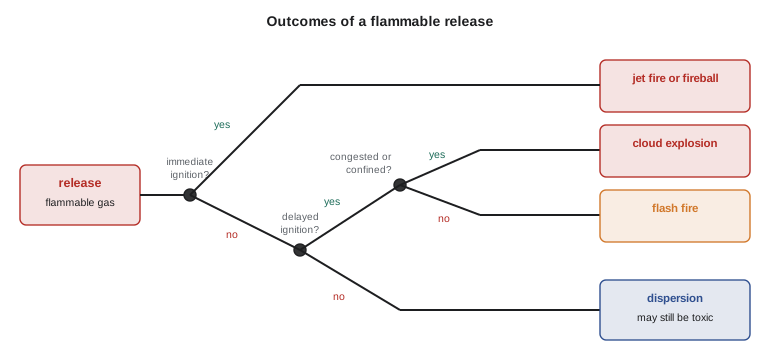
When containment is lost, what happens next depends on the material, the amount, the conditions of the release, the weather and whether and when the material finds an ignition source. The same leak of propane might disperse harmlessly, burn as a jet fire at the leak, flash back through a drifting cloud or explode with enough force to destroy buildings. Process safety engineers call the study of these outcomes consequence analysis. This lesson explains the main types of fire, explosion and toxic release, introduces the simple models used to estimate their effects, and shows how the results are used to site buildings and plan emergencies. The calculations here are simplified teaching versions; real studies use validated software and expert judgment.
From leak to outcome
A release first has to get out. Liquids under pressure come out as a jet and may partly flash to vapor; gases come out at high speed; volatile liquids form a pool that evaporates. Then the material either ignites quickly, ignites later after a cloud has formed, or does not ignite at all. An event tree lays out these branches. Lesson 7 uses event trees to estimate how often each outcome occurs; here we focus on what each outcome looks like.
Fires
| Fire type | How it happens | Main hazard |
|---|---|---|
| Pool fire | Liquid spills into a pool that burns | Thermal radiation, smoke, spread through drains |
| Jet fire | Pressurized gas or liquid ignites at the leak | Very high heat flux on anything it hits; can weaken steel in minutes |
| Flash fire | A drifting vapor cloud ignites and burns back without significant overpressure | People inside the cloud are burned; brief duration |
| Fireball | A large mass of fuel ignites at once, often after vessel failure | Intense radiation for seconds over a wide area |
| BLEVE | A pressure vessel of liquefied gas fails after being heated by fire | Fireball, blast and flying fragments of the vessel |
The effect of a fire on people and equipment depends mainly on the thermal radiation they receive, measured in kilowatts per square meter. Sunlight on a bright summer day is about 1 kW/m². The table gives approximate effects used in consequence studies.
| Heat flux (kW/m²) | Approximate effect |
|---|---|
| 1.6 | No discomfort even for long exposure |
| 4 to 5 | Pain within about 20 seconds; blistering possible; common limit for emergency responders in protective clothing for short periods |
| 12.5 | Wood can ignite with a pilot flame; significant chance of fatality for exposures of a minute |
| 25 | Unprotected steel may fail with long exposure; high chance of fatality |
| 37.5 | Damage to process equipment; near-certain fatality |
A simple way to estimate radiation from a fire at a distance is the point source model. It treats the fire as a single point radiating a fraction of its total heat release equally in all directions. It works reasonably well at distances several times larger than the flame size.
import math
# Point source model for radiation from a pool fire (illustrative).
burn_rate = 0.06          # kg/(m2 s), typical for hydrocarbon pools
area = 50.0               # pool area, m2
dHc = 43e6                # heat of combustion, J/kg
Xr = 0.30                 # fraction of heat radiated
tau = 0.8                 # atmospheric transmissivity
Q = burn_rate * area * dHc          # total heat release, W
print(f"Total heat release: {Q / 1e6:.0f} MW")
for R in (15, 25, 40, 60, 90):
    q = tau * Xr * Q / (4 * math.pi * R**2) / 1000   # kW/m2
print(f"distance {R:>3} m ({R * 3.281:4.0f} ft): {q:5.1f} kW/m2")Total heat release: 129 MW distance 15 m ( 49 ft): 10.9 kW/m2 distance 25 m ( 82 ft): 3.9 kW/m2 distance 40 m ( 131 ft): 1.5 kW/m2 distance 60 m ( 197 ft): 0.7 kW/m2 distance 90 m ( 295 ft): 0.3 kW/m2
The results show why radiation drops quickly with distance: doubling the distance cuts the heat flux to a quarter. At 15 m from this 50 m² pool fire the heat flux is nearly 11 kW/m², enough to cause severe burns within seconds. At 25 m it is about 4 kW/m², painful within about 20 seconds, so people must move away quickly. Beyond about 40 m it falls below 1.6 kW/m², where even long exposure causes no discomfort. Fire protection designers use results like these to set spacing between tanks and to decide where firefighting water monitors and deluge systems are needed.
Explosions
An explosion is a sudden release of energy that produces a pressure wave. Process plants face several kinds.
| Explosion type | Mechanism | Example |
|---|---|---|
| Vapor cloud explosion | Flame accelerates through a flammable cloud in a congested or confined area | Flixborough 1974, Buncefield 2005 |
| Confined explosion | Flammable mixture ignites inside a vessel, building or duct | Explosion in a solvent tank or dryer |
| Physical explosion | Vessel bursts from overpressure without combustion | Boiler or gas cylinder rupture |
| BLEVE | Heated liquefied gas vessel fails and the liquid flashes | Propane tank engulfed by fire |
| Condensed-phase explosion | Detonation of an unstable solid or liquid | Ammonium nitrate at West, Texas and Beirut |
| Dust explosion | Fine combustible dust suspended in air ignites | Sugar refinery, grain elevator (see HSE-313) |
The damage from an explosion is described by its peak overpressure: how far the pressure in the blast wave rises above atmospheric pressure. Small overpressures break windows; larger ones collapse buildings. Many people are injured not by the blast itself but by flying glass and collapsing structures.
| Overpressure | Approximate effect |
|---|---|
| 1 kPa (0.15 psi) | Breakage of some windows |
| 3.5 to 7 kPa (0.5 to 1 psi) | Widespread window breakage; injuries from flying glass |
| 7 to 14 kPa (1 to 2 psi) | Partial collapse of walls and roofs of houses; typical endpoint for offsite planning |
| 20 to 35 kPa (3 to 5 psi) | Serious damage to steel-frame buildings; serious injuries likely |
| above 70 kPa (10 psi) | Total destruction of most buildings; high chance of fatality |
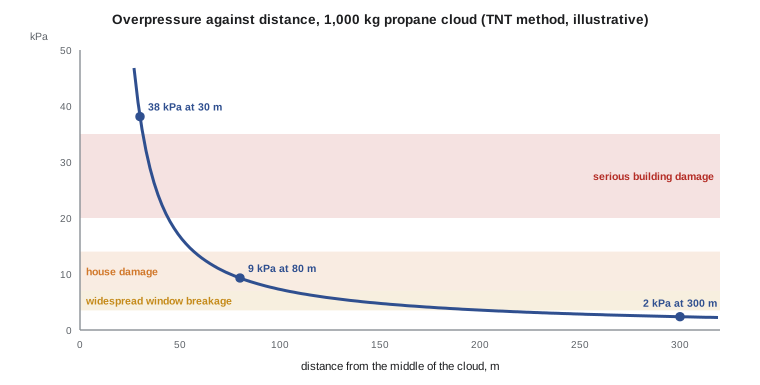
One simple and widely taught way to estimate overpressure from a vapor cloud explosion is the TNT equivalence method. It converts the combustion energy of the fuel in the cloud into an equivalent mass of TNT, using an explosion efficiency that is usually only a few percent, because most of the cloud burns without contributing to the blast. Distances are then scaled by the cube root of the TNT mass, a rule known as Hopkinson scaling: two explosions produce the same overpressure at the same scaled distance.
# TNT equivalence and Hopkinson scaling for a cloud explosion (VCE), illustrative.
# Overpressure from an approximate free-air TNT correlation (Mills, 1987), kPa.
def overpressure_kpa(Z):            # Z in m/kg^(1/3)
    return 1772 / Z**3 - 114 / Z**2 + 108 / Z

m = 1000          # kg of propane in the flammable cloud
dHc = 46e6        # J/kg
eta = 0.03        # explosion efficiency (3 percent)
E_tnt = 4.6e6     # J/kg
W = eta * m * dHc / E_tnt
print(f"TNT equivalent: {W:.0f} kg")
for R in (30, 50, 80, 120, 200, 300):
    Z = R / W ** (1 / 3)
    p = overpressure_kpa(Z)
print(f"R = {R:>3} m: Z = {Z:5.1f}, overpressure about {p:5.1f} kPa ({p / 6.895:4.2f} psi)")TNT equivalent: 300 kg R = 30 m: Z = 4.5, overpressure about 38.1 kPa (5.53 psi) R = 50 m: Z = 7.5, overpressure about 16.7 kPa (2.42 psi) R = 80 m: Z = 12.0, overpressure about 9.3 kPa (1.35 psi) R = 120 m: Z = 17.9, overpressure about 6.0 kPa (0.87 psi) R = 200 m: Z = 29.9, overpressure about 3.6 kPa (0.52 psi) R = 300 m: Z = 44.8, overpressure about 2.4 kPa (0.34 psi)
The TNT method is crude. It ignores the fact that vapor cloud explosions are much more severe in congested areas full of pipes and equipment, where turbulence accelerates the flame, and weaker in open areas. Modern studies use methods that account for congestion and confinement, such as the multi-energy and Baker-Strehlow-Tang methods, or computational fluid dynamics. The simple method still shows the main point: hundreds of meters around a large release can see overpressures that break windows and injure people.
Toxic releases
A toxic gas released into the air forms a plume or cloud that moves with the wind and spreads out as it travels. How far a harmful concentration reaches depends on the release rate, the wind speed, the atmospheric stability and the toxicity of the gas. Stable conditions, which usually occur on clear nights with light winds, let a cloud travel much farther before it dilutes. Gases heavier than air, such as chlorine and cold ammonia, hug the ground and flow into low areas.
A classic teaching model is the Gaussian plume, which assumes the concentration across the plume follows a bell-shaped curve that widens with distance. For a continuous release at ground level, the concentration on the plume centerline at ground level is given below. The spread parameters σy and σz grow with distance and depend on atmospheric stability; correlations published by Briggs are often used.
import math
# Ground-level centreline concentration for a continuous ground-level release
# (Gaussian plume, Briggs rural coefficients). Teaching example, not for design.
def sig(x, cls):
    if cls == "D":   # neutral
        return 0.08 * x / math.sqrt(1 + 0.0001 * x), 0.06 * x / math.sqrt(1 + 0.0015 * x)
    if cls == "F":   # very stable
        return 0.04 * x / math.sqrt(1 + 0.0001 * x), 0.016 * x / (1 + 0.0003 * x)

m_dot = 1.0                          # kg/s of chlorine
target = 3 * 70.9 / 24.45            # ERPG-2 of 3 ppm in mg/m3
for cls, u in (("D", 5.0), ("F", 2.0)):
    print(f"Stability {cls}, wind {u} m/s:")
    for x in (200, 500, 1000, 2000, 5000):
        sy, sz = sig(x, cls)
        c = m_dot * 1e6 / (math.pi * sy * sz * u)      # mg/m3
        flag = "above" if c > target else "below"
print(f" {x:>5} m: {c:9.1f} mg/m3 ({flag} ERPG-2 of {target:.1f} mg/m3)")Stability D, wind 5.0 m/s:
200 m: 381.8 mg/m3 (above ERPG-2 of 8.7 mg/m3)
500 m: 71.9 mg/m3 (above ERPG-2 of 8.7 mg/m3)
1000 m: 22.0 mg/m3 (above ERPG-2 of 8.7 mg/m3)
2000 m: 7.3 mg/m3 (below ERPG-2 of 8.7 mg/m3)
5000 m: 1.9 mg/m3 (below ERPG-2 of 8.7 mg/m3)
Stability F, wind 2.0 m/s:
200 m: 6655.6 mg/m3 (above ERPG-2 of 8.7 mg/m3)
500 m: 1172.2 mg/m3 (above ERPG-2 of 8.7 mg/m3)
1000 m: 339.1 mg/m3 (above ERPG-2 of 8.7 mg/m3)
2000 m: 109.0 mg/m3 (above ERPG-2 of 8.7 mg/m3)
5000 m: 30.5 mg/m3 (above ERPG-2 of 8.7 mg/m3)Even this simple model shows two important points. First, a release of 1 kg/s of chlorine exceeds ERPG-2 out to about 2 km in neutral, breezy conditions and beyond 5 km in very stable conditions. Second, stable night-time conditions with light winds give much higher concentrations at every distance than a breezy afternoon. Real planning uses dense-gas models and tools such as ALOHA, developed by the US EPA and NOAA, or commercial software, and considers the duration of exposure. Emergency plans use the results to decide shelter-in-place zones and evacuation areas.
Using consequence results
Consequence results are used to decide where buildings and people can be, how far apart equipment should be, and what the emergency plan must cover. After Texas City, the American Petroleum Institute strengthened API RP 752 on permanent buildings and introduced API RP 753 on portable buildings such as trailers, which require siting studies for buildings occupied near process units. Under the EPA Risk Management Program (40 CFR Part 68), covered facilities must perform offsite consequence analyses for worst-case and alternative release scenarios, using defined endpoints: an overpressure of 1 psi (6.9 kPa), a radiation dose equivalent to 5 kW/m² for 40 seconds, and toxic endpoints listed in the rule, which for many substances are based on ERPG-2 values.
Worked problem
Siting a temporary office trailer
A maintenance contractor wants to place a temporary office trailer 60 m from a unit that handles about 1,000 kg of propane inventory in congested pipework. Using the illustrative TNT calculation above, should the trailer be allowed there?
Show solution
- Find the estimated overpressure at 60 m: between the 50 m and 80 m results, roughly 13 kPa (about 2 psi).
- Compare with the effects table: 7 to 14 kPa can cause partial collapse of lightweight structures, and trailers are especially vulnerable.
- Recall Texas City, where most of the dead were in trailers close to the unit.
- Because the area is congested, the real overpressure could be higher than the simple TNT estimate.
- Move the trailer well outside the zone where overpressure exceeds about 3.5 to 7 kPa, or use a blast-resistant module, and confirm with a proper siting study.
Answer: No. Locate the trailer farther away, outside the blast and fire zones identified by a siting study, or use a purpose-built blast-resistant module.
Common mistakes
MistakeAssuming a leak that does not ignite at once is safe.
InsteadDelayed ignition of a drifting cloud can cause flash fires and explosions far from the leak.
MistakeTreating vapor clouds in open air as unable to explode.
InsteadCongestion from pipes, equipment and vegetation can produce damaging overpressure, as Buncefield showed.
MistakePlacing temporary trailers wherever there is space.
InsteadSite occupied buildings using consequence or siting studies, away from fire and blast zones.
MistakePlanning toxic release response for daytime weather only.
InsteadConsider stable night-time conditions, which carry harmful concentrations much farther.
MistakeUsing simple textbook models for final design decisions.
InsteadUse them for understanding, and validated tools and experts for design and siting.
Summary and key terms
- The outcome of a release depends on the material, amount, release conditions, weather and timing of ignition.
- Fires include pool fires, jet fires, flash fires, fireballs and BLEVEs; their effects depend on thermal radiation.
- Radiation from a fire falls with the square of distance in the point source model.
- Explosions are described by peak overpressure; flying glass and building collapse cause many injuries.
- TNT equivalence and Hopkinson scaling give rough estimates of vapor cloud explosion overpressure.
- Toxic plumes travel farther in stable, light-wind conditions; dense gases hug the ground.
- Consequence results guide building siting, equipment spacing and emergency planning.
- Consequence analysis
- Estimating the effects of fires, explosions and toxic releases.
- Pool fire
- A fire burning above a pool of spilled flammable liquid.
- Jet fire
- A fire fed by a pressurized release burning at the leak point.
- Flash fire
- Rapid burning of a vapor cloud without significant overpressure.
- BLEVE
- Boiling liquid expanding vapor explosion; failure of a heated vessel of liquefied gas.
- Vapor cloud explosion
- An explosion caused by ignition of a flammable vapor cloud, worsened by congestion.
- Overpressure
- The rise in pressure above atmospheric in a blast wave.
- TNT equivalence
- Expressing the blast effect of an explosion as an equivalent mass of TNT.
- Atmospheric stability
- How strongly the atmosphere suppresses vertical mixing; stable conditions keep plumes concentrated.
- Siting study
- An assessment of whether occupied buildings are safe from fire, blast and toxic hazards.
Practice problems
Work each problem on paper first, then reveal the answer to check.
Name three possible outcomes of a flammable gas release.
Show answer
Jet fire, flash fire, vapor cloud explosion, fireball or harmless dispersion.
Why can a jet fire be especially damaging to equipment?
Show answer
It produces very high heat flux on what it strikes and can weaken steel within minutes.
A pool fire gives 8 kW/m² at 20 m. Estimate the heat flux at 40 m using the point source model.
Show answer
About 2 kW/m², a quarter of the value at half the distance.
What causes most injuries from explosion overpressure in buildings?
Show answer
Flying glass and collapse of structures.
Why is the TNT method only a rough estimate for vapor cloud explosions?
Show answer
It ignores the strong effect of congestion and confinement on flame acceleration.
Calculate the TNT equivalent of 500 kg of propane with 3 percent efficiency.
Show answer
0.03 × 500 × 46 / 4.6 = 150 kg TNT.
If one explosion has four times the TNT mass of another, at what distance does it give the same overpressure as the smaller one at 100 m?
Show answer
100 × 4^(1/3) ≈ 159 m.
Why are night-time releases often more dangerous for toxic gases?
Show answer
Stable conditions and light winds limit mixing, so concentrations stay high farther downwind.
What did API RP 753 add after Texas City?
Show answer
Guidance on siting portable buildings such as trailers near process units.
What is a BLEVE?
Show answer
The failure of a vessel of liquefied gas heated by fire, producing a fireball, blast and fragments.
Lesson quiz · 5 questions
Score 60% or more to complete this lesson.
Create a free account to save your progress, take quizzes and earn a certificate.