
HSE-311 · Lesson 3 of 12 · 28 min
Hazards of process materials: flammability, reactivity and toxicity
Process safety starts with understanding the materials. A plant that handles a flammable solvent needs different safeguards from one that handles a toxic gas or a chemical that can react violently when it gets too hot. Most process hazards fall into three groups: materials that burn, materials that react, and materials that poison. This lesson explains the properties that matter in each group, how they are measured, and how to use them in simple calculations. HSE-102 covered labels and safety data sheets; here we look at the numbers behind them and what they mean for a process.
Where the information comes from
The first source is the safety data sheet (SDS), especially sections 2 (hazard identification), 9 (physical and chemical properties), 10 (stability and reactivity) and 11 (toxicological information). For process work, the SDS is a starting point rather than the whole story. Process conditions are often hotter, more concentrated or under higher pressure than the conditions the SDS describes, and mixtures can behave differently from pure substances. Process safety information also includes reaction data from calorimetry testing, the maximum intended inventory, and the safe upper and lower limits for temperature, pressure, flow and composition. Lesson 5 explains how process safety management rules require this information to be compiled and kept up to date.
Flammability
A flammable liquid does not burn as a liquid. It evaporates, and the vapor mixes with air. If the mixture is within the flammable range and meets an ignition source, it burns. Several properties describe how easily this happens.
| Property | Meaning | Why it matters |
|---|---|---|
| Flash point | Lowest liquid temperature at which the vapor can be ignited above the liquid | Below the flash point, a liquid gives off too little vapor to burn |
| Lower flammable limit (LFL) | Lowest vapor concentration in air that can burn | Gas detectors alarm at a fraction of the LFL |
| Upper flammable limit (UFL) | Highest concentration that can burn | Above it, the mixture is too rich, but dilution with air brings it back into range |
| Autoignition temperature | Temperature at which the mixture ignites without a spark or flame | Hot surfaces such as steam lines and exhausts can ignite vapor |
| Minimum ignition energy | Smallest spark energy that can ignite the mixture | Hydrogen and some solvents can be ignited by static discharge |
| Vapor density | Weight of the vapor relative to air | Heavy vapors flow along the ground and collect in pits and trenches |
| Material | Flash point (°C) | LFL (% vol) | UFL (% vol) | Autoignition (°C) |
|---|---|---|---|---|
| Hydrogen | gas | 4.0 | 75 | 500 (approx.) |
| Methane | gas | 5.0 | 15 | 540 (approx.) |
| Propane | gas | 2.1 | 9.5 | 450 (approx.) |
| Acetone | −20 | 2.5 | 12.8 | 465 (approx.) |
| Toluene | 4 | 1.1 | 7.1 | 480 (approx.) |
| Methanol | 11 | 6.0 | 36 | 440 (approx.) |
| Ammonia | gas | 15 | 28 | 650 (approx.) |
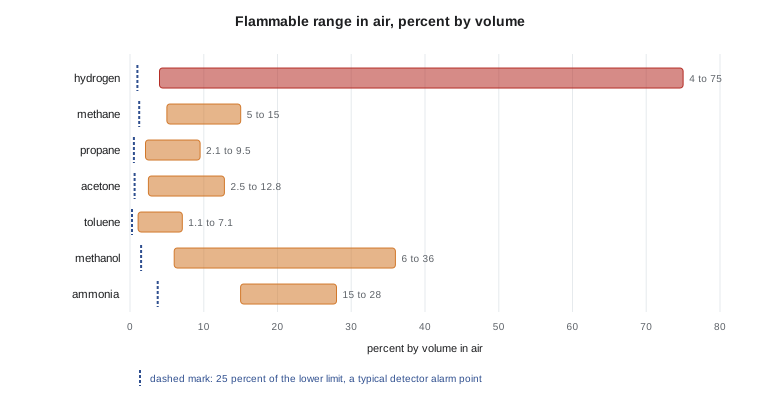
Two features make a material especially hazardous. A low lower flammable limit means that a small leak is enough to create a burnable mixture: toluene can burn at just over 1 percent in air. A wide flammable range, as hydrogen has, means that a release can burn over a wide range of concentrations as it disperses. Gas detectors in process areas are usually set to alarm at 10 to 25 percent of the LFL, so that people have time to act before the mixture can burn.
In the United States, OSHA's flammable liquids standard (29 CFR 1910.106) uses the GHS categories adopted in the Hazard Communication Standard: Category 1 for flash points below 23 °C (73.4 °F) with an initial boiling point at or below 35 °C (95 °F), Category 2 for flash points below 23 °C with a higher boiling point, Category 3 for 23 to 60 °C (140 °F) and Category 4 for 60 to 93 °C (199.4 °F). Fire codes based on NFPA 30 still use the older Class I, II and III system for storage quantities and building design.
Mixtures: Le Chatelier's rule
Process streams are often mixtures of flammable gases or vapors. The lower flammable limit of a mixture can be estimated with Le Chatelier's rule, which combines the limits of the components weighted by their share of the flammable part of the mixture.
Here each y is the percentage of a component in the flammable part of the mixture, so the y values add up to 100. The same form gives an estimate of the upper limit using the UFL values. The rule works well for similar hydrocarbons and less well for mixtures containing hydrogen or for very different compounds, so it is an estimate rather than a design value.
# Lower and upper flammable limits of a fuel gas mixture by Le Chatelier's rule.
mix = {            # percent of flammable gas, LFL %, UFL %
    "methane": (50, 5.0, 15.0),
    "ethane":  (30, 3.0, 12.4),
    "propane": (20, 2.1, 9.5),
}
assert sum(v[0] for v in mix.values()) == 100
lfl = 100 / sum(y / L for y, L, U in mix.values())
ufl = 100 / sum(y / U for y, L, U in mix.values())
print(f"Estimated LFL of mixture: {lfl:.2f} % by volume")
print(f"Estimated UFL of mixture: {ufl:.2f} % by volume")
print(f"25 % of LFL detector alarm point: {0.25 * lfl:.2f} % by volume ({0.25 * lfl * 10_000:.0f} ppm)")Estimated LFL of mixture: 3.39 % by volume Estimated UFL of mixture: 12.73 % by volume 25 % of LFL detector alarm point: 0.85 % by volume (8468 ppm)
Oxygen: the other side of the fire triangle
A fire needs fuel, oxygen and an ignition source. Process plants often control the oxygen side by blanketing tanks and reactors with nitrogen. For each fuel there is a minimum oxygen concentration (MOC), sometimes called the limiting oxygen concentration, below which a flame cannot spread whatever the fuel concentration. A rough estimate is the LFL multiplied by the number of moles of oxygen needed to burn one mole of fuel. For propane, which needs 5 moles of oxygen, the estimate is about 2.1 × 5 ≈ 10.5 percent oxygen; measured values are a little higher, around 11 to 12 percent. Inerting systems usually keep oxygen several percentage points below the MOC to leave a safety margin. Inerting has its own hazard: nitrogen is an asphyxiant, and entering an inerted vessel without breathing air has killed many workers (HSE-211 covers confined space entry).
Worked problem
Estimating the MOC and choosing an inerting target
A reactor handles toluene vapor. Toluene (C₇H₈) burns according to C₇H₈ + 9 O₂ → 7 CO₂ + 4 H₂O, and its LFL is about 1.1 percent. Estimate the MOC and suggest an oxygen limit for the nitrogen blanket.
Show solution
- Moles of oxygen per mole of fuel: 9.
- Estimated MOC ≈ LFL × 9 = 1.1 × 9 ≈ 9.9 percent oxygen.
- Measured values for many hydrocarbons are a little above this simple estimate, so the estimate is on the cautious side.
- A common practice is to control at least 2 to 4 percentage points below the MOC; for example, an alarm at 6 percent oxygen and a target of 5 percent or less, confirmed with oxygen analyzers.
Answer: The MOC is roughly 10 percent oxygen; a nitrogen blanket controlled at about 5 percent oxygen with an alarm at 6 percent leaves a reasonable margin.
Reactivity
Reactive hazards are chemical reactions that release energy or gas faster than the process can handle. They include runaway reactions in reactors, decomposition of unstable chemicals, polymerization of monomers, reactions with water or air, and reactions between incompatible materials mixed by mistake. Reactive chemical incidents are a large share of serious process accidents. The CSB studied 167 reactive incidents in the United States over two decades and found that many involved materials that were not covered by process safety management rules at the time.
Most reaction rates increase rapidly with temperature. A familiar rule of thumb is that the rate roughly doubles for each 10 °C rise. The exact factor depends on the activation energy and can be estimated with the Arrhenius equation. Because heat release grows exponentially with temperature while cooling grows only in proportion to the temperature difference, there is a point beyond which the cooling system cannot keep up. Above that point the temperature climbs faster and faster: a thermal runaway.
Another key number is the adiabatic temperature rise: how much the reaction mass would heat up if all the reactant reacted with no cooling at all. If that rise would take the mixture above its boiling point or above the temperature where a dangerous secondary decomposition begins, the reactor depends entirely on its cooling and protection systems.
import math
# Rate increase with temperature (Arrhenius) and adiabatic temperature rise.
R = 8.314                     # J/(mol K)
Ea = 80_000                   # activation energy, J/mol (illustrative)
T1 = 60 + 273.15
for dT in (10, 20, 30):
    T2 = T1 + dT
    ratio = math.exp(Ea / R * (1 / T1 - 1 / T2))
    print(f"{dT:>2} C hotter -> reaction about {ratio:4.1f} times faster")

dH = -120_000                 # heat of reaction, J/mol (exothermic)
C = 2_000                     # reactant concentration, mol/m3
rho, cp = 900, 2_000          # kg/m3, J/(kg K)
dT_ad = (-dH) * C / (rho * cp)
print(f"Adiabatic temperature rise: {dT_ad:.0f} K")
T_proc, T_boil = 60, 111      # process temperature and solvent boiling point, C
print(f"Maximum temperature of the synthesis reaction: {T_proc + dT_ad:.0f} C "
f"(solvent boils at {T_boil} C)")10 C hotter -> reaction about 2.3 times faster 20 C hotter -> reaction about 5.1 times faster 30 C hotter -> reaction about 10.9 times faster Adiabatic temperature rise: 133 K Maximum temperature of the synthesis reaction: 193 C (solvent boils at 111 C)
In this illustrative case, losing cooling would let the batch heat up by more than 130 °C, well past the solvent's boiling point. The pressure would rise, and if a secondary decomposition starts at those temperatures, the situation could escalate. A reactor like this needs reliable cooling, a high-temperature trip that stops the feed, a way to stop the reaction (for example, a quench or inhibitor), and an emergency relief system sized for the runaway case. Reaction calorimetry testing gives the real numbers.
| Reactive hazard | Examples | Typical safeguards |
|---|---|---|
| Exothermic runaway | Nitrations, polymerizations, batch reactions with accumulated reactant | Controlled dosing, cooling, high-temperature trips, quench, relief |
| Thermal decomposition | Organic peroxides, some nitro compounds, ammonium nitrate in fires | Temperature control, storage limits, separation distances |
| Water reactivity | Methyl isocyanate, oleum, sodium, some chlorides | Keep water out, dry inert gas, segregation |
| Air reactivity | Pyrophoric materials such as some metal alkyls and iron sulfide scale | Inert handling, wetting during maintenance |
| Incompatible mixing | Acid into cyanide or hypochlorite; oxidizer with fuel | Dedicated connections, labeling, segregation, compatibility charts |
| Polymerization | Styrene, acrylic acid, vinyl monomers | Inhibitor levels, temperature limits, oxygen management for some inhibitors |
Simple tools help identify incompatible combinations before they meet. The free Chemical Reactivity Worksheet, part of the CAMEO software developed by the US Environmental Protection Agency and the National Oceanic and Atmospheric Administration, predicts hazards when pairs of chemicals are mixed. Many plants build a compatibility matrix for every material on site and use it when assigning tanks, hoses and waste drums. HSE-312 covers chemical storage and segregation in more detail.
Toxicity
Toxic process materials can harm people at concentrations far below their flammable limits. For process safety, the concern is usually short, high exposures during a release rather than the long, low exposures covered by workplace exposure limits. Several sets of guideline values describe short-term toxic effects.
| Guideline | Purpose | Example: ammonia | Example: chlorine |
|---|---|---|---|
| Workplace exposure limit (8-hour) | Protects workers over a working lifetime | 25 ppm (TWA, approx.) | 0.1 to 0.5 ppm (varies by jurisdiction) |
| IDLH (NIOSH) | Concentration from which escape within 30 minutes must be possible | 300 ppm | 10 ppm |
| ERPG-2 (AIHA) | Up to 1 hour without serious or irreversible effects | 150 ppm | 3 ppm |
| ERPG-3 (AIHA) | Up to 1 hour without life-threatening effects | 750 ppm | 20 ppm |
| AEGL (US EPA program) | Thresholds for 10 minutes to 8 hours for public emergency planning | Several values by duration | Several values by duration |
Concentrations in air are given either in parts per million by volume or in milligrams per cubic meter. At 25 °C and normal atmospheric pressure, one mole of gas occupies about 24.45 liters, which gives a simple conversion.
# Converting ppm to mg/m3 at 25 C and 1 atm, and comparing with guideline values.
gases = {   # molar mass g/mol, ERPG-2 ppm, IDLH ppm (approximate values)
    "ammonia":           (17.03, 150, 300),
    "chlorine":          (70.90, 3, 10),
    "hydrogen sulfide":  (34.08, 30, 100),
}
for name, (M, erpg2, idlh) in gases.items():
    f = M / 24.45
    print(f"{name:<17} ERPG-2 {erpg2:>4} ppm = {erpg2 * f:7.1f} mg/m3 | "
f"IDLH {idlh:>4} ppm = {idlh * f:7.1f} mg/m3")ammonia ERPG-2 150 ppm = 104.5 mg/m3 | IDLH 300 ppm = 209.0 mg/m3 chlorine ERPG-2 3 ppm = 8.7 mg/m3 | IDLH 10 ppm = 29.0 mg/m3 hydrogen sulfide ERPG-2 30 ppm = 41.8 mg/m3 | IDLH 100 ppm = 139.4 mg/m3
Chlorine is about 50 times more toxic than ammonia by these measures, which is why a small chlorine leak at a water treatment plant can be as serious as a much larger ammonia leak. Toxic materials also differ in warning properties: ammonia is irritating at low concentrations and people move away, while hydrogen sulfide deadens the sense of smell at dangerous levels (HSE-244 covers hydrogen sulfide). Lesson 4 shows how these guideline values are used to estimate how far a toxic cloud could travel.
Inventory: how much is too much?
The amount of hazardous material on site matters as much as its properties. A 1-liter bottle of chlorine water is a laboratory chemical; a 1-metric ton chlorine container is a major hazard. Process safety laws use threshold quantities to decide which sites must have a formal program (Lesson 5), and inherently safer design starts by asking whether the inventory can be reduced. Bhopal stored tens of metric tons of methyl isocyanate that could have been made and used continuously in much smaller amounts.
Common mistakes
MistakeRelying only on the SDS for process hazards.
InsteadAdd process conditions, reaction calorimetry data and mixture behavior to the process safety information.
MistakeAssuming a liquid below its boiling point is safe from fire.
InsteadCheck the flash point; many solvents give off burnable vapor well below room temperature.
MistakeTreating a mixture above its UFL as safe.
InsteadRemember that leaks dilute with air and pass back through the flammable range.
MistakeUsing workplace exposure limits to plan for a toxic release.
InsteadUse short-term guidelines such as IDLH, ERPG and AEGL for emergency planning.
MistakeEntering a nitrogen-blanketed vessel because it cannot burn.
InsteadTreat inerted vessels as oxygen-deficient confined spaces that can kill in seconds.
Summary and key terms
- Process hazards fall mainly into flammability, reactivity and toxicity, and inventory multiplies all three.
- Flash point, flammable limits, autoignition temperature and minimum ignition energy describe how easily a material burns.
- Le Chatelier's rule estimates the flammable limits of gas and vapor mixtures.
- Inerting keeps oxygen below the minimum oxygen concentration, but creates an asphyxiation hazard.
- Reaction rates rise steeply with temperature, so loss of cooling can lead to thermal runaway.
- The adiabatic temperature rise shows how far a reaction could heat up with no cooling.
- Short-term toxicity guidelines such as IDLH and ERPG are used to plan for toxic releases.
- Flash point
- The lowest liquid temperature at which its vapor can be ignited.
- Lower flammable limit
- The lowest concentration of a gas or vapor in air that can burn.
- Upper flammable limit
- The highest concentration of a gas or vapor in air that can burn.
- Autoignition temperature
- The temperature at which a mixture ignites without a spark or flame.
- Minimum oxygen concentration
- The oxygen level below which a flame cannot spread in a fuel mixture.
- Inerting
- Replacing air with an inert gas such as nitrogen to keep oxygen below the MOC.
- Thermal runaway
- A reaction that heats up faster than it can be cooled, so temperature rises out of control.
- Adiabatic temperature rise
- The temperature increase if a reaction runs to completion with no heat removal.
- ERPG
- Emergency Response Planning Guideline values for one-hour exposures, published by AIHA.
- IDLH
- Immediately dangerous to life or health; a NIOSH concentration from which escape must be possible within 30 minutes.
Practice problems
Work each problem on paper first, then reveal the answer to check.
Why can toluene be a fire hazard at room temperature?
Show answer
Its flash point is about 4 °C, so it gives off enough vapor to burn at normal temperatures.
A gas has an LFL of 2 percent. At what concentration would a 20 percent LFL alarm activate?
Show answer
0.4 percent by volume, or 4,000 ppm.
Estimate the LFL of a mixture of 60 percent methane (LFL 5.0) and 40 percent propane (LFL 2.1).
Show answer
100 / (60/5.0 + 40/2.1) = 100 / (12 + 19.05) ≈ 3.2 percent.
Estimate the MOC of methane, which needs 2 moles of oxygen per mole and has an LFL of 5 percent.
Show answer
About 5 × 2 = 10 percent oxygen; measured values are near 12 percent.
What creates a thermal runaway?
Show answer
Heat generation rises exponentially with temperature while cooling rises only linearly, so beyond a point cooling cannot keep up.
A reaction has an adiabatic temperature rise of 40 K and runs at 50 °C. The solvent boils at 110 °C. Is boiling possible on loss of cooling?
Show answer
No; the maximum is about 90 °C, although secondary reactions should still be checked.
Convert 10 ppm of chlorine (M = 70.9) to mg/m³.
Show answer
10 × 70.9 / 24.45 ≈ 29 mg/m³.
Why is an 8-hour exposure limit unsuitable for release planning?
Show answer
Releases cause short, high exposures; short-term guidelines such as ERPG and AEGL apply.
Name two kinds of reactive hazard.
Show answer
Runaway reactions, decomposition, water reactivity, air reactivity, incompatible mixing, polymerization.
Why does inventory matter?
Show answer
The amount released sets the size of the possible fire, explosion or toxic cloud.
Lesson quiz · 5 questions
Score 60% or more to complete this lesson.
Create a free account to save your progress, take quizzes and earn a certificate.