
HSE-310 · Lesson 6 of 12 · 25 min
Permit-to-work systems
Some work in a plant is too dangerous to start on the word of one person. Entering a tank, cutting into a pipe that once held chemicals, welding near a dust collector, digging near buried cables or working on a high-voltage panel all need careful planning, checks by more than one person and clear agreement about who controls the equipment. A permit-to-work system provides that structure. It is a formal written process that authorizes specific work, in a specific place, for a specific time, under specific precautions.
What a permit is, and what it is not
A permit is not just a form. It is the visible part of a process that brings together the people who know the plant (operations), the people doing the work (maintenance or contractors) and the people who know the hazards (safety, engineering, specialists). The permit records what has been agreed: the hazards, the isolations, the tests, the PPE, the emergency arrangements and the limits of the work. When the permit is signed off by everyone involved, work can start. When conditions change or the work ends, the permit is closed or suspended.
A permit is not a substitute for competence, supervision or judgment. Investigations of major accidents, including the 1988 Piper Alpha disaster in the North Sea, in which a pump was started while its relief valve was off for maintenance under a separate permit, show that permit systems fail when they become paperwork exercises: forms filled in without looking at the job, handovers between shifts that lose information, and several permits for the same equipment that nobody cross-checks. Piper Alpha killed 167 people and led directly to modern permit-to-work practice in many industries.
Types of permits
Plants usually have a general permit for higher-risk maintenance plus special permits or certificates for particular hazards. Some combine them on one form with sections that are completed as needed. The table shows common types; your plant's names may differ.
| Permit or certificate | Used for | Key precautions |
|---|---|---|
| General work permit | Non-routine maintenance on plant equipment | Scope, hazards, isolation references, PPE |
| Hot work permit | Welding, cutting, grinding, open flames (HSE-216) | Gas test, combustibles cleared, fire watch |
| Confined space entry permit | Entry into tanks, vessels, pits, silos (HSE-211) | Isolation, ventilation, atmospheric testing, attendant, rescue plan |
| Line break or opening permit | Opening pipes, vessels or equipment that held hazardous material | Drain, purge, isolate, check for pressure and residue |
| Electrical work permit | Work on or near energized electrical equipment (HSE-214, HSE-224) | Justification, approach boundaries, arc flash PPE |
| Excavation or ground disturbance permit | Digging inside the plant site (HSE-217) | Locates, utility drawings, hand exposure |
| Working at heights permit | Work above the plant threshold without permanent protection (HSE-212) | Fall protection plan, anchors, rescue |
| Isolation certificate | Records energy isolations supporting other permits | Isolation points, locks, verification |
| Lifting plan or critical lift permit | Heavy or complex lifts (HSE-219) | Load weight, rigging, crane capacity, exclusion zone |
The permit life cycle
Most permit systems follow the same sequence. The details vary, but each step exists to catch a particular kind of failure.
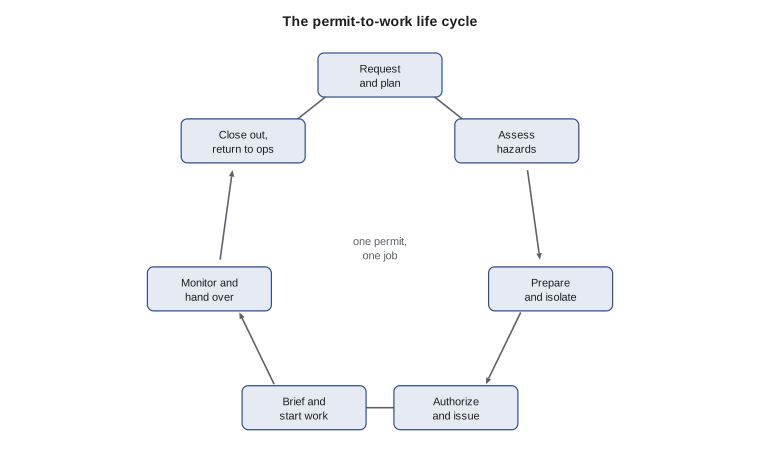
| Step | Who | What can go wrong if it is skipped |
|---|---|---|
| Request and plan | Work requester, planner | Scope is vague, so hazards are missed |
| Assess hazards | Issuer with performer and specialists | Hazards of the area or the task are not identified |
| Prepare and isolate | Operations | Equipment is still energized, pressurized or contaminated |
| Authorize and issue | Permit issuer (authorized person) | Work starts without anyone checking precautions are in place |
| Brief and start | Performer and crew | Crew does not know the hazards or limits |
| Monitor and hand over | Issuer, supervisors, both shifts | Changes go unnoticed; next shift starts equipment under work |
| Close out | Performer and issuer | Equipment returned to service with people, tools or open lines still present |
Roles in a permit system
Clear roles are the backbone of a permit system. The permit issuer, often a trained operations supervisor, owns the plant equipment and is responsible for preparing it safely and authorizing the work. The permit performer or receiver, often a maintenance supervisor or contractor lead, accepts the permit, briefs the crew and makes sure the work stays within its limits. Specialists, such as gas testers or electrical authorities, sign for their part. An area authority may approve all permits in a unit so that someone sees the whole picture. Only people trained and authorized by the plant can issue permits, and many plants keep a register of authorized issuers.
Simultaneous operations
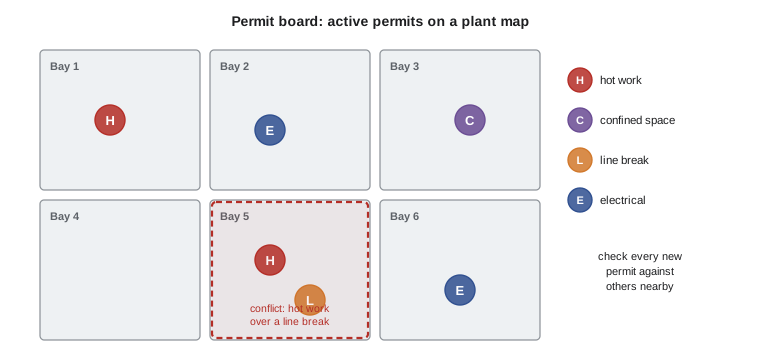
In a busy plant, several jobs often happen near each other at the same time. One crew may be welding on a platform while another opens a line below, a third is in a tank nearby and production continues in the next bay. Each job may be safe on its own, but together they can create new hazards: sparks falling onto an opened line, vapors from the line drifting to the welding, or an isolation for one job being removed by another crew. Managing simultaneous operations (SIMOPS) means checking permits against each other, not just one at a time. Many plants use a permit board or a digital system that shows all active permits on a plant map, and an area authority who reviews conflicts before issuing new permits.
# SIMOPS conflict check: flag active permits that should not run together (illustrative rules).
permits = [
    {"id": "HW-112", "type": "hot work",       "area": "Bay 3", "level": "platform"},
    {"id": "LB-047", "type": "line break",     "area": "Bay 3", "level": "floor"},
    {"id": "CS-020", "type": "confined space", "area": "Bay 4", "level": "floor"},
    {"id": "HW-113", "type": "hot work",       "area": "Bay 4", "level": "floor"},
    {"id": "EL-008", "type": "electrical",     "area": "Bay 1", "level": "floor"},
]
conflicts = {frozenset(["hot work", "line break"]): "sparks could ignite released gas",
             frozenset(["hot work", "confined space"]): "fumes or sparks may enter the space"}
for i, a in enumerate(permits):
    for b in permits[i + 1:]:
        reason = conflicts.get(frozenset([a["type"], b["type"]]))
        if reason and a["area"] == b["area"]:
            print(f"CONFLICT {a['id']} + {b['id']} in {a['area']}: {reason}")
print("Review each conflict with the area authority before issuing or continuing work.")CONFLICT HW-112 + LB-047 in Bay 3: sparks could ignite released gas CONFLICT CS-020 + HW-113 in Bay 4: fumes or sparks may enter the space Review each conflict with the area authority before issuing or continuing work.
Worked problem
A conflict on the permit board
During a weekend shutdown, a hot work permit is active for welding a bracket on a platform in Bay 3. A maintenance planner asks for a line-break permit to open a solvent line on the floor directly below. What should the area authority do?
Show solution
- Recognize the conflict: opening the solvent line could release flammable gas, and falling sparks could ignite it.
- Options: suspend the hot work while the line is opened, drained, purged and blanked; or schedule the line break for another time.
- If both must happen the same day, set conditions: line fully drained and gas-tested before hot work resumes, spark containment on the platform, continuous gas monitoring.
- Record the decision on both permits so that both crews and the next shift know the link.
Answer: Do not issue the line-break permit as a stand-alone job. Sequence the work or set linked conditions, and record them on both permits.
Shift handover and suspension
Many permits last longer than one shift, and handover is one of the most dangerous points in the system. The outgoing issuer must explain to the incoming issuer exactly what work is in progress, what is isolated, what has changed and what is still open. A permit should never be handed over by leaving it on a desk. When work stops for a break, a shift change or an emergency, the permit is suspended: the area is left safe, the crew leaves, and before work restarts the issuer checks that conditions are still as the permit describes. Gas tests usually must be repeated after any suspension.
Closing out
Closing a permit is as important as opening it. The performer confirms that the work is finished, tools and materials are removed, guards are replaced, blinds are removed or recorded, and the crew is clear. The issuer inspects the area, removes isolations in the correct order, and only then returns the equipment to operations. Many incidents happen when equipment is restarted with a temporary blind still in place, a valve left in the wrong position or a person still inside. A walk-down by both parties before sign-off catches most of these.
Auditing permit systems
Because permit systems fail quietly, plants audit them regularly: checking a sample of open and closed permits against what is happening in the field. Auditors look for permits where the hazards section is copied from a template, gas tests are missing or out of date, isolations do not match the equipment, signatures are missing, or work has gone beyond the permit's scope. A good audit visits the job site, not just the permit office. HSE-407 covers audit techniques in depth.
# Permit audit summary: share of sampled permits with each type of defect (illustrative).
sample = 40
defects = {"hazards copied from template": 9, "gas test missing or expired": 4,
           "isolation list incomplete": 6, "missing signature": 3,
           "work beyond permit scope": 2, "no handover record": 5}
for d, n in sorted(defects.items(), key=lambda kv: -kv[1]):
    print(f"{d:<30} {n:>2}/{sample}  {n / sample:5.1%}")
clean = sample - 14     # permits with no defect found (from the field check)
print(f"Permits with no defects: {clean}/{sample} = {clean / sample:.0%}")hazards copied from template 9/40 22.5% isolation list incomplete 6/40 15.0% no handover record 5/40 12.5% gas test missing or expired 4/40 10.0% missing signature 3/40 7.5% work beyond permit scope 2/40 5.0% Permits with no defects: 26/40 = 65%
OSHA does not have a single permit-to-work standard, but several standards require permits or equivalent written authorization: permit-required confined spaces (1910.146), hot work under the welding standards (1910.252) and NFPA 51B, and process safety management (1910.119), which requires hot work permits and safe work practices for opening process equipment. HSE-333 covers permits in oil and gas.
Digital permit systems
Many plants have moved from paper permits to electronic permit-to-work systems. These can show every active permit on a plant map, flag conflicts automatically, link permits to isolation records, record gas tests with time stamps, and make audits easier. They also bring risks: people can approve permits from an office without visiting the job, and a system outage can leave work in limbo. A good digital system still requires the issuer to walk the job, and keeps a simple paper fallback for outages.
Common mistakes
MistakeTreating the permit as a form to be filled in.
InsteadUse the permit to bring the right people together to plan and check the job in the field.
MistakeChecking each permit on its own.
InsteadCheck permits against each other for simultaneous operations conflicts.
MistakeHanding over permits by leaving them in the office.
InsteadHand over face to face, explaining work, isolations and changes.
MistakeRestarting suspended work without rechecking.
InsteadRecheck conditions and repeat gas tests after any suspension.
MistakeClosing a permit from the office.
InsteadWalk down the job with both parties before returning equipment to service.
Summary and key terms
- A permit-to-work authorizes specific high-risk work in a specific place, time and set of precautions.
- Permit failures, as at Piper Alpha, come from paperwork without field checks and poor handovers.
- Plants use general permits plus special permits for hot work, confined space, line break, electrical, excavation, heights and lifting.
- The life cycle runs from planning and hazard assessment through isolation, authorization, monitoring and close-out.
- Clear roles for issuers, performers and specialists are essential, and only authorized people issue permits.
- Simultaneous operations must be checked across permits, not one permit at a time.
- Handover, suspension and close-out are high-risk moments that need face-to-face checks and walk-downs.
- Permit-to-work
- A formal written system that authorizes specific high-risk work under specific precautions.
- Permit issuer
- The authorized person, usually from operations, who prepares equipment and authorizes work.
- Permit performer
- The person who accepts the permit and leads the work crew.
- Area authority
- A person responsible for approving all permits in a unit to see the whole picture.
- Isolation certificate
- A record of the energy isolations that support one or more permits.
- Line break
- Opening a pipe, vessel or piece of equipment that has contained a hazardous material.
- SIMOPS
- Simultaneous operations: several activities in the same area at the same time.
- Suspension
- Temporarily stopping work under a permit with the area left safe.
- Close-out
- Finishing a permit and returning equipment to operations after checks.
- Walk-down
- A joint field check of the work area by issuer and performer.
Practice problems
Work each problem on paper first, then reveal the answer to check.
What is the purpose of a permit-to-work?
Show answer
To authorize specific high-risk work under agreed precautions after checks by the right people.
What lessons about permits came from Piper Alpha?
Show answer
Permits fail when they are paperwork, handovers lose information and linked permits are not cross-checked.
Name five types of special permits.
Show answer
Any five: hot work, confined space, line break, electrical, excavation, working at heights, lifting.
Who is the permit issuer and what do they do?
Show answer
Usually an operations supervisor who prepares equipment safely and authorizes the work.
What is a simultaneous operations conflict?
Show answer
Two or more jobs near each other that together create hazards, such as hot work above a line break.
How should permits be handed over between shifts?
Show answer
Face to face, explaining work, isolations, changes and open items.
What must happen before suspended work restarts?
Show answer
The issuer rechecks conditions and gas tests are repeated.
List three things checked at close-out.
Show answer
Work finished, tools removed, guards back, blinds removed or recorded, crew clear, isolations removed in order.
What do permit audits look for?
Show answer
Copied hazards, missing or expired gas tests, incomplete isolations, missing signatures, work beyond scope.
Why should audits visit the job site?
Show answer
Paperwork can look complete while field conditions differ.
Lesson quiz · 5 questions
Score 60% or more to complete this lesson.
Create a free account to save your progress, take quizzes and earn a certificate.