
HSE-310 · Lesson 12 of 12 · 27 min
Emergency preparedness and capstone: a plant safety system
Even well-run plants have emergencies: fires, chemical releases, serious injuries, entrapment in confined spaces, power failures, severe weather and, rarely, explosions. What happens in the first few minutes decides how bad the outcome is. People who know the alarms, the exits and their roles move quickly and calmly; people who have never practiced freeze, go back for belongings or walk into danger. This lesson covers plant emergency preparedness and then brings the whole course together in a capstone: building a plant safety system for an invented food-processing plant. HSE-222 covers fire wardens and evacuation in depth.
Emergency plans
In the United States, OSHA requires most employers to have an emergency action plan (1910.38) and a fire prevention plan (1910.39), written if the employer has more than 10 employees. The emergency action plan covers reporting emergencies, evacuation procedures and routes, procedures for employees who remain to operate critical plant operations, accounting for employees, rescue and medical duties, and alarm systems. First aid and medical services are covered by 1910.151, emergency eyewashes and showers are required where corrosives are used, and facilities with listed chemicals may need emergency response plans under EPA rules and EPCRA.
| Emergency type | Plant examples | Key elements of the response |
|---|---|---|
| Fire | Fryer fire, dust collector fire, warehouse fire | Alarm, evacuation, sprinklers, fire department access |
| Chemical release | Ammonia leak, chlorine release, acid spill | Shelter or evacuate depending on wind, isolation, hazmat response |
| Serious injury | Amputation, crush injury, burns | First aid, emergency medical services, scene control, reporting |
| Confined space or height rescue | Worker collapsed in a tank, suspended in a harness | Trained rescue team, equipment ready, no untrained entry |
| Explosion | Dust explosion, boiler failure | Evacuation, account for people, secondary hazards |
| Utility failure | Power, refrigeration or steam loss | Safe shutdown, emergency lighting, product hazards |
| Severe weather | Tornado, ice storm, flood | Shelter areas, shutdown plans, communications |
| Security threat | Violent person, bomb threat | Lockdown or evacuation per plan, police |
Alarms and signals
People must recognize each alarm instantly. Many plants use different signals for different actions: a continuous bell or horn for evacuation, an intermittent tone or voice message for shelter in place during a toxic release, and a specific signal for an all-clear. Noisy areas need visual alarms such as strobes, and people wearing hearing protection must still be able to perceive the alarm. Alarms should be tested regularly and every new person should hear them during orientation.
Evacuate or shelter?
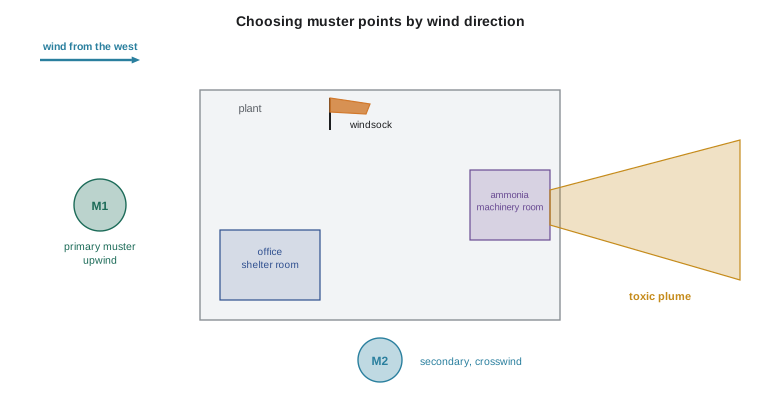
For fires and explosions the answer is almost always to evacuate. For a toxic gas release outside a building, sheltering in place in a designated room with ventilation shut down may be safer than walking through the cloud. For a release inside a building, people move upwind and away. Plants with ammonia, chlorine or other toxic gases plan these decisions in advance, mark shelter-in-place rooms, install windsocks visible from across the site, and train people to note wind direction and move crosswind or upwind. Muster points are chosen so that at least one is upwind for any likely wind direction.
Accounting for everyone
After an evacuation, the first question is whether everyone is out. Plants account for people using badge or turnstile data, sign-in sheets for visitors and contractors, and department headcounts at muster points. Wardens report to an incident commander, who passes any missing names to the fire department. Contractors and visitors are the people most often unaccounted for, which is why sign-in systems matter. Accounting must be fast; firefighters may risk their lives searching for someone who is actually at home.
# Muster headcount reconciliation (illustrative): who is on site but not yet accounted for?
on_site = {"E101", "E102", "E103", "E104", "E105", "C201", "C202", "C203", "V301"}
mustered = {"E101", "E103", "E104", "E105", "C201", "C203"}
known_safe_elsewhere = {"E102"}          # e.g. reported by phone, off site at the warehouse
missing = sorted(on_site - mustered - known_safe_elsewhere)
print(f"On site: {len(on_site)}  mustered: {len(mustered)}  safe elsewhere: {len(known_safe_elsewhere)}")
for p in missing:
    kind = {"E": "employee", "C": "contractor", "V": "visitor"}[p[0]]
print(f"UNACCOUNTED: {p} ({kind}) - report to incident commander and fire department")On site: 9 mustered: 6 safe elsewhere: 1 UNACCOUNTED: C202 (contractor) - report to incident commander and fire department UNACCOUNTED: V301 (visitor) - report to incident commander and fire department
Emergency response roles
Plants assign emergency roles in advance: incident commander, fire wardens, first aiders, emergency response team members for spills or rescue, people who shut down critical equipment, and someone to meet the fire department and give them information such as drawings, chemical inventories and the location of the incident. Each role needs training and a backup on every shift. Plants that depend on the public fire department for rescue in confined spaces or at height must confirm that the department can respond in time with the right equipment; often it cannot, and the plant needs its own trained rescue team.
Worked problem
An ammonia alarm at night
At 02:00 an ammonia detector in the machinery room of a food plant goes into high alarm. Six workers are on the night shift, two in the freezer area next to the machinery room. What should happen in the first ten minutes?
Show solution
- The alarm triggers the plant's toxic release signal and ventilation in the machinery room (as designed).
- Workers move away from the area, checking the windsock, and go to the upwind muster point; nobody enters the machinery room to investigate without proper protection and training.
- The shift lead accounts for all six and calls emergency services and the on-call refrigeration operator.
- The emergency shut-off for the ammonia system is operated from outside the machinery room if the procedure calls for it.
- Someone meets the fire department with the ammonia inventory, system drawings and the location of the alarm.
Answer: Evacuate upwind, account for everyone, call for help and operate remote shut-offs; do not investigate inside without protection and training.
Drills and learning
Plans that are never practiced do not work. Fire codes usually require fire drills at least once a year, and plants with significant hazards drill more often, including scenarios for chemical releases and rescues. Good drills are realistic, sometimes unannounced, run on different shifts, and followed by a debrief that identifies what went well and what to fix: blocked exits, alarms not heard, missing headcounts, confusion about roles. Real incidents and near misses are investigated in the same spirit (HSE-403).
Capstone: a plant safety system for Maple Creek Foods
Maple Creek Foods is an invented company used for this capstone. It runs a 9,000 m² (about 97,000 ft²) meat and vegetable processing plant with 180 workers on two shifts, plus 10 to 15 contractors most days and up to 80 during an annual two-week shutdown. The plant has ammonia refrigeration (about 4,000 kg, or 8,800 lb), slicers, mixers and grinders, a spiral freezer, conveyors, a fryer line, three loading docks, a racked warehouse with propane forklifts, sanitation with acid and chlorinated cleaners, and a small maintenance shop with welding. Last year it recorded 11 recordable injuries, mostly strains and cuts, and two near misses: a pedestrian almost struck by a reversing forklift, and a sanitation worker who reached into a running conveyor to clear debris.
Your task is to outline the core of a plant safety system for Maple Creek, drawing on every lesson in this course. The table below gives a model answer in outline; a real plan would be developed with workers, supervisors, the joint committee and specialists.
| Element | Key measures for Maple Creek | Lesson |
|---|---|---|
| Measuring performance | Track TRC and DART rates, SIF-potential events, near misses and leading indicators | 1 |
| Legal framework and roles | Map duties, committee inspections, pre-start reviews for new equipment | 2 |
| Orientation and contractors | Tiered orientation; life-saving rules; contractor prequalification and pre-job meetings | 3 |
| Hazard recognition | Energy-wheel walks on both shifts; quick reporting with feedback | 4 |
| Machines | Guard audit of slicers, grinders and conveyors; sanitation lockout procedure | 5 |
| Permits | Permits for hot work, confined space (spiral freezer, tanks), line break on ammonia | 6 |
| Fire | Fryer suppression, housekeeping standards, hot work permits with fire watch | 7 |
| Traffic and handling | Separate walkways in the warehouse, dock restraints, lift tables on packing lines | 8 |
| Chemicals and process | Ammonia program, segregation of acid and chlorinated cleaners, management of change | 9 |
| Health hazards | Noise survey of grinders, cold stress in freezers, ergonomics of cutting tasks | 10 |
| Shutdown | Scope freeze, isolation register, contractor orientation plan, start-up checklist | 11 |
| Emergencies | Ammonia release plan with windsocks and upwind muster, drills on both shifts | 12 |
# Maple Creek Foods: baseline rates and a simple priority ranking (illustrative).
hours = 180 * 1950
recordables, dart = 11, 6
print(f"TRC rate:  {recordables * 200_000 / hours:.2f} per 200,000 h")
print(f"DART rate: {dart * 200_000 / hours:.2f} per 200,000 h")
issues = [  # (issue, likelihood 1-5, severity 1-5)
    ("pedestrian-forklift conflict in warehouse", 4, 5),
    ("reaching into running conveyors during sanitation", 4, 5),
    ("ammonia release from machinery room", 2, 5),
    ("strains on packing lines", 5, 2),
    ("acid and chlorine cleaner mix-up", 2, 4),
]
print("Priorities:")
for name, l, s in sorted(issues, key=lambda x: -(x[1] * x[2])):
print(f" {l * s:>2} {name}")TRC rate: 6.27 per 200,000 h DART rate: 3.42 per 200,000 h Priorities: 20 pedestrian-forklift conflict in warehouse 20 reaching into running conveyors during sanitation 10 ammonia release from machinery room 10 strains on packing lines 8 acid and chlorine cleaner mix-up
Worked problem
Fixing the two near misses first
Both near misses at Maple Creek had serious injury or fatality potential. What would you do first about each?
Show solution
- Forklift near miss: install barriers to create a pedestrian walkway through the warehouse, add a controlled crossing with a stop line and light at the dock entrance, and set time separation for picking until barriers are in.
- Conveyor near miss: write a sanitation lockout procedure with group lockout for each line, provide locks and lockout stations at each line, and train sanitation crews and supervisors.
- For both: tell the workforce what happened and what is changing, and check after a month that the new controls are being used.
Answer: Treat both as top priorities because of their potential, apply direct controls (separation and lockout), and close the loop with workers.
Bringing it together
A plant safety system is not a set of separate programs. Orientation feeds the permit system; the permit system depends on lockout and hazard recognition; traffic plans, housekeeping and fire prevention support each other; shutdown planning tests everything at once; and emergency plans assume all of it might fail. The test of the system is what happens on an ordinary night shift, when a jam occurs, a forklift is behind schedule and nobody from management is watching. If the safe way is the easy and expected way, the system is working.
Common mistakes
MistakeAssuming the public fire department can perform any rescue in time.
InsteadConfirm their capability; many plants need their own trained rescue teams.
MistakeUsing one alarm for every emergency.
InsteadUse distinct signals for evacuation, shelter in place and all-clear, with visual alarms in noisy areas.
MistakeChoosing muster points without thinking about wind.
InsteadProvide upwind options and windsocks where toxic releases are possible.
MistakeForgetting contractors and visitors in headcounts.
InsteadUse sign-in systems so everyone on site can be accounted for.
MistakeRunning drills only on day shift.
InsteadDrill on every shift and debrief to fix problems.
Summary and key terms
- OSHA requires emergency action and fire prevention plans, with written plans for employers over 10 employees.
- Distinct, tested alarms tell people whether to evacuate or shelter in place.
- Toxic releases need wind-aware muster points, windsocks and shelter-in-place rooms.
- Fast, complete headcounts, including contractors and visitors, protect people and responders.
- Emergency roles need training and backups on every shift; plants often need their own rescue capability.
- Drills on every shift, followed by debriefs, keep plans working.
- A plant safety system links every element of this course and is tested by ordinary work on an ordinary night shift.
- Emergency action plan
- A written plan for how people respond to emergencies, including evacuation and accounting for people.
- Fire safety plan
- A plan required by fire codes covering emergency procedures, staff duties, drills and fire protection maintenance.
- Shelter in place
- Staying indoors in a designated room with ventilation shut down during an outdoor toxic release.
- Muster point
- A designated assembly area where people gather to be accounted for after evacuation.
- Incident commander
- The person in overall charge of the response to an emergency.
- Windsock
- A fabric cone that shows wind direction, used to decide where to move during a release.
- Headcount
- Confirming that everyone on site has been accounted for.
- Emergency response team
- Trained workers who respond to spills, fires or rescues within the plant.
- Drill
- A practice of an emergency response.
- Debrief
- A review after a drill or incident to identify what worked and what to improve.
Practice problems
Work each problem on paper first, then reveal the answer to check.
Which OSHA standards require emergency action and fire prevention plans?
Show answer
1910.38 and 1910.39.
Give three types of plant emergencies and a key response element for each.
Show answer
Fire (evacuate), chemical release (shelter or move upwind), serious injury (first aid and EMS), rescue (trained team).
Why should alarms for evacuation and shelter in place be different?
Show answer
They call for opposite actions, so people must recognize which one is sounding.
When might sheltering in place be safer than evacuating?
Show answer
During an outdoor toxic gas release when walking outside would take people through the cloud.
Why are windsocks useful in plants with toxic gases?
Show answer
They show wind direction so people can move upwind or crosswind to a safe muster point.
Who is most often unaccounted for after an evacuation, and how is this prevented?
Show answer
Contractors and visitors; through sign-in systems and badge data.
Why might a plant need its own rescue team?
Show answer
The public fire department may not be able to reach and perform confined space or height rescue in time.
What makes a drill useful?
Show answer
Realism, different shifts, sometimes unannounced, and a debrief that leads to fixes.
Calculate Maple Creek's TRC rate: 11 recordables, 180 workers × 1,950 hours.
Show answer
11 × 200,000 ÷ 351,000 ≈ 6.27 per 200,000 hours.
What is the real test of a plant safety system?
Show answer
Whether the safe way is the easy, expected way on an ordinary shift with nobody from management watching.
Lesson quiz · 5 questions
Score 60% or more to complete this lesson.
Create a free account to save your progress, take quizzes and earn a certificate.