
HSE-310 · Lesson 5 of 12 · 24 min
Machines, automation and robots
Machines are the heart of most plants, and they cause many of the worst injuries: amputations, crushing, entanglement and being struck by ejected parts. HSE-215 covers machine guarding in depth, HSE-210 covers lockout, and ROB-440 covers industrial robot cells. This lesson takes the plant-wide view: how machinery hazards show up in daily work, how a plant decides which safeguards to use, how automation changes the picture, and what everyone on the floor needs to know.
Where machines hurt people
Machine hazards concentrate at a few places. The point of operation is where the machine does its work on the material: cutting, pressing, punching, bending, shearing, forming. Power transmission parts carry energy to the point of operation: shafts, couplings, belts, pulleys, chains, sprockets and gears. Other moving parts include feed mechanisms, conveyors, rotating drums and reciprocating arms. Nip points form wherever two parts move together, or one part moves past a fixed object. Each can grab clothing, hair or a hand and pull it in faster than anyone can react.
| Hazard area | Examples | Typical injury |
|---|---|---|
| Point of operation | Press dies, saw blades, slicers, shears, injection mold closing | Amputation, laceration, crushing |
| Power transmission | Shafts, couplings, V-belts, chains and sprockets | Entanglement, fractures |
| In-running nip points | Rollers, belt and pulley, conveyor tail pulleys | Hands and arms drawn in |
| Reciprocating and transverse motion | Shuttles, sliding tables, robot arms | Crushing against fixed objects |
| Ejected material | Broken tooling, chips, parts thrown from lathes and grinders | Eye and impact injuries |
| Stored energy | Springs, flywheels, hydraulic and pneumatic cylinders | Unexpected movement after stopping |
In the United States, amputations are among the most serious machine injuries, and OSHA has run a national emphasis program on amputations in manufacturing for many years. Machine guarding (1910.212) was the tenth most cited OSHA standard in fiscal year 2025, and lockout/tagout (1910.147) the fourth. Specific standards cover mechanical power presses (1910.217), woodworking machinery (1910.213) and mechanical power-transmission apparatus (1910.219), and the ANSI B11 series gives detailed guidance.
Choosing safeguards
Safeguarding follows the hierarchy of controls. The best option is to design the hazard out, for example by enclosing the point of operation or using automatic feeding so nobody needs to reach in. Next come fixed guards, which are simple and reliable. Where people need regular access, interlocked guards or presence-sensing devices such as light curtains and safety mats stop the machine when someone enters. Two-hand controls keep both hands away during the hazardous motion but protect only the operator. Training, signs and PPE support these but cannot replace them.
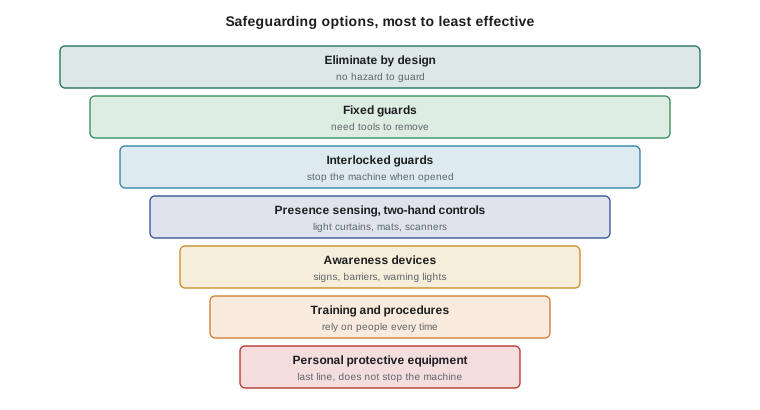
| Safeguard | Strengths | Limits |
|---|---|---|
| Fixed guard | Simple, reliable, no moving parts | Hinders frequent access; may be removed and not replaced |
| Interlocked guard | Allows access; stops hazardous motion when opened | Can be bypassed; must stop the machine before access |
| Light curtain | No physical barrier; good for frequent loading | Needs correct safety distance; does not stop ejected parts |
| Safety mat or area scanner | Detects people in an area | Can be defeated; sensitive to placement |
| Two-hand control | Keeps the operator's hands out of the danger zone | Protects only the operator, not helpers |
| Awareness barrier and signs | Cheap, easy to install | Do not prevent access |
Safety distance for presence-sensing devices
A light curtain stops a machine when a hand or body breaks the beams, but the machine takes time to stop. If the curtain is too close, a hand can reach the hazard before motion ends. Standards set a minimum safety distance based on the approach speed of a hand or body and the total stopping time. The simplified form used in CSA Z432, ISO 13855 and ANSI B11.19 multiplies an approach speed by the stopping time and adds an allowance that depends on how far a hand can penetrate the curtain before it is detected.
# Minimum safety distance for a vertical light curtain (simplified, illustrative).
# K = hand approach speed, T = total stopping time, C = penetration allowance.
K = 2000          # mm/s for close approach (a larger K applies at longer distances)
for T_ms in (80, 150, 250):
    T = T_ms / 1000
    for res_mm in (14, 30):                     # detection capability of the curtain
        C = max(0, 8 * (res_mm - 14))           # allowance in mm
        S = K * T + C
print(f"stop time {T_ms:>3} ms, resolution {res_mm} mm -> S = {S:5.0f} mm ({S / 25.4:4.1f} in)")stop time 80 ms, resolution 14 mm -> S = 160 mm ( 6.3 in) stop time 80 ms, resolution 30 mm -> S = 288 mm (11.3 in) stop time 150 ms, resolution 14 mm -> S = 300 mm (11.8 in) stop time 150 ms, resolution 30 mm -> S = 428 mm (16.9 in) stop time 250 ms, resolution 14 mm -> S = 500 mm (19.7 in) stop time 250 ms, resolution 30 mm -> S = 628 mm (24.7 in)
The calculation shows why stopping time matters. A press that takes 250 ms to stop needs the curtain more than half a meter away. If the brake wears and stopping time grows, the same curtain is no longer safe, which is why stopping performance must be checked regularly with a stop-time measuring device.
Lockout and its alternatives
Guards protect people during normal production. When people need to service, maintain, clean or clear jams on a machine, they often have to get past the guards, and then hazardous energy must be controlled. HSE-210 covers lockout in detail. In brief: identify every energy source, shut the machine down, isolate each source, apply personal locks and tags, release stored energy, and verify zero energy by trying to start the machine before anyone reaches in.
OSHA's lockout standard has a narrow exception for minor servicing done during normal production operations: tasks that are routine, repetitive and integral to the use of the equipment may be done under alternative measures that provide effective protection, such as interlocked guards or trapped-key systems. ANSI/ASSP Z244.1 describes how to justify alternative methods by risk assessment. Anything beyond minor servicing requires full lockout.
Worked problem
Is lockout needed?
Operators clear small jams on a carton erector several times a shift. The jam point is inside an interlocked guard door. The plant wants to avoid full lockout for each jam. What would make an alternative acceptable?
Show solution
- Confirm the task is routine, repetitive and integral to production, not maintenance.
- Check that opening the door removes all hazardous motion and stored energy reliably, using safety-rated components.
- Make sure restart requires a deliberate action outside the guard after the door closes, and that nobody else can restart while someone is inside.
- Document the risk assessment and the procedure, train operators, and audit the method.
- Require full lockout for anything beyond a simple jam, such as adjustments or repairs.
Answer: A documented, safety-rated alternative can be acceptable for minor jam clearing; full lockout remains required for maintenance and repair.
Automation and robots
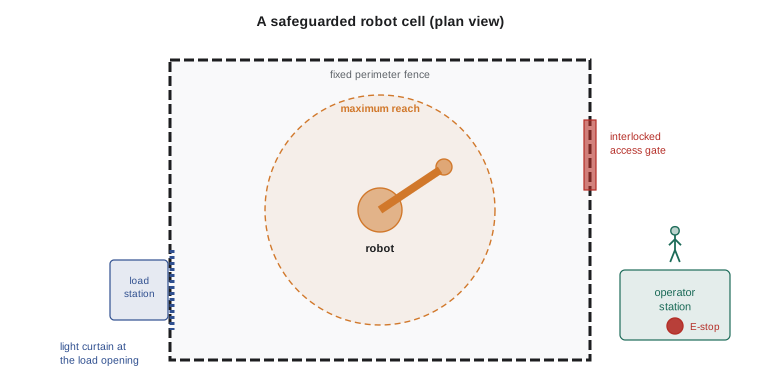
Automation removes people from many hazardous tasks: robots do welding, palletizing and painting, and automated guided vehicles move material. It also creates new hazards. Robots move quickly and can change direction unexpectedly, they can store energy, and they may restart automatically when a sensor clears. Most robot injuries happen not during normal operation but during programming, teaching, troubleshooting and maintenance, when people are inside the cell. Collaborative robots designed to work beside people use force and speed limits, but they still need a risk assessment of the whole application, including the tool and the part.
ANSI/RIA R15.06, based on ISO 10218, sets requirements for industrial robots and robot systems in the United States, including perimeter safeguarding, reduced speed for teaching, enabling devices and safe restart. ROB-430 and ROB-440 cover these in depth.
Machinery safety for everyone on the floor
Whatever your role, a few machine safety rules apply in every plant. Never reach into a machine you have not isolated, even for a second. Never bypass or defeat a guard or interlock. Report guards that are damaged, missing or hard to use, because a guard that interferes with work will eventually be removed. Keep loose clothing, jewelry, long hair and gloves away from rotating parts; gloves in particular can be caught by drills, lathes and rollers. Know where every emergency stop is, but remember that an emergency stop is not a lockout device.
Conveyors: the everyday killer
Conveyors deserve special mention because they are everywhere in plants and are involved in a large share of serious machinery injuries. The danger points are the in-running nips where a belt meets a pulley, especially the tail and head pulleys, take-ups, and transfer points between conveyors. Material builds up at these points, and workers reach in to clean or clear it while the belt is running. Clothing, gloves or a hand can be drawn in within a fraction of a second, and the force is enough to cause amputation or death. Pull-cord emergency stops along a conveyor help in an emergency but do not prevent the injury.
Effective controls include nip guards and enclosures at every pulley, guards designed so that cleaning can be done from outside or with the conveyor locked out, belt scrapers and skirting to reduce spillage, and spillage-clearing procedures that require lockout. Many plants have found that conveyor injuries fall sharply when guards are designed with maintenance and cleaning in mind, because people stop needing to remove them.
Buying and modifying machines safely
Most machinery hazards are cheapest to fix before the machine arrives. Purchase specifications should require compliance with OSHA standards and the relevant ANSI B11 standard, a documented risk assessment from the supplier, and guarding that allows cleaning and maintenance without removal. Used and imported machines often need upgrading, and any modification that affects guarding should be reviewed by a qualified person before the machine is used again.
Common mistakes
MistakeReaching into a machine because it is stopped.
InsteadA stopped machine can restart; isolate energy and verify before reaching in.
MistakeTreating an emergency stop as a lockout device.
InsteadEmergency stops stop motion; they do not isolate energy under your control.
MistakeMounting a light curtain wherever it fits.
InsteadPlace it at the calculated safety distance and check stopping time regularly.
MistakeAssuming two-hand controls protect everyone.
InsteadThey protect only the operator using them, not helpers or passers-by.
MistakeAssuming collaborative robots need no risk assessment.
InsteadAssess the whole application, including the tool, the part and the task.
Summary and key terms
- Machine hazards concentrate at the point of operation, power transmission parts, nip points and stored energy.
- Safeguarding follows the hierarchy: design out, fixed guards, interlocks and presence sensing, then awareness, training and PPE.
- Presence-sensing devices must be placed at a safety distance based on stopping time.
- Servicing and jam clearing need lockout or a documented, safety-rated alternative for minor tasks.
- Automation removes some hazards but creates new ones, especially during teaching and maintenance.
- Robot standards require perimeter safeguarding, reduced teaching speed, enabling devices and safe restart.
- Never reach into an unisolated machine, never bypass a guard, and report guards that hinder work.
- Point of operation
- Where a machine performs work on the material.
- Nip point
- A place where two parts move together, or a part moves past a fixed object, and can draw in a body part.
- Fixed guard
- A guard held in place permanently or by fasteners that need a tool to remove.
- Interlocked guard
- A guard connected to controls so the machine stops when it is opened.
- Presence-sensing device
- A device such as a light curtain or mat that detects a person and stops the machine.
- Safety distance
- The minimum distance between a presence-sensing device and the hazard, based on stopping time.
- Stopping time
- The time a machine takes to stop hazardous motion after a stop signal.
- Minor servicing
- Routine, repetitive tasks integral to production that may use alternative protection instead of full lockout.
- Enabling device
- A hand-held switch that allows robot motion only while held in the middle position.
- Collaborative robot
- A robot designed to work near people using force and speed limits.
Practice problems
Work each problem on paper first, then reveal the answer to check.
Name four places where machine hazards concentrate.
Show answer
Point of operation, power transmission, nip points, reciprocating parts, ejected material, stored energy.
Why is a fixed guard often preferred?
Show answer
It is simple and reliable with no moving parts to fail.
What is the main limit of a two-hand control?
Show answer
It protects only the operator, not helpers or others nearby.
A light curtain is used on a machine with a 200 ms stopping time and K = 2,000 mm/s, C = 0. What is the minimum distance?
Show answer
2,000 × 0.2 = 400 mm.
Why must stopping time be rechecked regularly?
Show answer
Brake wear can lengthen stopping time so the device is no longer far enough away.
List the main steps of lockout.
Show answer
Identify energy, shut down, isolate, lock and tag, release stored energy, verify zero energy.
When might an alternative to full lockout be acceptable?
Show answer
For minor, routine, repetitive production tasks with documented, effective, safety-rated protection.
When do most robot injuries happen?
Show answer
During programming, teaching, troubleshooting and maintenance with people inside the cell.
Why are gloves a hazard near some machines?
Show answer
They can be caught by rotating parts such as drills, lathes and rollers and pull the hand in.
Is an emergency stop a lockout device?
Show answer
No. It stops motion but does not isolate energy under your personal control.
Lesson quiz · 5 questions
Score 60% or more to complete this lesson.
Create a free account to save your progress, take quizzes and earn a certificate.