
HSE-310 · Lesson 11 of 12 · 24 min
Shutdowns, turnarounds and maintenance work
Most plants stop production from time to time to do work that cannot be done while running: major inspections, equipment replacement, cleaning, tie-ins of new equipment and repairs. Small plants may stop a line for a weekend; refineries, pulp mills and large food plants may run a turnaround for weeks with hundreds of extra contractor workers on site. Shutdowns compress a year's worth of high-risk work into a short time, with unfamiliar people, many simultaneous jobs, equipment in unusual states and intense schedule pressure. Many serious incidents happen during shutdowns, start-ups and the maintenance work around them. This lesson covers how plants plan and run shutdowns safely.
Why shutdowns are high risk
| Feature of shutdowns | Why it raises risk |
|---|---|
| Large contractor workforce | Many people new to the plant, its hazards and its rules |
| Many simultaneous jobs | Conflicts between permits, isolations and work areas (lesson 6) |
| Equipment in unusual states | Lines opened, vessels entered, guards removed, safety systems bypassed |
| High-risk tasks concentrated | Confined space entry, hot work, lifting, work at height all at once |
| Schedule pressure | Every day of shutdown costs lost production; shortcuts are tempting |
| Long hours and fatigue | Twelve-hour shifts for many days in a row |
| Shutdown and start-up transitions | Non-routine operating steps with less experience and more chance of error |
Planning a shutdown
Safe shutdowns start months before the first day. Planners define the scope of work, freeze it at an agreed date so last-minute additions do not overwhelm the plan, sequence jobs to avoid conflicts, prepare isolation plans and permits in advance, select and prequalify contractors, plan lifts and confined space entries, and arrange extra resources such as safety staff, rescue teams, first aid and washrooms. A good shutdown plan treats safety as part of the schedule, not a separate document: the time needed to isolate, purge, test and inspect is in the plan, so nobody is forced to choose between safety and the schedule.
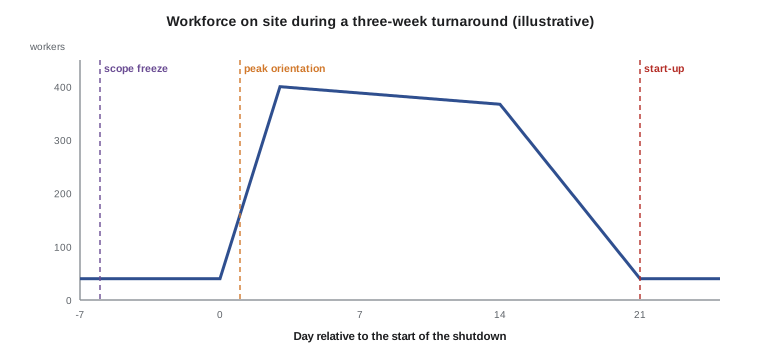
# Estimate the peak contractor workforce and orientation load for a shutdown (illustrative plan).
jobs = {  # job: (start day, duration days, crew size)
    "boiler inspection":      (1, 6, 18),
    "heat exchanger cleaning": (2, 5, 24),
    "conveyor replacement":   (1, 9, 30),
    "tank internal coating":  (3, 8, 16),
    "electrical tie-ins":     (5, 6, 12),
    "piping replacement":     (2, 10, 40),
}
days = 14
profile = [0] * (days + 1)
for start, dur, crew in jobs.values():
    for d in range(start, start + dur):
        profile[d] += crew
peak = max(profile); peak_day = profile.index(peak)
print("Day:  " + " ".join(f"{d:>3}" for d in range(1, days + 1)))
print("Crew: " + " ".join(f"{profile[d]:>3}" for d in range(1, days + 1)))
print(f"Peak {peak} workers on day {peak_day}; all must be oriented before they start")
print(f"At 25 people per orientation session, that is {-(-peak // 25)} sessions before day 1")Day: 1 2 3 4 5 6 7 8 9 10 11 12 13 14 Crew: 48 112 128 128 140 140 98 98 98 68 40 0 0 0 Peak 140 workers on day 5; all must be oriented before they start At 25 people per orientation session, that is 6 sessions before day 1
Scope control and the critical path
Shutdown schedules are usually built with the critical path method (CON-210). The critical path is the longest chain of dependent jobs, and it sets the shutdown length. Delays on the critical path delay start-up, which creates pressure; delays elsewhere can absorb some slack. Safety planning uses the schedule too: it shows when the most people are on site, when the most hazardous jobs overlap, and where extra supervision and rescue cover are needed. Late additions to scope, often called scope creep, are a classic cause of trouble because they arrive without planned isolations, permits or resources.
Worked problem
A late addition
On day 4 of a shutdown, an inspector finds corrosion on a pipe that was not in the plan. The maintenance manager wants a contractor crew to cut out and replace the section that night, using the hot work permit already active for a nearby job. What should happen?
Show solution
- Treat the new job as a change to scope, not an extension of an existing job.
- Plan the isolation: identify what the pipe carries, how it is drained and purged, and what must be locked out.
- Issue its own line-break and hot work permits, checking for conflicts with jobs nearby.
- Check that the crew is oriented, rested and not already on a long shift, and assign supervision.
- Update the schedule honestly; if the job affects the critical path, accept the delay rather than rushing.
Answer: A late job needs its own planning, isolation and permits, and an honest schedule update, not a borrowed permit and a rushed night shift.
Isolation for shutdown work
During a shutdown, many pieces of equipment must be isolated at once, and some isolations protect several jobs. Plants use group lockout or an isolation register to manage this. In group lockout, an authorized person isolates the equipment and locks the isolation points, placing the keys in a lockbox; each worker or crew then applies a personal lock to the box, so the isolation cannot be removed until every worker has removed their lock. The isolation register lists every isolation point, its position, the lock number, the permits it supports and its verification. HSE-210 covers lockout in detail.
| Isolation register field | Why it matters |
|---|---|
| Isolation point and tag number | Identifies exactly which valve, breaker or blind |
| Required position | Closed, open, blinded, disconnected, vented |
| Lock number and who applied it | Traceability of control |
| Permits supported | Shows which jobs depend on this isolation |
| Verification | Who tested for zero energy, how and when |
| Removal | Who removed it, when, after which permits closed |
# Can this isolation be removed? Check the register against open permits (illustrative).
register = {
    "V-101 (steam inlet)":  ["HW-210", "CS-031"],
    "MCC-4 breaker 12":     ["GW-118"],
    "Blind B-7 (solvent)":  ["LB-052", "HW-210"],
}
open_permits = {"CS-031", "LB-052"}
for point, permits in register.items():
    still_open = [p for p in permits if p in open_permits]
    if still_open:
        print(f"{point:<22} KEEP - supports open permit(s) {', '.join(still_open)}")
    else:
print(f"{point:<22} may be removed (all supported permits closed)")V-101 (steam inlet) KEEP - supports open permit(s) CS-031 MCC-4 breaker 12 may be removed (all supported permits closed) Blind B-7 (solvent) KEEP - supports open permit(s) LB-052
Contractor surge and fatigue
Shutdowns can double or triple the number of people on site in a few days. Every one of them needs orientation, and many need specific training for confined space, hot work or fall protection. Plants plan orientation sessions in advance, check training records at the gate, issue site-specific identification and pair new workers with experienced ones. Supervisors from contractor firms must know the plant permit system and stay with their crews. Long shifts and many consecutive days cause fatigue, which slows reactions and impairs judgment. Good shutdown planning limits hours and consecutive days, schedules the most hazardous work when people are fresh, and monitors fatigue.
Shutting down and starting up
The transitions at the start and end of a shutdown are among the most hazardous phases of plant operation. Shutting down involves draining, purging, cooling and depressurizing equipment, and isolating it from live parts of the plant. Starting up involves the reverse, often with equipment that has been modified, with temporary blinds that must all be removed, with instruments recalibrated, and with operators who do this only once a year. Many major accidents, including the 2005 Texas City explosion, happened during start-up. Plants use written start-up procedures, checklists, pre-start-up safety reviews for changed equipment, and extra supervision during these phases.
| Start-up check | Purpose |
|---|---|
| All permits closed and isolations removed per the register | No one is still working on equipment being started |
| Blinds removed or confirmed in place as intended | Lines are correctly open or closed |
| Guards and safety devices reinstalled and tested | Protection restored before operation |
| Changes reviewed through management of change | Modifications are understood and documented |
| Instruments, alarms and interlocks tested | Safety systems will act if needed |
| Headcount and area walk-down | Everyone is clear of equipment |
| Operators briefed on start-up procedure | Non-routine steps are done correctly |
Routine maintenance outside shutdowns
Not all maintenance happens during shutdowns. Plants do preventive maintenance, breakdown repairs and cleaning every day, often on equipment next to running lines. The same principles apply on a smaller scale: plan the job, identify energy sources, use permits where needed, isolate and verify, protect people from neighboring hazards, and hand back equipment carefully. Breakdown maintenance is the riskiest, because it is unplanned and production is waiting. Plants that do more planned preventive maintenance have fewer breakdowns and fewer of the rushed repairs that hurt people.
Daily shutdown meetings
During a shutdown, most plants hold short coordination meetings at the start of each shift. Supervisors from operations, maintenance and each contractor review the day's jobs, the permits needed, simultaneous operations conflicts, lifts and confined space entries, weather, and any incidents or near misses from the previous shift. The meeting is also the moment to stop and reset if things are going wrong: rising near misses, permit errors or fatigue. Some plants appoint a shutdown safety lead with the authority to pause work across the site.
Learning after the shutdown
When a shutdown ends, the pressure to restart and move on is strong, but a short review pays off. Which jobs ran late and why? Were there scope additions, permit errors, isolation problems or incidents? Did contractors perform as expected? Which lessons should change the next plan? Recording these findings, and feeding them into contractor evaluations, scope planning and procedures, is how plants make each shutdown safer than the last.
# Shutdown review: near misses per 10,000 hours by week (illustrative).
weeks = {"week 1": (9, 28_000), "week 2": (6, 36_000), "week 3": (2, 14_000)}
for w, (nm, hrs) in weeks.items():
print(f"{w}: {nm} near misses in {hrs:,} h -> {nm * 10_000 / hrs:.1f} per 10,000 h")week 1: 9 near misses in 28,000 h -> 3.2 per 10,000 h week 2: 6 near misses in 36,000 h -> 1.7 per 10,000 h week 3: 2 near misses in 14,000 h -> 1.4 per 10,000 h
Common mistakes
MistakeAdding late jobs under existing permits to save time.
InsteadTreat late additions as scope changes with their own planning, isolation and permits.
MistakePlanning safety separately from the schedule.
InsteadBuild isolation, testing and inspection time into the schedule itself.
MistakeRemoving an isolation when one job is finished.
InsteadCheck the register; keep it until every permit it supports is closed.
MistakeRunning long shifts for many days without limits.
InsteadLimit hours and consecutive days and schedule hazardous work when people are fresh.
MistakeTreating start-up as routine.
InsteadUse written procedures, checklists, reviews of changes and extra supervision.
Summary and key terms
- Shutdowns concentrate high-risk work, contractors, simultaneous jobs and schedule pressure.
- Safe shutdowns start with early planning, a scope freeze and safety built into the schedule.
- The critical path and workforce curve show when risk and supervision needs peak.
- Late additions need their own planning, isolation and permits.
- Group lockout and isolation registers manage many isolations supporting many permits.
- Contractor surge needs planned orientation, training checks and engaged supervisors; fatigue must be managed.
- Shutting down and starting up are high-risk transitions that need procedures, checklists and reviews.
- Shutdown
- A planned stop of production to carry out maintenance and other work.
- Turnaround
- A large planned shutdown, often lasting weeks, with major inspections and repairs.
- Scope freeze
- The date after which no new work is added to a shutdown plan without formal review.
- Scope creep
- Uncontrolled additions to the planned work.
- Critical path
- The longest chain of dependent tasks, which sets the duration of the shutdown.
- Group lockout
- A method where isolation keys are locked in a box to which each worker adds a personal lock.
- Isolation register
- A record of every isolation point, its state, locks, supported permits and verification.
- Blind
- A solid plate inserted in a pipe to positively isolate it.
- Start-up
- Returning equipment or a process to operation after a shutdown.
- Breakdown maintenance
- Unplanned repairs after equipment fails.
Practice problems
Work each problem on paper first, then reveal the answer to check.
Give four reasons shutdowns are high risk.
Show answer
Many contractors, simultaneous jobs, equipment in unusual states, concentrated high-risk tasks, schedule pressure, fatigue, transitions.
What is a scope freeze and why does it help safety?
Show answer
A cut-off for adding work; it prevents late jobs arriving without planned isolations and permits.
How can the workforce curve be used in safety planning?
Show answer
It shows when most people are on site, so orientation, supervision and rescue cover can be planned.
What should happen when a new job is found mid-shutdown?
Show answer
Plan it as a scope change with its own isolation, permits, crew checks and an honest schedule update.
How does group lockout work?
Show answer
Isolation keys go in a lockbox; each worker adds a personal lock so isolation stays until all are removed.
When can an isolation that supports several permits be removed?
Show answer
Only when every permit it supports is closed.
Name three ways to manage contractor surge.
Show answer
Planned orientation sessions, training checks at the gate, site ID, pairing with experienced workers, engaged supervisors.
Why are start-ups hazardous?
Show answer
They are non-routine, may involve modified equipment and leftover blinds, and operators do them rarely.
List four start-up checks.
Show answer
Permits closed, isolations removed, blinds checked, guards restored, changes reviewed, safety systems tested, headcount.
Why is breakdown maintenance riskier than planned maintenance?
Show answer
It is unplanned and rushed while production waits.
Lesson quiz · 5 questions
Score 60% or more to complete this lesson.
Create a free account to save your progress, take quizzes and earn a certificate.