
HSE-310 · Lesson 2 of 12 · 25 min
Law, roles and plant safety systems
Every plant operates inside a legal framework that sets out who must do what to keep people safe. The details differ between jurisdictions, but the structure is similar everywhere: a general duty on the employer, specific duties for supervisors and workers, detailed rules for particular hazards, and inspectors who can enforce them. Knowing that framework helps you understand why plants run the way they do, and what you can expect and demand.
The legal framework
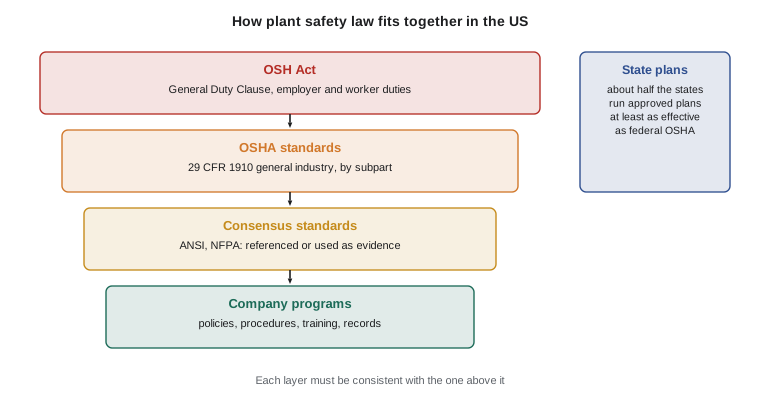
In the United States, most private-sector plants fall under the Occupational Safety and Health Act of 1970, enforced by the federal Occupational Safety and Health Administration (OSHA) or by an OSHA-approved state plan. State plans must be at least as effective as federal OSHA, and some, such as California, Washington and Michigan, have rules that go further. For plants, the key federal rules are the general industry standards in 29 CFR Part 1910, organized into subparts: walking-working surfaces (D), means of egress (E), occupational health and environmental control (G), hazardous materials (H), personal protective equipment (I), general environmental controls including lockout (J), materials handling (N), machinery and machine guarding (O), welding, cutting and brazing (Q), electrical (S) and toxic and hazardous substances (Z). Where no specific standard covers a serious recognized hazard, OSHA can cite the General Duty Clause, section 5(a)(1) of the Act.
Duties of the workplace parties
Under the OSH Act, the employer carries the primary legal duty: to provide a workplace free from recognized hazards that are causing or likely to cause death or serious physical harm, and to comply with OSHA standards. Workers must comply with the standards and rules that apply to their own conduct, but OSHA does not cite employees. Supervisors are the employer's agents, so what they know and allow is generally treated as the employer's knowledge. Workers have rights to information and training in a language they understand, to file complaints and request inspections, to see injury records, and to be protected from retaliation under section 11(c). A worker may refuse work only in narrow circumstances involving imminent danger, when there is no time to get the hazard corrected through normal channels.
| Party | Main duties | Example in a plant |
|---|---|---|
| Employer | Keep the workplace free of recognized serious hazards; comply with OSHA standards | Provides guarded machines, lockout devices and training |
| Supervisor | Acts for the employer; enforces rules and corrects hazards | Checks that the lockout procedure is followed on a jam |
| Worker | Comply with rules for their own conduct; rights to information and to report | Reports a missing guard and stops using the machine |
| Contractor | Responsible for its own workers; may share responsibility on multi-employer sites | Follows the plant permit system during a shutdown |
| Safety committee | Where required by state law or used voluntarily: inspect and recommend | Monthly inspection of a production area |
Due diligence and multi-employer responsibility
In the United States, OSHA's multi-employer citation policy means that on a site with several employers, more than one may be cited for the same hazard: the employer who created it, the one whose workers are exposed, the one responsible for correcting it and the one with general supervisory control. This matters in plants during shutdowns, when the host employer, maintenance contractors and specialty firms all work side by side. A host employer cannot hand all responsibility to contractors simply by contract. Courts have applied the policy in different ways, but the practical lesson is the same: plan and coordinate safety across every employer on site. HSE-406 covers contractor management in depth.
Worked problem
Responding to an OSHA inspection
An OSHA compliance officer arrives at a plant after a worker complaint about a press with a missing guard. What should the plant do?
Show solution
- Greet the officer, check credentials and have the plant's designated contact and an employee representative present.
- Take the press out of service and lock it out until the guard is replaced, without disturbing evidence.
- Provide requested records such as OSHA 300 logs, training records and the lockout program.
- Fix the cause, document the corrective action, and note dates for any abatement required by a citation.
Answer: Cooperate, correct the hazard immediately and document everything; prompt, documented abatement matters if citations follow.
Codes and standards
OSHA standards sometimes incorporate consensus standards by reference, and OSHA can use current consensus standards as evidence of recognized hazards and feasible controls. In US plants you will meet ANSI standards such as ANSI B11 (machine safety), ANSI/ASSP Z244.1 (lockout), ANSI/RIA R15.06 (industrial robots) and ANSI Z359 (fall protection), and NFPA codes such as NFPA 70E (electrical safety), NFPA 51B (hot work), NFPA 652 (combustible dust) and NFPA 101 (life safety). Fire codes are adopted by states and local authorities, usually based on the International Fire Code or NFPA 1.
Some states and many companies have a similar idea to a pre-start review. Before new or modified machinery, storage structures, dust collectors or flammable liquid systems are used, a qualified person reviews the design and installation against the applicable OSHA standards, consensus standards and the manufacturer's instructions, and signs off before workers are exposed. Process safety management (29 CFR 1910.119) requires a formal pre-startup safety review for covered highly hazardous chemical processes; HSE-311 covers that in detail.
From law to a plant safety system
Laws set the minimum. A plant turns them into a working system through a set of linked programs. A good system is not a binder on a shelf; it is how work is actually planned, authorized, done and checked every day. The elements below appear in almost every management system standard, including CSA Z45001 and ISO 45001, and HSE-404 covers them in depth.
| Element | What it does | Plant example |
|---|---|---|
| Policy and leadership | Sets commitment and accountability | Plant manager signs the policy and attends safety meetings |
| Hazard identification and risk assessment | Finds hazards and rates risk | Job hazard analyses for each production task |
| Programs and procedures | Defines how high-risk work is done | Lockout, permit-to-work, hot work, confined space |
| Training and competence | Makes sure people can work safely | Orientation, equipment authorization, refresher training |
| Contractor management | Controls work by other employers | Prequalification and site rules for contractors |
| Inspections and monitoring | Checks that controls work | Weekly area inspections and exposure monitoring |
| Incident reporting and investigation | Learns from events | Near miss reports and root cause analysis |
| Emergency preparedness | Plans for things that go wrong | Evacuation drills and spill response |
| Review and improvement | Keeps the system current | Annual management review of results |
# A simple self-check of a plant's safety system elements (illustrative scores 0-3).
scores = {
    "Policy and leadership": 3, "Hazard assessment": 2, "Programs and procedures": 2,
    "Training and competence": 1, "Contractor management": 1, "Inspections": 2,
    "Incident investigation": 2, "Emergency preparedness": 3, "Review": 1,
}
total = sum(scores.values()); best = 3 * len(scores)
print(f"Overall: {total}/{best} = {total / best:.0%}")
weak = sorted((v, k) for k, v in scores.items() if v <= 1)
print("Priorities (score 1 or less):", ", ".join(k for v, k in weak))Overall: 17/27 = 63% Priorities (score 1 or less): Contractor management, Review, Training and competence
Inspectors and enforcement
OSHA compliance officers can inspect workplaces during normal hours, usually without advance notice. Inspections are prioritized by imminent danger, fatalities and severe injuries, complaints, referrals and emphasis programs. Citations carry penalties that are adjusted for inflation each year; for serious and other-than-serious violations the maximum is in the range of $16,000 per violation, and for willful or repeated violations about ten times that. Employers must report a work-related fatality to OSHA within 8 hours and an in-patient hospitalization, amputation or loss of an eye within 24 hours.
Enforcement is not the main reason to run a safe plant, but it shows how seriously society treats plant hazards, and inspection reports are a useful source of lessons. When an inspector finds a problem in your plant, the question to ask is not how to satisfy the inspector but why your own system did not find it first.
Worker participation in practice
Federal OSHA does not require safety committees, but several states do, including Oregon and Washington, and many others encourage them through workers' compensation premium discounts. Where committees exist, they usually include worker and management members, meet monthly, inspect the plant, review incidents and make recommendations. Even where no committee is required, OSHA's recommended practices for safety and health programs treat worker participation as a core element: workers report hazards, take part in inspections and investigations, help develop procedures and have access to information such as injury logs and safety data sheets.
A committee is only as useful as the attention it gets. Good plants give committee members time to do inspections properly, respond promptly to recommendations, explain decisions when a recommendation is not adopted, and report progress back to the workforce. Poor plants treat the committee as a formality and let recommendations sit. Workers notice the difference quickly, and so do inspectors.
The right to refuse dangerous work in the United States is narrow. Under OSHA's regulation at 29 CFR 1977.12, a worker may refuse when, in good faith, they believe they face imminent danger of death or serious injury, a reasonable person would agree, there is not enough time to remove the danger through normal channels such as an OSHA complaint, and the worker has asked the employer to fix it where possible. Workers are protected from retaliation for reporting hazards and injuries under section 11(c) of the Act, and complaints of retaliation must generally be filed within 30 days.
In daily plant life, most safety problems are solved long before anyone needs a formal refusal. A worker points out a missing guard, a supervisor stops the machine, maintenance fixes it, and the job carries on safely. The formal rights matter because they guarantee that this conversation can always happen, even when production pressure is high.
Records that matter
Plants keep records for legal reasons, but the most useful records are also management tools. Training records show who is authorized for which equipment and when refreshers are due. Inspection records show which hazards were found and whether they were fixed. Incident and near miss records show patterns, such as repeated jams on one machine or repeated close calls at one crossing. Maintenance records show whether guards, interlocks, alarms and fire protection are being tested. When these records are kept in a way that people actually use, they become the backbone of due diligence and continuous improvement rather than a filing burden.
Common mistakes
MistakeBelieving workers carry no responsibility because OSHA cites only employers.
InsteadWorkers must follow the rules for their own conduct, and supervisors act for the employer.
MistakeTreating consensus standards as optional extras.
InsteadStandards adopted by regulation are law, and others are strong evidence of reasonable precautions.
MistakeAssuming a contract transfers all safety responsibility to the contractor.
InsteadHost employers keep duties for coordination and for hazards they control.
MistakeTreating the safety system as a set of binders.
InsteadA system is how work is actually planned, authorized, done and checked.
MistakeFixing only what an inspector found.
InsteadAsk why your own inspections and reporting did not find it first.
Summary and key terms
- Most US plants are under the OSH Act, enforced by federal OSHA or a state plan.
- The 29 CFR 1910 general industry standards set detailed rules by subpart.
- The employer carries the primary duty; the General Duty Clause covers recognized hazards without a specific standard.
- The multi-employer policy can make several employers responsible for one hazard.
- Qualified reviews before start-up, and pre-startup safety reviews under PSM, catch design problems early.
- A plant safety system links policy, risk assessment, procedures, training, contractors, inspections, investigation and emergency plans.
- Inspectors can enter, order compliance and stop work; serious incidents must be reported quickly.
- Occupational health and safety act
- The main law setting general duties for workplace safety in a jurisdiction.
- Regulation
- Detailed legal rules made under an act.
- Consensus standard
- A technical standard developed by a standards body such as CSA, ANSI or NFPA.
- Internal responsibility system
- The principle that everyone in a workplace shares responsibility for safety.
- General duty
- A broad legal duty to protect workers from hazards, beyond specific rules.
- Due diligence
- Taking every precaution reasonable in the circumstances, shown by evidence.
- Multi-employer worksite
- A site where workers of more than one employer work together.
- Pre-start review
- A documented check that new or modified equipment meets requirements before use.
- Safety management system
- The linked set of policies, programs and processes that manage safety.
- Stop-work order
- An inspector's order to stop work until a serious hazard is corrected.
Practice problems
Work each problem on paper first, then reveal the answer to check.
Which part of the CFR contains OSHA's general industry standards?
Show answer
29 CFR Part 1910.
When can OSHA use the General Duty Clause?
Show answer
When a serious recognized hazard exists that no specific standard covers.
What is the role of a supervisor in a plant?
Show answer
To make sure workers follow rules and procedures, warn them of hazards and correct problems.
Under the multi-employer policy, which employers might be cited?
Show answer
The creating, exposing, correcting and controlling employers.
Give three consensus standards relevant to plants.
Show answer
Any three: ANSI B11, Z244.1, R15.06, Z359; NFPA 70E, 51B, 652, 101.
What is a pre-startup safety review?
Show answer
A documented check before start-up that a new or modified covered process is ready and safe.
List five elements of a plant safety management system.
Show answer
Any five: policy, hazard assessment, procedures, training, contractor management, inspections, investigation, emergency preparedness, review.
Why can a contract not transfer all safety responsibility to a contractor?
Show answer
The host still controls the site and must coordinate work and manage hazards it creates or controls.
How quickly must an amputation be reported to OSHA?
Show answer
Within 24 hours.
What question should a plant ask after an inspector finds a hazard?
Show answer
Why its own inspections and reporting did not find it first.
Lesson quiz · 5 questions
Score 60% or more to complete this lesson.
Create a free account to save your progress, take quizzes and earn a certificate.