
HSE-252 · Lesson 4 of 12 · 25 min
Defensive driving II: intersections, merging, passing, backing and parking
Lesson 3 covered the basics of space, speed and visibility. This lesson applies them to the places where conflicts between road users are most likely: intersections, merges and lane changes, passing on two-lane roads, and the low-speed maneuvers of backing and parking that cause a surprising share of fleet collisions. In each case the defensive principle is the same. Slow down enough to see, assume others may not see you, and leave yourself a way out.
Intersections
Intersections are where paths cross, so they are where many of the most serious collisions happen: side impacts when someone runs a light or misjudges a gap, left-turn crashes with oncoming traffic, and collisions with pedestrians and cyclists in crosswalks. Defensive drivers treat every intersection as a hazard, even with a green light.
| Step | What to do |
|---|---|
| Approach | Look well ahead for the signal state, traffic, pedestrians and cyclists; cover the brake |
| Stale green | If the light has been green for a while, expect it to change and be ready to stop |
| Before entering | Scan left, center, right and left again, even on a green |
| Delay on a fresh green | Pause a moment and check for red-light runners before moving |
| Through the intersection | Keep scanning, avoid changing lanes, do not stop in the box |
| Turning | Yield to pedestrians and cyclists; check mirrors and blind spots for cyclists on the right |
Left turns across oncoming traffic are among the hardest judgments in driving. Oncoming vehicles are hard to judge for speed, and large vehicles can hide smaller ones such as motorcycles behind them. Wait in the intersection with your wheels pointed straight, so a rear-end impact will not push you into oncoming traffic. Turn only when you have a clear, generous gap, and remember that pedestrians may be crossing the road you are turning into. Where a protected left-turn arrow exists, using it, or planning routes with right turns and signals instead, reduces risk. Some delivery fleets have reported fewer collisions and less idling after planning routes to minimize left turns across traffic.
Right turns on red are permitted in most US states after a full stop unless signs prohibit them, though some cities restrict or ban them, notably New York City, and more cities are considering bans to protect pedestrians. A right turn on red requires yielding to pedestrians and to traffic with the green, and checking for cyclists coming up on the right.
Roundabouts reduce the severity of intersection crashes because entry speeds are low and the angles of conflict are shallow. Yield to traffic already in the roundabout, choose your lane before entering, signal your exit and watch for pedestrians at the crosswalks set back from the circle. Large trucks may need to use the central apron.
# Time needed to cross an intersection from a stop (illustrative acceleration).
import math
def crossing_time(width_m, vehicle_len_m, accel=2.0):
    d = width_m + vehicle_len_m          # clear the whole vehicle
    return math.sqrt(2 * d / accel)

for name, length, a in [("car", 5, 2.0), ("van", 6.5, 1.6), ("loaded truck", 12, 0.8)]:
    t = crossing_time(20, length, a)
    print(f"{name:13s}: {t:4.1f} s to clear a 20 m (66 ft) wide intersection")
# An oncoming vehicle at 60 km/h (37 mph) covers this distance in that time:
for t in (4.9, 5.5, 8.0):
print(f"In {t} s a vehicle at 60 km/h travels {60 / 3.6 * t:5.0f} m ({60 / 3.6 * t * 3.281:5.0f} ft)")car : 5.0 s to clear a 20 m (66 ft) wide intersection van : 5.8 s to clear a 20 m (66 ft) wide intersection loaded truck : 8.9 s to clear a 20 m (66 ft) wide intersection In 4.9 s a vehicle at 60 km/h travels 82 m ( 268 ft) In 5.5 s a vehicle at 60 km/h travels 92 m ( 301 ft) In 8.0 s a vehicle at 60 km/h travels 133 m ( 437 ft)
The point of that calculation is that a loaded truck can need eight seconds or more to clear an intersection from a stop. A driver who judges a gap by the standards of a car can pull a truck into the path of oncoming traffic that cannot stop in time.
Merging and lane changes
Merging onto a highway works best when you match the speed of traffic before you reach the end of the ramp. Use the full length of the acceleration lane, look for a gap early, signal, check mirrors and shoulder check, and merge smoothly. Stopping at the end of a ramp should be a last resort, because accelerating from a stop into fast traffic is far more dangerous. When others are merging, help them by adjusting speed or moving over a lane if it is safe.
Lane changes cause many sideswipe collisions. The routine is: mirror, signal, mirror, shoulder check, move gradually. Change one lane at a time. Avoid changing lanes in intersections, in the blind spot of a large vehicle, or when a vehicle in the far lane might move into the same space. In heavy traffic, the zipper merge, where vehicles use both lanes until the merge point and then take turns, keeps traffic moving and is encouraged in many places.
Passing on two-lane roads
Passing on a two-lane highway is one of the riskiest decisions in rural driving, because a mistake means a head-on collision at a combined speed that is almost always fatal. Before passing, ask whether you need to. Passing a vehicle going only a little below the limit saves very little time and requires a very long clear stretch.
# How much clear road does a pass need? (simplified, illustrative)
def pass_distance(your_kmh, their_kmh, oncoming_kmh, vehicle_len_m=20):
    rel = (your_kmh - their_kmh) / 3.6
    gap_needed = 2 * 30 + vehicle_len_m          # 30 m before and after the vehicle passed
    t = gap_needed / rel                          # time in the oncoming lane
    you = your_kmh / 3.6 * t
    oncoming = oncoming_kmh / 3.6 * t
    return t, you + oncoming

for theirs in (70, 80, 90):
    t, d = pass_distance(100, theirs, 100)
    print(f"Passing a truck at {theirs} km/h from 100 km/h: {t:4.1f} s in the other lane, "
f"need about {d:,.0f} m ({d * 3.281:,.0f} ft) of clear road")Passing a truck at 70 km/h from 100 km/h: 9.6 s in the other lane, need about 533 m (1,750 ft) of clear road Passing a truck at 80 km/h from 100 km/h: 14.4 s in the other lane, need about 800 m (2,625 ft) of clear road Passing a truck at 90 km/h from 100 km/h: 28.8 s in the other lane, need about 1,600 m (5,250 ft) of clear road
At small speed differences, a pass can take many seconds and need well over a kilometer of clear road. Defensive drivers pass only where the road is marked for passing and they can see far enough ahead, never on hills, curves or near intersections and driveways, and they abandon a pass early if in doubt. Passing lanes, where available, are far safer. If someone is passing you, hold your speed or slow slightly to help them complete it.
Backing
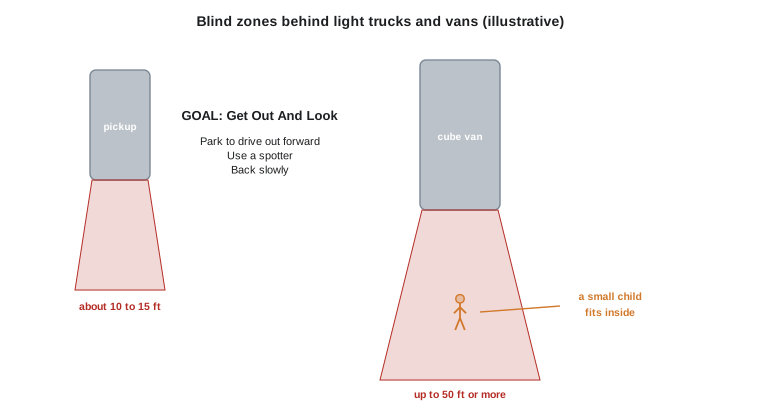
Backing collisions are common in fleets. They usually happen at low speed in parking lots, loading areas, driveways and job sites, and many involve fixed objects such as poles, gates and other vehicles. A minority involve people, often children or co-workers, and these can be fatal. Vans, trucks and pickups have large blind areas directly behind them, sometimes many meters long, in which a person or a small object is completely hidden.
| Practice | Why it works |
|---|---|
| Avoid backing where possible: pull through, park so you can drive out | The safest backing is the backing you do not do |
| Back in on arrival rather than out on departure | You see the space as you pass it, and drive out forward into traffic later |
| GOAL: Get Out And Look | Walk around the vehicle to check for people, objects and overhead hazards |
| Use a spotter where available, with agreed signals | A trained person can see what the driver cannot |
| Back slowly, using mirrors and cameras, and stop if you lose sight of the spotter | Low speed gives time to react |
| Sound the horn or use backup alarms where required | Warns people nearby |
Backup cameras and sensors reduce backing collisions, and rear-view cameras are now required on new light vehicles in both Canada and the United States. They do not remove the need to walk around and look, because cameras have limited fields of view, can be dirty, and do not show what is high or to the sides.
Parking and stopping at the roadside
Choose parking spots that let you leave by driving forward, away from heavy traffic and with good visibility. In parking lots, drive slowly, watch for people walking between cars and for vehicles reversing out, and treat the lot as a shared space. At the roadside, stopping for a delivery, a service call or a breakdown is a high-risk activity because passing traffic may come very close. Pull as far off the road as you safely can, use hazard lights, wear high-visibility clothing when outside the vehicle, and exit on the side away from traffic where possible.
All 50 states have move-over laws that require drivers to slow down and, where safe, move over a lane when passing stopped emergency vehicles, and many now include tow trucks, utility and maintenance vehicles and, in some states, any disabled vehicle with hazard lights flashing. Penalties include fines and points.
For workers who regularly stop at the roadside, such as utility crews or tow operators, the employer's traffic control plan matters even more. HSE-373 covers temporary traffic control and work zones in detail.
Worked problem
Planning a delivery stop
A courier must deliver to a business on a busy two-lane road with no parking. The only options are a narrow paved shoulder or a side street 80 m away. What should he do?
Show solution
- Stopping on a narrow shoulder of a busy road puts him close to passing traffic when he gets out and when he pulls back in.
- The side street lets him park off the main road, out of the traffic stream.
- Parking so he can drive out forward avoids backing out onto the main road later.
- The extra 80 m of walking takes about a minute and removes most of the roadside exposure.
Answer: Use the side street and park to drive out forward. A minute of walking is a small price for avoiding a roadside stop on a busy road.
Common mistakes
MistakeEntering an intersection the instant the light turns green.
InsteadPause and scan for red-light runners first.
MistakeWaiting to turn left with the wheels already turned.
InsteadKeep wheels straight until you go, so a rear-end impact does not push you into oncoming traffic.
MistakeStopping at the end of a highway ramp to wait for a gap.
InsteadUse the acceleration lane to match traffic speed and merge smoothly.
MistakePassing a slightly slower vehicle on a two-lane road to save time.
InsteadPass only where marked and clearly safe; small speed differences need very long clear distances.
MistakeBacking using only the camera.
InsteadAvoid backing where possible, and Get Out And Look before you do.
Summary and key terms
- Treat every intersection as a hazard; scan before entering, even on a green.
- Left turns across traffic are especially risky; keep wheels straight while waiting and choose generous gaps.
- Match traffic speed when merging and use mirror, signal, mirror, shoulder check for lane changes.
- Passing on two-lane roads needs long clear distances; pass only where marked and clearly safe.
- Backing causes many fleet collisions; avoid it, back in on arrival, and Get Out And Look.
- Choose parking that lets you drive out forward and minimize roadside stops on busy roads.
- Move-over laws require slowing and moving over for stopped emergency and service vehicles.
- Stale green
- A traffic light that has been green for some time and may soon change.
- Protected left turn
- A left turn made on a green arrow while oncoming traffic is stopped.
- Acceleration lane
- The lane at the end of an entrance ramp used to reach traffic speed before merging.
- Zipper merge
- Using both lanes up to a merge point, then taking turns to merge.
- Sideswipe
- A collision between vehicles traveling side by side.
- Backing
- Driving a vehicle in reverse.
- GOAL
- Get Out And Look: walking around a vehicle before moving, especially before backing.
- Spotter
- A person who guides a driver during maneuvers with agreed signals.
- Move-over law
- A law requiring drivers to slow down and move over for stopped emergency and service vehicles.
- Roundabout
- A circular intersection where entering traffic yields to traffic already circulating.
Practice problems
Work each problem on paper first, then reveal the answer to check.
What is a stale green, and how should you respond?
Show answer
A light that has been green a while; be ready to stop.
Why keep your wheels straight while waiting to turn left?
Show answer
If you are hit from behind, you will not be pushed into oncoming traffic.
How long might a loaded truck need to clear an intersection from a stop?
Show answer
About eight seconds or more.
List the steps for a lane change.
Show answer
Mirror, signal, mirror, shoulder check, move gradually.
Why is passing a vehicle going only slightly slower than you so risky?
Show answer
The pass takes a long time and needs a very long clear stretch of road.
What does GOAL stand for?
Show answer
Get Out And Look.
Why is backing in on arrival safer than backing out on departure?
Show answer
You see the space as you pass it, and later drive out forward with a clear view.
Do backup cameras replace walking around the vehicle?
Show answer
No; they have limited views, can be dirty and miss high or side objects.
What do move-over laws require?
Show answer
Slowing down and moving over a lane where safe for stopped emergency and specified service vehicles.
Name three precautions for a roadside stop.
Show answer
Any three: pull well off, hazard lights, high-visibility clothing, exit away from traffic, use a safer location if available.
Lesson quiz · 5 questions
Score 60% or more to complete this lesson.
Create a free account to save your progress, take quizzes and earn a certificate.