
HSE-252 · Lesson 11 of 12 · 25 min
Fleet safety programs and the law
Individual drivers make the decisions on the road, but organizations shape those decisions: who is allowed to drive, what vehicles they use, how schedules are set, what training they receive and what happens when things go wrong. A fleet safety program brings these together into a system. This lesson covers employers' legal duties for work driving, the regulatory systems for commercial carriers, and the elements of an effective fleet safety program, including driver selection, policies, training, telematics and measuring performance.
The employer's legal duties
Under the Occupational Safety and Health Act, employers have a general duty to provide a workplace free of recognized hazards likely to cause death or serious harm. OSHA does not generally regulate driving on public roads, which falls to the Department of Transportation and the states, but it can cite employers under the general duty clause for practices such as requiring employees to text while driving, and it requires work-related motor vehicle injuries to be recorded. Employers are also usually vicariously liable in civil law for collisions caused by employees driving in the course of their work, and lawsuits over serious truck and fleet crashes can result in very large verdicts.
Regulation of commercial carriers
Interstate commercial motor vehicle carriers must register with FMCSA and obtain a USDOT number. FMCSA's Compliance, Safety, Accountability (CSA) program uses roadside inspection, crash and investigation data in its Safety Measurement System to rank carriers in categories called BASICs, such as Unsafe Driving, Hours-of-Service Compliance, Driver Fitness, Controlled Substances and Alcohol, Vehicle Maintenance, Hazardous Materials Compliance and Crash Indicator. Carriers with poor scores face warning letters, investigations and, ultimately, orders to stop operating. Many states regulate intrastate carriers in similar ways.
| Element | Purpose |
|---|---|
| USDOT number and operating authority | Registration to operate commercial motor vehicles |
| Safety Measurement System (CSA) | Ranks carriers by BASIC categories |
| Compliance review or investigation | Review of a carrier's records and safety programs |
| FMCSA regulations | Rules on hours of service, inspections, cargo securement, drug testing and driver qualification |
Regulation of commercial carriers does not cover most light vehicles, such as cars, pickups and vans used by trades, sales and service staff. For those, the employer's own program is the main protection.
Building a fleet safety program
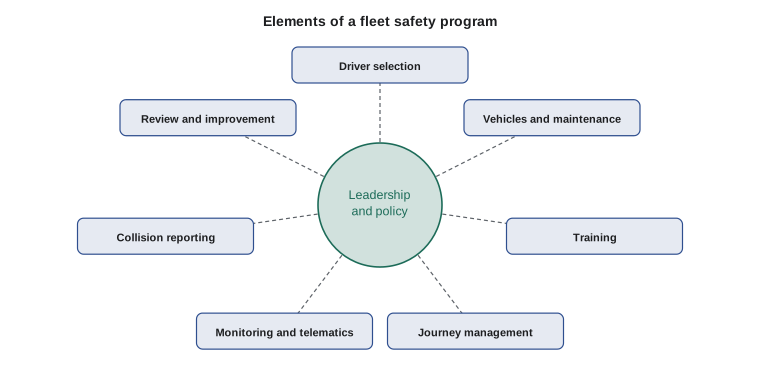
Effective fleet safety programs share common elements. They follow the same management system approach as other safety programs: leadership commitment, hazard identification, controls, training, monitoring and continual improvement. Recognized standards include ISO 39001 for road traffic safety management systems and, in the United States, the ANSI/ASSP Z15.1 standard on safe practices for motor vehicle operations.
Driver selection and qualification
Before allowing someone to drive for work, employers should confirm they hold a valid license of the right class, check their motor vehicle record (MVR) with the driver's written consent under the Fair Credit Reporting Act when a third party is used, and confirm medical fitness where required. CMV drivers must meet FMCSA driver qualification rules, including a medical examiner's certificate, an annual MVR review and, before hiring, a query of the Drug and Alcohol Clearinghouse. Workers who drive personal vehicles for work should provide proof of insurance that covers business use.
Policies
Clear written policies tell drivers what is expected. A typical fleet safety policy covers seatbelt use by all occupants, phone and device use, impairment, speed, fatigue limits for non-commercial drivers, use of company vehicles by family members, passengers, carrying tools and loads, pre-trip inspections, reporting defects, collisions and convictions, and driving in severe weather. Policies work only if managers follow them, explain the reasons, and apply them fairly.
Training
Training should match the risk. New drivers and drivers moving to a larger vehicle need practical, vehicle-specific training. All drivers benefit from periodic defensive driving refreshers, and targeted coaching after incidents or poor telematics scores. Training on winter driving before the season, on new vehicle technology, and on routes with special hazards, such as resource roads, adds value. Records of training should be kept.
Telematics and in-vehicle monitoring
Telematics systems record data such as location, speed, harsh braking, rapid acceleration, cornering, seatbelt use and idling. Some fleets add forward- and driver-facing cameras that record events. Used well, these tools give drivers feedback, identify risky patterns, support coaching, help investigations and often reduce collisions. Used badly, as tools for surveillance and punishment without explanation, they damage trust and can be gamed.
# Simple telematics risk score per 100 km (illustrative weights; real systems vary).
drivers = {
    "Driver A": {"km": 2400, "harsh_brake": 6, "harsh_accel": 4, "speeding_min": 35, "phone_events": 0},
    "Driver B": {"km": 1800, "harsh_brake": 22, "harsh_accel": 15, "speeding_min": 140, "phone_events": 5},
    "Driver C": {"km": 3100, "harsh_brake": 9, "harsh_accel": 3, "speeding_min": 60, "phone_events": 1},
}
weights = {"harsh_brake": 1.0, "harsh_accel": 0.7, "speeding_min": 0.1, "phone_events": 3.0}
for name, d in drivers.items():
    events = sum(weights[k] * d[k] for k in weights)
    score = events / d["km"] * 100
print(f"{name}: {score:4.2f} weighted events per 100 km ({d['km'] / 1.609:,.0f} miles driven)")Driver A: 0.51 weighted events per 100 km (1,492 miles driven) Driver B: 3.42 weighted events per 100 km (1,119 miles driven) Driver C: 0.65 weighted events per 100 km (1,927 miles driven)
Normalizing events by distance, as in that example, matters; a driver who covers more ground will naturally record more events. Scores should start conversations, not end them. A high harsh-braking count might mean a driver is following too closely, or it might mean a congested urban route; coaching should find out which.
Monitoring must respect privacy and labor law. A few states, including New York, Connecticut and Delaware, require employers to give notice of electronic monitoring of employees, and several state privacy laws are expanding rules on employee data. Unionized workplaces may need to bargain over monitoring. Employers should tell drivers what is collected, why, who can see it and how long it is kept.
Measuring performance
Fleet safety performance is usually measured with rates that allow comparison over time and between groups. Lagging indicators measure outcomes, such as collisions per million kilometers or miles, injuries, and costs. Leading indicators measure activities that prevent collisions, such as the percentage of drivers trained, completed pre-trip inspections, telematics events per 100 km, and the time taken to repair reported defects. Both are useful; leading indicators show problems before collisions happen.
# Fleet collision rate and cost (illustrative data for one year).
collisions = 14
preventable = 9
distance_km = 2_850_000
cost_direct = 96_000      # repairs, deductibles
cost_indirect_factor = 2.5  # downtime, admin, lost productivity often exceed direct costs (illustrative)
rate = collisions / (distance_km / 1_000_000)
print(f"Collision rate: {rate:.1f} per million km ({collisions / (distance_km / 1.609 / 1_000_000):.1f} per million miles)")
print(f"Preventable share: {preventable / collisions:.0%}")
print(f"Estimated total cost: ${cost_direct * (1 + cost_indirect_factor):,.0f} (direct ${cost_direct:,})")Collision rate: 4.9 per million km (7.9 per million miles) Preventable share: 64% Estimated total cost: $336,000 (direct $96,000)
Many fleets classify each collision as preventable or not preventable, asking whether the driver failed to do everything reasonable to avoid it. This is not the same as legal fault: a driver might be rear-ended at a light (not preventable) or might hit a car that ran a stop sign after failing to scan the intersection (possibly preventable). The classification helps target coaching and training.
Worked problem
Starting a program for a small fleet
A property management company has 25 staff who drive company pickups and their own cars to maintain buildings. It has no fleet safety program. Where should it start?
Show solution
- Leadership: management issues a short policy statement and assigns a fleet safety coordinator.
- Inventory: list all drivers and vehicles, including personal vehicles used for work, and check licenses, abstracts or MVRs, and insurance.
- Policies: adopt rules on seatbelts, phones, impairment, fatigue, pre-trip checks and reporting.
- Vehicles: set a maintenance schedule, a defect reporting method and winter tire policy where relevant.
- Training: provide defensive driving awareness for all drivers and vehicle-specific training for pickups.
- Measure: track collisions, near misses and inspections, and review them quarterly.
Answer: Start with leadership, driver and vehicle records, a short set of policies, maintenance and training, then measure and improve. Telematics can come later once the basics are in place.
Vehicle selection
The vehicles a fleet buys shape its safety for years. When choosing vehicles, fleets can favor models with high crash test ratings and proven safety technology such as automatic emergency braking, lane departure warning, blind-spot monitoring and rear cross-traffic alerts. Vans should have bulkheads and cargo restraints, and trucks may need side guards and camera systems to protect cyclists and pedestrians. The smallest vehicle that does the job is often the safest choice, because it is easier to maneuver and see around.
Contractors and rental vehicles
Fleet safety programs should also cover contractors who drive on the organization's behalf and rental vehicles used by employees. Contracts can require contractors to have their own driving policies, insurance and license checks. Employees using rental vehicles should inspect them before driving, adjust mirrors and seats, and take time to learn the controls, because unfamiliar vehicles add risk on the first trip.
Culture
Policies and technology matter, but culture decides whether they work. In a strong safety culture, drivers believe managers want them to arrive safely more than they want the job done fast, they report incidents and near misses without fear, and they speak up when schedules are unrealistic. Managers build that culture through what they do: not calling drivers they know are on the road, approving overnight stays without argument, praising safe decisions, and fixing the problems drivers raise.
Seatbelts and vehicle occupants
Seatbelts remain the single most effective protection in a collision, cutting the risk of death for front-seat occupants by roughly half in many studies. All provinces and states require seatbelt use, with some exceptions, but compliance among work drivers, especially in pickups and on short trips around job sites, is often lower than among the general public. Fleet policies should require every occupant to buckle up on every trip, and telematics systems that detect unbuckled driving can support coaching. Policies should also cover how many people may ride in a vehicle and forbid riding in cargo areas or truck beds.
Allowing personal use of fleet vehicles
Some employers let employees take vehicles home or use them for personal errands. That can be a valued benefit, but it extends the employer's exposure. Policies should state who may drive the vehicle (often only the employee, not family members), whether alcohol is ever permitted in the vehicle, and how personal use is recorded for tax purposes.
Common mistakes
MistakeAssuming workplace safety law stops at the parking lot.
InsteadA vehicle used for work is a workplace, and the employer's duties apply.
MistakeIgnoring employees who drive their own cars for work.
InsteadInclude them: check licenses, insurance and vehicle condition, and apply the policy.
MistakeUsing telematics only to punish drivers.
InsteadUse data for coaching and feedback, explain it, and respect privacy law.
MistakeMeasuring only collisions.
InsteadTrack leading indicators such as training, inspections and telematics events too.
MistakeTreating commercial carrier rules as covering all fleet vehicles.
InsteadLight vehicles are mostly outside carrier regulation, so the employer's program must cover them.
Summary and key terms
- Employers have legal duties to protect workers who drive, and can be liable for their collisions.
- Commercial carriers are regulated through safety ratings, audits and detailed rules.
- Light-vehicle fleets depend mainly on the employer's own program.
- A fleet safety program covers leadership, driver selection, vehicles, policies, training, journey management, monitoring and investigation.
- Check licenses, driving records, medical fitness and insurance before and during employment.
- Use telematics for coaching and improvement, and comply with privacy and monitoring laws.
- Measure with both lagging and leading indicators, normalized by distance driven.
- Fleet safety program
- An organized system for managing the risks of work driving.
- General duty
- A broad legal obligation on employers to protect workers from hazards.
- Vicarious liability
- Legal responsibility of an employer for harm caused by employees acting in the course of their work.
- Safety fitness certificate
- A Canadian authorization for a carrier to operate commercial vehicles.
- CVOR
- Commercial Vehicle Operator's Registration, Ontario's carrier registration and safety record system.
- USDOT number
- The identifier issued to carriers registered with FMCSA.
- Driver abstract
- An official record of a driver's license status, convictions and suspensions.
- Leading indicator
- A measure of preventive activity that predicts future performance.
- Lagging indicator
- A measure of outcomes such as collisions and injuries.
- Preventable collision
- A collision the driver could reasonably have avoided by driving defensively.
Practice problems
Work each problem on paper first, then reveal the answer to check.
Why does an employer's safety duty apply to driving?
Show answer
A vehicle used for work is a workplace.
What does CSA stand for in the FMCSA context?
Show answer
Compliance, Safety, Accountability.
Name two standards for road traffic safety management.
Show answer
ISO 39001 and ANSI/ASSP Z15.1.
What should be checked before someone drives for work?
Show answer
A valid license of the right class, driving record, medical fitness where required and, for personal vehicles, business-use insurance.
List five topics a fleet safety policy should cover.
Show answer
Any five: seatbelts, phones, impairment, speed, fatigue, passengers, loads, inspections, reporting, severe weather.
Why should telematics events be normalized by distance?
Show answer
Drivers who cover more ground naturally record more events.
Give an example of a leading indicator.
Show answer
Percentage of drivers trained, completed inspections, telematics events per 100 km, or defect repair time.
What is the difference between preventable and at fault?
Show answer
Preventable asks whether the driver could reasonably have avoided the collision; fault is a legal decision.
Calculate a collision rate for 6 collisions in 1.5 million km.
Show answer
4 collisions per million km.
What should employers tell drivers about telematics data?
Show answer
What is collected, why, who can see it and how long it is kept.
Lesson quiz · 5 questions
Score 60% or more to complete this lesson.
Create a free account to save your progress, take quizzes and earn a certificate.