
HSE-252 · Lesson 8 of 12 · 25 min
Vehicle inspection and maintenance
A well-maintained vehicle is a basic safety control. Brakes that work, tires with good tread and the right pressure, clear glass, working lights and secure loads all make collisions less likely and less severe. Vehicle defects contribute to only a minority of collisions directly, but they often make the difference between a near miss and a crash. This lesson covers the pre-trip inspection, the main items to check, the legal inspection requirements for commercial vehicles, maintenance programs and securing loads.
The pre-trip inspection
A pre-trip inspection, sometimes called a circle check or walk-around, is a quick, systematic check of the vehicle before driving. For a car or light truck it takes only a few minutes. Walk around the vehicle in the same order every time so nothing is missed, then check the inside. Report any defect according to company procedure, and do not drive a vehicle with a defect that makes it unsafe, such as faulty brakes, a damaged tire or steering problems.
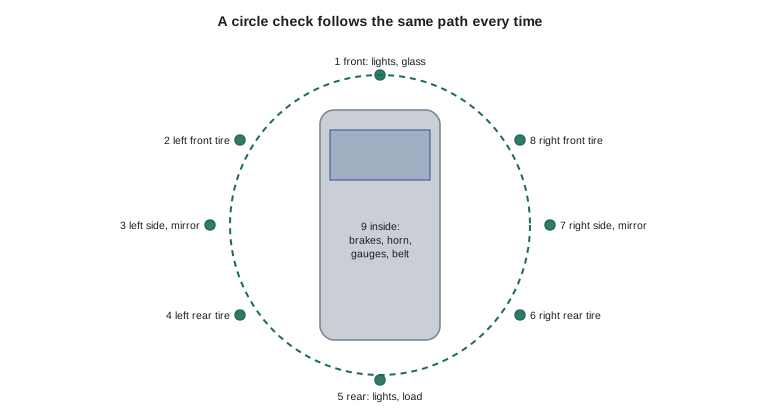
| Area | What to check |
|---|---|
| Around the vehicle | Leaks under the vehicle, body damage, objects or people nearby |
| Tires and wheels | Inflation, tread depth, cuts or bulges, missing wheel nuts |
| Lights | Headlights, tail and brake lights, signals, hazard lights, clearance lights |
| Glass and mirrors | Clean, uncracked windshield; mirrors clean and adjusted |
| Load and equipment | Cargo secured, tailgate and doors closed, ladder racks tied |
| Under the hood (periodically) | Oil, coolant, washer fluid, brake fluid, belts |
| Inside | Brakes and parking brake, steering, horn, wipers, washers, gauges, seatbelt, warning lights |
| Emergency equipment | First aid kit, fire extinguisher, warning triangles, winter kit in season |
Tires
Tires are the only contact between the vehicle and the road, and their condition has a large effect on braking and handling, especially in the wet. Two checks matter most. First, inflation: check pressure with a gauge when tires are cold, and inflate to the vehicle maker's figure on the door-jamb placard, not the maximum printed on the tire. Underinflated tires overheat, wear faster, increase fuel use and can fail. Second, tread depth: deeper tread clears water and grips snow.
Most US states set a minimum tread depth of 2/32 inch (about 1.6 mm) for passenger vehicles. Federal rules for commercial motor vehicles (49 CFR 393.75) require at least 4/32 inch on steering-axle tires and 2/32 inch on other tires. Wear bars become flush with the tread at 2/32 inch, and many experts recommend replacing tires at 4/32 inch for wet-road safety and 6/32 inch for snow.
# Tread depth checks: mm and 32nds of an inch (illustrative fleet thresholds).
def to_32nds(mm):
    return mm / 25.4 * 32

readings_mm = {"LF": 6.2, "RF": 5.9, "LR": 3.1, "RR": 1.4}
for pos, mm in readings_mm.items():
    if mm < 1.6:
        status = "below legal minimum - remove from service"
    elif mm < 3.2:
        status = "replace soon (poor wet grip)"
    else:
        status = "OK"
    print(f"{pos}: {mm:.1f} mm = {to_32nds(mm):4.1f}/32 in  -> {status}")
# Pressure check against a door-placard value of 240 kPa (35 psi)
for pos, kpa in {"LF": 238, "RF": 205, "LR": 241, "RR": 236}.items():
    low = (240 - kpa) / 240
print(f"{pos}: {kpa} kPa ({kpa * 0.145:.0f} psi) {'LOW by ' + format(low, '.0%') if low > 0.1 else 'OK'}")LF: 6.2 mm = 7.8/32 in -> OK RF: 5.9 mm = 7.4/32 in -> OK LR: 3.1 mm = 3.9/32 in -> replace soon (poor wet grip) RR: 1.4 mm = 1.8/32 in -> below legal minimum - remove from service LF: 238 kPa (35 psi) OK RF: 205 kPa (30 psi) LOW by 15% LR: 241 kPa (35 psi) OK RR: 236 kPa (34 psi) OK
Brakes, steering and lights
Signs of brake problems include a soft or spongy pedal, a pedal that sinks toward the floor, grinding or squealing, pulling to one side and a brake warning light. Steering problems include excessive play, vibration and pulling. Any of these is a reason to stop using the vehicle until it is repaired. Lights are easy to check and often neglected: walk around with the lights on, or use a reflection in a window at night. A burnt-out brake light means drivers behind you get no warning when you slow down.
Commercial vehicle inspection rules
For commercial motor vehicles, FMCSA rules require drivers to be satisfied that the vehicle is in safe operating condition before driving it (49 CFR 396.13) and to prepare a driver vehicle inspection report (DVIR) at the end of each day's work covering brakes, steering, lights, tires, horn, wipers, mirrors, coupling devices, wheels and emergency equipment (49 CFR 396.11). Since 2014, property-carrying drivers need to prepare a DVIR only when a defect or deficiency is found or reported. Defects affecting safe operation must be repaired, and the repair certified, before the vehicle is driven again. Commercial motor vehicles must also pass a periodic inspection at least once every 12 months (49 CFR 396.17).
| Defect class | Examples | Action |
|---|---|---|
| Defect not affecting safety | Interior trim, minor cosmetic damage | Note and schedule repair |
| Defect affecting safe operation | Brake problems, steering problems, tire with exposed cord, lights out, loose coupling | Do not drive until repaired and certified |
Roadside inspections by state officers follow the Commercial Vehicle Safety Alliance (CVSA) out-of-service criteria used across North America. A vehicle found with an out-of-service defect is taken off the road until repaired, and violations feed into the carrier's Compliance, Safety, Accountability (CSA) scores, which lesson 11 covers.
Maintenance programs
Daily checks catch obvious problems, but they do not replace scheduled maintenance. A fleet maintenance program sets service intervals for each vehicle, based on the manufacturer's schedule, distance and engine hours, and the type of use. It tracks defects reported by drivers through to repair, handles manufacturer safety recalls promptly, and keeps records. Good programs make reporting defects easy and quick, so drivers are not tempted to ignore them, and give someone clear authority to take a vehicle out of service.
| Element | Example practice |
|---|---|
| Preventive maintenance schedule | Oil, filters, brakes, tires and inspections at set intervals by distance or time |
| Defect reporting | App or form for drivers; defects acknowledged within a set time |
| Out-of-service authority | Supervisor or mechanic can tag a vehicle unsafe and lock it out |
| Recall management | Check vehicle identification numbers against recall notices and repair promptly |
| Records | Service history, inspection reports and repairs kept for each vehicle |
| Personal vehicles | Policy requiring roadworthy condition, valid registration and adequate insurance |
Securing loads
Unsecured loads cause collisions in two ways. Items falling from vehicles strike other road users or cause them to swerve, and items moving inside the vehicle can strike the driver in a sudden stop or crash. In a frontal collision at 50 km/h, a loose 10 kg toolbox can hit with a force equivalent to hundreds of kilograms. Tools and equipment in vans should be stored in fixed racks or bins, behind a bulkhead separating the cargo area from the cab, and ladders and materials on roof racks should be tied down with rated straps.
# Why loose objects are dangerous in a crash: effective force during a sudden stop.
g = 9.81
def effective_weight_kg(mass_kg, kmh, stop_distance_m):
    v = kmh / 3.6
    decel = v ** 2 / (2 * stop_distance_m)      # average deceleration in m/s^2
    return mass_kg * decel / g                  # equivalent static load in kg

for item, mass in [("phone", 0.2), ("laptop", 2), ("toolbox", 10)]:
    for kmh in (50,):
        w = effective_weight_kg(mass, kmh, 0.6)   # cab crushes/stops over about 0.6 m
print(f"{item:8s} {mass:5.1f} kg at {kmh} km/h ({kmh / 1.609:.0f} mph): acts like about {w:6.0f} kg ({w * 2.205:6.0f} lb)")phone 0.2 kg at 50 km/h (31 mph): acts like about 3 kg ( 7 lb) laptop 2.0 kg at 50 km/h (31 mph): acts like about 33 kg ( 72 lb) toolbox 10.0 kg at 50 km/h (31 mph): acts like about 164 kg ( 361 lb)
Commercial motor vehicles must follow the FMCSA cargo securement rules (49 CFR 393.100 to 393.136), which set requirements for tiedowns, working load limits and specific commodities. Many states also have general unsecured-load laws for any vehicle, with higher penalties when debris causes injury.
Worked problem
Is the van fit to drive?
During his morning circle check, a technician finds one rear tire visibly low, a brake light out, and a ladder on the roof rack held by a single frayed strap. He is already late. What should he do?
Show solution
- Check the low tire with a gauge. If it is well below the placard pressure or has a puncture, it must be inflated or repaired before driving.
- A brake light out is a safety defect that reduces warning to drivers behind. Report it and get it fixed before driving if possible.
- Replace the frayed strap and secure the ladder with at least two rated straps.
- Report all three defects through the company system, and tell dispatch he will be late.
Answer: Fix or report the defects before driving. Being late is not a reason to drive an unsafe vehicle, and the company should back that decision.
Electric and hybrid vehicles
Many fleets are adding electric vans and pickups. Their daily checks are similar, with a few differences. Check the charge level and planned range before leaving, especially in cold weather, which can reduce range substantially. Inspect charging cables and connectors for damage, and never use a damaged cable. Electric vehicles are heavy because of their batteries, which affects tire wear and braking, so tire checks matter even more. They are also very quiet at low speed, so drivers should take extra care around pedestrians in parking lots and yards. High-voltage systems should be serviced only by trained technicians, and any damage to the battery area after a collision should be reported.
Using the inspection to start a conversation
A pre-trip inspection is also a moment to check the driver. Are you rested, fit and focused today? Do you know the route and the weather? Is anything on your mind that might distract you? Some fleets build these questions into the daily inspection app, so drivers confirm their own readiness along with the vehicle's. A driver who answers honestly that they slept badly can be given a shorter route or a co-driver, which is a far better outcome than discovering the problem after a collision.
Weekly and monthly checks
Some items need checking less often than daily, such as fluid levels under the hood, the spare tire, the fire extinguisher's gauge and inspection tag, and the contents of the first aid and winter kits. A simple weekly checklist helps, and the results can be recorded in the same app as daily checks.
Common mistakes
MistakeInflating tires to the maximum pressure printed on the sidewall.
InsteadUse the vehicle maker's pressure on the door-jamb placard, checked cold.
MistakeDriving on tires at the legal tread limit through winter.
InsteadReplace tires well before the legal limit for wet and winter grip.
MistakeSkipping the pre-trip check when in a hurry.
InsteadA few minutes of checking is part of the job; do not drive with safety defects.
MistakeLeaving tools and equipment loose in the cab.
InsteadSecure them in racks or behind a bulkhead.
MistakeAssuming drivers will report defects without an easy system.
InsteadProvide a quick reporting method and act on reports promptly.
Summary and key terms
- Pre-trip inspections catch defects before they cause collisions; follow the same order every time.
- Check tire pressure against the door placard and replace tires well before the legal tread limit.
- Brake, steering, light and glass defects make a vehicle unsafe to drive until repaired.
- Commercial vehicles have legal trip or daily inspection and periodic inspection requirements.
- A fleet maintenance program schedules service, tracks defects and manages recalls.
- Secure loads inside and outside the vehicle; loose objects become dangerous projectiles.
- Drivers and supervisors must have authority to take unsafe vehicles out of service.
- Pre-trip inspection
- A systematic check of a vehicle before it is driven.
- Circle check
- A walk-around inspection following a set path around the vehicle.
- Tread depth
- The depth of the grooves in a tire's tread.
- Wear bar
- A raised bar in a tire groove that shows when tread has reached the legal minimum.
- Door-jamb placard
- A label on the driver's door frame giving recommended tire pressures and loads.
- Major defect
- A defect that makes a vehicle unsafe to drive until repaired.
- Out-of-service criteria
- Standards used at roadside inspections to remove unsafe vehicles from service.
- Preventive maintenance
- Scheduled servicing to prevent failures.
- Recall
- A manufacturer's notice that a vehicle has a safety defect needing repair.
- Cargo securement
- Methods of restraining loads so they do not shift or fall.
Practice problems
Work each problem on paper first, then reveal the answer to check.
Why should a circle check follow the same order each time?
Show answer
So nothing is missed.
What pressure should tires be inflated to?
Show answer
The vehicle maker's figure on the door-jamb placard, checked when cold.
What is the minimum tread depth for steering-axle tires on commercial motor vehicles?
Show answer
4/32 inch.
Name three signs of brake problems.
Show answer
Any three: soft or sinking pedal, grinding or squealing, pulling to one side, warning light.
When must a property-carrying CMV driver prepare a DVIR?
Show answer
When a defect or deficiency is found or reported.
What should happen to a vehicle with a major defect?
Show answer
It must not be driven until repaired.
Name three elements of a fleet maintenance program.
Show answer
Any three: preventive schedule, defect reporting, out-of-service authority, recall management, records, personal vehicle policy.
Why are loose objects in the cab dangerous?
Show answer
In a sudden stop they act with many times their weight and can strike occupants.
How should ladders on a roof rack be secured?
Show answer
With at least two rated straps in good condition.
What should a driver do if they find a safety defect but are running late?
Show answer
Report and fix it before driving, and tell dispatch they will be late.
Lesson quiz · 5 questions
Score 60% or more to complete this lesson.
Create a free account to save your progress, take quizzes and earn a certificate.