
HSE-252 · Lesson 1 of 12 · 28 min
Why driving is the riskiest thing most workers do
Ask a group of workers what the most dangerous part of their job is, and most will name something on the site: working at heights, heavy equipment, electricity, chemicals. Few will name the drive to the site. Yet for most people who drive as part of their work, the road is the single biggest risk they face. A delivery driver, a home care nurse, a sales representative, an electrician with a service van, a supervisor who drives between projects and a forestry worker on a logging road all share the same hazard: a vehicle moving at speed, surrounded by other vehicles, people, animals and weather.
This course is for people who drive for work and for the supervisors and fleet managers who are responsible for them. It covers how collisions happen, how to drive defensively, how fatigue, distraction and impairment raise risk, how to drive in winter and at night, how to check a vehicle, and how employers build fleet safety programs. It is awareness training. It is not a driver's license course and it does not meet the Federal Motor Carrier Safety Administration (FMCSA) Entry-Level Driver Training (ELDT) rule, which since 7 February 2022 has required training from a provider on the Training Provider Registry before a first commercial driver's license (CDL) skills test. Your employer must also give you training specific to its vehicles, loads and routes.
The numbers
In the United States, transportation incidents are the leading cause of death at work. The Bureau of Labor Statistics Census of Fatal Occupational Injuries counted 5,070 fatal work injuries in 2024, and 1,937 of them, 38.2 percent, were transportation incidents. Roadway incidents involving motorized land vehicles alone accounted for 1,146 deaths, about 23 percent of all work deaths. These figures do not count ordinary commuting, so the true burden of driving on working people is larger still.
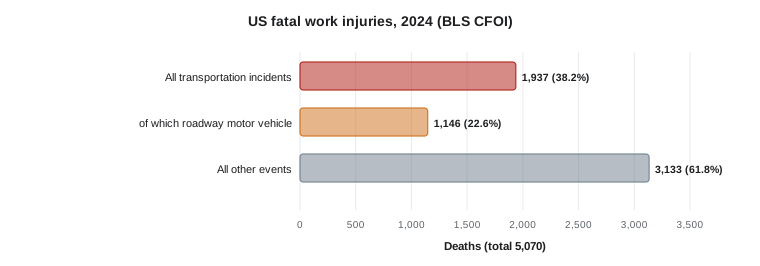
Behind each statistic are many more injuries. For every death on the road there are dozens of serious injuries and hundreds of minor collisions: whiplash, fractures, concussions, and the bent fenders and broken mirrors that fleets pay for every week. Collisions are also among the most expensive incidents an employer faces, because they combine injury costs, vehicle repair or replacement, liability to third parties and lost work.
# Exposure adds up: how far does a working driver go in a year? (illustrative)
km_per_day = 180          # a service technician's typical day
days_per_year = 230
km_year = km_per_day * days_per_year
print(f"Annual distance: {km_year:,} km  ({km_year / 1.609:,.0f} miles)")
# Illustrative fleet collision rate: 4 collisions per million km driven
rate_per_million_km = 4.0
expected = km_year / 1_000_000 * rate_per_million_km
print(f"Expected collisions per driver-year at that rate: {expected:.2f}")
for years in (5, 10, 20):
print(f"Chance of at least one collision in {years:>2} years: about {1 - (1 - expected) ** years:.0%}")Annual distance: 41,400 km (25,730 miles) Expected collisions per driver-year at that rate: 0.17 Chance of at least one collision in 5 years: about 60% Chance of at least one collision in 10 years: about 84% Chance of at least one collision in 20 years: about 97%
Why the road is different from the site
On a construction site or in a plant, the employer controls almost everything: who is allowed in, how equipment is guarded, what the speed limit is, where pedestrians walk, and how work is supervised. On a public road, the employer controls far less. Other drivers, cyclists and pedestrians are not trained, supervised or even aware of the employer's rules. Weather and road conditions change by the hour. The driver is alone most of the time, with no supervisor watching and no co-worker to stop them when they are tired or distracted. That is why fleet safety relies so heavily on the driver's own judgment, habits and training, and on systems that support them.
The road is also familiar, and familiarity breeds complacency. Most adults have driven for years without a serious crash, so they come to think of driving as low risk and of themselves as better than average. Surveys in many countries have found that a large majority of drivers rate their own skill as above average, which cannot be true of most of them. That optimism makes it easy to answer one more message, push on when tired or drive a little faster to make up time.
| Feature | Typical worksite | Public road |
|---|---|---|
| Who controls the environment | The employer | Mostly no one; shared with the public |
| Training of others present | Workers are trained and inducted | Other road users have only a license or none |
| Supervision | Supervisors present | Driver usually alone |
| Conditions | Mostly stable and planned | Weather, traffic and light change constantly |
| Speeds and energy | Low speeds on site | Highway speeds with very high energy |
| Perceived risk | Often seen as dangerous | Often seen as routine |
Who drives for work
Driving for work is not only for professional truck and bus drivers. It includes anyone who drives a vehicle for a work purpose, whether the vehicle belongs to the employer or the worker. Many workers who drive their own car to a client's home or between offices do not think of themselves as fleet drivers, and their employers sometimes forget them too. Most occupational health and safety laws treat a vehicle used for work as a workplace, so the employer's general duty to protect workers applies on the road as well as in the building. Lesson 11 looks at what this means for employers.
| Group | Examples | Typical vehicles |
|---|---|---|
| Professional drivers | Long-haul and local truck drivers, bus and transit operators, couriers | Tractor-trailers, straight trucks, buses, vans |
| Mobile trades and services | Electricians, plumbers, HVAC and appliance technicians, utility crews | Pickup trucks and service vans |
| Health and social services | Home care nurses, personal support workers, social workers | Personal cars |
| Sales and management | Sales representatives, supervisors, inspectors, real estate agents | Company or personal cars |
| Resource and rural work | Forestry, mining, oil and gas, agriculture workers | Pickups on gravel and resource roads, ATVs |
| Occasional drivers | Office staff running errands, students on placements | Rental or personal cars |
Worked problem
Recognizing a work driver
A community agency's office manager drives her own car to the bank twice a week to make deposits and occasionally picks up supplies. Does the agency need to think about her driving?
Show solution
- The trips are made for a work purpose, during work time, at the employer's request.
- Her car is therefore being used as a workplace for those trips, even though she owns it.
- The agency should confirm she holds a valid license, has adequate insurance for business use, and knows its policy on phones, fatigue and reporting collisions.
- It should also make sure she is not pressured to drive in severe weather or when unwell.
Answer: Yes. Occasional work driving in a personal vehicle is still work driving, and the employer's duties apply to those trips.
Energy: why speed matters so much
The damage done in a collision depends on the energy that must be absorbed, and that energy grows with the square of speed. Kinetic energy is one half of mass times speed squared. Doubling speed does not double the energy, it quadruples it. Even small increases in speed make a large difference. This is why a crash at 60 km/h is far more likely to kill a pedestrian than one at 30 km/h, and why speed is the single factor most closely linked to crash severity.
# Kinetic energy grows with the square of speed (a 2,000 kg pickup).
mass = 2000  # kg
def ek_kj(kmh):
    v = kmh / 3.6
    return 0.5 * mass * v ** 2 / 1000
base = ek_kj(80)
for kmh in (50, 80, 88, 100, 120):
    print(f"{kmh:>3} km/h ({kmh / 1.609:5.1f} mph): {ek_kj(kmh):7.0f} kJ  ({ek_kj(kmh) / base:4.2f} x the energy at 80 km/h)")
print(f"A 10% speed increase (80 to 88 km/h) adds {ek_kj(88) / base - 1:.0%} more energy")50 km/h ( 31.1 mph): 193 kJ (0.39 x the energy at 80 km/h) 80 km/h ( 49.7 mph): 494 kJ (1.00 x the energy at 80 km/h) 88 km/h ( 54.7 mph): 598 kJ (1.21 x the energy at 80 km/h) 100 km/h ( 62.2 mph): 772 kJ (1.56 x the energy at 80 km/h) 120 km/h ( 74.6 mph): 1111 kJ (2.25 x the energy at 80 km/h) A 10% speed increase (80 to 88 km/h) adds 21% more energy
Worked problem
What 10 percent faster really means
A driver usually travels a rural highway at 55 mph but decides to drive at about 60.5 mph, about 10 percent faster, to save time. How much more energy will a crash involve, and how much time does the driver save on a 40 mile trip?
Show solution
- Energy is proportional to speed squared, so the ratio is 1.1² = 1.21, about 21 percent more energy.
- At 55 mph, 40 miles takes about 43.6 minutes. At 60.5 mph it takes about 39.7 minutes.
- The saving is under four minutes, and in real traffic it is usually less, because of slower vehicles, lights and curves.
Answer: About 21 percent more crash energy for a saving of under four minutes. The trade is almost never worth it.
Causes are rarely just bad luck
Collisions are often described as accidents, as if they were random events no one could foresee. Research on crashes tells a different story. Most collisions involve a chain of factors that combine: a driver who is slightly tired, a phone notification, a wet road, a worn tire, a schedule that leaves no slack, and a junction with poor sight lines. Remove any one link and the crash might not happen. Lesson 2 examines this chain in detail and introduces the main human factors. The rest of the course looks at each link and what drivers and employers can do about it.
That view is hopeful, because it means most collisions can be prevented. The same tools that work on site work on the road: identify the hazards, eliminate or reduce them where possible, plan the work, train people, supervise, and learn from every incident and near miss. Lesson 12 brings these tools together in a fleet safety and journey management plan for a service company.
The rest of this course
Lessons 2 to 4 cover how collisions happen and the core defensive driving techniques. Lessons 5 and 6 deal with distraction, impairment and fatigue, including hours-of-service rules for commercial drivers. Lesson 7 covers winter, night and bad weather. Lesson 8 covers vehicle inspection and maintenance, and lesson 9 sharing the road with vulnerable road users and large vehicles. Lesson 10 explains what to do after a collision, lesson 11 how employers build fleet safety programs, and lesson 12 is the capstone plan. Related courses include HSE-218 for forklifts and other powered mobile equipment on site, HSE-250 for transporting dangerous goods, HSE-373 for traffic control and work zones, and HSE-243 for cold stress.
Common mistakes
MistakeThinking driving is low risk because you have never had a serious crash.
InsteadRoad crashes are among the leading causes of work deaths; past luck is not a safety system.
MistakeAssuming only professional truck drivers drive for work.
InsteadAnyone driving for a work purpose, in any vehicle, is a work driver.
MistakeTreating speed as a small factor if you are a skilled driver.
InsteadCrash energy rises with the square of speed, so small increases have large effects.
MistakeCalling collisions accidents that cannot be prevented.
InsteadMost collisions come from a chain of factors that can be broken.
MistakeTreating this course as license or commercial driver training.
InsteadIt is awareness training; licensing and entry-level commercial training are separate requirements.
Summary and key terms
- For most people who drive for work, the road is their biggest occupational risk.
- Road vehicle incidents are among the leading causes of work deaths in both Canada and the United States.
- The employer controls far less on the road than on site, so driver habits and supporting systems matter most.
- Anyone who drives for a work purpose is a work driver, whoever owns the vehicle.
- Crash energy rises with the square of speed; small speed increases buy little time and add a lot of risk.
- Most collisions come from a chain of factors that can be identified and broken.
- This is awareness training, not a license course or commercial entry-level training.
- Work driving
- Driving any vehicle for a work purpose, other than ordinary commuting.
- Fleet
- The vehicles an organization owns, leases or uses for its work, including personal vehicles used on business.
- Collision
- Contact between a vehicle and another vehicle, person, animal or object; preferred to the word accident.
- Kinetic energy
- The energy of a moving object, equal to half its mass times the square of its speed.
- Exposure
- The amount of driving a person does, often measured in distance or hours.
- Collision rate
- Collisions per unit of exposure, such as per million kilometers or miles driven.
- Entry-level training
- Mandatory training required before a first commercial license road or skills test.
- Defensive driving
- Driving to prevent collisions despite the actions of others and the conditions around you.
- Optimism bias
- The tendency to believe you are less likely than others to have a crash.
- Complacency
- Reduced attention and care that comes from routine and familiarity.
Practice problems
Work each problem on paper first, then reveal the answer to check.
What share of US work deaths in 2024 were transportation incidents?
Show answer
38.2 percent, or 1,937 of 5,070 deaths.
Give three differences between a worksite and a public road.
Show answer
Any three: who controls the environment, training of others present, supervision, changing conditions, speed and energy, perceived risk.
Name four groups of workers who drive for work besides truck drivers.
Show answer
Any four: trades and service technicians, home care workers, sales staff, supervisors and inspectors, resource workers, occasional drivers.
If speed doubles, what happens to kinetic energy?
Show answer
It becomes four times as large.
A driver goes 10 percent faster. Roughly how much more crash energy is involved?
Show answer
About 21 percent more, because 1.1² = 1.21.
Why is optimism bias dangerous for drivers?
Show answer
It leads drivers to underestimate their risk and accept unsafe choices such as speeding or using a phone.
Is a worker who drives her own car to the bank for her employer a work driver?
Show answer
Yes. The trip is for a work purpose, so the employer's duties apply.
What does it mean to say collisions come from a chain of factors?
Show answer
Several conditions combine, such as fatigue, distraction, weather and vehicle condition; removing one link can prevent the crash.
Why is the word collision preferred to accident?
Show answer
Accident suggests chance; collision describes the event without implying it could not be prevented.
Does this course meet the FMCSA ELDT requirement?
Show answer
No. ELDT must be delivered by a registered provider before a first CDL skills test.
Lesson quiz · 5 questions
Score 60% or more to complete this lesson.
Create a free account to save your progress, take quizzes and earn a certificate.