
HSE-252 · Lesson 3 of 12 · 27 min
Defensive driving I: space, speed and visibility
Defensive driving rests on a simple idea: give yourself enough time and space to see a problem, decide what to do and do it, even when someone else makes a mistake. Three things buy you that time and space: a speed suited to the conditions, a safe gap around your vehicle, and good visibility, meaning both seeing and being seen. This lesson covers all three, starting with how far it really takes to stop.
Stopping distance
Total stopping distance has two parts. Reaction distance is how far the vehicle travels while the driver perceives the hazard and moves to the brake. Braking distance is how far it travels once the brakes are applied until it stops. Reaction distance grows in direct proportion to speed. Braking distance grows with the square of speed, and it depends heavily on how much grip the tires have on the road surface, expressed as a friction coefficient, μ (mu).
In this formula, v is speed in meters per second, t_r is perception–reaction time in seconds, μ is the friction coefficient, and g is 9.81 m/s². Typical values of μ for a car with good tires are around 0.7 on dry pavement, 0.4 to 0.5 on wet pavement, 0.2 on packed snow and 0.1 or less on glare ice. Real values vary with tires, road surface, temperature and the vehicle, so treat any calculation as illustrative. Heavier vehicles such as loaded trucks need considerably longer to stop than cars, because their brakes and tires cannot generate as much deceleration for their mass.
# Stopping distance = reaction distance + braking distance (illustrative friction values).
g = 9.81
def stop_m(kmh, mu, t_r=1.5):
    v = kmh / 3.6
    return v * t_r + v ** 2 / (2 * mu * g)

surfaces = {"dry": 0.7, "wet": 0.45, "snow": 0.2, "ice": 0.1}
print("Speed            " + "  ".join(f"{s:>8}" for s in surfaces))
for kmh in (50, 80, 100):
    row = "  ".join(f"{stop_m(kmh, mu):6.0f} m" for mu in surfaces.values())
    print(f"{kmh:>3} km/h          {row}")
for mph in (30, 50, 60):
    kmh = mph * 1.609
    row = "  ".join(f"{stop_m(kmh, mu) * 3.281:6.0f} ft" for mu in surfaces.values())
print(f"{mph:>3} mph {row}")Speed dry wet snow ice 50 km/h 35 m 43 m 70 m 119 m 80 km/h 69 m 89 m 159 m 285 m 100 km/h 98 m 129 m 238 m 435 m 30 mph 109 ft 133 ft 216 ft 367 ft 50 mph 229 ft 296 ft 528 ft 945 ft 60 mph 304 ft 399 ft 733 ft 1335 ft
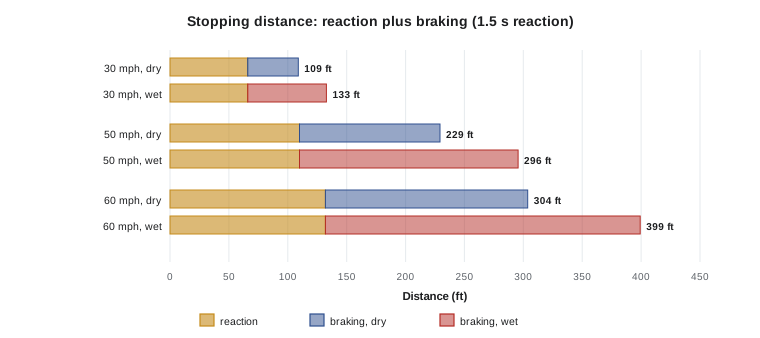
Two lessons stand out from those numbers. First, at highway speed a car travels a long way before the driver even touches the brake, so seeing hazards early matters as much as braking hard. Second, a wet or icy road multiplies braking distance. A following gap that is comfortable on a dry summer afternoon can be far too short on a wet evening.
Worked problem
Can you stop in time?
You are driving at 50 mph on a wet road (μ ≈ 0.45). A car pulls out from a driveway 200 ft ahead and stops across your lane. With a reaction time of 1.5 s, can you stop?
Show solution
- Speed in m/s: 50 mph × 0.447 = 22.4 m/s.
- Reaction distance: 22.4 × 1.5 = 33.5 m, or about 110 ft.
- Braking distance: 22.4² ÷ (2 × 0.45 × 9.81) ≈ 57 m, or about 186 ft.
- Total: about 296 ft, which is more than the 200 ft available.
Answer: No. You would still be traveling fast when you reached the car. Slowing down where driveways and side roads are close together is the defensive answer.
Following distance: the time gap
The most common type of collision for many fleets is the rear-end crash, and the main cause is following too closely. Because stopping distance depends on speed, a fixed distance gap does not work. Instead, defensive drivers keep a time gap. Pick a fixed object ahead, such as a sign or a shadow. When the vehicle in front passes it, count seconds. If you reach the object before you finish counting your target, you are too close.
| Situation | Minimum time gap |
|---|---|
| Car, good conditions | 3 seconds |
| Light truck or van, or loaded pickup | 4 seconds |
| Heavy truck or bus | 6 seconds or more |
| Wet road, night, fog or heavy traffic | Add at least 1 to 2 seconds |
| Snow or ice | Double the normal gap or more |
| Being tailgated | Increase your own gap ahead to give both of you room |
Many older guides suggested two seconds. Most fleet safety programs now use at least three seconds for cars and longer for larger vehicles, because two seconds leaves almost no margin once you account for real reaction times. When another driver cuts into your gap, simply ease off and rebuild it. Tailgating them to keep others out only transfers the danger to you.
# What a time gap means in distance at different speeds.
for kmh in (50, 80, 100, 110):
    v = kmh / 3.6
    print(f"{kmh:>3} km/h: 2 s = {2 * v:4.0f} m, 3 s = {3 * v:4.0f} m, 4 s = {4 * v:4.0f} m, 6 s = {6 * v:4.0f} m")
for mph in (30, 50, 60, 70):
    fps = mph * 1.467
print(f"{mph:>3} mph: 2 s = {2 * fps:4.0f} ft, 3 s = {3 * fps:4.0f} ft, 4 s = {4 * fps:4.0f} ft, 6 s = {6 * fps:4.0f} ft")50 km/h: 2 s = 28 m, 3 s = 42 m, 4 s = 56 m, 6 s = 83 m 80 km/h: 2 s = 44 m, 3 s = 67 m, 4 s = 89 m, 6 s = 133 m 100 km/h: 2 s = 56 m, 3 s = 83 m, 4 s = 111 m, 6 s = 167 m 110 km/h: 2 s = 61 m, 3 s = 92 m, 4 s = 122 m, 6 s = 183 m 30 mph: 2 s = 88 ft, 3 s = 132 ft, 4 s = 176 ft, 6 s = 264 ft 50 mph: 2 s = 147 ft, 3 s = 220 ft, 4 s = 293 ft, 6 s = 440 ft 60 mph: 2 s = 176 ft, 3 s = 264 ft, 4 s = 352 ft, 6 s = 528 ft 70 mph: 2 s = 205 ft, 3 s = 308 ft, 4 s = 411 ft, 6 s = 616 ft
A space cushion all around
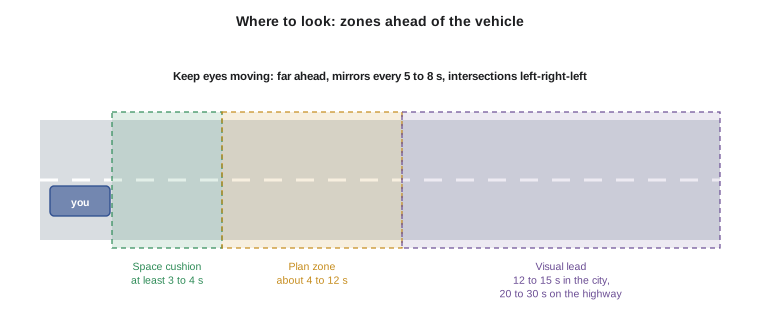
Space matters to the sides and behind as well as ahead. Defensive drivers try to keep an escape route, a place to steer if the vehicle ahead stops suddenly or something enters the lane. On multi-lane roads, avoid driving alongside other vehicles for long periods, especially in a large truck's blind spots. Adjust speed to open gaps rather than sitting in packs. When stopped in traffic, leave enough space to see the rear tires of the vehicle in front touching the pavement; that leaves room to pull around it if it stalls and reduces the chance of being pushed into it if you are hit from behind.
Speed for conditions
Posted speed limits are the maximum under good conditions, not a target. Defensive drivers set speed for what they can see and the grip they have. A useful check is whether you could stop within the distance you can see to be clear. On a hill crest, in fog, on a curve with trees on the inside, or at night beyond your headlights, that distance can be short, and safe speed must be lower than the limit. Speed differences matter too: driving much slower than surrounding traffic on a highway can also create risk, so in poor conditions it may be safer to leave the highway or wait it out.
Speed limits and enforcement are set by states and localities. Many cities have lowered residential limits, often to 25 or 20 mph, and automated speed cameras are allowed in a growing number of states. Work zones and school zones often carry higher fines. Fleet policies should require drivers to obey limits in all of them, and many fleets set governed top speeds for trucks.
Seeing: scan, aim high, keep your eyes moving
Good drivers look far ahead. Defensive driving courses often recommend looking 12 to 15 seconds ahead in the city, which is about a block or more, and 20 to 30 seconds ahead on the highway. Looking far ahead gives early warning of brake lights, merging traffic and hazards, and helps you steer smoothly. Keep your eyes moving rather than staring at one spot: check mirrors every five to eight seconds, glance at gauges briefly, and scan intersections left, center, right and left again before entering. Staring at the vehicle directly ahead narrows attention and leaves you surprised by everything else.
Blind spots and mirrors
Every vehicle has blind spots, areas around it that the driver cannot see in the mirrors or through the windows. Pickups, vans and trucks have large ones, especially directly behind and to the right. Set mirrors to reduce overlap: the side mirrors should show only a sliver of your own vehicle, so they cover the lanes beside you. Then, before changing lanes, do a shoulder check, a quick glance over the shoulder into the blind spot. Blind-spot monitoring systems help, but they can miss fast-approaching vehicles, motorcycles and cyclists, so treat them as a backup, not a replacement.
Visibility also means keeping glass and lights clean and clear. A frosted rear window, a dirty windshield that scatters low sun, wipers that streak and headlights covered in road grime all reduce what you see and how well others see you. Lesson 8 covers the pre-trip check that catches these problems.
Being seen
The other half of visibility is making sure others notice you. Drive with headlights on at all times, including daytime running lights at the rear where available, because many older daytime running light systems light only the front. Signal early, before braking, so others know your intentions. Avoid lingering in other drivers' blind spots. In fleet vehicles, high-visibility markings and conspicuity tape help, particularly on vans and trucks that stop at the roadside.
Worked problem
Rebuilding the gap
You are keeping a 3 second gap on a busy highway when a car moves into the space ahead, leaving you about 1 second behind it. What should you do?
Show solution
- Ease off the accelerator rather than braking hard, unless braking is needed to avoid contact.
- Let the gap grow back to 3 seconds over the next few seconds.
- Check your mirror; if someone is close behind, avoid sudden braking that could cause them to hit you.
- Do not speed up to close the gap or flash your lights; that adds conflict without adding safety.
Answer: Drop back smoothly and rebuild the gap. Your own space cushion is what protects you; it does not matter who fills it.
Common mistakes
MistakeUsing a fixed distance, such as a few car lengths, as a following gap.
InsteadUse a time gap of at least 3 seconds for cars and more for larger vehicles and poor conditions.
MistakeTreating the speed limit as the right speed in all conditions.
InsteadDrive at a speed that lets you stop within the distance you can see to be clear.
MistakeStaring at the vehicle directly ahead.
InsteadLook 12 to 15 seconds ahead in the city and 20 to 30 seconds on the highway, and keep your eyes moving.
MistakeChanging lanes on mirrors or blind-spot sensors alone.
InsteadAlways add a shoulder check.
MistakeAssuming braking distance on a wet road is about the same as on a dry one.
InsteadWet, snowy and icy roads can double braking distance or more.
Summary and key terms
- Stopping distance is reaction distance plus braking distance.
- Reaction distance grows with speed; braking distance grows with speed squared and with lower friction.
- Keep a time gap of at least 3 seconds for cars, more for larger vehicles, and add more in poor conditions.
- Keep a space cushion and an escape route around your vehicle.
- Set speed for what you can see and the grip you have, not just the posted limit.
- Look well ahead, scan constantly, set mirrors properly and shoulder check before changing lanes.
- Help others see you with headlights, early signals and by avoiding their blind spots.
- Stopping distance
- The total distance traveled from seeing a hazard to stopping: reaction distance plus braking distance.
- Reaction distance
- Distance traveled during perception–reaction time.
- Braking distance
- Distance traveled from applying the brakes until the vehicle stops.
- Friction coefficient
- A number describing how much grip tires have on a surface; written μ.
- Following gap
- The time between the vehicle ahead passing a point and your vehicle reaching it.
- Space cushion
- Open space kept around a vehicle to allow time and room to react.
- Escape route
- A path you could steer into to avoid a collision.
- Visual lead time
- How far ahead, in seconds of travel, a driver is looking.
- Blind spot
- An area around a vehicle that the driver cannot see directly or in the mirrors.
- Shoulder check
- A quick look over the shoulder into the blind spot before moving sideways.
Practice problems
Work each problem on paper first, then reveal the answer to check.
What are the two parts of stopping distance?
Show answer
Reaction distance and braking distance.
If speed doubles, what happens to braking distance on the same surface?
Show answer
It roughly quadruples.
About how far does a car travel at 60 mph during a 1.5 s reaction time?
Show answer
About 132 ft.
How do you measure a 3 second following gap?
Show answer
When the vehicle ahead passes a fixed object, count; you should not reach the object before three seconds.
What following gap should a heavy truck keep in good conditions?
Show answer
About 6 seconds or more.
How should you adjust your gap on snow or ice?
Show answer
At least double the normal gap.
How far ahead should you look on the highway?
Show answer
About 20 to 30 seconds.
How should side mirrors be set?
Show answer
So they show only a sliver of your own vehicle and cover the adjacent lanes.
When stopped in traffic, how much space should you leave ahead?
Show answer
Enough to see the rear tires of the vehicle ahead touching the pavement.
What is a safe speed in fog or at night?
Show answer
One that lets you stop within the distance you can see to be clear.
Lesson quiz · 5 questions
Score 60% or more to complete this lesson.
Create a free account to save your progress, take quizzes and earn a certificate.