
HSE-245 · Lesson 7 of 12 · 29 min
Vaccination and fitness for work
Vaccination works on the last link of the chain of infection: it makes people less susceptible. For several infections that matter at work, including hepatitis B, measles, influenza, pertussis and chickenpox, vaccination is the most effective control available. This lesson explains how vaccines protect individuals and groups, which vaccines are commonly recommended for workers, how workplaces run vaccination programs, and how fitness-for-work decisions, sick leave and return to work fit into infection control.
How vaccines protect
A vaccine trains the immune system to recognize an infectious agent without causing the disease. Some vaccines give long-lasting protection after a full series, such as measles and hepatitis B. Others need regular boosters or updating, such as tetanus every ten years and influenza every year, because immunity wanes or the virus changes. No vaccine is 100 percent effective, but even partial protection reduces the chance of infection, the severity of illness and, for many vaccines, the chance of passing the infection on.
Vaccines also protect people who are not vaccinated or who do not respond well to vaccines, such as infants, people with weakened immune systems and frail older adults. When enough people are immune, an infected person meets too few susceptible people to keep the chain going, and outbreaks fade. This is called community immunity or herd immunity.
Reproduction numbers and the herd immunity threshold
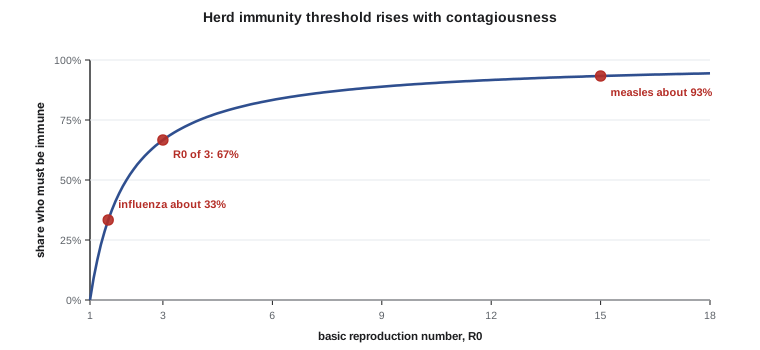
The basic reproduction number, R₀, is the average number of people one infected person infects in a fully susceptible population. Measles has an R₀ of roughly 12 to 18, among the highest of any disease; seasonal influenza is often around 1 to 2. The effective reproduction number, Rₜ, is the average number actually infected at a given time, which falls as more people become immune. An outbreak grows when Rₜ is above 1 and shrinks when it is below 1.
If a fraction p of the population is immune, then in a simple model Rₜ = R₀ × (1 − p). Setting Rₜ below 1 gives the herd immunity threshold:
# Herd immunity threshold for different basic reproduction numbers (simple model)
for disease, r0 in [("seasonal influenza (approx.)", 1.5), ("an R0 of 3", 3.0),
                    ("pertussis (approx.)", 12.0), ("measles (approx.)", 15.0)]:
    pc = 1 - 1 / r0
print(f"{disease:<28} R0 = {r0:>4}: threshold {pc:.0%} immune")seasonal influenza (approx.) R0 = 1.5: threshold 33% immune an R0 of 3 R0 = 3.0: threshold 67% immune pertussis (approx.) R0 = 12.0: threshold 92% immune measles (approx.) R0 = 15.0: threshold 93% immune
For measles, about 93 to 95 percent of people need to be immune to stop sustained spread. That is why communities with lower coverage have outbreaks even when national coverage looks high, and why Canada lost its measles elimination status in November 2025. Real populations are not evenly mixed, so pockets of low coverage in a school, congregation or workplace can sustain spread even when the overall rate is above the threshold.
Simulating an outbreak with an SIR model
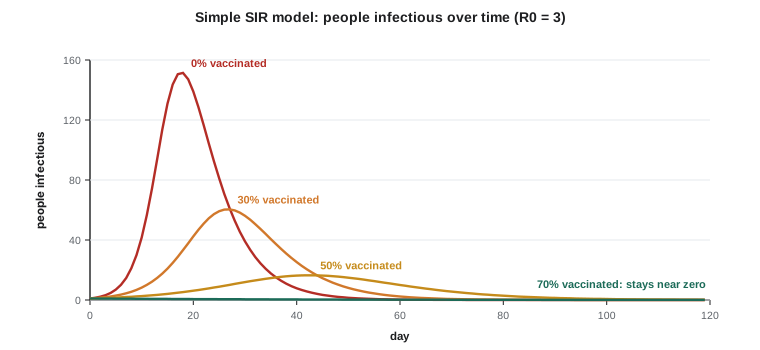
Epidemiologists use compartment models to explore how infections spread. The simplest, the SIR model, divides a population into Susceptible, Infectious and Recovered (immune) groups. Each day, susceptible people become infected at a rate proportional to contacts with infectious people, and infectious people recover at a fixed rate. Starting with part of the population already immune by vaccination shows how coverage changes the size of an outbreak.
# Deterministic SIR model (Euler steps) of a 500-person workplace and its contacts.
def outbreak(r0=3.0, infectious_days=5.0, vaccinated=0.0, n=500, days=200):
    gamma = 1 / infectious_days
    beta = r0 * gamma
    s = n * (1 - vaccinated) - 1
    i, r = 1.0, n * vaccinated
    peak = 0.0
    for _ in range(days * 10):            # time step 0.1 day
        new_inf = beta * s * i / n * 0.1
        new_rec = gamma * i * 0.1
        s, i, r = s - new_inf, i + new_inf - new_rec, r + new_rec
        peak = max(peak, i)
    total = n - s - n * vaccinated        # people infected during the outbreak
    return total, peak

for v in (0.0, 0.3, 0.5, 0.6, 0.7):
    total, peak = outbreak(vaccinated=v)
print(f"{v:.0%} vaccinated: about {total:5.0f} infected, peak {peak:4.0f} ill at once")0% vaccinated: about 471 infected, peak 152 ill at once 30% vaccinated: about 288 infected, peak 60 ill at once 50% vaccinated: about 147 infected, peak 16 ill at once 60% vaccinated: about 66 infected, peak 4 ill at once 70% vaccinated: about 8 infected, peak 1 ill at once
With an illustrative R₀ of 3, the model's herd immunity threshold is about 67 percent. Below it, the outbreak still infects many people, though fewer as coverage rises; above it, the outbreak fizzles out after a handful of cases. The model is simplified: it assumes a perfect vaccine, even mixing and no other controls. In reality, other layers such as ventilation, staying home when sick and masking lower the effective reproduction number too, which is why layered controls work even when vaccine coverage is incomplete.
Vaccines commonly recommended for workers
Vaccine recommendations for adults in the United States come from the CDC's adult immunization schedule, based on recommendations of its Advisory Committee on Immunization Practices (ACIP), with states running their own programs and requirements. ACIP's membership was replaced in June 2025 and some of its recommendations have since changed, so check the current schedule. For workers, recommendations depend on the job.
| Vaccine | Workers for whom it is commonly recommended | Notes |
|---|---|---|
| Hepatitis B | Anyone with reasonably anticipated exposure to blood or body fluids: health care, dental, personal services, first responders, laboratory, custodial and waste workers | Series of two or three doses depending on product; post-vaccination testing for health care workers (lesson 8) |
| Influenza (seasonal) | Health care and long-term care workers; workers in close contact with the public; everyone six months and older in most recommendations | Every year; protects workers and vulnerable patients |
| COVID-19 | Health care workers and people at higher risk; recommendations have changed over time | Check current national and local guidance |
| Measles, mumps, rubella (MMR) | Health care workers, child care and school staff, travelers; anyone without evidence of immunity | Two doses for health care workers born in or after 1957 (in most guidance) without other evidence of immunity |
| Varicella (chickenpox) | Health care, child care and school workers without evidence of immunity | Two doses |
| Tetanus, diphtheria, pertussis (Tdap) | All adults; especially health care workers and those caring for infants | Tetanus booster every ten years; Tdap once as an adult and in each pregnancy |
| Hepatitis A | Some sewage and wastewater workers, laboratory staff, certain travelers and others at risk | Depends on exposure assessment |
| Rabies (pre-exposure) | Veterinary staff, animal control, wildlife and some laboratory workers | Post-exposure treatment is still needed after a bite |
Running a workplace vaccination program
Employers in health care and other higher-risk sectors often run vaccination programs, and in some cases the law requires them to offer specific vaccines, as with hepatitis B for workers covered by bloodborne pathogen rules. A good program:
- identifies which jobs need which vaccines through the hazard assessment;
- offers recommended vaccines at no cost and during working hours where possible;
- keeps confidential records of vaccination and immunity, separate from personnel files, and of informed declinations;
- provides clear information about benefits, risks and side effects;
- reviews records before staff start in roles where proof of immunity is expected, such as measles immunity in health care;
- has a plan for staff who cannot be vaccinated or decline, such as reassignment during outbreaks;
- runs annual campaigns for seasonal vaccines, with easy access such as on-site clinics.
Mandatory vaccination policies are generally lawful for private employers, but they must provide reasonable accommodation for employees who cannot be vaccinated because of a disability under the Americans with Disabilities Act or because of a sincerely held religious belief under Title VII, unless accommodation would cause undue hardship. Some states restrict vaccine mandates, while others require certain vaccines for health care workers, and federal rules on health care facilities have changed over time. Get legal advice before introducing a mandatory policy, and check current state law.
Fitness for work and staying home when sick
Staying home when infectious is one of the most effective controls, and also one of the hardest to achieve, because many workers cannot afford to lose pay or fear letting colleagues down. A good policy sets out which symptoms mean staying home, how long to stay away, how to report absence, whether remote work is an option and what pay or leave applies. Common exclusion rules in health care, child care and food service include staying away until 48 hours after vomiting or diarrhea stops, and until fever has gone without fever-reducing medication for at least 24 hours with improving symptoms for respiratory illness. Public health guidance sets the details for specific diseases and settings.
There is no federal requirement for private employers to provide paid sick leave in the United States. The Family and Medical Leave Act gives eligible employees up to 12 weeks of unpaid, job-protected leave for a serious health condition, but it does not cover most short illnesses. More than a dozen states and the District of Columbia, plus many cities and counties, require paid sick leave; for example, California requires at least five days or 40 hours a year, and New York requires up to 56 hours for larger employers. Check the law where you work. Employers can offer more generous leave, and many do because it reduces spread.
# Cost of influenza-like illness in a 200-person workplace (illustrative)
staff = 200
attack_rate = 0.10            # share who get influenza-like illness in a season
days_off = 3.0                # average days missed per case
presenteeism_days = 2.0       # days worked while ill at half productivity
daily_value = 350             # value of a worker-day, dollars
cases = staff * attack_rate
absence = cases * days_off * daily_value
present = cases * presenteeism_days * 0.5 * daily_value
print(f"cases: {cases:.0f}")
print(f"absence cost: ${absence:,.0f}")
print(f"presenteeism cost: ${present:,.0f}")
for coverage, effectiveness in [(0.4, 0.5), (0.7, 0.5)]:
    avoided = cases * coverage * effectiveness
print(f"{coverage:.0%} vaccinated, {effectiveness:.0%} effective: about {avoided:.0f} cases avoided")cases: 20 absence cost: $21,000 presenteeism cost: $7,000 40% vaccinated, 50% effective: about 4 cases avoided 70% vaccinated, 50% effective: about 7 cases avoided
Return to work after illness or exposure
Return-to-work decisions balance the worker's health, the risk to others and the job. For most short illnesses, workers return when they meet the exclusion criteria. After certain exposures, such as a non-immune health care worker exposed to measles or chickenpox, public health may require the worker to stay away during the incubation period even if they feel well. Workers with long-term infections, such as hepatitis B or HIV, can usually work normally; restrictions apply only to a small number of procedures in health care where there is a risk of transmission to patients, and decisions are made case by case by expert panels with strict confidentiality. Discrimination against workers because of an infection that poses no real risk is prohibited by human rights and disability law.
Worked problem
Planning for a measles exposure
A non-immune receptionist at a walk-in clinic was in the waiting room with a patient later confirmed to have measles. What happens next?
Show solution
- Public health will be notified of the case and will identify contacts.
- The receptionist is susceptible, so public health may offer measles vaccine within 72 hours of exposure or immune globulin within six days, depending on age and circumstances.
- Because the receptionist is non-immune, public health will usually require exclusion from work from day 5 to day 21 after exposure, even if vaccinated after the exposure.
- The clinic should review all staff immunity records, so that only staff with presumed immunity work with suspected measles cases in future.
Answer: Follow public health direction on post-exposure vaccine or immune globulin and exclusion, and fix the gap in immunity records.
Worked problem
Writing a stay-home rule for a child care center
A child care center wants a simple rule for staff with stomach illness. What should it say?
Show solution
- Gastrointestinal illness such as norovirus spreads easily among young children and staff.
- A common public health rule is to stay home until at least 48 hours after the last episode of vomiting or diarrhea.
- The policy should say how to report absence, that staff will not be penalized for following it, and how pay or leave applies.
- During an outbreak, follow public health direction, which may add other measures.
Answer: Staff with vomiting or diarrhea stay home until 48 hours after symptoms end, report the absence and are supported by the leave policy.
Common mistakes
MistakeAssuming high average vaccine coverage prevents all outbreaks.
InsteadPockets of low coverage can sustain spread, especially for very contagious diseases like measles.
MistakeTreating vaccination as a substitute for other controls.
InsteadLayer vaccination with hand hygiene, ventilation and stay-home policies.
MistakeKeeping vaccination records in personnel files.
InsteadKeep them confidential and separate, with access limited to those who need them.
MistakeWriting a stay-home policy without pay or leave support.
InsteadPolicies work only if workers can afford to follow them.
MistakeExcluding workers with hepatitis B or HIV from ordinary jobs.
InsteadRestrictions apply only to specific procedures with real transmission risk, decided case by case.
Summary and key terms
- Vaccination reduces susceptibility and, for many vaccines, onward transmission.
- R₀ is the average number infected by one case in a susceptible population; Rₜ falls as immunity rises.
- The herd immunity threshold is 1 − 1/R₀, about 93 to 95 percent for measles.
- SIR models show how higher vaccine coverage shrinks and delays outbreaks.
- Recommended worker vaccines depend on the job and include hepatitis B, influenza, MMR, varicella, Tdap and others.
- Vaccination programs need confidential records, informed consent and accommodation where required by law.
- There is no federal paid sick leave requirement; many states and cities require it.
- Vaccine
- A product that trains the immune system to recognize an infectious agent without causing the disease.
- Community (herd) immunity
- Protection of a population when enough people are immune that infection cannot keep spreading.
- Basic reproduction number (R₀)
- The average number of people one case infects in a fully susceptible population.
- Effective reproduction number (Rₜ)
- The average number of people one case infects at a given time, given existing immunity and controls.
- Herd immunity threshold
- The share of a population that must be immune to stop sustained spread, 1 − 1/R₀ in a simple model.
- SIR model
- A model dividing a population into susceptible, infectious and recovered groups.
- Booster
- A later vaccine dose that restores or strengthens protection.
- Informed declination
- A documented decision by a worker not to receive an offered vaccine after receiving information.
- Exclusion period
- The time an ill or exposed worker must stay away from work to prevent spread.
- Undue hardship
- The legal limit of an employer's duty to accommodate.
Practice problems
Work each problem on paper first, then reveal the answer to check.
What is the herd immunity threshold for a disease with an R₀ of 4?
Show answer
75 percent.
Why can measles spread even when national coverage is about 90 percent?
Show answer
The threshold is about 93 to 95 percent, and pockets of low coverage allow spread.
What happens to an outbreak when Rₜ falls below 1?
Show answer
It shrinks and eventually stops.
Name three vaccines commonly recommended for health care workers.
Show answer
Any three of hepatitis B, influenza, COVID-19, MMR, varicella and Tdap.
Why are vaccination records kept separate from personnel files?
Show answer
They are confidential medical information.
What is a common stay-home rule for vomiting or diarrhea?
Show answer
Stay home until 48 hours after the last episode.
Does US federal law require private employers to provide paid sick leave?
Show answer
No; some states and cities require it, and FMLA leave is unpaid.
Why may a non-immune worker be excluded after a measles exposure even if they feel well?
Show answer
They could become infectious during the incubation period before symptoms appear.
In the SIR example, why does the outbreak fizzle at 70 percent coverage?
Show answer
Coverage is above the 67 percent threshold for an R₀ of 3, so Rₜ is below 1.
What must an employer consider before making vaccination mandatory?
Show answer
Whether it is reasonable, the legal duty to accommodate, sector rules and getting legal advice.
Lesson quiz · 5 questions
Score 60% or more to complete this lesson.
Create a free account to save your progress, take quizzes and earn a certificate.