
HSE-245 · Lesson 2 of 12 · 28 min
How infections spread
To stop an infection, you need to know how it moves. Every infection that passes from one person to another follows the same basic path: an infectious agent leaves a source, travels by some route, enters a new person and finds that person able to be infected. Infection control practitioners describe this path as the chain of infection. Each link in the chain is a place where a control can break it.
This lesson explains the six links, the main routes of transmission and the timing of infection, from exposure to symptoms. It focuses on what matters for workplace controls. The biology of bacteria, viruses, fungi and parasites is covered in BIOL-108, lesson 7, and basic laboratory biosafety in BIOL-107, lesson 4.
The chain of infection
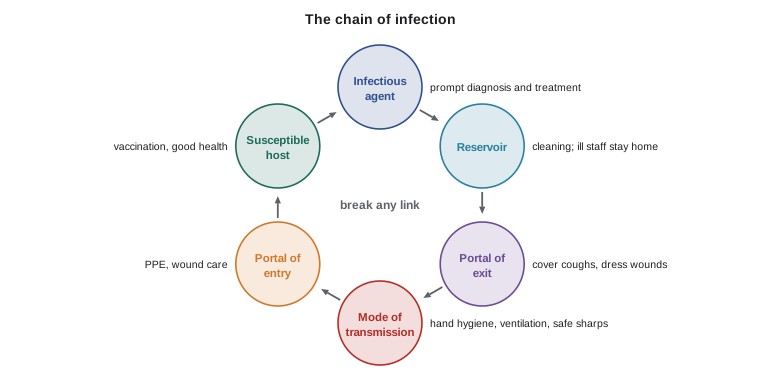
The infectious agent is the microorganism or virus that causes the disease: influenza virus, norovirus, Staphylococcus aureus, hepatitis B virus, Mycobacterium tuberculosis and so on. Agents differ in how many particles it takes to cause infection (the infectious dose), how long they survive outside the body, how resistant they are to disinfectants and how severe the illness is. Norovirus, for example, needs only a few particles to infect someone and survives for days on surfaces, which is why it spreads so explosively in care homes and on cruise ships.
The reservoir is where the agent lives and multiplies. For most workplace infections the reservoir is people: sick people, people in the incubation period who are not yet ill, and carriers who never feel ill at all. Other reservoirs include animals (for example, poultry and dairy cattle for avian influenza), water systems (Legionella in cooling towers, hot water systems and decorative fountains), soil and contaminated equipment.
The portal of exit is how the agent leaves the reservoir: the respiratory tract when someone breathes, talks, coughs or sneezes; the gut through vomit and stool; blood through wounds or needles; skin lesions; and other body fluids.
The mode of transmission is how it travels. This is the link most workplace controls target, and the next section describes it in detail.
The portal of entry is how it gets into the new host: inhaled into the nose, throat and lungs; through the mucous membranes of the eyes, nose and mouth; swallowed; through broken skin, cuts or needlesticks.
The susceptible host is a person who can be infected. Susceptibility depends on immunity from vaccination or past infection, age, pregnancy, chronic illness, medications that suppress the immune system and even fatigue and stress. A worker with eczema on their hands has more portals of entry than a worker with intact skin.
Modes of transmission
| Mode | How it works | Examples | Key controls |
|---|---|---|---|
| Direct contact | Physical contact between a source and a host, such as touching skin, wounds or body fluids | Scabies, herpes simplex, MRSA skin infections | Hand hygiene, gloves, covering wounds |
| Indirect contact | Contact with a contaminated object or surface (a fomite), then touching the eyes, nose or mouth | Norovirus, C. difficile, many respiratory viruses | Cleaning and disinfection, hand hygiene, not touching the face |
| Droplet and close-range respiratory | Larger respiratory particles that travel a short distance and land on mucous membranes | Influenza, pertussis, RSV, common colds | Distance, barriers, medical masks, eye protection, staying home when sick |
| Airborne | Small particles that remain suspended and travel on air currents over longer distances and times | Tuberculosis, measles, chickenpox; COVID-19 in poorly ventilated spaces | Ventilation, filtration, airborne isolation rooms, respirators, immunity |
| Bloodborne | Blood or certain body fluids entering through sharps injuries, broken skin or mucous membranes | Hepatitis B, hepatitis C, HIV | Safer sharps, gloves, eye protection, vaccination, exposure response |
| Food and water | Swallowing food or water contaminated with stool, toxins or organisms | Norovirus, Salmonella, E. coli O157, hepatitis A | Food safety, hand hygiene, excluding ill food handlers |
| Vector-borne | Spread by insects or ticks | Lyme disease, West Nile virus | Repellents, clothing, habitat control |
Many agents use more than one route. Influenza spreads mostly through respiratory particles at close range but can also spread by touching contaminated surfaces and, in crowded, poorly ventilated rooms, over longer distances. Norovirus spreads through the fecal-oral route, through contaminated surfaces and through vomit particles that become airborne when someone vomits. Controls need to match all the important routes, not just one.
Droplets, aerosols and an evolving understanding
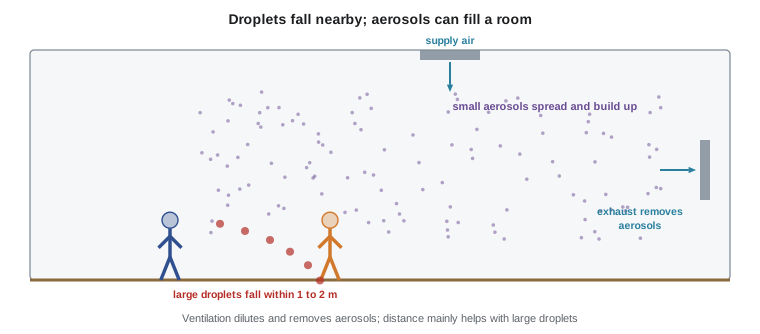
For decades infection control divided respiratory transmission sharply into droplet spread (large particles that fall within about one to two meters, or three to six feet) and airborne spread (tiny particles that float). The COVID-19 pandemic forced a rethink. People exhale a continuous range of particle sizes, from large droplets to very small aerosols, whenever they breathe, talk, sing or cough. Larger particles fall quickly; smaller ones stay aloft and build up in a room unless ventilation removes them. Most transmission still happens at close range, where the concentration of exhaled particles is highest, but in crowded, poorly ventilated rooms, small particles can infect people farther away.
Public health agencies have updated their language to reflect this. Many now speak of respiratory transmission through short-range and longer-range aerosols, and they emphasize ventilation and well-fitting masks or respirators alongside distance. The older droplet and airborne categories remain useful for deciding which precautions to use for a particular disease in health care, as lesson 10 explains, but workplaces should not assume that a short distance is enough in a stuffy room. Lesson 6 covers ventilation.
Timing: from exposure to illness
Infections follow a timeline that matters for control. After exposure, there is an incubation period before symptoms appear. For influenza it is usually one to four days; for norovirus, 12 to 48 hours; for measles, about 10 to 14 days; for hepatitis B, weeks to months. People are often infectious before symptoms start, which is why screening for symptoms alone cannot stop every case. The infectious period is the time during which a person can pass the agent on; for measles it starts about four days before the rash and lasts until about four days after it.
| Infection | Typical incubation | Main routes | Notes for the workplace |
|---|---|---|---|
| Influenza | 1 to 4 days | Respiratory, contact | Infectious from about a day before symptoms; annual vaccine |
| COVID-19 | About 2 to 5 days | Respiratory (short and longer range) | Infectious before and soon after symptoms; vaccines reduce severe illness |
| Norovirus | 12 to 48 hours | Fecal-oral, surfaces, vomit aerosols | Very low infectious dose; resists many disinfectants |
| Measles | About 10 to 14 days (up to 21) | Airborne | Extremely contagious; immunity from two doses of vaccine |
| Tuberculosis | Weeks to years | Airborne | Only active lung disease is infectious; screening in some sectors |
| Hepatitis B | 6 weeks to 6 months | Bloodborne, sexual, birth | Vaccine highly effective; post-exposure options exist |
How likely is infection after an exposure?
Whether an exposure leads to infection depends on the dose received, the route, the agent and the person's immunity. One brief contact may carry a small chance of infection, but repeated contacts add up. If each contact carries an independent probability p of infection, the chance of at least one infection after n contacts is one minus the chance of escaping every time.
# Cumulative chance of infection after repeated contacts (illustrative values of p).
for p in (0.01, 0.05):
    for n in (1, 5, 10, 20, 50):
        risk = 1 - (1 - p) ** n
print(f"p = {p:.2f} per contact, {n:2d} contacts: {risk:5.1%}")p = 0.01 per contact, 1 contacts: 1.0% p = 0.01 per contact, 5 contacts: 4.9% p = 0.01 per contact, 10 contacts: 9.6% p = 0.01 per contact, 20 contacts: 18.2% p = 0.01 per contact, 50 contacts: 39.5% p = 0.05 per contact, 1 contacts: 5.0% p = 0.05 per contact, 5 contacts: 22.6% p = 0.05 per contact, 10 contacts: 40.1% p = 0.05 per contact, 20 contacts: 64.2% p = 0.05 per contact, 50 contacts: 92.3%
The probabilities in this model are illustrative, and real exposures are not independent or identical, but the lesson holds: small risks repeated many times become large risks. A receptionist who greets a hundred people a day during flu season, or a nurse caring for the same infectious patient over a week, faces far more risk than a single contact suggests. Controls that cut the risk per contact, such as ventilation, hand hygiene and masks, pay off because they apply to every contact.
Colonization, carriers and resistant organisms
Not everyone who carries an organism is sick. Many people carry Staphylococcus aureus in their noses without symptoms; this is called colonization. Colonized people can still spread the organism. Antibiotic-resistant organisms such as methicillin-resistant Staphylococcus aureus (MRSA), vancomycin-resistant enterococci (VRE) and carbapenemase-producing organisms (CPO) are a growing concern in health care because infections are harder to treat. They spread mainly by contact, so hand hygiene and cleaning are central to stopping them. Overuse of antibiotics drives resistance, which is why antibiotic stewardship programs are part of hospital infection control.
Breaking the chain in practice
Most workplace programs use several controls at once, each breaking a different link. Vaccination makes hosts less susceptible. Staying home when sick removes a reservoir from the workplace. Covering coughs and dressing wounds blocks portals of exit. Hand hygiene, cleaning and ventilation interrupt transmission. Gloves, eye protection and masks protect portals of entry. Because no single control is perfect, layering them, sometimes described as the Swiss cheese model, gives much better protection than any one alone.
Worked problem
Mapping a norovirus outbreak to the chain of infection
Several staff and residents at a long-term care home develop vomiting and diarrhea within two days. Map the chain of infection and name one control for each link.
Show solution
- Agent: norovirus, highly infectious, survives on surfaces and resists alcohol-based hand rub better than many viruses.
- Reservoir: ill residents and staff, and people who are recovering but still shedding virus.
- Portal of exit: vomit and stool. Control: prompt clean-up of vomit and diarrhea with the right disinfectant.
- Transmission: contaminated hands, surfaces and food, and vomit aerosols. Controls: soap-and-water hand washing, disinfection of high-touch surfaces with a product effective against norovirus, cohorting staff.
- Portal of entry: swallowing. Control: no eating in resident areas, hand washing before food.
- Susceptible host: everyone; there is no vaccine. Control: exclude ill staff until 48 hours after symptoms end (a common rule) and restrict visitors.
Answer: Controls at every link, especially exclusion of ill staff, hand washing with soap and water, and disinfection with a product that kills norovirus, are needed to end the outbreak.
Worked problem
Choosing controls by route
A clinic will see a patient with suspected measles. Why are a medical mask and six feet of distance not enough for staff?
Show solution
- Measles is spread by airborne particles that stay suspended and can remain infectious in a room for up to about two hours after the patient leaves.
- Distance and medical masks help with short-range spread but do not stop small airborne particles reliably.
- Controls: assess the patient in an airborne infection isolation room or a closed room with good ventilation, have only staff with presumed immunity (two documented doses of vaccine or other evidence) care for the patient, and use fit-tested N95 respirators, as covered in HSE-240.
- After the patient leaves, keep the room closed long enough for ventilation to clear it before reuse.
Answer: Measles needs airborne controls: immunity, a ventilated room and respirators, not just distance and masks.
Common mistakes
MistakeAssuming people are only infectious when they feel sick.
InsteadMany infections spread before symptoms start or from carriers without symptoms.
MistakeBelieving six feet of distance always prevents respiratory spread.
InsteadSmall aerosols can build up in poorly ventilated rooms; ventilation and masks or respirators also matter.
MistakeControlling only one route for an agent that uses several.
InsteadMatch controls to every important route, such as hands, surfaces and air for norovirus.
MistakeIgnoring repeated low-risk contacts.
InsteadSmall per-contact risks add up over many contacts.
MistakeTreating colonized people as harmless.
InsteadColonized people can still spread resistant organisms; routine practices apply to everyone.
Summary and key terms
- The chain of infection has six links: agent, reservoir, portal of exit, mode of transmission, portal of entry and susceptible host.
- Breaking any link stops transmission, and layering several controls gives the best protection.
- Main modes are contact, respiratory (short and longer range), airborne, bloodborne, food and water, and vectors.
- People exhale a range of particle sizes; ventilation matters as well as distance.
- Incubation and infectious periods mean people can spread infection before symptoms appear.
- Small per-contact risks add up across many contacts, so controls that act on every contact pay off.
- Colonized people and antibiotic-resistant organisms spread mainly by contact, making hand hygiene and cleaning central.
- Chain of infection
- The six links that an infection must pass through to spread from one person to another.
- Reservoir
- The place where an infectious agent lives and multiplies, such as people, animals, water or soil.
- Fomite
- An object or surface that carries infectious agents from one person to another.
- Aerosol
- Very small particles suspended in air that can travel on air currents and build up indoors.
- Incubation period
- The time between exposure to an infectious agent and the start of symptoms.
- Infectious period
- The time during which an infected person can pass the agent to others.
- Infectious dose
- The number of organisms needed to cause infection.
- Colonization
- The presence of an organism on or in the body without causing illness.
- Antibiotic-resistant organism
- A bacterium that is not killed by antibiotics that normally work, such as MRSA or VRE.
- Swiss cheese model
- The idea that several imperfect layers of protection together stop most hazards.
Practice problems
Work each problem on paper first, then reveal the answer to check.
Name the six links in the chain of infection.
Show answer
Infectious agent, reservoir, portal of exit, mode of transmission, portal of entry and susceptible host.
What is a fomite? Give an example.
Show answer
An object or surface that carries germs, such as a door handle, phone or keyboard.
Which link does vaccination break?
Show answer
The susceptible host.
Why can screening for symptoms not catch every infectious person?
Show answer
Many people are infectious before symptoms start or never develop symptoms.
If each contact carries a 2 percent risk, what is the risk after 30 independent contacts?
Show answer
About 45 percent, from 1 − 0.98^30.
Why is norovirus so hard to control?
Show answer
It has a very low infectious dose, survives on surfaces and resists many disinfectants, including alcohol-based hand rub.
Which diseases are classic airborne infections?
Show answer
Tuberculosis, measles and chickenpox.
What changed in how agencies describe respiratory spread after COVID-19?
Show answer
They recognize a range of particle sizes and the role of aerosols, stressing ventilation as well as distance.
Why is hand hygiene central to controlling MRSA?
Show answer
MRSA spreads mainly by contact through hands and surfaces.
Give one portal of exit and one portal of entry for bloodborne pathogens.
Show answer
Exit: blood from a wound or needle. Entry: a needlestick, broken skin or mucous membranes.
Lesson quiz · 5 questions
Score 60% or more to complete this lesson.
Create a free account to save your progress, take quizzes and earn a certificate.