
HSE-245 · Lesson 5 of 12 · 29 min
Cleaning, disinfection and sterilization
Surfaces and equipment carry germs from one person to the next. A door handle, a shared keyboard, a blood pressure cuff, a tattoo machine grip, a change table or a reused instrument can all transmit infection if they are not cleaned and, where needed, disinfected or sterilized. This lesson explains the difference between those three processes, how to choose the right one, how to use disinfectants safely and effectively, and how to organize environmental cleaning so that it actually happens.
Three different processes
Cleaning is the physical removal of dirt, organic material such as blood and body fluids, and many germs from a surface, using water, detergent and friction. Cleaning does not necessarily kill germs, but it removes most of them, and it is always the first step: disinfectants and sterilants cannot work properly through a layer of dirt or dried blood.
Disinfection uses a chemical or physical process to kill most disease-causing microorganisms on a cleaned surface, but not necessarily bacterial spores. Disinfectants are classed by how much they kill. Low-level disinfectants kill most vegetative bacteria, some fungi and enveloped viruses such as influenza. Intermediate-level disinfectants also kill tuberculosis bacteria and more resistant viruses. High-level disinfection kills all microorganisms except large numbers of bacterial spores and is used for some reusable medical devices.
Sterilization destroys all forms of microbial life, including spores. It is used for instruments that enter sterile body tissue or the bloodstream, such as surgical instruments and reusable piercing tools. Common methods are steam under pressure (autoclaving), dry heat and low-temperature chemical methods for heat-sensitive devices.
Sanitizing is a term used especially in food service for reducing germs on food contact surfaces to safe levels; sanitizers are approved for that use and are usually rinsed or allowed to air dry according to the label.
The Spaulding classification
Reusable equipment is classified by how it is used, following a system proposed by Earle Spaulding in the 1960s and still used in Canada and the United States. The more invasive the use, the higher the level of processing needed.
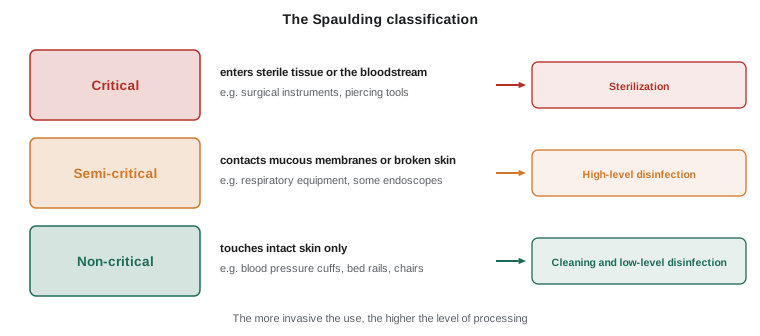
| Category | Contact | Examples | Minimum processing |
|---|---|---|---|
| Critical | Enters sterile tissue or the vascular system | Surgical instruments, dental scalers, reusable piercing tools, implants | Sterilization (or single-use sterile items) |
| Semi-critical | Contacts mucous membranes or non-intact skin | Endoscopes, laryngoscope blades, some dental handpieces, vaginal speculums | High-level disinfection; sterilization preferred where possible |
| Non-critical | Contacts intact skin only | Blood pressure cuffs, stethoscopes, thermometers with covers, wheelchairs, exam tables | Cleaning and low- or intermediate-level disinfection |
| Environmental surfaces | Usually no direct patient contact, or hand contact only | Floors, walls, door handles, light switches, desks | Cleaning, with disinfection of high-touch surfaces |
Processing reusable medical and dental devices, called reprocessing, is a specialized job. Facilities that reprocess critical or semi-critical devices must follow the manufacturer's instructions for use, validated processes and national standards, with monitoring, records and trained staff. Failures in reprocessing have caused outbreaks and mass notifications of patients who may have been exposed to hepatitis or HIV. Many smaller clinics and studios use single-use sterile items for critical uses to avoid the risk. If a device cannot be reprocessed according to the manufacturer's instructions with the equipment available, it should not be reused.
Choosing a disinfectant
In the United States, surface disinfectants are pesticides registered by the Environmental Protection Agency, and each carries an EPA registration number. The label states the organisms the product is registered to kill, the contact time, the dilution and the surfaces it can be used on, and under federal law the label is the legal instruction for use. The EPA publishes lists of registered products that meet its criteria for specific pathogens, such as List N for the virus that causes COVID-19, List G for norovirus and List K for C. difficile spores. Disinfectants and sterilants for medical devices are regulated by the Food and Drug Administration.
When choosing a product, consider:
- the organisms of concern (for example, a product effective against norovirus during a gastrointestinal outbreak, or a sporicidal product for C. difficile);
- the contact time: the length of time the surface must stay wet for the product to work, which can range from 30 seconds to 10 minutes;
- compatibility with the surfaces and equipment, according to the equipment manufacturer;
- safety for workers and occupants, including respiratory and skin irritation;
- whether the product is a one-step cleaner-disinfectant that can clean and disinfect lightly soiled surfaces in one go;
- ease of use, such as ready-to-use wipes or sprays versus concentrates that need dilution.
| Active ingredient | Typical uses | Advantages | Cautions |
|---|---|---|---|
| Sodium hypochlorite (bleach) | General disinfection, blood spills, norovirus and C. difficile (at higher strength) | Broad spectrum, fast, inexpensive | Corrosive; irritates skin, eyes and lungs; inactivated by organic matter; never mix with ammonia or acids |
| Accelerated or enhanced hydrogen peroxide | General disinfection in health care and other settings | Broad spectrum, short contact times, fewer residues | Can irritate at higher concentrations; check material compatibility |
| Quaternary ammonium compounds (quats) | Low-level disinfection of floors, walls and furniture | Good cleaning properties, low odor | Weak against some viruses and spores; can cause asthma in some workers; can bind to cotton cloths |
| Alcohols (60 to 90 percent) | Small surfaces and equipment, such as stethoscopes | Fast, no residue | Flammable; evaporates before long contact times; weak against spores and some viruses |
| Peracetic acid | High-level disinfection and sterilization of devices | Works in presence of organic matter | Strong odor and irritant; specialized use |
| Phenolics | Some hospital and laboratory surfaces | Effective against tuberculosis | Not for infant areas; residues; irritation |
Contact time and log reduction
Disinfectants do not work instantly. The label's contact time is the time the surface must stay visibly wet. Wiping a surface and drying it immediately, or using so little product that it dries in ten seconds when the label says three minutes, may leave most germs alive. Ready-to-use wipes are convenient, but one wipe may only keep a small area wet; large surfaces may need several.
Disinfectant performance is described as a log reduction. Each log is a tenfold reduction in the number of live organisms. A 3-log reduction kills 99.9 percent; a 6-log reduction kills 99.9999 percent.
import math
# Log reduction from a starting count N0 to a surviving count N
for n0, n in [(1_000_000, 1000), (1_000_000, 1), (50_000, 50)]:
    logs = math.log10(n0 / n)
    killed = 1 - n / n0
print(f"{n0:>9,} -> {n:>5,} survivors: {logs:.1f}-log reduction ({killed:.4%} killed)")1,000,000 -> 1,000 survivors: 3.0-log reduction (99.9000% killed) 1,000,000 -> 1 survivors: 6.0-log reduction (99.9999% killed) 50,000 -> 50 survivors: 3.0-log reduction (99.9000% killed)
Consider what a 99.9 percent kill means when the starting number is large: a million germs become a thousand survivors. That is why cleaning first matters. Removing most of the soil and organisms physically lowers the starting number, so the disinfectant has fewer survivors to deal with and is not inactivated by organic material.
Diluting bleach
Household bleach is sold at several strengths, commonly about 5.25 percent or 6 percent sodium hypochlorite, and concentrated products are higher. Public health agencies recommend different working strengths for different jobs. A common general disinfection strength is about 1,000 parts per million (ppm) of available chlorine; for blood spills and for norovirus or C. difficile, guidance often recommends about 5,000 ppm. Always follow the product label and your public health unit's guidance, because strengths and claims vary. One percent equals 10,000 ppm.
# Bleach dilution: how much stock bleach to make 1 L (1000 mL) of working solution
def ml_of_stock(stock_percent, target_ppm, final_ml=1000):
    stock_ppm = stock_percent * 10_000
    return target_ppm * final_ml / stock_ppm

for stock in (5.25, 6.0):
    for target in (1000, 5000):
        v = ml_of_stock(stock, target)
print(f"{stock}% bleach to {target:>5} ppm: {v:5.1f} mL bleach + water to make 1000 mL")5.25% bleach to 1000 ppm: 19.0 mL bleach + water to make 1000 mL 5.25% bleach to 5000 ppm: 95.2 mL bleach + water to make 1000 mL 6.0% bleach to 1000 ppm: 16.7 mL bleach + water to make 1000 mL 6.0% bleach to 5000 ppm: 83.3 mL bleach + water to make 1000 mL
Make diluted bleach fresh, usually daily, because it loses strength over time, especially in warm conditions and in light. Label the container with the contents, strength and date. Never mix bleach with ammonia, acids or other cleaners, which can release toxic chloramine or chlorine gas. Workers who prepare disinfectants need training under WHMIS in Canada or the Hazard Communication standard in the United States, access to safety data sheets and the protective equipment the label and data sheet call for, usually gloves and eye protection.
Environmental cleaning programs
In health care and long-term care, environmental services staff are front-line infection control workers. Good programs define what is cleaned, how, how often, with what product and by whom, and they check the results. Key principles include:
- clean from cleaner areas to dirtier areas and from high surfaces to low surfaces, so contamination is not spread;
- give special attention to high-touch surfaces, such as bed rails, call bells, light switches, door handles, taps, toilet flush handles and shared equipment;
- increase frequency during outbreaks and in areas with patients on additional precautions;
- use color-coded cloths and mops for different areas, such as bathrooms versus patient rooms, and change them often;
- use microfiber cloths where appropriate, which remove more organisms than cotton and do not bind quats;
- clean and disinfect shared equipment between users, with a clear rule on who is responsible for which items.
Checking cleaning quality is important because visual inspection misses a lot. Fluorescent markers placed on surfaces before cleaning, then checked with ultraviolet light, show whether surfaces were actually wiped. Adenosine triphosphate (ATP) meters measure organic residue. These tools are used for feedback and training rather than as a measure of germs directly.
Outside health care
Offices, schools, gyms and stores do not need hospital-level disinfection for routine cleaning. Regular cleaning with detergent, plus disinfection of high-touch surfaces at a frequency that matches use, is usually enough. During outbreaks of gastrointestinal illness or when public health advises, increase the frequency and use a product with a claim against the relevant organism. Avoid fogging or spraying disinfectant into the air or onto people; it exposes workers and occupants to chemicals and is not a substitute for cleaning. Child care settings follow public health requirements for cleaning toys, change tables and food areas.
Worked problem
Choosing the right process for studio equipment
A piercing studio reuses stainless steel receiving tubes and forceps, and wipes down its chairs and counters between clients. Classify each item and state the minimum processing.
Show solution
- Receiving tubes and forceps contact the piercing site, which is broken skin and tissue, so they are treated as critical items.
- Critical items need cleaning followed by sterilization in a validated sterilizer (for example, a steam autoclave with routine biological and chemical indicator monitoring), or must be replaced with single-use sterile items.
- Chairs and counters touch intact skin or have hand contact only; they are non-critical or environmental surfaces.
- They need cleaning and low-level disinfection between clients with a registered product used at the correct contact time.
Answer: Sterilize (or use single-use sterile) tools that pierce or contact broken skin; clean and disinfect chairs and counters between clients.
Worked problem
Fixing a contact time problem
A clinic uses a disinfectant wipe with a 3-minute contact time to clean exam tables between patients. Staff wipe the table and immediately place new paper on it. What is the problem, and how can it be fixed?
Show solution
- The surface is covered before the 3-minute contact time, and the wipe probably dried well before then anyway.
- The table may not be disinfected even though it looks clean.
- Options: switch to a product with a shorter contact time (for example, one minute) that suits the surface, use enough wipes to keep the surface wet for the full time, and build the waiting time into the room turnover routine.
- Train staff and audit the practice, for example by timing turnovers.
Answer: Keep the surface wet for the full labeled contact time, or choose a product whose contact time fits the workflow.
Common mistakes
MistakeSpraying disinfectant on a dirty surface without cleaning first.
InsteadClean first; disinfectants are less effective through soil and organic matter.
MistakeWiping and drying immediately.
InsteadKeep the surface wet for the full labeled contact time.
MistakeUsing a low-level disinfectant on critical instruments.
InsteadSterilize critical items, or use single-use sterile items.
MistakeMixing bleach with ammonia or other cleaners to make it stronger.
InsteadNever mix; it can release toxic gas. Dilute bleach with water only, as directed.
MistakeFogging offices with disinfectant during cold season.
InsteadClean and disinfect high-touch surfaces; airborne spraying adds chemical exposure without replacing cleaning.
Summary and key terms
- Cleaning removes soil and many germs; disinfection kills most germs; sterilization kills all microbial life including spores.
- Cleaning always comes first, because soil and organic matter protect germs and inactivate disinfectants.
- The Spaulding classification sets processing by use: sterilize critical items, high-level disinfect semi-critical items, clean and disinfect non-critical items.
- Choose an EPA-registered disinfectant with claims against the organisms of concern, and follow its label, which is the legal instruction for use.
- Each log reduction is a tenfold drop; a 3-log reduction kills 99.9 percent.
- Dilute bleach correctly using C1V1 = C2V2, make it fresh, label it and never mix it with other chemicals.
- Environmental cleaning programs focus on high-touch surfaces, clean-to-dirty order and checking results.
- Cleaning
- The physical removal of soil, organic material and many germs using water, detergent and friction.
- Disinfection
- A process that kills most disease-causing microorganisms on a cleaned surface, but not necessarily spores.
- Sterilization
- A process that destroys all forms of microbial life, including spores.
- Spaulding classification
- A system that classes reusable items as critical, semi-critical or non-critical by how they are used.
- Reprocessing
- The cleaning, disinfection or sterilization of reusable medical or dental devices.
- Contact time
- The time a surface must stay wet with a disinfectant for it to work as labeled.
- Log reduction
- The reduction in live organisms expressed in powers of ten; 3-log equals 99.9 percent.
- High-touch surface
- A surface touched often by many people, such as door handles, light switches and bed rails.
- ppm (parts per million)
- A unit of concentration; 1 percent equals 10,000 ppm.
- Disinfectant registration number
- The EPA registration number on disinfectants registered with the US Environmental Protection Agency.
Practice problems
Work each problem on paper first, then reveal the answer to check.
What is the difference between disinfection and sterilization?
Show answer
Disinfection kills most germs but not necessarily spores; sterilization kills all microbial life including spores.
Why must surfaces be cleaned before they are disinfected?
Show answer
Soil and organic matter protect germs and inactivate many disinfectants.
Classify a reusable dental scaler and state its processing.
Show answer
Critical; it must be cleaned and sterilized.
Classify a blood pressure cuff and state its processing.
Show answer
Non-critical; clean and low-level disinfect.
What does a 4-log reduction mean?
Show answer
A 10,000-fold reduction; 99.99 percent of organisms killed.
How much 5.25 percent bleach is needed to make 1 L of 1,000 ppm solution?
Show answer
About 19 mL of bleach, topped up with water to 1,000 mL.
Why should bleach never be mixed with ammonia-based cleaners?
Show answer
The mixture releases toxic chloramine gas.
Name four high-touch surfaces in a patient room.
Show answer
Any four of bed rails, call bell, light switch, door handle, over-bed table, taps and toilet flush handle.
How can a supervisor check whether surfaces were actually cleaned?
Show answer
Using fluorescent markers checked with ultraviolet light, or ATP meters, along with observation.
Why is fogging an office with disinfectant a poor idea?
Show answer
It exposes people to chemicals and does not replace cleaning of high-touch surfaces.
Lesson quiz · 5 questions
Score 60% or more to complete this lesson.
Create a free account to save your progress, take quizzes and earn a certificate.