
HSE-245 · Lesson 4 of 12 · 28 min
Hand hygiene
Hands are the most common vehicle for spreading infection at work. They touch faces, food, keyboards, door handles, patients, children, tools and each other hundreds of times a day. Cleaning hands at the right moments, with the right product and the right technique, is the single most important infection prevention practice in health care, and one of the cheapest and most effective in every other workplace too.
The idea is not new. In the 1840s, the Hungarian physician Ignaz Semmelweis showed that deaths from childbed fever fell dramatically when doctors cleaned their hands with chlorinated lime between performing autopsies and delivering babies. His colleagues largely rejected the finding, and it took decades, and the germ theory of Pasteur and Lister, for hand hygiene to become standard practice. Even today, studies in hospitals often find that health care workers clean their hands at fewer than half of the moments when they should. The barrier is rarely knowledge; it is habit, workload, access and culture.
Two methods: rub or wash
There are two ways to clean hands. Alcohol-based hand rub (ABHR), usually containing 60 to 90 percent alcohol, kills most bacteria and many viruses quickly, is gentler on skin than repeated washing, and can be placed exactly where work happens. Soap and running water removes dirt, organic material and germs physically; plain soap does not need to be antimicrobial to work, because the rubbing and rinsing remove organisms.
| Situation | Preferred method | Why |
|---|---|---|
| Hands look clean, routine moments | Alcohol-based hand rub | Fast, effective against most germs, easier on skin, available at the point of care |
| Hands visibly soiled with dirt, blood or body fluids | Soap and water | Alcohol does not penetrate organic material well |
| After using the toilet | Soap and water | Removes contamination from stool |
| Before handling or eating food | Soap and water (or hand rub if no sink and hands look clean) | Food safety rules usually require washing |
| Caring for someone with norovirus or C. difficile diarrhea | Soap and water | Norovirus resists alcohol better than many viruses, and C. difficile spores are not killed by alcohol |
| After removing gloves | Hand rub or soap and water | Gloves leak and hands are contaminated during removal |
Alcohol-based hand rub works best when enough product is used to keep the hands wet for 20 to 30 seconds while rubbing all surfaces. Too little product dries in a few seconds and misses areas. Hand washing should take 40 to 60 seconds in total, including at least 15 to 20 seconds of lathering and rubbing, followed by thorough rinsing and drying with a single-use towel. Shared cloth towels recontaminate hands. In health care, the towel is used to turn off the tap if taps are not hands-free.
Technique
Germs survive in the places people miss: thumbs, fingertips, between the fingers and the backs of the hands. Studies using fluorescent lotion under ultraviolet light show the same blind spots again and again. A consistent sequence, practiced until it is automatic, covers them.
Rings, watches and long or artificial nails trap germs and make thorough cleaning harder. Many health care employers require bare hands and wrists below the elbow during care, short natural nails and no artificial nails or nail enhancements, because studies have linked artificial nails to outbreaks of serious infections in intensive care units. Outside health care, removing rings and watches during food handling and personal services is a sensible practice.
The moments that matter
Knowing when to clean hands is as important as knowing how. The World Health Organization's "My 5 Moments for Hand Hygiene" model is used around the world in health care. Canada's national approach, promoted by Public Health Ontario and other agencies as "Your 4 Moments for Hand Hygiene", combines two of the WHO moments and is used in many provinces. Both aim at the same thing: cleaning hands before touching a patient or a clean or sterile site, and after contact that may have contaminated them.
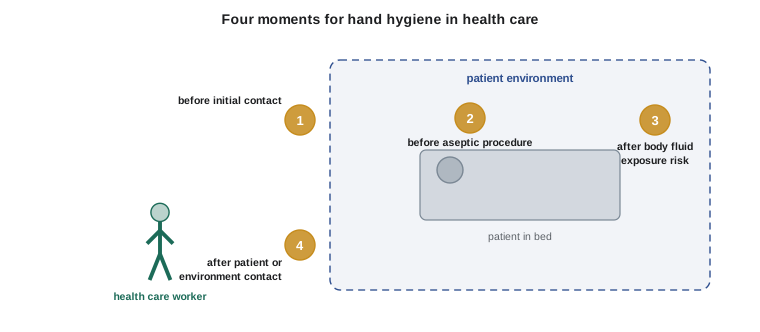
Outside health care, the same logic applies to everyday tasks. Clean your hands:
- before eating, preparing food or touching your face, eyes or contact lenses;
- after using the toilet, changing a diaper or helping someone else use the toilet;
- after coughing, sneezing or blowing your nose;
- after handling garbage, cleaning, or touching shared equipment in a busy area;
- before and after first aid or touching a wound;
- after removing gloves;
- when arriving at work and before going home.
Gloves are not a substitute
Gloves protect the wearer's hands from contamination, but they do not replace hand hygiene. Gloves can have tiny holes, hands become contaminated when gloves are taken off, and gloves worn too long carry germs from one surface or person to the next just as bare hands would. Clean your hands before putting on gloves when a clean task follows, change gloves between people and between dirty and clean tasks on the same person, and clean your hands after removing them. Wearing gloves when they are not needed, such as for routine office tasks, wastes supplies and gives a false sense of protection. Lesson 10 covers glove use in more detail.
Skin care
Frequent hand hygiene can damage skin, and damaged skin is both uncomfortable and a risk: cracks and dermatitis hold more bacteria and are portals of entry for bloodborne pathogens. Alcohol-based hand rubs with built-in emollients are usually gentler than repeated washing with soap and hot water. Using lukewarm water, patting hands dry and applying an employer-provided, compatible hand lotion during the shift and after work all help. Some lotions, especially petroleum-based ones, can damage latex gloves or reduce the effect of certain antiseptics, so workplaces should provide products that are known to be compatible. Workers with persistent dermatitis should be assessed by occupational health; it is a recognized occupational skin disease, and it is often caused by irritation from wet work and frequent washing rather than allergy.
Making hand hygiene easy
Hand hygiene compliance rises when the right product is in the right place. Practical steps include:
- hand rub dispensers at entrances, reception desks, break rooms, elevators and, in health care, at the point of care (within arm's reach of where care is given);
- enough sinks with hands-free taps, soap and single-use towels, kept stocked;
- a cleaning and refill schedule with a named person responsible;
- simple visual reminders near dispensers and sinks, refreshed so they do not fade into the background;
- leaders who model the behavior;
- feedback on performance, through audits or electronic monitoring, shared in a supportive rather than punitive way.
Alcohol-based hand rub is flammable. Fire codes allow dispensers in corridors and rooms, but limit their size and spacing and keep them away from ignition sources such as electrical outlets and switches. Supplies in bulk storage must be kept according to the fire code, and the product's safety data sheet describes hazards. Some settings, such as mental health units, correctional facilities and schools, choose products or dispenser types that reduce the risk of people drinking hand rub.
Measuring hand hygiene
Hospitals and long-term care homes often audit hand hygiene by direct observation: a trained auditor watches care for a set period and records whether each opportunity (each moment that called for hand hygiene) was met. Compliance is the number of opportunities met divided by the number observed. Because staff behave better when they know they are watched (the Hawthorne effect), observed rates usually overestimate true compliance. Electronic systems that count dispenser use, and covert or rotating auditors, help reduce this bias.
A small number of observations gives an uncertain estimate. Reporting a confidence interval, not just a single percentage, shows how much the result could vary by chance. The Wilson score interval works well for proportions, especially with small samples.
import math

def wilson(met, n, z=1.96):
    p = met / n
    mid = (p + z * z / (2 * n)) / (1 + z * z / n)
    half = z * math.sqrt(p * (1 - p) / n + z * z / (4 * n * n)) / (1 + z * z / n)
    return mid - half, mid + half

# Hand hygiene audits on two units (opportunities met, opportunities observed)
for unit, met, n in [("Unit A", 41, 60), ("Unit B", 168, 240)]:
    lo, hi = wilson(met, n)
print(f"{unit}: {met}/{n} = {met / n:.0%}, 95% interval {lo:.0%} to {hi:.0%}")Unit A: 41/60 = 68%, 95% interval 56% to 79% Unit B: 168/240 = 70%, 95% interval 64% to 75%
Unit A and Unit B have similar compliance, but Unit A's interval is much wider because it is based on far fewer observations. A manager should not conclude that Unit A is worse, or that a small change from one month to the next is real, without enough data. The same logic applies to any audit with a pass or fail result, from cleaning checks to protective equipment use.
Hand hygiene for the public
In workplaces open to the public, such as stores, offices, transit, gyms and schools, hand rub at entrances and in high-traffic areas encourages customers and visitors to clean their hands too. Schools that teach and schedule hand washing for children, before eating and after recess and the toilet, see fewer absences from gastrointestinal and respiratory illness. Child care staff should supervise and help young children wash their hands and wash their own after every diaper change.
Worked problem
Fixing a missed hand hygiene opportunity
A personal support worker helps a resident to the toilet, removes her gloves, and immediately goes to adjust a second resident's pillow. What went wrong, and what should happen?
Show solution
- Helping with toileting carries a risk of contact with stool, and hands become contaminated during glove removal.
- Moving to the second resident without cleaning hands skips the moments 'after body fluid exposure risk' and 'after patient environment contact' for the first resident and 'before patient contact' for the second.
- Because of possible stool contamination, washing with soap and water is preferred, especially during a gastrointestinal outbreak.
- The worker should clean hands after glove removal and again on entering the second resident's space, using hand rub if hands look clean and no outbreak is under way.
Answer: Clean hands immediately after removing gloves, preferably with soap and water after toileting, and before touching the next resident or their surroundings.
Worked problem
Improving hand hygiene in a school cafeteria
A school sees repeated waves of stomach illness. Students line up for lunch straight from the playground, and the nearest sink is down the hall. What practical changes would help?
Show solution
- Gastrointestinal illness spreads through the fecal-oral route, and hands are the main vehicle.
- Schedule supervised hand washing before lunch, perhaps by class, and add sinks or portable hand washing stations near the cafeteria if possible.
- Provide alcohol-based hand rub at the cafeteria entrance as a backup when hands look clean, recognizing that soap and water is better against norovirus.
- Teach and refresh the technique with younger students, and make sure soap and towels are always stocked.
Answer: Make hand washing a scheduled, supervised step before eating, close to the cafeteria, with hand rub as a backup.
Common mistakes
MistakeUsing alcohol-based hand rub on visibly soiled hands.
InsteadWash visibly soiled hands with soap and water.
MistakeUsing a small squirt of hand rub that dries in five seconds.
InsteadUse enough to keep hands wet for 20 to 30 seconds while rubbing all surfaces.
MistakeTreating gloves as a substitute for hand hygiene.
InsteadClean hands before and after glove use and change gloves between people and tasks.
MistakeRelying on alcohol rub during a norovirus or C. difficile outbreak.
InsteadWash with soap and water, which removes organisms that alcohol does not reliably kill.
MistakeConcluding a unit improved because one small audit rose a few points.
InsteadCheck sample sizes and confidence intervals before drawing conclusions.
Summary and key terms
- Hands are the most common vehicle for spreading infection, and hand hygiene is the most important single practice.
- Alcohol-based hand rub is preferred for clean-looking hands; soap and water is needed for soiled hands, after the toilet and for norovirus or C. difficile.
- Technique matters: cover thumbs, fingertips, between fingers and backs of hands for 20 to 30 seconds (rub) or 40 to 60 seconds (wash).
- The moments for hand hygiene focus on before clean contact and after possible contamination.
- Gloves do not replace hand hygiene; clean hands before and after using them.
- Skin care prevents dermatitis, which trap germs and creates portals of entry.
- Make hand hygiene easy with well-placed, stocked supplies, and interpret audit results with confidence intervals.
- Hand hygiene
- Cleaning hands with alcohol-based hand rub or soap and water to remove or kill germs.
- Alcohol-based hand rub (ABHR)
- A hand rub containing about 60 to 90 percent alcohol that kills most bacteria and many viruses.
- Point of care
- The place where care is given, where hand rub should be within arm's reach.
- Hand hygiene moments
- The specific times when hand hygiene is needed, such as before patient contact and after body fluid exposure risk.
- Patient environment
- The patient and the area and items around them that may be contaminated.
- Aseptic procedure
- A procedure that must be done without introducing germs, such as inserting a catheter.
- Emollient
- A moisturizing ingredient that protects skin from drying.
- Irritant contact dermatitis
- Skin damage caused by repeated contact with water, soap or chemicals.
- Compliance rate
- The proportion of hand hygiene opportunities in which hand hygiene was performed.
- Hawthorne effect
- The tendency of people to change behavior when they know they are being observed.
Practice problems
Work each problem on paper first, then reveal the answer to check.
When should soap and water be used instead of hand rub?
Show answer
When hands are visibly soiled, after using the toilet, before food handling where required, and during norovirus or C. difficile outbreaks.
How long should hands stay wet with alcohol-based hand rub?
Show answer
About 20 to 30 seconds while rubbing all surfaces.
Name three areas of the hands that are often missed.
Show answer
Thumbs, fingertips, between the fingers and the backs of the hands (any three).
What are the four moments for hand hygiene in health care?
Show answer
Before initial patient or environment contact, before an aseptic procedure, after body fluid exposure risk, and after patient or environment contact.
Why do gloves not replace hand hygiene?
Show answer
Gloves can leak, hands get contaminated during removal, and dirty gloves spread germs just like hands.
Why is hand dermatitis an infection risk?
Show answer
Damaged skin holds more bacteria and allows bloodborne pathogens to enter.
Why might observed hand hygiene audits overestimate compliance?
Show answer
Because of the Hawthorne effect: people behave better when watched.
An audit finds 18 of 25 opportunities met. Why should the manager be cautious?
Show answer
With only 25 observations the confidence interval is wide, so the true rate is uncertain.
What fire safety issue applies to alcohol-based hand rub?
Show answer
It is flammable; dispenser size, spacing and storage must follow the fire code, away from ignition sources.
Give two everyday moments for hand hygiene outside health care.
Show answer
Any two of before eating, after the toilet, after coughing or sneezing, after handling garbage, after removing gloves.
Lesson quiz · 5 questions
Score 60% or more to complete this lesson.
Create a free account to save your progress, take quizzes and earn a certificate.