
HSE-243 · Lesson 9 of 12 · 30 min
Cold injuries
Cold injuries fall into two groups. Local injuries damage particular parts of the body, usually the fingers, toes, ears, nose and cheeks, and include frostnip, frostbite, trench foot and chilblains. Systemic injury affects the whole body: hypothermia, a fall in core temperature that impairs the brain and heart and can kill. Workers can suffer both at once. This lesson describes each injury, how to recognize it and how it develops. Lesson 11 covers emergency response.
Frostnip
Frostnip is the mildest cold injury: the skin and the tissue just beneath it become very cold and numb, but do not actually freeze. The skin looks pale or white and feels numb or tingly, typically on the cheeks, nose, ears, fingers or toes. Frostnip goes away completely when the area is rewarmed, usually with some tingling, redness or mild pain as blood flow returns, and it leaves no lasting damage.
Frostnip is a warning. It means the skin is close to freezing, and if exposure continues, frostbite will follow. A buddy system is useful here, because people often cannot see or feel frostnip on their own faces; a co-worker who notices a white patch on someone's cheek should tell them at once so they can cover it and warm up.
Frostbite
Frostbite is the freezing of body tissue. Ice crystals form in and between cells, damaging them directly, and the blood vessels in the area are injured, causing clotting and loss of blood supply that can kill tissue even after it thaws. Frostbite occurs when skin temperature falls below about minus 0.5 to minus 2 °C, which can happen within minutes at very low wind chills or through contact with cold metal or supercooled liquids such as fuel.
Frostbite is classified by depth, much like burns. Superficial frostbite affects the skin and the tissue just under it. The skin is white or grayish-yellow, waxy and hard to the touch on the surface but still soft underneath; after rewarming, it becomes red, swollen and painful, and blisters filled with clear fluid may form within a day. Deep frostbite affects all layers of the skin and the tissues below, including muscle, tendon and bone. The area is hard, white or blue-gray, cold and numb, and does not move when pressed. After rewarming, blood-filled blisters may form, and the tissue may turn black over the following days and weeks as it dies. Deep frostbite can lead to amputation.
| Injury | What happens | Appearance | Outcome |
|---|---|---|---|
| Frostnip | Skin very cold but not frozen | Pale, numb, tingling | Recovers fully on rewarming |
| Superficial frostbite | Skin and tissue just below frozen | White, waxy, hard surface but soft beneath; clear blisters after rewarming | Usually heals in weeks; may leave cold sensitivity |
| Deep frostbite | All skin layers and deeper tissue frozen | Hard, white or blue-gray, numb; blood-filled blisters, then blackening | Tissue loss and possible amputation |
| Trench (immersion) foot | Prolonged wet cold above freezing damages nerves and vessels | Swollen, numb, pale or mottled, then red and painful | Can cause lasting pain, sensitivity and tissue damage |
| Chilblains | Inflammation of small vessels after repeated cold exposure | Itchy, red or purple swellings on fingers, toes or ears | Usually heal in 1 to 3 weeks; may recur |
Frostbite usually affects the parts of the body furthest from the core and most exposed: fingers, toes, ears, nose, cheeks and chin. Tight boots, gloves or watch straps that restrict circulation, wet socks or gloves, contact with metal or fuel, smoking, alcohol, previous frostbite, diabetes and vascular disease all increase the risk. People with frostbite often do not feel it happening, because the cold numbs the area first.
One important principle for response, covered in lesson 11, is that frozen tissue should not be thawed if there is any chance it will refreeze, because refreezing causes much worse damage than staying frozen for a while longer. Frozen tissue must also never be rubbed, especially with snow, which causes additional damage.
Non-freezing cold injury: trench foot
Trench foot, also called immersion foot or non-freezing cold injury, develops when feet stay cold and wet for many hours or days at temperatures above freezing, typically between 0 and 15 °C. It was named for the soldiers in the trenches of the First World War, but it still occurs in workers who stand in cold water or wear wet boots for long periods, such as those in fishing, construction in wet ground, forestry, emergency response, and among people experiencing homelessness. The constant wet cold damages nerves, blood vessels and skin.
At first, the feet are cold, numb, pale or mottled and may be swollen. After rewarming, they become red, hot, swollen and very painful, and blisters or ulcers can form. Severe cases can lead to infection, tissue death and long-lasting nerve pain and sensitivity to cold. Trench foot is prevented by keeping feet dry: waterproof boots, changing into dry socks at least daily and more often when wet, drying boots between shifts, and limiting time standing in water. A similar injury can affect the hands of workers whose hands stay wet and cold.
Chilblains
Chilblains, also called pernio, are itchy, tender, red or purple swellings on the fingers, toes, ears or nose that appear a few hours after repeated exposure to cold, damp conditions above freezing. They result from inflammation of the small blood vessels in the skin as it rewarms. They usually heal within one to three weeks but can recur each winter. Keeping hands and feet warm and dry, and rewarming gradually rather than with direct intense heat, helps prevent them.
Hypothermia
Hypothermia is a fall in core body temperature below 35 °C. It develops when heat loss exceeds heat production for long enough that the body's defenses are overwhelmed. It is often thought of as a deep-winter hazard, but many cases occur in wet, windy conditions at temperatures above freezing, and in cold water at any time of year. It also occurs indoors in cold storage, and in people who are injured or immobilized in cold conditions, for example after a fall.
Hypothermia is usually divided into stages by core temperature, though the boundaries are approximate and individuals vary.
| Stage | Core temperature | Typical signs |
|---|---|---|
| Mild | 35 to 32 °C | Shivering, cold pale skin, fumbling hands, slurred speech, poor judgment, irritability, "the umbles": stumbles, mumbles, fumbles, grumbles |
| Moderate | 32 to 28 °C | Shivering may decrease or stop, confusion, drowsiness, slow breathing and pulse, loss of coordination, may stop trying to protect themselves |
| Severe | Below 28 °C | Unconscious, very slow or undetectable breathing and pulse, rigid muscles, fixed pupils; heart rhythm problems and cardiac arrest likely |
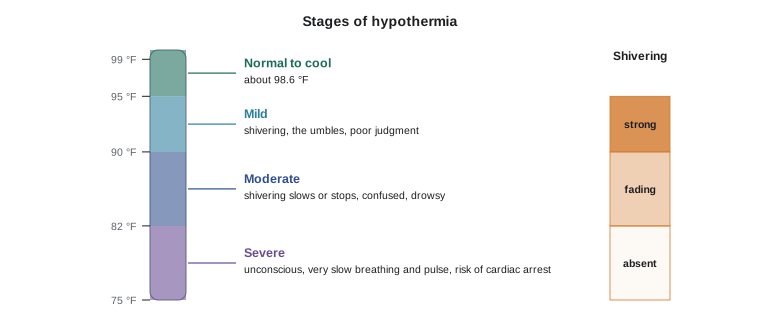
In the field, nobody is likely to have an accurate core thermometer, so responders judge the stage by the person's behavior and condition. A person who is shivering but alert and able to look after themselves probably has mild hypothermia. A person whose shivering has stopped, who is confused or drowsy, or who has stopped trying to stay warm probably has moderate or severe hypothermia and needs urgent medical care. Some rescue organizations use a simple staging system based on consciousness and shivering for this reason.
Poor judgment is one of the earliest and most dangerous effects. People with mild hypothermia often deny that anything is wrong, make poor decisions, refuse help, or behave oddly. In severe cases, some people undress as they become confused and feel paradoxically warm, a behavior known as paradoxical undressing. Co-workers and supervisors must watch for these signs, because the affected worker may not recognize them.
# Field staging of hypothermia from observations (illustrative teaching aid)
def stage(alert, shivering, conscious, breathing):
    if not breathing:
        return "possible cardiac arrest: call 911, start CPR if trained, handle gently"
    if not conscious:
        return "severe: call 911, handle very gently, insulate, keep horizontal"
    if not alert or not shivering:
        return "moderate: call 911, insulate, gentle handling, no walking"
    return "mild: get out of the cold, dry clothes, insulate, warm sweet drinks if alert"

cases = [
    ("shivering, joking, fumbling gloves",   dict(alert=True,  shivering=True,  conscious=True,  breathing=True)),
    ("stopped shivering, confused",          dict(alert=False, shivering=False, conscious=True,  breathing=True)),
    ("unresponsive, slow breathing",         dict(alert=False, shivering=False, conscious=False, breathing=True)),
]
for desc, obs in cases:
print(f"{desc:38s} -> {stage(**obs)}")shivering, joking, fumbling gloves -> mild: get out of the cold, dry clothes, insulate, warm sweet drinks if alert stopped shivering, confused -> moderate: call 911, insulate, gentle handling, no walking unresponsive, slow breathing -> severe: call 911, handle very gently, insulate, keep horizontal
The teaching aid shows the logic responders use: the less alert the person and the less they shiver, the more serious the hypothermia and the more gently they must be handled. People with moderate or severe hypothermia have an irritable heart that can go into a dangerous rhythm with rough handling, so they should be moved gently and kept horizontal. Lesson 11 explains the response in more detail.
Afterdrop and rewarming
During rewarming, core temperature can continue to fall for a while, a phenomenon called afterdrop, as cold blood from the limbs returns to the core and as the body continues to lose heat. Rapid rewarming of the arms and legs, or vigorous movement, can make it worse. This is why people with moderate or severe hypothermia should be rewarmed under medical supervision, with heat applied to the trunk rather than the limbs, and why they should not be made to walk or exercise to warm up.
Cold and the heart
Cold places extra strain on the heart. Narrowing of blood vessels raises blood pressure, the heart works harder to pump against it, and heavy work such as clearing snow by hand, pushing vehicles or breaking ice adds to the load. Heart attacks increase in cold weather, and heavy manual snow clearing with a shovel is a well-known trigger, particularly in people who are not used to strenuous work or have heart disease. Workers with known heart conditions should discuss cold-weather work with their health care provider, and heavy manual snow removal should be mechanized, shared and paced where possible.
Cold and the lungs
Breathing very cold, dry air can trigger narrowing of the airways in people with asthma and some others, causing coughing, wheezing and shortness of breath. Heavy work in very cold air increases the effect. Covering the mouth and nose with a scarf or mask that warms and humidifies the air helps, as does keeping reliever medication available and warm enough to work. Workers with asthma should have a plan for cold-weather work.
Raynaud's phenomenon and vibration
Raynaud's phenomenon is an exaggerated narrowing of the blood vessels in the fingers, and sometimes toes, in response to cold or stress. The fingers turn white, then blue, then red as blood flow returns, with numbness and pain. It occurs on its own in some people, but it is also a feature of hand-arm vibration syndrome, sometimes called vibration white finger, caused by long-term use of vibrating tools such as chainsaws, grinders, jackhammers and impact wrenches. Cold triggers the attacks, and cold and vibration together are worse than either alone. Workers who use vibrating tools in the cold should keep their hands warm and dry, use anti-vibration tools and gloves where available, take breaks, and report symptoms such as white or numb fingers early.
Cold and other injuries
As with heat, cold contributes to many injuries that are not recorded as cold injuries. Slips and falls on ice and snow are among the most common winter injuries. Dropped tools and loads, vehicle crashes in poor conditions, falls from height when hands are numb, carbon monoxide poisoning from heaters and engines run in enclosed spaces for warmth, and fires from portable heaters are all part of the winter hazard picture. A cold stress program should address these related hazards, not only frostbite and hypothermia.
Worked problem
Recognizing mild hypothermia
Late in a wet, windy afternoon at 4 °C, a laborer who has been digging a trench in soaked clothing starts making mistakes, drops tools, slurs some words and insists he is fine when asked. He is shivering hard. What is likely happening, and what should be done?
Show solution
- Wet clothing, wind and a temperature just above freezing are classic conditions for hypothermia.
- Shivering, fumbling, slurred speech and denial suggest mild hypothermia.
- He should stop work at once and be taken to a warm shelter or vehicle, out of the wind and rain.
- Remove wet clothing, replace with dry clothing and blankets, give warm sweet drinks if he is fully alert, and watch closely; if shivering stops or confusion increases, call 911.
Answer: Probable mild hypothermia. Get him out of the cold, into dry clothes and insulation, and monitor closely, calling for help if he worsens.
Worked problem
Distinguishing frostnip from frostbite
During a break at minus 28 °C wind chill, a worker notices a white patch on a co-worker's cheek. After 10 minutes in the warm truck, the patch turns red and tingles, and normal feeling returns. On another worker, two fingertips are hard and waxy and stay numb after 20 minutes in the truck. What are these injuries?
Show solution
- The cheek patch was white and numb but recovered fully with rewarming: frostnip.
- The fingertips are hard, waxy and remain numb: frostbite, at least superficial and possibly deeper.
- The worker with frostbite should not return to the cold and should not rub the fingers.
- Frostbitten fingers need careful rewarming only if refreezing can be prevented, and medical assessment.
Answer: Frostnip on the cheek; frostbite on the fingertips, which needs protection from further cold and medical assessment.
Common mistakes
MistakeRubbing frostbitten skin with snow or vigorously massaging it.
InsteadNever rub frostbitten tissue; it causes more damage.
MistakeThawing frostbitten feet in the field when the worker must walk out through snow.
InsteadDo not thaw tissue if it may refreeze; refreezing causes worse damage.
MistakeAssuming a hypothermic worker who has stopped shivering is getting better.
InsteadLoss of shivering in a cold person suggests worsening hypothermia.
MistakeMaking a hypothermic worker walk or exercise to warm up.
InsteadHandle gently and keep horizontal in moderate or severe hypothermia to avoid heart rhythm problems and afterdrop.
MistakeIgnoring white or numb fingers in workers using vibrating tools in the cold.
InsteadThese can signal hand-arm vibration syndrome; report early and reduce exposure.
Summary and key terms
- Local cold injuries include frostnip, frostbite, trench foot and chilblains.
- Frostnip recovers fully; frostbite freezes tissue and can lead to tissue loss.
- Trench foot results from prolonged wet cold above freezing and is prevented by keeping feet dry.
- Hypothermia is core temperature below 35 °C, staged as mild, moderate and severe.
- Loss of shivering, confusion and drowsiness mean worsening hypothermia and need emergency care.
- Afterdrop and heart rhythm problems make gentle handling essential in moderate and severe hypothermia.
- Cold strains the heart and lungs, triggers Raynaud's attacks and contributes to slips, crashes and other injuries.
- Frostnip
- Very cold, numb skin that has not frozen and recovers fully with rewarming.
- Frostbite
- Freezing of body tissue, classified as superficial or deep.
- Trench foot
- A non-freezing cold injury caused by prolonged wet cold, also called immersion foot.
- Chilblains
- Itchy, red or purple swellings from inflammation of small skin vessels after cold exposure.
- Hypothermia
- Core body temperature below 35 °C.
- Afterdrop
- A continued fall in core temperature during rewarming.
- Paradoxical undressing
- Removal of clothing by a confused person with severe hypothermia who feels warm.
- The umbles
- Stumbles, mumbles, fumbles and grumbles: early behavioral signs of hypothermia.
- Raynaud's phenomenon
- Exaggerated narrowing of finger blood vessels causing white, then blue, then red fingers.
- Hand-arm vibration syndrome
- Damage to blood vessels and nerves of the hands from long-term vibrating tool use.
Practice problems
Work each problem on paper first, then reveal the answer to check.
What is the difference between frostnip and frostbite?
Show answer
Frostnip is very cold, numb skin that has not frozen and recovers fully; frostbite is frozen tissue that can be permanently damaged.
Describe deep frostbite.
Show answer
Hard, white or blue-gray, numb tissue frozen through all skin layers and deeper, which may form blood-filled blisters and blacken.
Why must frostbitten tissue not be thawed if it might refreeze?
Show answer
Refreezing causes much worse damage than staying frozen a little longer.
What conditions cause trench foot?
Show answer
Feet that stay cold and wet for many hours or days at temperatures above freezing.
Give two ways to prevent trench foot.
Show answer
Any two of waterproof boots, changing to dry socks at least daily, drying boots between shifts and limiting time standing in water.
What core temperature defines hypothermia?
Show answer
Below 35 °C.
List four signs of mild hypothermia.
Show answer
Any four of shivering, fumbling, stumbling, slurred speech, poor judgment and irritability.
Why are people with moderate or severe hypothermia handled gently?
Show answer
Their cold heart is prone to dangerous rhythms, and movement can worsen afterdrop.
Why is heavy manual snow clearing a risk for some workers?
Show answer
Cold raises blood pressure and the heavy work adds strain, increasing the risk of heart attack.
How do cold and vibration interact?
Show answer
Cold triggers attacks of vibration white finger, and together they increase the risk and severity of hand-arm vibration syndrome.
Lesson quiz · 5 questions
Score 60% or more to complete this lesson.
Create a free account to save your progress, take quizzes and earn a certificate.