
HSE-243 · Lesson 2 of 12 · 31 min
How the body controls temperature
Every control in this course works by changing one or more of the ways the body gains and loses heat. A supervisor who understands those pathways can look at a work site and see why a fan helps in one place and hurts in another, why a reflective shield makes a large difference beside a furnace but little difference in a humid kitchen, and why a worker in a vapor-barrier suit can overheat on a cool day. This lesson builds that picture.
The core and the shell
Physiologists divide the body into a core and a shell. The core is the brain, heart, lungs and abdominal organs, which must stay close to 37 °C to work properly. The shell is the skin, fat and muscles of the limbs, whose temperature can vary much more. The body protects the core by adjusting blood flow to the shell. In heat, blood vessels in the skin widen so that warm blood from the core can shed heat at the surface. In cold, they narrow so that the shell becomes an insulating layer, and hands and feet cool sharply while the core stays warm.
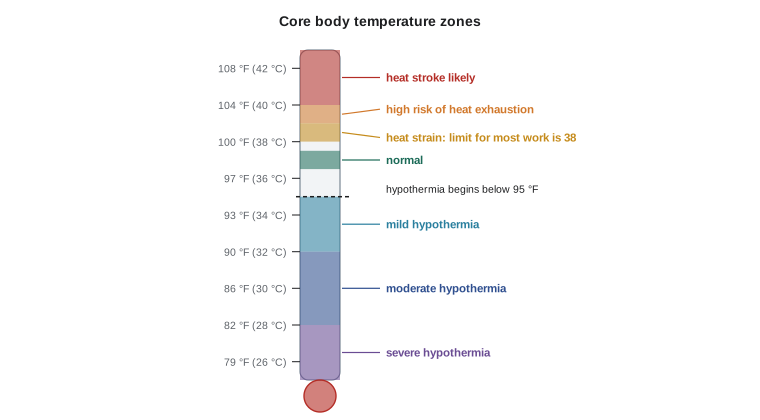
A healthy resting core temperature is about 36.5 to 37.5 °C. During hard work in heat, a rise to 38 °C is generally acceptable for acclimatized workers under close supervision, and many occupational guidelines aim to keep core temperature at or below 38 °C (38.5 °C for medically selected, acclimatized workers under monitoring). Above 39 °C, the risk of heat exhaustion rises steeply, and at 40 °C and above, heat stroke becomes likely. On the cold side, a core temperature below 35 °C is the definition of hypothermia.
The heat balance equation
The body is in heat balance when the heat it gains equals the heat it loses. Physiologists write this as an equation for the rate of heat storage, S, in watts:
Here M is metabolic heat production, W is external mechanical work done, C is heat exchanged by convection, R is heat exchanged by radiation, K is heat exchanged by conduction, and E is heat lost by evaporation of sweat and moisture from the lungs. The plus-or-minus signs show that convection, radiation and conduction can either add heat to the body or remove it, depending on whether the surroundings are hotter or cooler than the skin. Evaporation can only remove heat.
If S is zero, core temperature is stable. If S is positive, the body is storing heat and core temperature is rising. If S is negative, the body is losing heat and temperature is falling. Every heat stress control works by changing one of the terms: reducing M by slowing the work, reducing R with shields and shade, changing C with air movement, or increasing E by helping sweat evaporate.
Metabolic heat
Muscles are inefficient. Only about 20 to 25 percent of the energy they use becomes mechanical work, at best, and for most tasks the figure is lower. The rest becomes heat. A person at rest produces around 100 watts of heat, about as much as an old incandescent light bulb. Light work such as sitting with moderate arm movements or driving produces around 180 watts. Moderate work such as walking at a normal pace, light lifting or scrubbing produces about 300 watts. Heavy work such as digging with a shovel, carrying loads or climbing stairs produces around 415 watts, and very heavy work such as running, hard digging or rescue work can exceed 520 watts.
| Work category | Typical metabolic rate (W) | Examples |
|---|---|---|
| Rest | 115 | Sitting quietly |
| Light | 180 | Sitting with light hand or arm work, driving, inspection, standing with light tasks |
| Moderate | 300 | Walking about 5 km/h, moderate lifting and pushing, scrubbing, hammering, weeding |
| Heavy | 415 | Shovel work, carrying heavy loads, sawing, pushing heavy carts, digging |
| Very heavy | 520 | Very intense activity at a fast pace, climbing with loads, emergency rescue |
Because metabolic heat is the term the employer controls most directly, reducing work rate is one of the most powerful heat controls. Mechanical lifting aids, carts, conveyors, rotating heavy tasks among crew members and slowing the pace all cut M. Doubling the work rate can more than double the heat that must be shed.
Convection
Convection is heat transfer between the skin and the air moving across it. When air is cooler than the skin, which is usually around 33 to 35 °C, moving air carries heat away, and the faster it moves, the more heat it removes. That is why a breeze feels good on a warm day and why wind makes cold weather feel colder. When air is hotter than the skin, convection adds heat to the body. A fan blowing 45 °C air at a worker heats them up through convection, although it may still help if it speeds the evaporation of sweat enough to outweigh the extra heat gain. In very hot, humid air, fans can make things worse.
Radiation
Every surface radiates heat, and hotter surfaces radiate much more. The sun, molten metal, furnaces, kilns, ovens, hot asphalt and sunlit roofs and walls all radiate heat to nearby workers, even when the air between them is cool. Radiant heat passes through air without warming it, which is why standing in the shade or behind a shield can feel immediately cooler even though the air temperature has not changed. In cold weather, the body radiates heat to cold surroundings, such as a clear night sky, cold walls in a freezer, or snow and ice.
Radiant heat is controlled differently from air temperature. Shade, reflective shields, insulation on hot equipment, distance, and reflective or aluminized clothing all reduce radiant gain. A thermometer reading air temperature does not detect radiant heat at all, which is why heat stress indices such as the wet bulb globe temperature include a black globe thermometer.
Conduction
Conduction is heat transfer through direct contact. In heat, it matters when workers kneel on hot roofs, touch hot metal or sit on hot equipment, but its overall contribution to heat stress is usually small. In cold, it matters a great deal. Metal tools, ladders, railings and the ground conduct heat away from the hands, knees and feet quickly, and skin touching metal below about minus 7 °C can freeze. Water conducts heat roughly 25 times faster than air, which is why immersion in cold water is so dangerous and why wet clothing chills people so quickly.
Evaporation
Evaporation of sweat is the body's most important way to lose heat in hot conditions, and the only way once air and surroundings are hotter than the skin. Each liter of sweat that evaporates from the skin removes about 680 watt-hours of heat, roughly 2,400 kilojoules. A worker sweating one liter an hour during heavy work can shed about 680 watts this way, but only if the sweat evaporates. Sweat that drips off the body or soaks into clothing does not cool.
Evaporation depends on the difference between the water vapor pressure at the skin and in the air, and on air movement. In dry air, sweat evaporates readily, even at high temperatures. In humid air, it evaporates slowly, and in saturated air or inside impermeable clothing it hardly evaporates at all. That is why 35 °C in a humid kitchen can be more dangerous than 40 °C in a dry desert, and why encapsulating suits are so dangerous: they block evaporation completely, and the worker's body heat has nowhere to go.
# Heat balance for a worker in two environments (illustrative values in watts)
def storage(M, W, C, R, K, E_max):
    E_req = M - W + C + R + K          # evaporation needed for balance
    E = min(E_req, E_max)              # evaporation actually possible
    return E_req, E, M - W + C + R + K - E

cases = {
    "dry, 35 C, shade, moderate work":  dict(M=300, W=30, C=20,  R=10,  K=0, E_max=600),
    "humid, 35 C, sun, moderate work":  dict(M=300, W=30, C=20,  R=150, K=0, E_max=330),
    "impermeable suit, 25 C":           dict(M=300, W=30, C=-20, R=0,   K=0, E_max=40),
}
for name, c in cases.items():
    need, got, S = storage(**c)
    print(f"{name:34s} needs E={need:4.0f} W, gets E={got:4.0f} W, storage S={S:4.0f} W")

# How fast does core temperature rise with S watts stored? (75 kg, c = 3.49 kJ/kg/K)
mass, c_body = 75, 3.49
for S in (0, 110, 250):
    rise_per_h = S * 3600 / (mass * c_body * 1000)
print(f"S = {S:3d} W -> core temperature rises about {rise_per_h:.1f} C per hour")dry, 35 C, shade, moderate work needs E= 300 W, gets E= 300 W, storage S= 0 W humid, 35 C, sun, moderate work needs E= 440 W, gets E= 330 W, storage S= 110 W impermeable suit, 25 C needs E= 250 W, gets E= 40 W, storage S= 210 W S = 0 W -> core temperature rises about 0.0 C per hour S = 110 W -> core temperature rises about 1.5 C per hour S = 250 W -> core temperature rises about 3.4 C per hour
The model is simplified and its numbers are illustrative, but the pattern is real. In dry shade, sweat can remove all the heat the body produces, and core temperature stays stable. Add sun and humidity, and the body cannot shed enough heat; a storage of about 110 watts raises core temperature by roughly 1.5 °C an hour, enough to take a worker from 37 °C to dangerous levels within two hours. In an impermeable suit, even at a comfortable 25 °C, core temperature can rise by around 3 °C an hour.
How the body responds to heat
When core temperature starts to rise, the brain's thermostat, in the hypothalamus, triggers two main responses. First, skin blood vessels widen, sending more warm blood to the surface. Second, sweating begins and increases. The heart must now pump blood both to working muscles and to the skin, so heart rate rises. If the worker is also losing body water through sweat, blood volume falls, and the heart has to work harder still. This competition for blood is at the root of most heat illness: eventually the circulation cannot meet every demand, and blood pressure, brain function or temperature control starts to fail.
Heart rate is one of the best simple indicators of heat strain. Sustained heart rates above about 180 beats per minute minus the worker's age, or a heart rate that does not recover to around 120 beats per minute within a minute or so of stopping work, suggest excessive strain. Some heat stress programs use wearable heart rate or core temperature sensors for high-risk work, which lesson 7 discusses.
How the body responds to cold
When the body loses heat, the first response is vasoconstriction: blood vessels in the skin and limbs narrow, reducing blood flow to the shell and preserving core heat. Hands, feet, ears and nose cool quickly. Periodically, blood vessels in the fingers reopen briefly, a reflex called cold-induced vasodilation, which helps protect the fingers from freezing but differs widely between people. The second response is shivering, which can increase heat production several-fold for short periods, at the cost of energy, coordination and fatigue. People also respond by behavior: adding layers, moving more, seeking shelter.
Shivering is a warning sign, not a solution. It uses large amounts of energy, makes fine hand work clumsy and tires workers quickly. When energy reserves run low, or when core temperature falls far enough, shivering stops, and the body cools faster. A worker who has stopped shivering while still cold is in serious danger, not getting better.
Factors that change individual tolerance
Two workers in the same conditions can respond very differently. Acclimatization is the biggest factor in heat tolerance, and lesson 6 covers it in detail. Physical fitness improves tolerance to both heat and cold. Body size and composition matter: larger people produce more heat in absolute terms, and body fat insulates against cold but slows heat loss in heat. Age reduces sweating capacity and thirst sensation, and older workers may be slower to recover. Dehydration, recent illness with fever or diarrhea, lack of sleep, and alcohol use the day before all reduce heat tolerance.
Many medications affect temperature control. Some reduce sweating, such as certain antihistamines and anticholinergic drugs; some reduce the heart's ability to increase output, such as beta blockers; some increase fluid loss, such as diuretics; and some affect the brain's thermostat or thirst, such as certain antipsychotics and antidepressants. Stimulants, including some drugs used for attention deficit disorder and illicit stimulants, increase heat production. Workers do not have to tell the employer about their health conditions or medications, but they should be told that these factors matter and encouraged to ask their health care provider or pharmacist whether their medications affect heat or cold tolerance.
Worked problem
Choosing the right control from the heat balance
Workers at a steel mill tap molten metal at a furnace. The air temperature is 32 °C, humidity is low, and workers say the heat on their faces and chests is unbearable when they face the furnace. A manager suggests adding fans. Which heat balance terms dominate, and what would you suggest?
Show solution
- The intense heat on the face and chest from a furnace is radiant heat, R, which passes through air without warming it much.
- The air is 32 °C and dry, so sweat can evaporate well; evaporation is not the main limit.
- Fans affect convection and evaporation, not radiation, and at 32 °C air they give limited extra cooling.
- The most effective controls reduce R: reflective or water-cooled shields, insulating hot surfaces, increasing distance, and aluminized face shields and clothing for the tapping task.
Answer: Radiant heat dominates, so radiant shielding and reflective protective clothing will help much more than fans.
Worked problem
Estimating sweat needed for heat balance
A worker producing 400 W of metabolic heat, doing about 40 W of external work, gains 60 W from radiation and loses 20 W by convection. How much sweat must evaporate each hour to stay in balance, using 680 W·h per liter?
Show solution
- Heat to remove by evaporation: E = M − W + R − C = 400 − 40 + 60 − 20 = 400 W.
- Over an hour, that is 400 W·h of heat.
- Sweat evaporated: 400 ÷ 680 ≈ 0.59 L per hour.
- More sweat than this will actually be produced, because some drips off without evaporating.
Answer: About 0.6 L of sweat must evaporate each hour, and the worker will produce more than that, so fluid replacement must keep pace.
Common mistakes
MistakeUsing fans in any hot environment.
InsteadFans help when air is cooler than skin or speeds evaporation; in very hot, humid air they can add heat.
MistakeMeasuring only air temperature beside furnaces or in the sun.
InsteadRadiant heat is not detected by an air thermometer; use a globe thermometer or WBGT.
MistakeAssuming sweating always cools the body.
InsteadOnly sweat that evaporates removes heat; in humid air or impermeable clothing it may not evaporate.
MistakeTreating shivering as a sign the body is coping well.
InsteadShivering is a warning; when it stops in a cold worker, hypothermia may be worsening.
MistakeIgnoring medications and recent illness when planning heat work.
InsteadMany medications and illnesses reduce tolerance; workers should be told and encouraged to seek advice.
Summary and key terms
- The body protects a core temperature near 37 °C by adjusting blood flow to the skin and limbs.
- The heat balance equation is S = M − W ± C ± R ± K − E; when S is positive, core temperature rises.
- Metabolic heat rises sharply with work rate, so slowing or mechanizing work is a powerful control.
- Radiant heat is controlled by shade, shields and distance; air thermometers do not measure it.
- Evaporation of sweat is the main cooling route in heat and fails in humid air or impermeable clothing.
- In cold, vasoconstriction and shivering protect the core but leave hands and feet vulnerable.
- Acclimatization, fitness, age, hydration, illness and medications all change individual tolerance.
- Metabolic heat (M)
- Heat produced by the body's metabolism, rising with physical work.
- Convection
- Heat exchange between the skin and moving air or water.
- Radiation
- Heat exchange by infrared radiation between the body and surrounding surfaces, such as the sun or a furnace.
- Conduction
- Heat exchange through direct contact with solid surfaces or water.
- Evaporation
- Heat loss when sweat or moisture changes to vapor on the skin or in the lungs.
- Heat storage (S)
- The net rate at which heat is gained or lost by the body.
- Vasodilation
- Widening of blood vessels, which increases blood flow to the skin.
- Vasoconstriction
- Narrowing of blood vessels, which reduces blood flow to the skin and extremities.
- Hypothalamus
- The part of the brain that acts as the body's thermostat.
- Shivering
- Involuntary muscle activity that generates heat in response to cold.
Practice problems
Work each problem on paper first, then reveal the answer to check.
Write the heat balance equation and name each term.
Show answer
S = M − W ± C ± R ± K − E: storage, metabolic heat, external work, convection, radiation, conduction and evaporation.
What happens to core temperature when S is positive?
Show answer
It rises because the body is storing heat.
Roughly how much heat does moderate work produce?
Show answer
About 300 watts.
Why does a black globe thermometer appear in heat stress indices?
Show answer
To capture radiant heat, which an air thermometer does not detect.
When can a fan increase heat stress?
Show answer
When the air is much hotter than the skin and too humid for extra evaporation to compensate.
How much heat does one liter of evaporated sweat remove?
Show answer
About 680 watt-hours, or roughly 2,400 kJ.
Why are impermeable suits dangerous even at moderate temperatures?
Show answer
They block evaporation, so body heat cannot be shed.
Why does water chill the body so much faster than air?
Show answer
Water conducts heat roughly 25 times faster than air.
Name three types of medication that can reduce heat tolerance.
Show answer
Any three of antihistamines or anticholinergics, beta blockers, diuretics, some antipsychotics or antidepressants, and stimulants.
Why is a cold worker who stops shivering a concern?
Show answer
Shivering may stop because energy is exhausted or hypothermia is worsening, so the body cools faster.
Lesson quiz · 5 questions
Score 60% or more to complete this lesson.
Create a free account to save your progress, take quizzes and earn a certificate.