
HSE-243 · Lesson 10 of 12 · 31 min
Cold stress law and prevention
Cold stress is regulated in much the same way as heat stress in the United States: there is no specific federal OSHA cold stress standard, and OSHA relies on the General Duty Clause and related standards, with the ACGIH threshold limit values for cold stress and NIOSH guidance as technical references. This lesson describes the law as of October 2026 and then turns to prevention: planning, clothing, shelters, warm-up schedules, hand and foot protection, cold storage, and working on ice.
The ACGIH cold stress TLVs
The ACGIH cold stress TLVs aim to keep workers' deep body temperature from falling below 36 °C and to prevent cold injury to the extremities. They are based on equivalent chill temperature, which is essentially wind chill, and set out protective measures at different levels. Among their main elements: workers should be protected so that core temperature stays at or above 36 °C; adequate insulating dry clothing is needed below about 4 °C; when equivalent chill temperatures are below about minus 7 °C, heated warming shelters should be available nearby and workers should use them at regular intervals; fine work with bare hands for more than a short time below about 16 °C needs special measures to keep hands warm; and below set temperatures, workers should wear gloves, then mittens. The TLVs also include a work/warm-up schedule for outdoor work, described below.
The law
Federal OSHA
OSHA has no specific cold stress standard. It can cite serious cold hazards under the General Duty Clause, section 5(a)(1), and it enforces related standards that apply in cold conditions, including personal protective equipment (1910.132), walking-working surfaces and slips on ice, medical services and first aid, ventilation and carbon monoxide hazards from heaters, and injury recording. OSHA publishes cold stress guidance and, with NIOSH, recommends planning for cold weather, providing warm areas, scheduling work for warmer times, using the buddy system and training workers to recognize cold stress.
NIOSH and other references
NIOSH publishes cold stress guidance that recommends many of the same measures as the ACGIH TLVs, and the National Weather Service wind chill chart is widely used to plan outdoor work. Some state plans address cold in specific industries; for example, Alaska's occupational safety rules and guidance give particular attention to cold, remote work. Unionized workplaces often have cold weather provisions in collective agreements.
State plans and employer policies
Most states with their own OSHA plans do not have cold-specific standards either, but their general duty provisions and PPE rules apply. Many employers in cold regions adopt the ACGIH work/warm-up schedule or the NWS wind chill chart as company policy. Wherever you work, the practical expectation is a written cold stress plan, adequate clothing and shelter, warm-up breaks, training and a way to respond to cold injury.
Planning for cold work
A cold stress plan starts with knowing what is coming. Supervisors should check the forecast temperature, wind and precipitation daily and use wind chill to set the level of precautions for the day. The plan should define trigger levels, for example by wind chill bands, and the actions at each: covering exposed skin, warm-up breaks, limits on exposure time, rescheduling non-essential outdoor work, and stopping work in extreme conditions. Heavy work should be scheduled for the warmest part of the day where practicable, and work should be planned to keep workers out of wind and wet.
Pacing matters in the cold, because heavy work that makes people sweat soaks their clothing, and they chill when they stop. Workers should be able to adjust layers, take short breaks before they become exhausted, and avoid working to the point of heavy sweating. Fatigue increases cold risk, so long shifts in severe cold need extra breaks. New workers, like new heat workers, need time and coaching to learn how to dress and pace themselves for cold work.
Clothing
Clothing for cold work is usually built in layers. A base layer next to the skin, made of synthetic fabric or wool, moves moisture away from the skin; cotton is a poor choice because it holds water and loses insulation when wet. One or more insulating middle layers, such as fleece, wool or synthetic or down fill, trap warm air. An outer shell blocks wind and water while letting some water vapor escape. Layers let workers add or remove insulation as work rate and conditions change, so they can stay warm without sweating heavily.
Insulation is measured in clo units, where 1 clo is roughly a business suit. The amount needed depends on activity: a person standing still at minus 20 °C may need 3 to 4 clo or more, while a person doing heavy work may need much less, so adjustable layering is essential. Clothing must also fit over required equipment such as fall protection harnesses, and flame-resistant or high-visibility requirements still apply in winter. Clothing that becomes wet should be changed, and spare dry clothing, socks and gloves should be available on site.
The head, hands and feet need particular attention. A large share of heat can be lost from an uncovered head, and hard hat liners or balaclavas that fit under a hard hat are available. Hands need insulated gloves or mittens appropriate to the task; mittens are warmer, gloves allow more dexterity, and liner gloves under mittens let workers do brief fine work without exposing bare skin. Feet need insulated, waterproof boots with enough room for warm socks and circulation; tight boots increase frostbite risk. Face protection, such as balaclavas, neck gaiters and goggles, is needed when wind chill is in the high-risk range.
Warming shelters and warm-up breaks
Warm-up breaks let workers restore body heat and rewarm hands and feet. They should be taken in a heated shelter, vehicle or building close to the work, with somewhere to dry or change clothing and to get warm drinks and food. The ACGIH TLVs, and BC's regulation, call for heated shelters when the equivalent chill temperature is below minus 7 °C. Shelters must be safe: fuel-burning heaters in enclosed spaces can produce carbon monoxide, so heaters must be designed for the space, vented as required, and the space monitored with carbon monoxide alarms. Workers should not warm up by sitting in idling vehicles in enclosed areas or snowbanks where exhaust can accumulate.
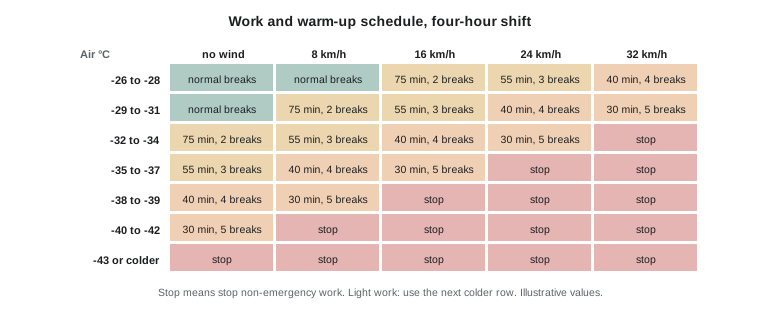
The ACGIH TLVs include a work/warm-up schedule for outdoor work during a four-hour shift, developed from guidance first published by the Saskatchewan Department of Labor. It sets the maximum work period and the number of warm-up breaks, each about 10 minutes in a warm place, for combinations of air temperature and wind speed. The colder and windier it is, the shorter the work periods and the more breaks are needed, until non-emergency work should stop.
| Air temperature (sunny sky) | No noticeable wind | 8 km/h wind | 16 km/h wind | 24 km/h wind | 32 km/h wind |
|---|---|---|---|---|---|
| −26 to −28 °C | normal breaks | normal breaks | 75 min (2) | 55 min (3) | 40 min (4) |
| −29 to −31 °C | normal breaks | 75 min (2) | 55 min (3) | 40 min (4) | 30 min (5) |
| −32 to −34 °C | 75 min (2) | 55 min (3) | 40 min (4) | 30 min (5) | stop non-emergency work |
| −35 to −37 °C | 55 min (3) | 40 min (4) | 30 min (5) | stop non-emergency work | stop non-emergency work |
| −38 to −39 °C | 40 min (4) | 30 min (5) | stop non-emergency work | stop non-emergency work | stop non-emergency work |
| −40 to −42 °C | 30 min (5) | stop non-emergency work | stop non-emergency work | stop non-emergency work | stop non-emergency work |
| −43 °C and below | stop non-emergency work | stop non-emergency work | stop non-emergency work | stop non-emergency work | stop non-emergency work |
# Look up the illustrative work/warm-up schedule (4-hour shift)
ROWS = [(-26, -28), (-29, -31), (-32, -34), (-35, -37), (-38, -39), (-40, -42)]
COLS = [0, 8, 16, 24, 32]          # km/h; wind rounded up to the next column
TABLE = [
    ["normal", "normal", "75/2", "55/3", "40/4"],
    ["normal", "75/2", "55/3", "40/4", "30/5"],
    ["75/2", "55/3", "40/4", "30/5", "stop"],
    ["55/3", "40/4", "30/5", "stop", "stop"],
    ["40/4", "30/5", "stop", "stop", "stop"],
    ["30/5", "stop", "stop", "stop", "stop"],
]
def schedule(temp_c, wind_kmh, light_work=False):
    if temp_c > -26:
        return "above table range: normal breaks, with wind chill precautions"
    r = next((i for i, (hi, lo) in enumerate(ROWS) if lo <= round(temp_c) <= hi), None)
    if r is None:
        return "stop non-emergency work"
    if light_work:
        r += 1                                   # light work: use next colder row
        if r >= len(ROWS):
            return "stop non-emergency work"
    c = next((j for j, w in enumerate(COLS) if wind_kmh <= w), None)
    if c is None:
        return "stop non-emergency work"
    cell = TABLE[r][c]
    if cell == "stop":   return "stop non-emergency work"
    if cell == "normal": return "normal breaks"
    work, breaks = cell.split("/")
    return f"max {work} min work, {breaks} warm-up breaks per 4 h"

for t, w, light in [(-27, 12, False), (-30, 20, False), (-33, 5, True), (-36, 25, False)]:
print(f"{t} C, wind {w} km/h, light={light!s:5s} -> {schedule(t, w, light)}")-27 C, wind 12 km/h, light=False -> max 75 min work, 2 warm-up breaks per 4 h -30 C, wind 20 km/h, light=False -> max 40 min work, 4 warm-up breaks per 4 h -33 C, wind 5 km/h, light=True -> max 40 min work, 4 warm-up breaks per 4 h -36 C, wind 25 km/h, light=False -> stop non-emergency work
The schedule is a practical tool for supervisors. For moderate work at minus 30 °C with a 20 km/h wind, rounded up to the 24 km/h column, it allows work periods of no more than 40 minutes with four warm-up breaks in a four-hour shift. For light work, such as equipment operation in an unheated cab or standing inspection work, the next colder row is used, because light work produces less body heat. At minus 36 °C with a 25 km/h wind, non-emergency outdoor work should stop.
Other controls
Engineering controls for cold work include windbreaks and enclosures around work areas, heated or tented work areas on construction sites, heated cabs on equipment, radiant heaters at fixed work stations, insulated handles on tools, and mechanical aids that reduce the need for heavy work that leads to sweating. In cold storage, controls include reducing air speed at work stations, insulated floor mats at fixed positions, warm break rooms and rotation between cold and warm areas.
Administrative controls include the warm-up schedule, scheduling outdoor work for warmer hours, the buddy system to watch for frostbite and hypothermia, check-in systems for people working alone, limiting the number of workers exposed, and providing warm, sweet drinks and high-energy food. Caffeinated and alcoholic drinks are poor choices, because they increase fluid loss, and alcohol increases heat loss. Workers should be trained in cold hazards, symptoms, proper clothing, the use of warming shelters and the emergency plan.
Slips on ice deserve a place in every cold plan. Clearing snow and ice, sanding and salting walkways and work areas, providing ice cleats or studded footwear, and marking hazards prevent many winter injuries. Ladders, scaffolds and roofs need particular attention when icy.
Working on ice
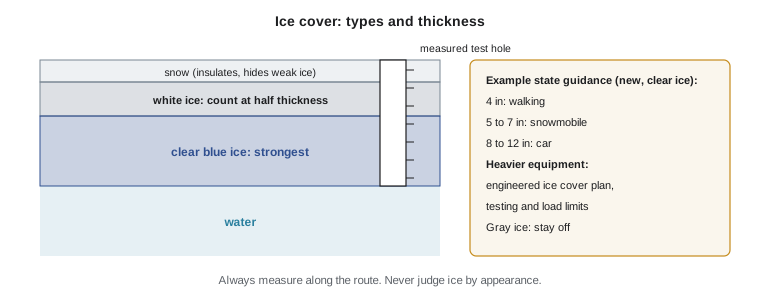
Work on ice covers, such as ice roads, winter drilling and construction, ice fishing operations, utility crossings and rescues, carries the risk of falling through the ice into cold water. Ice strength depends on its thickness and type: clear blue ice is strongest, white or snow ice made from frozen slush is much weaker, and gray ice indicates water and should be avoided. Moving water, springs, pressure ridges, cracks, snow cover, which insulates ice and slows its growth, and warm spells all weaken ice. State natural resource agencies publish thickness guidance; for example, Minnesota's guidance suggests at least 4 inches of new, clear ice for walking, 5 to 7 inches for a snowmobile, and 8 to 12 inches for a car. For heavier vehicles and equipment, engineered ice cover plans with testing and load limits are needed.
A common engineering rule for the allowable load on clear ice is Gold's formula, which relates the safe load to the square of the ice thickness. In one form, the allowable load P in kilograms is A times h squared, where h is the thickness of clear, sound ice in centimeters and A is a coefficient chosen for safety, often around 3.5 to 4 for working loads in published guidelines. White ice is usually counted at half its thickness. The formula shows why doubling the ice thickness roughly quadruples the allowable load.
# Gold's formula, illustrative only: P (kg) = A * h^2, h in cm of clear, sound ice
A = 4.0                     # illustrative coefficient for a working load
def effective_thickness(clear_cm, white_cm):
    return clear_cm + 0.5 * white_cm          # white ice counted at half

for clear, white in [(20, 0), (30, 0), (30, 10), (60, 0)]:
    h = effective_thickness(clear, white)
    print(f"clear {clear} cm + white {white} cm -> effective {h:.0f} cm, "
f"allowable load about {A * h**2:,.0f} kg")clear 20 cm + white 0 cm -> effective 20 cm, allowable load about 1,600 kg clear 30 cm + white 0 cm -> effective 30 cm, allowable load about 3,600 kg clear 30 cm + white 10 cm -> effective 35 cm, allowable load about 4,900 kg clear 60 cm + white 0 cm -> effective 60 cm, allowable load about 14,400 kg
These results are illustrative only and must never be used to decide whether a vehicle can cross real ice. Allowable loads depend on many factors that a simple formula cannot capture: cracks, temperature, speed, how long a load stays parked, spacing between vehicles and the condition of the ice. Work on ice requires a site-specific plan, regular thickness measurements along the route, load limits set by a competent person, and rescue equipment and procedures for falling through, including personal flotation such as float suits, ice picks or awls, throw ropes and a trained rescue team.
Worked problem
Using the work/warm-up schedule
A pipeline crew doing moderate work will be outdoors at minus 31 °C with a 15 km/h wind. What does the illustrative schedule allow, and what should change for the equipment operator in an unheated cab doing light work?
Show solution
- Minus 31 °C falls in the minus 29 to minus 31 row; 15 km/h rounds up to the 16 km/h column.
- For the moderate-work crew, the schedule gives a maximum work period of 55 minutes with 3 warm-up breaks in a four-hour shift.
- Light work uses the next colder row, minus 32 to minus 34, where the 16 km/h column gives 40 minutes with 4 breaks.
- Heated shelter is required nearby, and workers must have full face protection and dry spare clothing.
Answer: Crew: up to 55 minutes of work between warm-ups, 3 breaks per 4 hours. Operator doing light work: up to 40 minutes, 4 breaks.
Worked problem
Reviewing a cold stress plan
A highway contractor's cold plan says: wear warm clothing and use common sense. What is missing?
Show solution
- A credible plan needs an assessment of cold hazards and specific actions, even without a federal cold standard.
- The plan needs daily monitoring of temperature and wind chill, with trigger levels and specific actions.
- It needs requirements for layered clothing, face, hand and foot protection, spare dry clothing, and heated shelters below minus 7 °C equivalent chill.
- It needs a warm-up schedule, a buddy system, training, carbon monoxide controls for heaters, slip prevention and an emergency response for frostbite and hypothermia.
Answer: Nearly everything: an assessment, triggers, specific controls, shelter, warm-up schedule, training and emergency procedures.
Common mistakes
MistakeWearing cotton base layers for heavy outdoor winter work.
InsteadUse synthetic or wool base layers that move moisture away from the skin.
MistakeWarming up in an idling vehicle in an enclosed space or snowbank.
InsteadUse properly vented shelters with carbon monoxide alarms; keep exhaust clear.
MistakeUsing the moderate-work row of the warm-up schedule for light work.
InsteadLight work produces less heat; use the next colder row.
MistakeJudging ice safety by its appearance.
InsteadMeasure thickness and type at regular intervals; white ice counts at half.
MistakeUsing Gold's formula alone to approve vehicle crossings.
InsteadVehicles and equipment on ice need a site-specific plan, testing and load limits set by a competent person.
Summary and key terms
- The ACGIH cold stress TLVs aim to keep core temperature at or above 36 °C and prevent cold injury.
- OSHA has no cold stress standard but enforces the General Duty Clause and related standards.
- A cold plan monitors temperature and wind chill daily and sets actions at trigger levels.
- Layered clothing with moisture-moving base layers, insulation and a wind and water shell lets workers adjust to work rate.
- Warm-up breaks in heated, safely ventilated shelters are essential in severe cold.
- The work/warm-up schedule shortens work periods with colder, windier conditions and lighter work.
- Work on ice needs measurement, ice type assessment, load limits and rescue planning.
- Equivalent chill temperature
- An index of the combined cooling effect of temperature and wind, essentially wind chill.
- Cold exposure control plan
- A written plan describing how cold stress will be assessed and controlled.
- Work/warm-up schedule
- A table setting maximum work periods and warm-up breaks by air temperature and wind speed.
- Warming shelter
- A heated, safely ventilated space near the work where workers rewarm.
- Clo
- A unit of clothing insulation; 1 clo is roughly a business suit.
- Base layer
- Clothing next to the skin that moves moisture away.
- Shell layer
- Outer clothing that blocks wind and water.
- Clear blue ice
- Strong, transparent ice formed by freezing water.
- White ice
- Weaker, opaque ice formed from frozen slush or snow, usually counted at half thickness.
- Gold's formula
- An engineering rule relating the allowable load on ice to the square of its thickness.
Practice problems
Work each problem on paper first, then reveal the answer to check.
What core temperature do the ACGIH cold TLVs aim to protect?
Show answer
At or above 36 °C.
Does OSHA have a specific cold stress standard?
Show answer
No; it uses the General Duty Clause and related standards.
Describe a three-layer clothing system.
Show answer
A moisture-moving base layer, an insulating middle layer and a wind- and water-resistant shell.
Why is cotton a poor base layer for cold work?
Show answer
It holds moisture and loses insulation when wet.
Moderate work at minus 33 °C with an 8 km/h wind. What does the illustrative schedule allow?
Show answer
Up to 55 minutes of work with 3 warm-up breaks per 4-hour shift.
Why does light work use the next colder row of the schedule?
Show answer
Light work produces less body heat, so workers cool faster.
What hazard do fuel-burning heaters in shelters create?
Show answer
Carbon monoxide poisoning; heaters must be vented and alarms used.
How is white ice treated when estimating ice strength?
Show answer
It is usually counted at half its thickness.
Using P = 4h² in kg, what is the illustrative load for 25 cm of clear ice?
Show answer
2,500 kg; illustrative only.
List three items of rescue equipment for work on ice.
Show answer
Any three of float suits or PFDs, ice picks or awls, throw ropes and a trained rescue team.
Lesson quiz · 5 questions
Score 60% or more to complete this lesson.
Create a free account to save your progress, take quizzes and earn a certificate.