
HSE-243 · Lesson 1 of 12 · 28 min
Why heat and cold injure workers
People can work safely in a remarkable range of temperatures, from a refrigerated warehouse at minus 25 °C to a foundry floor where radiant heat makes the air feel like an oven. The human body is good at protecting its core temperature, but it has limits. When the environment, the work and the clothing together push heat into the body faster than it can get rid of it, or draw heat out faster than the body can make it, the core temperature starts to drift. A drift of only a couple of degrees changes how well a person thinks, moves and judges risk. A larger drift can kill.
This course is about recognizing and controlling those thermal hazards at work. It covers heat stress and cold stress, how they are measured, how US federal and state rules treat them, and how to build a practical program that protects workers in summer and winter. It is awareness and supervisor training. It does not certify anyone in first aid; the first aid content in lesson 11 is at an awareness level, and every workplace still needs people trained in first aid as OSHA's medical services and first aid standards require. Personal protective equipment in general is covered in HSE-104, and confined spaces, where heat often builds up, are covered in HSE-216.
Heat stress and heat strain
Two terms are used throughout this course, and they mean different things. Heat stress is the total heat load on the body: the heat produced by muscles doing work plus the heat gained from or lost to the environment, adjusted for the clothing being worn. It describes the situation. Heat strain is the body's response to that load: a rising heart rate, sweating, a rising core temperature, and eventually illness if the load is too high or lasts too long. The same heat stress can produce very different heat strain in two people, depending on fitness, acclimatization, hydration, health and medications.
Cold stress and cold strain work the same way. Cold stress is the combination of air temperature, wind, wetness and contact with cold surfaces that draws heat from the body. Cold strain is the response: shivering, narrowing of blood vessels in the hands and feet, falling skin temperature, and, if the loss continues, falling core temperature and frozen tissue.
Thinking in terms of stress and strain keeps the focus on what can be controlled. The employer can change the stress, by shading a work area, scheduling heavy work for cooler hours, providing heated shelters or reducing exposure time. The employer can also reduce strain by helping workers acclimatize, keeping them hydrated, and watching for early symptoms so that people stop before they are harmed.
Who is exposed
Thermal hazards are not limited to a few unusual jobs. Outdoor work in summer exposes roofers, road builders, landscapers, farm workers, utility crews, construction laborers, delivery drivers, letter carriers, flaggers, firefighters, and anyone working in direct sun on hot pavement. Indoor heat exposes workers in foundries, smelters, glass and ceramics plants, bakeries, commercial kitchens, laundries, boiler rooms, mines, warehouses without air conditioning, and vehicles and equipment cabs. Workers wearing impermeable protective clothing, such as asbestos abatement crews, hazardous materials responders and some health care workers, can develop heat strain even at moderate temperatures, because their sweat cannot evaporate.
Cold exposes a different but overlapping group: construction and utility crews in winter, forestry and oil and gas workers in the northern states, commercial fishers, search and rescue teams, ski area staff, and workers in cold storage, meat processing and refrigerated warehouses. In Alaska, the northern plains and the upper Midwest, wind chill can make exposed skin freeze within minutes, and cold is a major planning factor for any outdoor winter work.
Why the problem is growing
Extreme heat is becoming more common. Average temperatures across North America have risen over the past century, and heat waves have become more frequent, longer and more intense. Nights stay warmer during heat waves, which matters because the body recovers overnight; a worker who cannot cool down at night starts the next shift already strained. Heat waves also arrive earlier in the year, before workers have adapted.
The western North America heat dome of late June 2021 showed how deadly an extreme event can be. Hundreds of people died in Oregon, Washington and British Columbia, and Oregon adopted emergency, then permanent, heat rules for workers after a farmworker died moving irrigation lines during the event. Since then more states have adopted heat standards, and OSHA proposed a federal heat injury and illness prevention rule in August 2024, held an informal hearing in mid-2025 and, as of October 2026, had not issued a final rule.
Cold has not gone away either. Warmer average winters can bring more freeze-thaw cycles, rain on snow, and unstable ice, and cold snaps can still be severe. A warm winter can make workers and supervisors complacent about ice thickness on lakes and rivers, and wet cold near freezing is often more dangerous than dry cold well below it because wet clothing loses much of its insulation.
How big is the problem?
Heat illness is under-recorded. Many cases are treated on site and never reported, and when a worker dies of a heart attack or a fall on a hot day, heat is often not listed as a cause even if it contributed. The Bureau of Labor Statistics counted 48 work-related deaths from exposure to environmental heat in 2024, and about 7,100 heat-related cases involving days away from work, job restriction or transfer in 2023 and 2024 combined; BLS changed its classification system with the 2023 data, so comparisons with earlier years need care. Researchers who link temperature data to injury claims have found that the risk of all kinds of workplace injury, not only heat illness, rises on hot days, because heat reduces concentration, grip and judgment.
Cold injuries are also under-reported. Frostbite of fingers and toes is often treated as a minor problem, and hypothermia may be recorded only when it causes a death or a dramatic rescue. Cold also contributes indirectly to injuries from slips on ice, dropped tools and loads, vehicle crashes and falls through ice.
The cost of getting it wrong
The direct harms are illness and injury. A worker with heat exhaustion may lose a day or two; a worker with heat stroke may suffer permanent brain, kidney or heart damage or die. Frostbite can mean amputation, and hypothermia can kill quietly. The indirect effects are just as important to an employer. Productivity falls in heat: studies of outdoor workers have found output falling substantially as wet bulb globe temperature rises past the high twenties in degrees Celsius. Errors, near misses and conflict become more common. Equipment operators misjudge distances. Workers rush to finish before the hottest part of the day, or skip breaks to keep up with a crew.
# Illustrative: how much useful work is lost when breaks are not planned,
# compared with planned work-rest cycles that keep people working safely.
shift_h = 10
scenarios = {
    "planned 45 min work / 15 min rest":      {"work_frac": 0.75, "stopped_h": 0.0},
    "no plan: worker collapses at hour 6":    {"work_frac": 1.00, "stopped_h": 4.0},
    "no plan: crew slows down to 60 % pace": {"work_frac": 0.60, "stopped_h": 0.0},
}
for name, s in scenarios.items():
    productive = (shift_h - s["stopped_h"]) * s["work_frac"]
print(f"{name:40s} productive hours = {productive:4.1f} of {shift_h}")planned 45 min work / 15 min rest productive hours = 7.5 of 10 no plan: worker collapses at hour 6 productive hours = 6.0 of 10 no plan: crew slows down to 60 % pace productive hours = 6.0 of 10
The numbers are illustrative, but the point holds in practice. A planned work-rest cycle looks like lost time on paper. In reality, it often produces more useful work over a shift than a crew pushing through until someone collapses or everyone slows to a crawl. An unplanned emergency also stops the whole crew, brings in emergency services and may stop the job for an investigation.
The structure of this course
Lessons 2 to 7 deal with heat. Lesson 2 explains how the body makes and loses heat, which is the foundation for everything else. Lesson 3 describes the heat illnesses from mild to deadly. Lesson 4 covers how heat stress is measured, including the wet bulb globe temperature, humidex and the heat index. Lesson 5 looks at the law and exposure limits. Lessons 6 and 7 cover prevention: acclimatization, water, rest and shade, work-rest cycles, engineering controls, cooling equipment and special situations.
Lessons 8 to 10 deal with cold: how cold affects the body and how wind chill is calculated, the cold injuries from frostnip to hypothermia, and cold stress law and prevention, including warm-up schedules and working on ice. Lesson 11 covers emergency response for both, and lesson 12 brings everything together in a year-round program for an invented contractor.
Language used in this course
This course uses degrees Celsius for temperatures, with Fahrenheit shown where it helps. Wet bulb globe temperature is usually written as WBGT. When the course says an exposure is above a limit, it means above the screening criteria or threshold limit values that a regulator has adopted, not above some absolute line between safe and unsafe. Thermal limits are designed to protect nearly all healthy, acclimatized workers, not every individual, and some workers will need more protection than the limits provide.
Worked problem
Recognizing a hidden heat hazard
A crew is installing insulation in the attic of a warehouse on a mild day of 24 °C in early May. The supervisor says heat is not an issue because it is not hot outside. What should the supervisor consider?
Show solution
- Attics and roof spaces under a sunlit roof can be much hotter than the outdoor air, often 15 °C or more above it by early afternoon.
- The work is heavy, involves climbing and carrying, and the crew may wear coveralls and respirators for fibrous insulation, which reduce evaporative cooling.
- Early May is before most workers have acclimatized to heat, so their tolerance is low.
- The supervisor should measure conditions in the attic itself, plan work-rest cycles and water, and schedule attic work for the morning.
Answer: Outdoor air temperature is a poor guide. The heat stress depends on the conditions at the work location, the work rate, the clothing and the workers' acclimatization.
Worked problem
Recognizing a hidden cold hazard
In late March, a utility crew is repairing a line beside a river. The air is 3 °C with rain and a steady wind of 30 km/h. One worker says they have worked at minus 30 °C and this is nothing. What is the hazard?
Show solution
- Rain soaks clothing, and wet insulation loses much of its warmth.
- The wind strips heat from wet clothing and skin by convection and evaporation.
- Temperatures just above freezing do not trigger the habits people use in deep cold, such as layering and limiting exposure.
- Hypothermia can develop over a few hours in wet, windy conditions well above freezing, and the river adds a drowning and cold water immersion hazard.
Answer: Cold, wet and windy weather near freezing can cause hypothermia. The crew needs waterproof outer layers, dry spare clothing, a warm shelter and limits on exposure time.
Common mistakes
MistakeJudging heat stress from the outdoor air temperature alone.
InsteadHeat stress depends on air temperature, humidity, radiant heat, air movement, work rate and clothing at the work location.
MistakeAssuming cold is only dangerous below minus 20 °C.
InsteadWet, windy conditions near freezing can cause hypothermia, and wet clothing loses much of its insulation.
MistakeTreating heat illness as a matter of individual toughness.
InsteadHeat strain depends on acclimatization, hydration, health and medications; the employer controls the conditions and the work plan.
MistakeThinking planned rest breaks always cost productivity.
InsteadPlanned work-rest cycles often produce more useful work than pushing until a crew slows down or someone collapses.
MistakeRelying on this course as first aid training.
Instead
Summary and key terms
- Heat stress is the total heat load from work, environment and clothing; heat strain is the body's response.
- Cold stress is the heat drawn from the body by temperature, wind, wetness and contact; cold strain is the response.
- Outdoor workers, indoor hot-process workers, cold storage workers and anyone in impermeable clothing can be at risk.
- Extreme heat events are becoming more frequent, longer and earlier in the season.
- Heat and cold injuries are under-recorded, and heat also raises the risk of other injuries.
- Planned controls such as work-rest cycles usually protect both workers and productivity.
- Heat stress
- The net heat load on the body from metabolic heat, the environment and clothing.
- Heat strain
- The body's physiological response to heat stress, such as increased heart rate, sweating and rising core temperature.
- Cold stress
- The combination of conditions, including temperature, wind, wetness and contact with cold surfaces, that removes heat from the body.
- Cold strain
- The body's response to cold stress, including shivering, reduced blood flow to the extremities and falling tissue temperature.
- Core temperature
- The temperature of the body's deep tissues and organs, normally about 37 °C.
- Acclimatization
- Gradual physiological adaptation to working in heat over several days.
- Heat dome
- A persistent ridge of high pressure that traps hot air over a region for days.
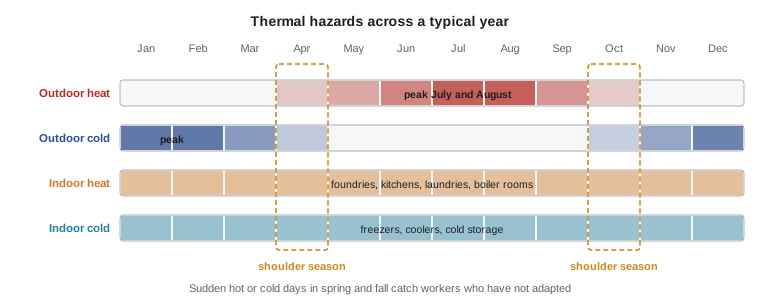
- Shoulder season
- Spring and fall periods when sudden hot or cold days catch workers who have not adapted.
- Thermal hazard
- Any work condition that can raise or lower body temperature enough to cause harm.
- WBGT
- Wet bulb globe temperature, an index of heat stress combining air temperature, humidity, radiant heat and air movement.
Practice problems
Work each problem on paper first, then reveal the answer to check.
Explain the difference between heat stress and heat strain.
Show answer
Heat stress is the total heat load on the body; heat strain is the body's response to that load.
List four outdoor occupations at risk of heat stress.
Show answer
Any four of roofers, road builders, landscapers, farm workers, utility crews, construction laborers, delivery drivers, flaggers and firefighters.
List three indoor workplaces where heat stress is common.
Show answer
Any three of foundries, smelters, bakeries, commercial kitchens, laundries, boiler rooms and mines.
Why are workers in impermeable protective clothing at risk even at moderate temperatures?
Show answer
Their sweat cannot evaporate, so the main cooling mechanism is blocked.
Why do warm nights during a heat wave increase the risk to workers?
Show answer
Workers cannot recover overnight and start the next shift already strained.
Why can 3 °C with rain and wind be more dangerous than dry minus 15 °C?
Show answer
Wet clothing loses insulation, wind increases heat loss, and people take fewer precautions near freezing.
Give two indirect ways heat increases injury risk.
Show answer
Reduced concentration and judgment, sweaty grip, fatigue, rushing and skipping breaks (any two).
Why is heat illness under-recorded?
Show answer
Many cases are treated on site and not reported, and heat is often not listed as a contributing cause.
What is a shoulder season, and why does it matter?
Show answer
Spring or fall periods when sudden heat or cold catches workers who are not adapted.
Does this course certify workers in first aid?
Show answer
No. It is awareness training; workplaces still need trained first aid attendants or responders.
Lesson quiz · 5 questions
Score 60% or more to complete this lesson.
Create a free account to save your progress, take quizzes and earn a certificate.