
HSE-243 · Lesson 7 of 12 · 29 min
Engineering controls, cooling gear and special heat situations
Water, rest, shade and acclimatization protect workers by managing their exposure. Engineering controls go further: they reduce the heat itself, so that workers face less heat stress no matter how well they follow the plan. This lesson looks at engineering controls for indoor and outdoor heat, at personal cooling equipment, and at situations where the usual guidance is not enough, such as work in impermeable protective clothing, hot confined areas, and workers with medical conditions that reduce heat tolerance.
Controlling radiant heat
Near furnaces, ovens, kilns, molten metal and other hot sources, radiant heat is usually the biggest part of the heat load. Radiant heat travels in straight lines and can be blocked. Reflective shields made of polished aluminum or stainless steel reflect most radiant heat back toward the source. Absorbing shields, such as water-cooled panels or water curtains, absorb radiant heat and carry it away. Insulating hot surfaces, such as steam pipes, furnace walls and ovens, reduces both radiant and convective heat to the workroom and saves energy. Shields can be fixed, movable, or built into equipment, and transparent shields such as heat-reflecting glass or metal mesh let operators see the process.
Distance also helps, because radiant heat spreads out and its intensity falls rapidly as workers move away from a compact source. Remote controls, longer tools and automation can keep workers further from hot sources. Doors and openings on furnaces and ovens should be closed whenever possible.
Controlling hot air and humidity
General ventilation replaces hot, humid air with cooler outdoor air. It works when outdoor air is cooler than indoor air, which is common in hot industrial buildings in spring and fall but not always in summer heat waves. Local exhaust ventilation removes hot air and steam at the source, for example canopy hoods over ovens, dishwashers and steam kettles in commercial kitchens, and is more efficient than trying to cool a whole building.
Spot cooling directs cooled or fresh air at individual work stations. Air conditioning, while energy-intensive, is the most reliable way to reduce air temperature and humidity in enclosed spaces such as control rooms, equipment cabs, rest areas and warehouses. Evaporative coolers, sometimes called swamp coolers, cool air by evaporating water into it; they work well in dry climates but add humidity, so they are much less effective, and can be counterproductive, in humid conditions. Dehumidifiers help in steamy areas such as laundries.
Fans increase air movement, which speeds evaporation of sweat and convective cooling when air is cooler than the skin. At air temperatures above about 35 °C, especially when humidity is high, fans can increase heat gain by convection faster than they increase evaporation. As a rule of thumb, fans are helpful up to the mid-thirties in Celsius and should be used cautiously above that, ideally in combination with cooling or with misting in dry conditions.
Outdoor engineering controls
Outdoors, the main engineering controls are shade structures over work areas and rest areas, air-conditioned or ventilated cabs on equipment, cooled rest trailers, misting fans in dry climates, and reflective or cooler surfaces. Mechanical aids that reduce the metabolic workload, such as conveyors, hoists, wheelbarrows, powered carts and lift-assist devices, are also engineering controls for heat, because they reduce the heat the workers produce. On construction sites, enclosed work areas such as tented scaffolding can be ventilated or cooled.
Equipment cabs deserve attention. A closed cab without working air conditioning on a sunny day can reach dangerous temperatures within minutes, and operators may be unable to leave the cab easily. Air conditioning in cabs should be maintained, and operators should not be asked to work in a cab whose cooling has failed in hot weather.
Personal cooling equipment
When engineering controls cannot reduce heat enough, personal cooling equipment can help. Common types include:
| Type | How it works | Best uses | Limitations |
|---|---|---|---|
| Evaporative vests, bandanas and towels | Wetted fabric cools as water evaporates | Dry, breezy conditions; light work | Little effect in humid air or under impermeable clothing |
| Phase-change vests | Packs that melt at about 15 to 18 °C absorb heat | Humid conditions; under some protective clothing | Last about 1 to 3 hours; need recharging; add weight |
| Ice vests | Ice packs absorb heat | Short, very hot tasks | Can be too cold on skin; short duration; heavy |
| Cooled-air systems (vortex tubes) | Compressed air cooled and blown into a suit or hood | Fixed work stations, blasting, encapsulated work | Need a compressed air line; restrict movement |
| Circulating liquid systems | Chilled water pumped through tubes in a garment | Hazmat, firefighting, military, very hot work | Expensive; need a power source or ice reservoir |
| Reflective clothing | Aluminized outer layer reflects radiant heat | Furnaces, molten metal, fire | Blocks evaporation; for short radiant exposures only |
Cooling equipment should be chosen for the actual conditions and tested with workers. A phase-change vest that melts at about 15 °C does not chill the skin uncomfortably and works in humid air, whereas evaporative vests work poorly when humidity is high. Workers should understand that cooling gear supplements, and does not replace, water, rest and acclimatization.
Clothing choice matters too. For outdoor work in sun, loose, lightweight, light-colored, breathable clothing with long sleeves protects against both heat and ultraviolet radiation. A wide-brimmed hard hat attachment or a neck shade helps. Where protective clothing is required, such as flame-resistant clothing, choose the lightest garment that provides the needed protection, and account for its effect on heat stress using the clothing adjustment factors from lesson 5.
Physiological monitoring in high-risk work
For work where heat stress is severe or where workers wear impermeable clothing, physiological monitoring can tell when an individual worker is approaching dangerous strain. Methods include recording heart rate during work and recovery, measuring oral or ear temperature after work periods, and wearable sensors that estimate core temperature. Some programs set individual limits, such as stopping work if heart rate stays above 180 minus age for several minutes or if estimated core temperature reaches 38.5 °C. Monitoring needs trained people to interpret the results, clear rules on what happens when a limit is reached, and careful handling of the personal health information it generates.
# Illustrative heart rate monitoring rule for a worker in an encapsulating suit
age = 42
limit = 180 - age                    # sustained HR limit
recovery_target = 120                # HR one minute after stopping work
log = [  # (minute, heart rate during work) for one work period
    (5, 128), (10, 139), (15, 146), (20, 149), (25, 151)]
over = [m for m, hr in log if hr > limit]
print(f"Sustained HR limit for age {age}: {limit} bpm")
print("Minutes above limit:", over if over else "none")

recovery_hr = 126                    # measured 1 minute after stopping
if over or recovery_hr > recovery_target:
    print(f"Recovery HR {recovery_hr} bpm > {recovery_target}: extend rest and cool before next entry")
else:
print("Recovery adequate: next work period may proceed")Sustained HR limit for age 42: 138 bpm Minutes above limit: [10, 15, 20, 25] Recovery HR 126 bpm > 120: extend rest and cool before next entry
In the example, the worker's heart rate stays below the sustained limit of 138 beats per minute until minute 15, then exceeds it, and recovery is slow. The rule says to extend the rest and cooling period before the next entry, and perhaps to shorten the work period. Rules like this are simple, but they catch rising strain earlier than waiting for symptoms.
Impermeable and encapsulating clothing
Workers in vapor-barrier coveralls, chemical protective suits, encapsulating hazmat suits, asbestos abatement gear, or bomb disposal suits face heat stress that has little to do with the weather. Their sweat cannot evaporate, so the main cooling route is blocked. Core temperature can rise quickly even in a cool building. For this work, the ACGIH screening criteria do not apply; instead, employers should limit work periods, often to 30 to 60 minutes or less depending on work rate and conditions, provide cooled rest areas where suits can be opened or removed safely, use personal cooling such as phase-change vests or cooled-air systems, and monitor workers physiologically. Decontamination and doffing time must be included in the planning, because workers remain in the suit until they are decontaminated. Respirator use adds to the strain, and respirator selection is covered in HSE-240.
Hot enclosed and confined areas
Attics, crawl spaces, boiler interiors, tanks, vaults, ship holds and similar spaces can become far hotter than the surrounding area, with poor air movement and sometimes high humidity. Where these are confined spaces, the confined space entry program, covered in HSE-216, must address heat stress along with atmospheric hazards, including ventilation that also cools, limits on entry time, communication with an attendant and a rescue plan that accounts for the difficulty of cooling a worker inside the space. Even areas that are not formally confined spaces, such as attics, need measurement, planning and short work periods in hot weather.
Indoor hot industries
Foundries, steel mills, glass and ceramics plants, smelters, bakeries, commercial kitchens, laundries and power plants have heat all year round. In these workplaces, radiant shielding, local exhaust, insulation and spot cooling should be the backbone of the program, supported by work-rest schedules based on measured WBGT, cool rest rooms, water and electrolytes, and acclimatization for new workers. Heat stress often rises sharply during summer heat waves, when outdoor air can no longer cool the building, so plans should include summer measures such as extra breaks and rescheduling maintenance.
Workers at higher individual risk
Some workers are more vulnerable to heat because of health conditions, medications, age, pregnancy or previous heat illness. Employers cannot generally require workers to disclose health conditions, but they can and should make it easy for workers to seek accommodation. Training should explain which conditions and medications can reduce heat tolerance, and invite workers to consult their health care provider and to tell the employer if they need adjustments, such as more frequent breaks, assignment to cooler tasks or a slower acclimatization schedule. Medical evaluation programs for high-heat jobs, where they exist, should focus on fitness for the specific work and keep medical details confidential.
Pregnant workers are an important example. Heat stress in pregnancy can harm both the worker and the fetus, and the body's ability to lose heat changes during pregnancy. Under the Pregnant Workers Fairness Act, which took effect in 2023, covered employers must provide reasonable accommodations for known limitations related to pregnancy unless doing so would cause undue hardship, which can include reduced heat exposure, more breaks and reassignment.
Wildfire smoke and heat together
Heat waves often bring wildfire smoke, and the two together are worse than either alone. Smoke irritates the lungs and adds to cardiovascular strain, while respirators that protect against smoke particles increase breathing effort and heat strain. When air quality is poor during hot weather, employers should reduce work intensity and duration, provide clean-air rest areas such as air-conditioned buildings with good filtration, and follow air quality and respiratory protection guidance (HSE-240).
Worked problem
Choosing controls for a commercial kitchen
In a restaurant kitchen in July, cooks report headaches and dizziness during the dinner rush. The WBGT near the grill line is 30 °C. The kitchen has one wall fan and an old hood that does not seem to draw well. What controls would you recommend, in order of priority?
Show solution
- Engineering: have the exhaust hood serviced and balanced so it captures heat and steam at the source; add make-up air so the hood works properly.
- Engineering: provide spot cooling with conditioned air directed at the grill and fryer stations, and insulate or shield the hottest equipment where possible.
- Administrative: rotate cooks off the hottest stations, schedule short breaks in a cool area, provide cold water and electrolyte drinks, and acclimatize new staff.
- Monitoring and training: train staff on heat illness signs, use a buddy check during rushes, and remeasure WBGT after changes.
Answer: Fix the exhaust and add spot cooling first, then rotation, breaks, water and training, and remeasure to confirm the improvement.
Worked problem
Planning work in encapsulating suits
A hazmat team will clean up a spill in a warehouse at 26 °C, wearing fully encapsulating suits with self-contained breathing apparatus. The work is moderate to heavy. How should heat stress be managed?
Show solution
- The suits block evaporation, so the WBGT screening criteria do not apply even though the warehouse is only 26 °C.
- Limit entries to short periods, such as 20 to 30 minutes depending on air supply and work rate, including time to decontaminate.
- Provide a cooled rehabilitation area outside the hot zone with water, shade or air conditioning and a place to remove suits after decontamination.
- Monitor heart rate and, where possible, core temperature estimates before and after each entry, and use phase-change cooling vests under the suits.
Answer: Short entries, physiological monitoring, personal cooling and a cooled rehab area, because encapsulating suits make heat stress severe at any temperature.
Common mistakes
MistakeUsing fans in very hot, humid conditions as the main control.
InsteadAbove about 35 °C fans can add heat; use cooling, shade and rest instead.
MistakeInstalling evaporative coolers in a humid kitchen or laundry.
InsteadEvaporative coolers add humidity and work poorly in humid conditions.
MistakeRelying on cooling vests instead of water, rest and acclimatization.
InsteadCooling equipment supplements, not replaces, the basic controls.
MistakeApplying WBGT screening criteria to workers in encapsulating suits.
InsteadUse short work periods, physiological monitoring and personal cooling.
MistakeRequiring workers to disclose medical conditions before heat work.
InsteadTrain workers about risk factors and make it easy to request accommodation confidentially.
Summary and key terms
- Engineering controls reduce the heat itself and should come first where practicable.
- Reflective and absorbing shields, insulation and distance control radiant heat.
- Local exhaust, ventilation, spot cooling and air conditioning control hot air and humidity.
- Fans help up to about 35 °C but can add heat in very hot, humid air.
- Personal cooling equipment must suit the conditions and supplements the basic controls.
- Impermeable suits require short work periods, physiological monitoring and personal cooling.
- Workers with medical conditions, medications or pregnancy may need accommodation.
- Reflective shield
- A barrier, often polished metal, that reflects radiant heat away from workers.
- Absorbing shield
- A barrier, such as a water-cooled panel, that absorbs radiant heat and carries it away.
- Local exhaust ventilation
- Ventilation that captures hot air or steam at the source.
- Spot cooling
- Directing cooled or fresh air at a specific work station.
- Evaporative cooler
- A device that cools air by evaporating water into it, effective mainly in dry climates.
- Phase-change vest
- A cooling garment with packs that absorb heat as they melt at a set temperature, often about 15 °C.
- Vortex tube
- A device that produces cooled air from compressed air for cooling suits or hoods.
- Encapsulating suit
- Protective clothing that fully encloses the worker and blocks evaporation of sweat.
- Rehabilitation area
- A cooled area where workers rest, rehydrate and recover between work periods.
- Accommodation
- Changes to work to meet the needs of a worker with a medical condition, disability or pregnancy.
Practice problems
Work each problem on paper first, then reveal the answer to check.
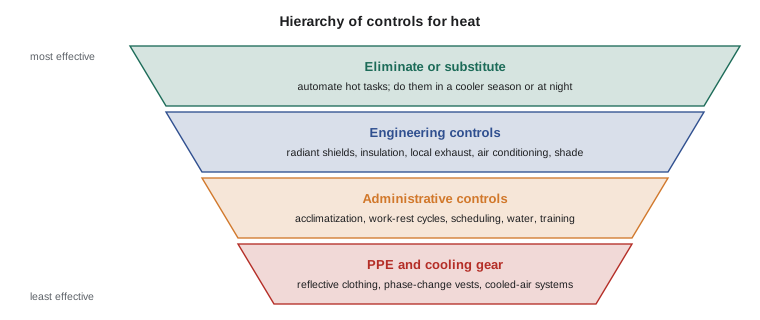
List the levels of the hierarchy of controls applied to heat.
Show answer
Elimination or substitution, engineering controls, administrative controls, and personal protective and cooling equipment.
How does a reflective shield reduce heat stress?
Show answer
It reflects radiant heat from a hot source away from the worker.
Why is local exhaust more efficient than general ventilation over an oven?
Show answer
It captures hot air and steam at the source before they spread through the workroom.
When can fans make heat stress worse?
Show answer
At air temperatures above about 35 °C, especially in humid air.
Why do evaporative coolers work poorly in humid conditions?
Show answer
They add moisture to air that is already humid, so little evaporation and cooling occur.
What is an advantage of a phase-change vest in humid conditions?
Show answer
It cools by melting, not evaporation, so it works in humid air and does not chill the skin excessively.
Why are mechanical lifting aids a heat control?
Show answer
They reduce the metabolic heat workers produce.
A worker is 50. What sustained heart rate limit does the 180 minus age rule give?
Show answer
130 beats per minute.
Why must decontamination time be included when planning work in encapsulating suits?
Show answer
Workers stay in the suit, unable to cool, until they are decontaminated.
How should an employer address workers whose medications may reduce heat tolerance?
Show answer
Train workers on the risk, encourage them to consult their health care provider, and make confidential accommodation easy to request.
Lesson quiz · 5 questions
Score 60% or more to complete this lesson.
Create a free account to save your progress, take quizzes and earn a certificate.