
HSE-241 · Lesson 8 of 12 · 27 min
Hearing protectors: types, ratings and derating
Hearing protectors are the last line of defense against noise. They are cheap, portable and, when properly selected, fitted and worn, highly effective. They are also the control most likely to fail without anyone noticing: a foam earplug pushed only halfway in, an earmuff seal broken by safety glasses, a protector removed for a few minutes in the loudest part of the shift. This lesson covers the main types of protectors, how they are rated, why laboratory ratings overstate real-world protection and how to estimate the protection a worker actually receives. Lesson 9 covers fitting, fit testing and day-to-day use.
HSE-104 Personal Protective Equipment, lesson 5, introduced protector types and ratings. This lesson goes further into the calculations and selection decisions that a program coordinator or supervisor needs.
Types of hearing protectors
| Type | Description | Strengths | Limitations |
|---|---|---|---|
| Foam earplugs | Slow-recovery polyurethane foam rolled down and inserted into the ear canal, where it expands | High attenuation when deeply inserted; inexpensive; comfortable for many | Very sensitive to fitting technique; disposable; hands must be clean |
| Premoulded earplugs | Reusable flanged plugs of silicone or plastic in several sizes | Washable; quick to insert; no rolling needed | Must be sized to the canal; attenuation varies with fit |
| Custom-molded earplugs | Made from an impression of the individual ear canal | Comfortable for long wear; consistent fit; can include filters or communication | Higher cost; need fit verification; ears change over time |
| Banded or semi-insert plugs | Pods held at or in the canal entrance by a band | Convenient for intermittent exposure; easy to put on and remove | Lower attenuation; band can transmit noise |
| Passive earmuffs | Cups with cushions that seal around the ear, held by a headband | Easy to fit and check visually; consistent; durable | Hot in warm conditions; seal broken by glasses, hair and hoods; less effective at low frequencies than deep plugs |
| Level-dependent and communication earmuffs | Electronic earmuffs that pass quiet sounds and speech but limit loud sounds, or include radios | Improve awareness and communication; useful for intermittent and impulse noise | Cost; batteries; must still meet the attenuation needed |
| Active noise reduction | Earmuffs or plugs that generate anti-noise to cancel low-frequency sound | Adds protection at low frequencies | Less effective at high frequencies; electronics |
| Helmet-mounted earmuffs | Earmuffs attached to a hard hat | Integrated with head protection | Must be approved as a combination; positioning can be poor |
No single type is best for everyone. Ear canal shapes differ, some workers find plugs uncomfortable and others find muffs hot, and the job may require communication, compatibility with other equipment or protection against impulse noise. Offering a choice of at least two or three types and sizes improves comfort and consistent use, which matter more than the highest rating on the package.
How protectors are rated
Protector ratings are based on laboratory tests in which a panel of listeners wears the protector and the difference between their hearing thresholds with and without it is measured at several frequencies. The results are combined into a single number or class. Because the test conditions are ideal, with careful fitting, the published ratings describe what is possible, not what is typical.
| Rating system | Where used | How it is applied |
|---|---|---|
| Noise Reduction Rating (NRR) | Required on protectors sold in the United States under the EPA labeling rule (40 CFR Part 211, Subpart B); also printed on many products sold in Canada | Subtracted from the C-weighted level, or from the A-weighted level after subtracting 7 dB |
| CSA Z94.2 class and grade | Canada; referenced by many provincial regulations | Class A, B or C, with an L suffix for good low-frequency attenuation, matched to the exposure level; grades based on a sound level conversion value |
| Single Number Rating (SNR) | European Union and many other countries (ISO 4869) | Subtracted from the C-weighted level |
| Octave band attenuation data | Published with most protectors | The most accurate method, used with octave band measurements of the noise |
The NRR is still the most widely printed rating in North America. The EPA labeling rule that defines it dates from 1979 and remains in force in 2026; proposals to modernize the test method and label have not been adopted. NRRs are typically 20 to 33 dB for earplugs and 18 to 31 dB for earmuffs.
Many protectors sold in the United States also carry Canadian CSA Z94.2 classes or European SNR values, because the same products are sold in several markets. OSHA's Appendix B to 1910.95 describes how to apply the NRR, and the OSHA Technical Manual and NIOSH guidance describe how to derate it for real-world conditions.
| Worker exposure, Lex,8 (dBA) | Recommended CSA Z94.2 class |
|---|---|
| Up to 90 | Class C or better |
| Above 90 up to 95 | Class B or BL or better |
| Above 95 up to 105 | Class A or AL |
| Above 105 | Dual protection: Class A earplug with Class B earmuff at minimum, and engineering controls urgently reviewed |
Why real-world protection is lower
Workplace studies that measure protection on workers wearing their own protectors as they normally do consistently find much lower attenuation than the label suggests, especially for earplugs. The gap has several causes: shallow insertion of foam plugs, wrong plug size, earmuff seals broken by glasses or hair, worn cushions, and protectors that move during work. The variation between individuals is also large: some workers achieve close to the label value, while others get almost nothing from the same product.
To allow for this, several derating methods reduce the label rating before estimating protection.
| Method | Calculation with an A-weighted exposure | Notes |
|---|---|---|
| OSHA Appendix B | Protected TWA = TWA − (NRR − 7) | Used to judge whether protectors meet 1910.95(j): attenuate to 90 dBA, or 85 dBA after a standard threshold shift |
| OSHA 50 percent derating | Protected level = TWA − (NRR − 7) ÷ 2 | Used in the OSHA Technical Manual when judging the relative effectiveness of protectors and engineering controls |
| NIOSH derating | Earmuffs: subtract 25 percent of the NRR; foam plugs 50 percent; other plugs 70 percent; then apply to the C-weighted level, or subtract 7 dB from the derated NRR for A-weighted levels | Reflects typical differences between protector types |
| C-weighted method | Protected level = dBC − NRR | Preferred when a C-weighted measurement is available |
| Individual fit testing | Use the measured personal attenuation rating for that worker and protector | The most accurate; see Lesson 9 |
def protected(dba, nrr, method, kind="foam"):
    if method == "label":            # dBA - (NRR - 7)
        return dba - (nrr - 7)
    if method == "half":             # half of (NRR - 7)
        return dba - (nrr - 7) / 2
    if method == "niosh":            # NIOSH type-based derating
        factor = {"muff": 0.75, "foam": 0.50, "other": 0.30}[kind]
        return dba - (nrr * factor - 7)
    raise ValueError(method)

cases = [("foam plug", 32, "foam"), ("premoulded plug", 25, "other"), ("earmuff", 27, "muff")]
dba = 100
print(f"Exposure {dba} dBA")
print("protector         NRR   label   50 %   NIOSH")
for name, nrr, kind in cases:
    print(f"{name:<17} {nrr:>3}  {protected(dba, nrr, 'label'):6.1f} "
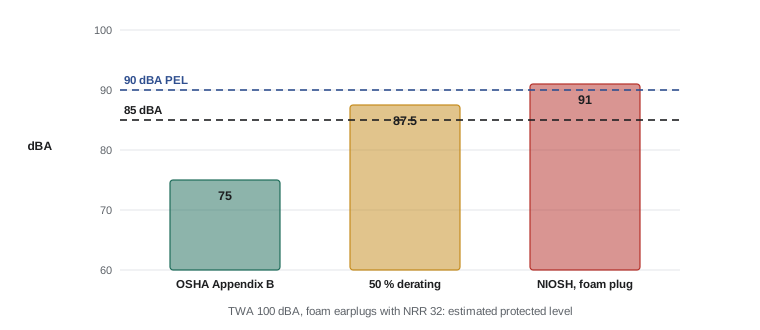
f"{protected(dba, nrr, 'half'):6.1f} {protected(dba, nrr, 'niosh', kind):7.1f}")Exposure 100 dBA protector NRR label 50 % NIOSH foam plug 32 75.0 87.5 91.0 premoulded plug 25 82.0 91.0 99.5 earmuff 27 80.0 90.0 86.8
At 100 dBA, every protector looks excellent on the label but none is clearly adequate after derating. The premoulded plug, with a 70 percent NIOSH derating, offers very little. Results like these explain why engineering controls are essential at high levels and why individual fit testing, which replaces assumptions with measurements, is increasingly used.
Dual protection
At very high levels, an earplug and an earmuff can be worn together. The protection is not the sum of the two ratings, because sound reaches the inner ear through bone conduction, bypassing both protectors. A common rule, used by OSHA, is to add 5 dB to the rating of the more protective device. In practice, dual protection gives roughly 3 to 10 dB more than the better single protector, and bone conduction limits total protection to around 40 to 50 dB at most frequencies. Dual protection is usually recommended above about 100 to 105 dBA and is required by MSHA at very high mining exposures. It should be treated as a signal that engineering controls are urgently needed.
Worked problem
Checking whether a protector is adequate
A worker's TWA is 98 dBA, and C-weighted measurements are not available. The proposed protector is an earmuff with an NRR of 26. Does it meet 1910.95(j) by Appendix B, and what does the 50 percent derating suggest?
Show solution
- Appendix B: 98 − (26 − 7) = 79 dBA, below 90 dBA, so it meets 1910.95(j) on paper.
- With a 50 percent derating: 98 − 9.5 = 88.5 dBA, below 90 but above 85.
- If the worker has a standard threshold shift, the protector must attenuate to 85 dBA, which the derated estimate does not achieve.
- Options: fit test the worker, consider a higher-rated earmuff or dual protection, and pursue engineering controls.
Answer: It meets Appendix B on paper but the derated estimate of about 88.5 dBA leaves little margin, and would not be adequate after a standard threshold shift. Fit testing and engineering controls are needed.
The octave band method
The most accurate laboratory-based method uses octave band measurements of the noise and the protector's octave band attenuation data. For each band, the assumed protection value, typically the mean attenuation minus two standard deviations, is subtracted from the A-weighted band level, and the protected bands are combined. This method shows clearly when a protector is weak at the frequencies where the noise is strongest, which is common for low-frequency noise.
import math

bands = [125, 250, 500, 1000, 2000, 4000, 8000]
a_corr = [-16.1, -8.6, -3.2, 0.0, 1.2, 1.0, -1.1]
noise = [102, 100, 96, 92, 88, 84, 80]          # unweighted band levels, low-frequency noise
mean = [18.0, 20.0, 24.0, 28.0, 32.0, 38.0, 36.0]  # protector mean attenuation (illustrative)
sd = [4.0, 4.0, 3.5, 3.5, 3.0, 3.5, 4.0]

def combine(levels):
    return 10 * math.log10(sum(10 ** (L / 10) for L in levels))

a_bands = [n + a for n, a in zip(noise, a_corr)]
protected = [La - (m - 2 * s) for La, m, s in zip(a_bands, mean, sd)]
print(f"Unprotected: {combine(a_bands):.1f} dBA")
print(f"Protected (mean - 2 SD): {combine(protected):.1f} dBA")
worst = max(range(len(bands)), key=lambda i: protected[i])
print(f"Band contributing most after protection: {bands[worst]} Hz")Unprotected: 98.1 dBA Protected (mean - 2 SD): 82.5 dBA Band contributing most after protection: 250 Hz
For this low-frequency noise, the protected level is controlled by the 125 to 500 Hz bands, where the protector is weakest, while the high-frequency bands contribute almost nothing. A protector with an L rating, or one with better low-frequency performance, would be a better choice.
Over-protection
More attenuation is not always better. A protector that reduces exposure far below what is needed can make speech and warning signals inaudible, isolate the worker and encourage removal. Most guidance suggests aiming for a protected level of roughly 70 to 80 dBA, enough to bring exposure safely under the limit without cutting the worker off from the environment. Workers with existing hearing loss are particularly vulnerable to over-protection, because they may not hear alarms at all. Level-dependent electronic earmuffs, flat-attenuation earplugs, which reduce all frequencies equally, and communication headsets help in these situations.
| Protected level (dBA) | Assessment |
|---|---|
| Above 85 | Insufficient protection |
| 80 to 85 | Acceptable but with little margin |
| 70 to 80 | Optimal for most situations |
| 65 to 70 | Acceptable; check communication and alarm audibility |
| Below 65 | Possible over-protection; isolation and removal more likely |
Selecting protectors for the job
Selection brings together the exposure, the noise spectrum and the needs of the work and the worker. Questions to ask include: How much attenuation is needed after derating? Is the noise low-frequency? Is it continuous, intermittent or impulsive? Does the worker need to hear speech, radios or warning signals? Is it hot, dirty or wet? Does the worker wear a hard hat, safety glasses, a respirator or a welding helmet? Will protectors be put on and taken off frequently? Does the worker have an existing hearing loss or an ear condition? The answers usually point to two or three suitable products, among which the worker can choose.
Common mistakes
MistakeChoosing the protector with the highest NRR on the package.
InsteadChoose for adequate derated attenuation, comfort, compatibility and the needs of the job, and offer a choice.
MistakeSubtracting the full NRR from an A-weighted level.
InsteadSubtract 7 dB from the NRR for A-weighted levels, and apply a derating to reflect real use.
MistakeAdding the NRRs of an earplug and an earmuff for dual protection.
InsteadAdd only about 5 dB to the better protector; bone conduction limits combined protection.
MistakeGiving every worker the most protective device available.
InsteadAim for a protected level of about 70 to 80 dBA to avoid over-protection and isolation.
MistakeIgnoring low-frequency noise when selecting protectors.
InsteadCompare dBC and dBA or use octave band data, and choose protectors with good low-frequency attenuation where needed.
Summary and key terms
- Protector types include foam, premoulded and custom earplugs, banded plugs, passive and electronic earmuffs and helmet-mounted muffs, each with strengths and limitations.
- Ratings such as the NRR, CSA Z94.2 classes and grades, and the SNR come from laboratory tests under ideal fitting.
- Real-world protection is usually much lower, especially for earplugs, so ratings are derated.
- Common methods are dBA − (NRR − 7), the 50 percent derating, NIOSH type-based derating and individual fit testing.
- Dual protection adds about 5 dB to the better protector and signals an urgent need for engineering controls.
- The octave band method shows weaknesses at particular frequencies, such as low-frequency noise.
- Aim for protected levels of about 70 to 80 dBA, avoid over-protection and match protectors to the job and the worker.
- Noise Reduction Rating (NRR)
- The single-number laboratory attenuation rating required on hearing protectors sold in the United States.
- CSA Z94.2 class
- The Canadian classification of protectors as Class A, B or C, with A the most protective.
- L suffix
- A CSA designation for protectors with good attenuation at low frequencies.
- Single Number Rating (SNR)
- The European single-number attenuation rating under ISO 4869.
- Derating
- Reducing a laboratory rating to estimate the protection workers typically receive.
- Dual protection
- Wearing earplugs and earmuffs together for very high noise levels.
- Bone conduction
- Transmission of sound to the inner ear through the skull, which limits the protection any protector can give.
- Octave band method
- Estimating protected level band by band from noise spectra and protector attenuation data.
- Over-protection
- Attenuation so great that speech and warnings become inaudible, increasing isolation and removal.
- Level-dependent protector
- An electronic protector that passes quiet sounds but limits loud sounds.
Practice problems
Work each problem on paper first, then reveal the answer to check.
A worker is exposed to 96 dBA. An earplug has an NRR of 29. What is the protected level using dBA − (NRR − 7)?
Show answer
96 − 22 = 74 dBA.
Using the 50 percent derating, what is the protected level in the same case?
Show answer
96 − 11 = 85 dBA.
Using NIOSH derating for a foam plug with NRR 29 at 96 dBA, what is the protected level?
Show answer
Derated NRR 14.5; 96 − (14.5 − 7) = 88.5 dBA.
What is the approximate dual-protection rating for a plug with NRR 30 and a muff with NRR 25?
Show answer
30 + 5 = 35 dB, applied to the C-weighted level.
Why is the protection from dual protection limited?
Show answer
Sound reaches the inner ear by bone conduction, bypassing both protectors.
Which CSA class is recommended for a Lex,8 of 93 dBA?
Show answer
Class B or BL or better.
What protected level range is generally considered optimal?
Show answer
About 70 to 80 dBA.
Why can over-protection be dangerous?
Show answer
Workers may not hear speech or warning signals and are more likely to remove protectors.
When is the octave band method especially useful?
Show answer
When the noise has strong low-frequency content or the protector is weak at some frequencies.
Name four questions to ask when selecting a protector.
Show answer
Any four of attenuation needed, noise spectrum, noise pattern, communication needs, environment, compatibility with other PPE, frequency of removal and existing hearing loss.
Lesson quiz · 5 questions
Score 60% or more to complete this lesson.
Create a free account to save your progress, take quizzes and earn a certificate.