
HSE-241 · Lesson 5 of 12 · 27 min
Interpreting exposure: dose, TWA and Lex,8
Lesson 4 described how noise is measured. This lesson is about what the numbers mean. A worker's day is rarely spent at one steady level; it is a mixture of loud tasks, quieter periods, breaks and sometimes overtime. Regulations compare that mixture with a single limit, so the measurements have to be combined into one figure: a dose expressed as a percentage, a time-weighted average or an 8-hour normalized level. Understanding how those figures are calculated lets you check reports, see which tasks drive the dose and test what-if scenarios before spending money on controls.
Noise dose
The noise dose expresses a worker's exposure as a percentage of the daily allowance. A dose of 100 percent means the worker received exactly the amount allowed by the limit; 200 percent means twice the allowance. For a day made up of periods at different levels, each period uses up a fraction of the allowance equal to the time spent divided by the time allowed at that level:
Here C is the time actually spent at each level and T is the allowable time at that level from the formula in Lesson 3. Because the allowable time depends on the criterion level and exchange rate, the same day can give quite different doses under different rules.
Worked problem
Calculating a dose by hand
A press operator spends 3 hours at 92 dBA, 2 hours at 88 dBA and 3 hours at 82 dBA. Using an 85 dBA criterion and a 3 dB exchange rate, what is the dose?
Show solution
- Allowable time at 92 dBA: 8 ÷ 2^((92 − 85) ÷ 3) = 8 ÷ 2^2.33 ≈ 1.59 hours.
- Allowable time at 88 dBA: 8 ÷ 2^1 = 4 hours.
- Allowable time at 82 dBA: 8 ÷ 2^(−1) = 16 hours.
- Dose = 100 × (3 ÷ 1.59 + 2 ÷ 4 + 3 ÷ 16) = 100 × (1.89 + 0.50 + 0.19) ≈ 258 percent.
Answer: About 258 percent of the daily allowance. The 3 hours at 92 dBA contribute almost three-quarters of the total, so that task is where control effort should go.
Converting dose to a level
A percentage is useful but people more often want a level that can be compared directly with the limit. With a 3 dB exchange rate, the 8-hour equivalent level, called Lex,8 or LEX,8h in Canada and ISO standards, is:
So a dose of 258 percent with an 85 dBA criterion gives 85 + 10 log10(2.58) ≈ 89.1 dBA. Lex,8 can also be calculated directly from the levels and durations, by summing the energy of each period and normalizing to 8 hours:
with each duration t in hours. Both formulas give the same answer for a 3 dB exchange rate.
For OSHA's 5 dB exchange rate, the corresponding figure is the time-weighted average, TWA, given in Appendix A of 1910.95:
A dose of 100 percent is a TWA of 90 dBA, the PEL, and a dose of 50 percent is a TWA of 85 dBA, the action level. The constant 16.61 is 5 divided by log10(2). For comparisons with the NIOSH REL, use the 3 dB form, Lex,8 = 85 + 10 log10(D ÷ 100).
Doing the calculation in code
A short script makes it easy to compare rules, check a report or test the effect of a control. The function below calculates dose and the equivalent level for any criterion, exchange rate and threshold.
import math

def dose(segments, criterion=85, exchange=3, threshold=None):
    """segments: list of (hours, dBA). Returns the dose as a percentage."""
    d = 0.0
    for hours, level in segments:
        if threshold is not None and level < threshold:
            continue
        allowed = 8 / 2 ** ((level - criterion) / exchange)
        d += hours / allowed
    return 100 * d

def level_from_dose(d, criterion=85, exchange=3):
    q = exchange / math.log10(2)
    return criterion + q * math.log10(d / 100)

day = [(3, 92), (2, 88), (3, 82)]

d_ca = dose(day, 85, 3)
print(f"85/3 rule:   dose {d_ca:5.0f} %, Lex,8 {level_from_dose(d_ca, 85, 3):.1f} dBA")
d_fed = dose(day, 87, 3)
print(f"87/3 rule:   dose {d_fed:5.0f} %, level {level_from_dose(d_fed, 87, 3):.1f} dBA")
d_pel = dose(day, 90, 5, threshold=90)
print(f"OSHA PEL:    dose {d_pel:5.0f} %, TWA {level_from_dose(d_pel, 90, 5):.1f} dBA")
d_al = dose(day, 90, 5, threshold=80)
print(f"OSHA action: dose {d_al:5.0f} %, TWA {level_from_dose(d_al, 90, 5):.1f} dBA")85/3 rule: dose 258 %, Lex,8 89.1 dBA 87/3 rule: dose 162 %, level 89.1 dBA OSHA PEL: dose 49 %, TWA 84.9 dBA OSHA action: dose 81 %, TWA 88.5 dBA
The same day is well over the limit under the Canadian provincial rule, over the federal Canadian rule, under the OSHA PEL and over the OSHA action level. That is not a contradiction; it shows how much the rule chosen matters.
Which tasks drive the dose?
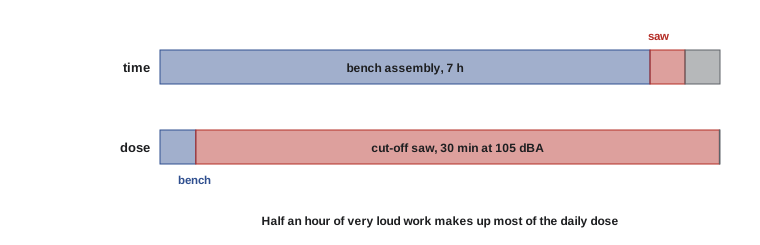
Dose calculations are most useful when they show where the dose comes from. Because allowable time halves with each 3 dB, short periods at high levels can dominate. A worker who spends 7 hours at a comfortable 82 dBA and only 30 minutes using a cut-off saw at 105 dBA receives most of the day's dose from the saw.
import math

def allowed(level, criterion=85, exchange=3):
    return 8 / 2 ** ((level - criterion) / exchange)

tasks = [
    ("bench assembly", 7.0, 82),
    ("cut-off saw", 0.5, 105),
    ("break room", 0.5, 65),
]
total = sum(h / allowed(L) for _, h, L in tasks)
print(f"Total dose: {100 * total:.0f} %  (Lex,8 {85 + 10 * math.log10(total):.1f} dBA)")
for name, h, L in tasks:
    share = (h / allowed(L)) / total
    print(f"  {name:<15} {h:4.1f} h at {L} dBA -> {share:6.1%} of dose")

# What if the saw time is halved, or the saw is quietened by 6 dB?
for label, saw in [("saw time halved", (0.25, 105)), ("saw 6 dB quieter", (0.5, 99))]:
    t = 7.0 / allowed(82) + saw[0] / allowed(saw[1]) + 0.5 / allowed(65)
print(f"{label:<17} dose {100 * t:4.0f} %, Lex,8 {85 + 10 * math.log10(t):.1f} dBA")Total dose: 679 % (Lex,8 93.3 dBA) bench assembly 7.0 h at 82 dBA -> 6.4% of dose cut-off saw 0.5 h at 105 dBA -> 93.5% of dose break room 0.5 h at 65 dBA -> 0.0% of dose saw time halved dose 361 %, Lex,8 90.6 dBA saw 6 dB quieter dose 203 %, Lex,8 88.1 dBA
Half an hour on the saw delivers more than nine-tenths of the dose. Quietening the saw by 6 dB, for example with a better blade, a water feed or a shroud, does more than halving the time spent on it. Results like these give supervisors a clear, quantified case for engineering controls.
Shifts longer than 8 hours
Exposure limits are written for an 8-hour day, but many workers do 10- or 12-hour shifts. The calculations above handle this automatically, because the dose adds up all the time actually spent. A worker at a steady 85 dBA for 12 hours has a dose of 150 percent and a Lex,8 of 86.8 dBA, over the limit, even though the level never exceeded 85 dBA. Forgetting to account for the extra hours is a common reason why long-shift workers are underprotected.
OSHA's dose formula covers any shift length, so a 12-hour shift at a steady 90 dBA is a dose of 150 percent and a TWA of about 92.9 dBA, over the PEL. Long shifts also reduce the quiet recovery time between exposures, which is another reason to aim for exposures well below the limit for those workers.
Worked problem
A 12-hour shift
A compressor station operator works 12-hour shifts. Dosimetry shows a steady 84 dBA for the whole shift. Is the operator over the 85 dBA Lex,8 limit?
Show solution
- Energy over the shift corresponds to 12 hours at 84 dBA.
- Lex,8 = 84 + 10 log10(12 ÷ 8) = 84 + 1.76 ≈ 85.8 dBA.
- Equivalently, the dose is (12 ÷ 10.08) × 100 ≈ 119 percent, because 84 dBA is allowed for about 10.08 hours.
- The operator is over the limit despite never being above 85 dBA, so controls or protection and program enrollment are needed.
Answer: Yes. Lex,8 is about 85.8 dBA, or a dose of about 119 percent, because the shift is 12 hours long.
Uncertainty and variation
Noise exposure varies from day to day with production, maintenance, weather (doors open or closed) and the mix of tasks. A single day's measurement is a sample, not the truth. Measurement standards such as ISO 9612 and CSA Z107.56 describe how to estimate uncertainty, which comes from the instrument, microphone position, sampling and day-to-day variation. Typical expanded uncertainties for a careful occupational assessment are in the range of 1.5 to 3 dB.
The practical consequences are straightforward. A result just below the limit does not show compliance with confidence. Many programs treat any result within about 3 dB of the limit as potentially over it, add those workers to the hearing conservation program and measure again. For job groups, several samples on different days give a better estimate, and the group's energy-average level, not the arithmetic average, should be used.
import math, random, statistics

random.seed(11)
# Lex,8 results from 8 full-shift dosimeter samples for one job group (illustrative)
samples = [round(random.gauss(84.5, 2.0), 1) for _ in range(8)]
print("Samples:", samples)
arith = statistics.mean(samples)
energy = 10 * math.log10(sum(10 ** (L / 10) for L in samples) / len(samples))
sd = statistics.stdev(samples)
print(f"Arithmetic mean {arith:.1f} dBA, energy mean {energy:.1f} dBA, SD {sd:.1f} dB")
print(f"Samples above 85 dBA: {sum(L > 85 for L in samples)} of {len(samples)}")
print(f"Energy mean plus 2 SD: {energy + 2 * sd:.1f} dBA")Samples: [82.1, 85.3, 86.5, 83.5, 81.8, 84.4, 85.5, 86.7] Arithmetic mean 84.5 dBA, energy mean 84.8 dBA, SD 1.9 dB Samples above 85 dBA: 4 of 8 Energy mean plus 2 SD: 88.6 dBA
Even though the arithmetic mean is below 85 dBA, the energy mean is close to the limit and several individual samples exceed it. The group should be treated as over the limit and enrolled in the program, with controls considered.
Peak levels
Dose and Lex,8 describe continuous and intermittent noise well, and with a 3 dB exchange rate they also capture the energy of impulse noise. Very intense impulses, though, can cause immediate mechanical damage regardless of the daily dose. That is why jurisdictions that set one have a separate peak limit, typically 140 dBC or 140 dB peak, and why dosimeter reports show the highest peak recorded. Lesson 11 covers impulse noise.
Communicating results to workers
Workers deserve to know their exposure in terms they understand. A dose percentage can be explained as how much of the day's safe allowance was used up; saying that the maintenance crew used up three times their allowance by lunchtime is clearer than quoting 91.8 dBA. Time histories showing the loud spikes from specific tasks help workers see why protectors matter at particular moments. Results should also be shared with the joint health and safety committee or representative, and used to update the hearing conservation program.
Common mistakes
MistakeComparing a 12-hour shift's average level directly with an 8-hour limit.
InsteadCalculate the dose or Lex,8 for the actual shift length; long shifts increase exposure.
MistakeAssuming the longest task produces most of the dose.
InsteadCalculate each task's share; short, very loud tasks often dominate.
MistakeConverting dose to a level with the wrong exchange rate.
InsteadUse 10 log10(D ÷ 100) for a 3 dB rule and 16.61 log10(D ÷ 100) for a 5 dB rule.
MistakeTreating a result just under the limit as proof of compliance.
InsteadAllow for uncertainty and variation; measure again and treat results within about 3 dB of the limit as potentially over.
MistakeAveraging group results arithmetically.
InsteadUse the energy average and look at the spread of individual results.
Summary and key terms
- Noise dose is the sum of time spent divided by time allowed at each level, expressed as a percentage of the daily allowance.
- With a 3 dB exchange rate, Lex,8 = criterion + 10 log10(dose ÷ 100); with OSHA's 5 dB rule, TWA = 16.61 log10(dose ÷ 100) + 90.
- The same day can be over one rule and under another, so the applicable rule matters.
- Short, very loud tasks often dominate the dose, and quietening them usually helps more than shortening them.
- Shifts longer than 8 hours raise the dose even at constant level.
- Measurements carry uncertainty of a few decibels and vary day to day, so results near the limit need caution and repeat sampling.
- Peak limits address impulse noise separately, and results should be explained to workers in plain terms.
- Noise dose
- A worker's exposure as a percentage of the daily allowance under a given limit.
- Allowable time
- The time permitted at a given level before the daily allowance is used up.
- Lex,8
- The A-weighted exposure level normalized to an 8-hour day, used with a 3 dB exchange rate.
- Time-weighted average (TWA)
- In OSHA usage, the 8-hour exposure level calculated with a 5 dB exchange rate.
- Task contribution
- The share of the daily dose produced by a particular task.
- Extended shift
- A work shift longer than 8 hours, which increases dose at a given level.
- Measurement uncertainty
- The range within which the true exposure is likely to lie, given instrument and sampling limitations.
- Day-to-day variation
- Changes in a worker's exposure from one day to the next because of production and task differences.
- Energy mean
- The average of decibel values calculated on an energy basis.
- Peak sound pressure level
- The highest instantaneous level reached, used to assess impulse noise.
Practice problems
Work each problem on paper first, then reveal the answer to check.
Under an 85 dBA, 3 dB rule, what dose does 4 hours at 91 dBA give?
Show answer
91 dBA is allowed for 2 hours, so 4 hours is a dose of 200 percent.
Convert a dose of 400 percent to Lex,8 under an 85 dBA, 3 dB rule.
Show answer
85 + 10 log10(4) ≈ 91.0 dBA.
Convert a dose of 200 percent to an OSHA TWA.
Show answer
16.61 log10(2) + 90 ≈ 95.0 dBA.
What is Lex,8 for 10 hours at a steady 86 dBA?
Show answer
86 + 10 log10(10 ÷ 8) ≈ 87.0 dBA.
A worker spends 7.5 hours at 80 dBA and 0.5 hours at 100 dBA. Which period gives more dose under the 85/3 rule?
Show answer
The half hour at 100 dBA: it uses 0.5 ÷ 0.25 = 200 percent, against about 30 percent for the 7.5 hours.
Why can quietening a task by 6 dB help more than halving its duration?
Show answer
A 6 dB reduction quarters the energy, while halving time only halves it.
Why should results within about 3 dB of the limit be treated cautiously?
Show answer
Measurement uncertainty and day-to-day variation mean the true exposure may exceed the limit.
What does a threshold of 80 dBA on a dosimeter do?
Show answer
It ignores sound below 80 dBA in the dose calculation.
How would you explain a dose of 300 percent to a worker?
Show answer
They used up three times their safe daily noise allowance.
Why is a peak limit needed in addition to a dose limit?
Show answer
Very intense impulses can cause immediate mechanical damage regardless of the daily dose.
Lesson quiz · 5 questions
Score 60% or more to complete this lesson.
Create a free account to save your progress, take quizzes and earn a certificate.