
HSE-241 · Lesson 1 of 12 · 32 min
How hearing works and how noise damages it
Noise-induced hearing loss is one of the oldest recognized occupational diseases and still one of the most common. Blacksmiths, boilermakers and weavers were described as going deaf centuries ago, and the pattern has not changed much: a worker spends years around loud machinery, notices nothing dramatic, and one day realizes that conversations in a restaurant have become exhausting, that the television is always too loud for everyone else, and that a constant ringing has become part of every quiet evening. The damage is permanent. No surgery, medication or hearing aid restores the cells that noise destroys.
This course is about preventing that outcome. It is written for supervisors, safety coordinators, joint health and safety committee members, hearing conservation program administrators and workers who work in noisy places. It builds on the short overview of hearing protection in HSE-104 Personal Protective Equipment, lesson 5, and goes much further into how hearing is damaged, how noise is measured and assessed, how exposure limits work in your jurisdiction, how noise is controlled at the source, how hearing protectors are rated and fitted, how audiometric testing detects early damage, and how all of these fit together in a program that actually works.
The course does not make anyone a qualified noise surveyor, audiometric technician or audiologist. OSHA's occupational noise standard, 29 CFR 1910.95, requires audiometric tests to be performed by a licensed or certified audiologist, otolaryngologist or other physician, or by a technician who is certified by the Council for Accreditation in Occupational Hearing Conservation or who has equivalent competence, and complex noise problems usually need an industrial hygienist or acoustical engineer. Think of this course as the knowledge base that lets you read a noise survey intelligently, recognize a weak program and make sound decisions about controls.
The journey of a sound
Hearing turns tiny pressure fluctuations in the air into nerve signals the brain interprets as speech, music, alarms and machinery. The system has three main parts, and noise damages them in different ways.
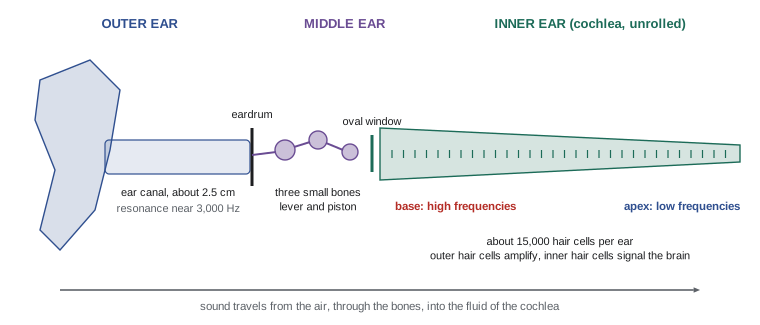
The outer ear consists of the visible pinna and the ear canal, a tube about 2.5 centimeters long that ends at the eardrum. The canal is not just a passage. Its length makes it resonate most strongly at around 3,000 Hz, boosting sounds in that range by roughly 10 to 15 decibels before they reach the eardrum. That resonance helps us understand speech, but it also means the inner ear receives the most energy in the 3,000 to 6,000 Hz region, which is exactly where noise damage first appears.
The middle ear is an air-filled space behind the eardrum containing three tiny bones, the malleus, incus and stapes. They act as a lever and piston, converting the large, low-pressure movements of the eardrum into small, high-pressure movements at the oval window, the entrance to the fluid-filled inner ear. Two small muscles attached to these bones contract in response to loud sound, stiffening the chain and reducing transmission by a modest amount. This acoustic reflex takes tens of milliseconds to engage, so it offers almost no protection against sudden impulses such as gunshots or hammer blows, and it fatigues during long exposures.
The inner ear contains the cochlea, a snail-shaped spiral about the size of a pea. Inside the cochlea, the basilar membrane runs along its length and carries roughly 15,000 sensory hair cells in each ear: one row of inner hair cells, which send signals to the brain, and three rows of outer hair cells, which act as amplifiers that sharpen and boost quiet sounds. Different frequencies make different parts of the membrane vibrate most strongly. High frequencies stimulate the base of the cochlea, near the oval window, and low frequencies stimulate the apex.
How noise destroys hair cells
Hair cells take their name from the bundles of stiff projections, called stereocilia, on their upper surface. When the basilar membrane vibrates, the stereocilia bend, opening ion channels that trigger nerve signals. Loud sound bends them further and faster than they are built to handle. Two kinds of damage follow.
Mechanical damage happens with very intense sound, such as an explosion or a gunshot close to the ear. Stereocilia can fracture or fuse, hair cells can be torn from their supports, and in extreme cases the eardrum ruptures or the middle ear bones are disrupted. This is called acoustic trauma, and the hearing loss can be immediate.
Metabolic damage is the more common pathway at work. Hours of loud noise drive the hair cells to work at their limit. They produce damaging molecules known as reactive oxygen species, blood flow in the cochlea changes, and the cells exhaust their ability to repair themselves. Some cells die over the following hours and days. Outer hair cells are the most vulnerable, so the first effect is a loss of the cochlea's amplification: quiet sounds become harder to hear, and sounds lose their sharpness. Once a hair cell dies in a human ear, it is not replaced.
Research since about 2009 has added a third concern. Noise that causes only a temporary threshold shift, after which the audiogram returns to normal, can still permanently destroy some of the synapses connecting inner hair cells to the auditory nerve. This cochlear synaptopathy, sometimes called hidden hearing loss, does not show up on a standard audiogram but may explain why some noise-exposed people with normal test results struggle to understand speech in background noise. The research in humans is still developing, but it reinforces a simple message: a temporary dulling of hearing after a noisy shift is not harmless.
| Effect | What the worker notices | Is it permanent? |
|---|---|---|
| Temporary threshold shift | Muffled hearing after a noisy shift, often with ringing, recovering over hours to a day or two | Hearing thresholds recover, but repeated episodes predict permanent loss and may leave hidden synapse damage |
| Permanent threshold shift | Gradual difficulty hearing high-pitched sounds, consonants and speech in noise | Yes |
| Tinnitus | Ringing, buzzing, hissing or roaring with no outside source, temporary or constant | Often permanent once it becomes constant |
| Hyperacusis | Ordinary sounds seem uncomfortably or painfully loud | Variable |
| Acoustic trauma | Sudden loss, pain or ringing after an explosion, gunshot or blast | Often partly or wholly permanent |
The noise notch
Hearing ability is measured with an audiogram, which records the quietest level a person can hear at each of several test frequencies, usually from 500 Hz to 8,000 Hz. Results are plotted in decibels hearing level (dB HL), where 0 dB HL is the average threshold of young people with normal hearing. Larger numbers mean worse hearing, so audiograms are drawn with higher numbers lower on the chart, and hearing loss appears as a line that dips downward.
Noise-induced hearing loss has a characteristic shape. Because the ear canal resonance and the mechanics of the cochlea concentrate damage in the 3,000 to 6,000 Hz region, the earliest change is a dip, or notch, centered around 4,000 Hz, with better hearing at 8,000 Hz. As exposure continues, the notch deepens and widens into the lower frequencies that carry much of the information in speech. Age-related hearing loss, by contrast, usually slopes steadily downward toward the highest frequencies without recovering at 8,000 Hz. Real audiograms often show both patterns combined, which is one reason why interpreting them is a job for trained professionals.
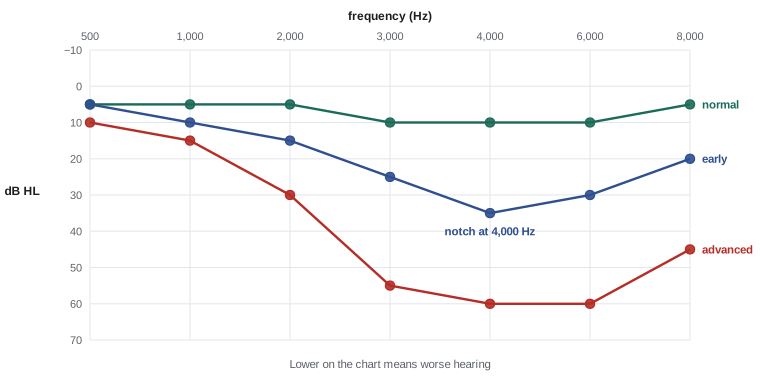
Why does a notch at 4,000 Hz matter if most speech energy is below 2,000 Hz? Because consonants such as s, f, th, t and k carry most of their information in the higher frequencies, and consonants carry most of the meaning in speech. A worker with a notch hears that someone is talking but cannot tell whether they said fifty or sixty, fit or sit, and struggles most when there is background noise. Many people with early noise damage say that others mumble.
Worked problem
Reading a simple audiogram
A 38-year-old millwright has these thresholds in the left ear, in dB HL: 500 Hz, 10; 1,000 Hz, 10; 2,000 Hz, 15; 3,000 Hz, 35; 4,000 Hz, 45; 6,000 Hz, 40; 8,000 Hz, 20. What pattern does this show, and what should happen next?
Show solution
- Thresholds at 500 to 2,000 Hz are within the normal range, so low and mid frequencies are largely intact.
- Thresholds worsen sharply at 3,000 to 6,000 Hz, with the worst value at 4,000 Hz.
- Hearing improves again at 8,000 Hz, which is the recovery typical of a noise notch rather than age-related loss.
- The pattern is consistent with noise-induced hearing loss. The worker's history, both work and leisure noise, should be reviewed, and the result compared with the baseline test. The program should confirm that exposures are controlled and that protectors are suitable and properly worn.
Answer: A noise notch centered at 4,000 Hz. The audiometric program should refer the result for professional review, compare it with earlier tests, and trigger a review of the worker's exposure and protection.
Tinnitus
Tinnitus is the perception of sound with no external source. Noise-exposed workers often describe a high-pitched ringing or hissing after a loud shift, which fades overnight. With continued exposure, it can become constant. Constant tinnitus is linked to poorer sleep, difficulty concentrating, anxiety and depression, and for some people it is more disabling than the hearing loss itself. Tinnitus is often the first warning sign that a worker is overexposed, and workers should be encouraged to report it rather than dismiss it.
US data show how common these problems are. NIOSH has long estimated that about 22 million US workers are exposed to potentially hazardous noise at work each year, and hearing loss has for years been among the most commonly recorded occupational illnesses in manufacturing on OSHA logs. Surveys consistently find that a large share of noise-exposed workers do not wear hearing protection all the time, and that tinnitus is far more common among people with a history of noisy work than among those without.
Who is at risk
Noise hazards are not limited to factories. They occur wherever powerful machinery, impacts, compressed air, combustion, amplified sound or many people talking at once are found.
| Sector | Typical noise sources | Typical levels, dBA (illustrative) |
|---|---|---|
| Manufacturing | Presses, stamping, grinding, compressed air, pneumatic tools | 85 to 105 |
| Construction | Jackhammers, saws, impact wrenches, heavy equipment, pile driving | 85 to 115 |
| Mining and quarrying | Drills, crushers, haul trucks, ventilation fans | 90 to 115 |
| Forestry and sawmills | Chainsaws, planers, debarkers, chippers | 95 to 115 |
| Agriculture | Tractors without cabs, grain dryers, livestock buildings, chainsaws | 85 to 110 |
| Transportation | Engine rooms, airports, rail yards, truck cabs with open windows | 80 to 110 |
| Entertainment and hospitality | Amplified music, clubs, concerts, kitchens | 85 to 110 |
| Public safety and military | Firearms, sirens, explosives, aircraft | Impulses above 140 dB peak |
Within any workplace, exposure depends on the job, not just the location. A maintenance mechanic who moves between quiet offices and very loud equipment rooms may have a higher daily exposure than an operator who stays at one moderately loud machine. That is why later lessons emphasize personal dosimetry for mobile workers.
Why noise is underestimated
Noise is easy to underestimate for several reasons. The damage is painless and gradual, so workers rarely connect a difficulty hearing at age fifty with the shop floor at age twenty-five. People adapt to noise and stop noticing it. The decibel scale is logarithmic, so a machine that sounds only a little louder may deliver several times as much acoustic energy. Workers also often believe that they are tough, used to it, or that their ears have adjusted, when in fact the temporary dulling they feel is the first stage of damage.
Noise also has effects beyond the ear. High noise interferes with communication and can mask warning shouts, reversing alarms and approaching vehicles, contributing to injuries. Long-term noise exposure is associated with raised blood pressure, fatigue and stress, and noise in offices and call centers, though usually below hearing-damage levels, reduces concentration. This course focuses on hearing, but good noise control brings these other benefits too.
Worked problem
Spotting early warning signs in a work group
A supervisor of a fabrication crew hears three comments in one week: one welder says his ears ring for an hour after work, another says her family complains that she keeps the television too loud, and a third says he takes his earmuffs off when grinding near the doorway because it is only for a minute or two. What should the supervisor make of this?
Show solution
- Ringing after work is a sign of temporary threshold shift and possible overexposure.
- Needing the television louder may indicate an existing permanent shift and should prompt a check of the worker's audiometric results.
- Removing earmuffs for short periods during loud tasks can deliver a large share of the daily dose, as later lessons show.
- Together, the comments suggest that the crew's exposure is not under control. The supervisor should request a noise assessment, review controls on the grinding work, reinforce the rules on protector use, and make sure the workers are enrolled in audiometric testing.
Answer: These are early warning signs that exposures are too high or protection is not consistently worn. They justify a noise assessment, a review of controls and follow-up through the audiometric program.
Noise exposure outside work
Hearing does not distinguish between work and leisure. Power tools at home, motorcycles, snowmobiles, recreational shooting, concerts and personal music players can all add to the dose. A worker who spends the day just under the workplace limit and the evening at a loud concert or on a firing range adds risk that no workplace program measures. Good programs include education on off-the-job noise, and many employers allow workers to take hearing protectors home. Audiometric results are also interpreted with leisure noise in mind, because a shift in hearing may come from either source.
What this course covers
Lesson 2 covers the sound basics needed for noise control: decibels, frequency, weighting and how levels combine. Lesson 3 sets out the exposure limits and laws in your jurisdiction. Lessons 4 and 5 cover how noise is measured and how exposure is calculated. Lessons 6 and 7 cover engineering controls, administrative controls and the structure of a hearing conservation program. Lessons 8 and 9 cover hearing protectors in depth, including ratings, derating and fit testing. Lesson 10 covers audiometric testing and recording. Lesson 11 covers impulse noise, substances that damage hearing and special workplaces. Lesson 12 brings everything together in a capstone program for an invented plant.
The physics of sound is covered in more depth, from a film and recording perspective, in FILM-310 Sound for Film, lesson 2. This course uses only the physics needed to protect hearing.
Common mistakes
MistakeTreating ringing or muffled hearing after a shift as normal and harmless.
InsteadTreat temporary threshold shift and tinnitus as warning signs of overexposure and investigate the exposure.
MistakeAssuming that workers adapt or toughen up to noise over time.
InsteadRecognize that apparent adaptation is gradual, permanent damage to hair cells.
MistakeExpecting hearing aids or treatment to restore noise damage.
InsteadUnderstand that destroyed hair cells do not regenerate and hearing aids only partly compensate, so prevention is the only effective strategy.
MistakeJudging the hazard by whether the noise feels uncomfortable.
InsteadMeasure the noise; levels well below the pain threshold cause permanent damage over time.
MistakeIgnoring noise exposure outside work when interpreting hearing changes.
InsteadAsk about leisure noise and educate workers to protect their hearing off the job as well.
Summary and key terms
- Noise-induced hearing loss is permanent, painless and gradual, and it remains one of the most common occupational diseases.
- Sound travels through the outer and middle ear to the cochlea, where hair cells convert vibration into nerve signals; high frequencies are detected near the base of the cochlea.
- Loud noise destroys hair cells mechanically or metabolically, and outer hair cells are the most vulnerable; lost hair cells are not replaced.
- Temporary threshold shifts are warning signs, and noise can damage auditory nerve synapses even when the audiogram recovers.
- Noise damage first appears as a notch around 4,000 Hz with recovery at 8,000 Hz, and it affects understanding of consonants and speech in noise.
- Tinnitus is common, can become permanent and is often the first sign of overexposure.
- Noise hazards occur in many sectors, exposure depends on the job, and leisure noise adds to the total risk.
- Noise-induced hearing loss
- Permanent hearing loss caused by exposure to loud sound, usually over a long period.
- Cochlea
- The spiral, fluid-filled organ of the inner ear that contains the sensory hair cells.
- Hair cells
- Sensory cells in the cochlea that convert vibration into nerve signals; outer hair cells amplify, inner hair cells transmit.
- Stereocilia
- The stiff hair-like projections on hair cells that bend in response to sound.
- Temporary threshold shift
- A temporary worsening of hearing after noise exposure that recovers within hours or days.
- Permanent threshold shift
- A lasting worsening of hearing thresholds caused by damage to the inner ear.
- Tinnitus
- The perception of ringing, buzzing or other sound with no external source.
- Audiogram
- A chart of the quietest sounds a person can hear at each test frequency.
- Noise notch
- A dip in the audiogram around 3,000 to 6,000 Hz, typically deepest at 4,000 Hz, characteristic of noise damage.
- Cochlear synaptopathy
- Permanent loss of connections between inner hair cells and auditory nerve fibers, which may not show on a standard audiogram.
Practice problems
Work each problem on paper first, then reveal the answer to check.
Why does noise damage usually appear first around 4,000 Hz?
Show answer
The ear canal resonance and cochlear mechanics concentrate energy and stress in the 3,000 to 6,000 Hz region.
Which hair cells are most vulnerable to noise, and what do they do?
Show answer
The outer hair cells, which amplify and sharpen quiet sounds.
Why does the acoustic reflex give little protection against gunshots?
Show answer
It takes tens of milliseconds to engage, longer than the rise time of an impulse.
What is a temporary threshold shift, and why should it concern a supervisor?
Show answer
A temporary loss of hearing sensitivity after noise; it signals overexposure and repeated episodes lead to permanent loss.
How does a noise notch differ from typical age-related hearing loss on an audiogram?
Show answer
A noise notch dips around 4,000 Hz and recovers at 8,000 Hz; age-related loss usually slopes down steadily to the highest frequencies.
Why do people with noise damage often say others mumble?
Show answer
They lose high-frequency consonant information, so they hear speech but cannot distinguish words, especially in background noise.
Name three effects of noise other than hearing loss.
Show answer
Masking of warnings and communication, raised blood pressure and stress, fatigue and reduced concentration.
Why is a mobile maintenance worker sometimes more exposed than a fixed machine operator?
Show answer
Exposure depends on time spent at each level; brief periods in very loud areas can dominate the daily dose.
What is cochlear synaptopathy?
Show answer
Permanent loss of synapses between inner hair cells and the auditory nerve, which may occur even when thresholds recover.
Give two examples of leisure noise that adds to workplace exposure.
Show answer
Any two of power tools, recreational shooting, motorcycles, snowmobiles, concerts and personal music players.
Lesson quiz · 5 questions
Score 60% or more to complete this lesson.
Create a free account to save your progress, take quizzes and earn a certificate.