
HSE-241 · Lesson 12 of 12 · 27 min
Capstone: a hearing conservation program
This capstone brings the whole course together. You will work through the design of a hearing conservation program for an invented company, Larkspur Metal Works, using the methods from earlier lessons: assessing exposures, ranking sources, choosing engineering and administrative controls, selecting protectors, planning training and audiometric testing, and setting up evaluation. Larkspur is fictional, and its noise levels, costs and staffing are illustrative, but the problems it faces are typical of real plants. At the end, you will review a weak draft program and identify what it is missing.
The plant
Larkspur Metal Works is a 95-person metal fabrication plant in Ohio. It makes steel enclosures and brackets for the electrical industry on two 8-hour shifts and one 10-hour weekend maintenance shift. The plant has a stamping area with four mechanical presses, a fabrication bay with shears, grinders and welding stations, a paint line with a compressed-air blow-off station, an assembly and packing area, a maintenance shop and offices. It is covered by federal OSHA and 29 CFR 1910.95, and it has a labor-management safety committee.
Until now, Larkspur's noise management has consisted of earplug dispensers at the doors of the stamping area and a sign reading hearing protection required. There has never been a full noise assessment, and audiometric testing was dropped five years ago after a change of provider. Two long-serving press operators have recently filed hearing loss claims, and the new health and safety coordinator has been asked to build a proper program.
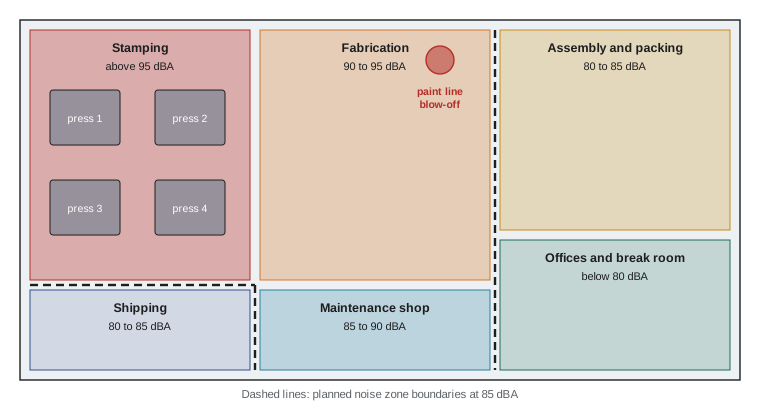
Step 1: assess exposures
The coordinator hires an occupational hygienist, who runs a noise survey with area measurements, full-shift dosimetry on at least three workers in each job group over several days, and task-based measurements for the main tasks. The table summarizes the task data for five similar exposure groups.
| Job group (workers) | Main tasks and typical daily time | Task levels, dBA |
|---|---|---|
| Press operators (12) | Running press 6 h; die changes 1 h; breaks 1 h | 98; 90; 70 |
| Fabricators (18) | Grinding 1.5 h; shearing 2 h; welding 3.5 h; breaks 1 h | 102; 94; 86; 70 |
| Paint line operators (8) | Blow-off station 2 h; loading line 5 h; breaks 1 h | 99; 84; 70 |
| Assembly and packing (30) | Assembly 7 h; breaks 1 h | 83; 70 |
| Maintenance (7, 10-hour shifts) | Work in stamping and fabrication 4 h; shop 4 h; elsewhere 2 h | 96; 88; 80 |
import math

def lex8(tasks):
    """tasks: list of (hours, dBA). Lex,8 normalized to 8 hours."""
    return 10 * math.log10(sum(h * 10 ** (L / 10) for h, L in tasks) / 8)

groups = {
    "Press operators":   (12, [(6, 98), (1, 90), (1, 70)]),
    "Fabricators":       (18, [(1.5, 102), (2, 94), (3.5, 86), (1, 70)]),
    "Paint line":        (8,  [(2, 99), (5, 84), (1, 70)]),
    "Assembly/packing":  (30, [(7, 83), (1, 70)]),
    "Maintenance (10 h)": (7, [(4, 96), (4, 88), (2, 80)]),
}
over = 0
for name, (n, tasks) in groups.items():
    L = lex8(tasks)
    dose = 100 * 10 ** ((L - 85) / 10)
    flag = "over 85" if L > 85 else ("within 3 dB" if L > 82 else "")
    if L > 85:
        over += n
    print(f"{name:<19} workers {n:>2}  Lex,8 {L:5.1f} dBA  dose {dose:6.0f} %  {flag}")
print(f"Workers over 85 dBA Lex,8: {over} of {sum(n for n, _ in groups.values())}")Press operators workers 12 Lex,8 96.9 dBA dose 1536 % over 85 Fabricators workers 18 Lex,8 95.8 dBA dose 1194 % over 85 Paint line workers 8 Lex,8 93.3 dBA dose 678 % over 85 Assembly/packing workers 30 Lex,8 82.5 dBA dose 56 % within 3 dB Maintenance (10 h) workers 7 Lex,8 93.7 dBA dose 737 % over 85 Workers over 85 dBA Lex,8: 45 of 75
Four of the five groups are over an 85 dBA exposure, the OSHA action level and the NIOSH limit, so they must be in the hearing conservation program. Using OSHA's 5 dB rule, the press operators, fabricators and maintenance mechanics are also over the 90 dBA PEL, which triggers the requirement for feasible engineering or administrative controls. Assembly and packing is within 3 dB of 85 dBA, so the coordinator decides to include that group too, as a precaution.
Step 2: rank the sources and plan engineering controls
The hygienist's source measurements and switch-off tests identify the main contributors in each area. The coordinator and the maintenance manager estimate the reduction and cost of possible controls, and rank them by the exposure reduction they buy and the number of workers who benefit.
| Source | Control option | Estimated reduction at worker (illustrative) | Estimated cost (illustrative) |
|---|---|---|---|
| Paint line blow-off (open pipes) | Engineered air nozzles and lower pressure | 10 dB at station | $1,500 |
| Press part ejection into steel bins | Rubber-lined chutes and bins, reduced drop height | 5 dB at presses | $6,000 |
| Press air exhausts | Exhaust silencers on clutch and brake valves | 3 dB at presses | $2,400 |
| Presses overall | Partial enclosures with sound-absorbing panels and sealed access doors | 6 to 8 dB at presses | $85,000 |
| Fabrication grinding | Lower-noise grinding discs, damped workpiece fixtures, grinding booth with absorption | 5 to 8 dB for grinding | $22,000 |
| Building | Ceiling baffles in stamping and fabrication | 3 to 5 dB away from machines | $40,000 |
The plan puts the cheap, high-value measures first: air nozzles, lined chutes and bins, and exhaust silencers in the first three months, followed by the grinding improvements and ceiling baffles in the first year, and the press enclosures in the second year as part of the capital budget. The coordinator documents why the press enclosures cannot be done immediately, including cost and the need to redesign material handling, and sets a review date. Buy-quiet requirements are added to all purchase specifications, with a target of 80 dBA at the operator position.
import math

def lex8(tasks):
    return 10 * math.log10(sum(h * 10 ** (L / 10) for h, L in tasks) / 8)

before = {
    "Press operators": [(6, 98), (1, 90), (1, 70)],
    "Fabricators": [(1.5, 102), (2, 94), (3.5, 86), (1, 70)],
    "Paint line": [(2, 99), (5, 84), (1, 70)],
}
# Phase 1 (nozzles, lined chutes, silencers) and phase 2 (grinding, baffles, enclosures)
phase1 = {
    "Press operators": [(6, 98 - 6.2), (1, 90), (1, 70)],     # chutes 5 dB plus silencers 3 dB combined
    "Fabricators": [(1.5, 102), (2, 94), (3.5, 86), (1, 70)],
    "Paint line": [(2, 89), (5, 84), (1, 70)],
}
phase2 = {
    "Press operators": [(6, 98 - 6.2 - 7), (1, 90 - 3), (1, 70)],
    "Fabricators": [(1.5, 102 - 6), (2, 94 - 3), (3.5, 86 - 3), (1, 70)],
    "Paint line": [(2, 89), (5, 84), (1, 70)],
}
print("Group             before  phase 1  phase 2   (Lex,8, dBA)")
for g in before:
print(f"{g:<16} {lex8(before[g]):7.1f} {lex8(phase1[g]):8.1f} {lex8(phase2[g]):8.1f}")Group before phase 1 phase 2 (Lex,8, dBA) Press operators 96.9 91.0 84.6 Fabricators 95.8 95.8 90.6 Paint line 93.3 85.5 85.5
The paint line group drops close to the limit with the air nozzles alone. Press operators improve by several decibels in phase 1 and are brought to around the limit by the enclosures in phase 2. Fabricators improve less, because welding and shearing remain, so they will need hearing protection for the foreseeable future. Hearing protectors therefore remain part of the program, but the exposures they must control are much lower.
Step 3: administrative controls
The coordinator adds a few administrative measures: grinding is concentrated at two booths rather than done anywhere in the bay; the break room is relocated away from the stamping wall and soundproofed; maintenance work on presses is scheduled when neighboring presses are stopped where possible; and walkways are rerouted so that assembly workers no longer pass between the presses. Job rotation is considered for press operators but rejected, because it would bring more workers into high exposure without reducing the total.
Step 4: hearing protection
Protector selection is based on each group's exposure after phase 1 controls, derated attenuation, the noise spectrum and the needs of the work. The coordinator buys a fit testing system and trains two staff to use it.
| Group | TWA after phase 1, 5 dB rule (dBA) | Selection |
|---|---|---|
| Press operators | Above 90 | Earplugs in several types and sizes, or earmuffs; individual fit test with a target personal attenuation rating of at least 15 dB |
| Fabricators | Above 90 | Earplugs or earmuffs compatible with welding helmets; fit test target of at least 18 dB; dual protection available for prolonged grinding |
| Paint line | About 85 | Earplugs; fit test; avoid over-protection so operators can hear the line |
| Maintenance | Above 90 | Choice of earplugs and earmuffs; electronic level-dependent earmuffs for communication; fit test target of at least 18 dB |
| Assembly and packing | Below 85 | Protectors available and encouraged; required when entering marked zones |
Step 5: training, zones and supervision
Every worker in the program receives a 45-minute session with hands-on fitting and a fit test, followed by short toolbox talks every quarter. Supervisors receive an extra session on enforcing zones, checking fit visually and handling complaints. The noise map is used to mark zone boundaries with floor tape and signs, and the rule is simple: everyone entering a marked zone wears hearing protection, including managers and visitors. Dispensers and a selection of protectors are placed at every zone entrance.
Step 6: audiometric testing
Audiometric testing is required under 1910.95(g) for all employees at or above 85 dBA. A provider is contracted to conduct baseline tests for all workers in the program within the first six months, after at least 14 hours without workplace noise, and annual tests thereafter, with review by an audiologist. New hires receive a baseline before their first noisy shift where possible. Standard threshold shifts trigger the follow-up in 1910.95(g) and recordkeeping review under 1904.10.
Step 7: evaluation and budget
The program sets measurable indicators and a budget, which the coordinator presents to senior management with the hearing loss claims as context.
| Indicator | Target |
|---|---|
| Workers in program with current baseline audiogram | 100 percent within 6 months |
| Workers fit tested with adequate personal attenuation rating | 100 percent within 6 months; retest annually |
| Protector use observed in zones during walk-throughs | At least 95 percent |
| Phase 1 engineering controls completed | Within 3 months |
| Annual significant shift rate by group | Below 3 percent within 3 years, investigated by group |
| Noise reassessment | After phase 1 and phase 2, and whenever equipment changes |
costs = {  # first-year costs, illustrative
    "Noise survey by hygienist": 9000,
    "Phase 1 engineering controls": 1500 + 6000 + 2400,
    "Grinding improvements and ceiling baffles": 22000 + 40000,
    "Fit testing system and training": 7500,
    "Protectors (75 workers)": 75 * 120,
    "Audiometric testing (75 workers)": 75 * 45,
    "Training time (75 workers, 1.5 h at $40)": 75 * 1.5 * 40,
}
for item, c in costs.items():
    print(f"{item:<44} ${c:>9,.0f}")
total = sum(costs.values())
print(f"{'Total first-year cost':<44} ${total:>9,.0f}")
print(f"Cost per worker in program: ${total / 75:,.0f}")Noise survey by hygienist $ 9,000 Phase 1 engineering controls $ 9,900 Grinding improvements and ceiling baffles $ 62,000 Fit testing system and training $ 7,500 Protectors (75 workers) $ 9,000 Audiometric testing (75 workers) $ 3,375 Training time (75 workers, 1.5 h at $40) $ 4,500 Total first-year cost $ 105,275 Cost per worker in program: $1,404
The first-year cost is substantial but modest compared with the cost of hearing loss claims, lost productivity from communication problems and the human cost of permanent hearing loss and tinnitus. The press enclosures are budgeted separately for year two.
Reviewing a weak draft
Before the coordinator arrived, a consultant had drafted a short program for Larkspur. Reviewing it is a useful test of everything in this course.
| Draft program statement | Problem | What it should say |
|---|---|---|
| Noise levels are known to be high in stamping, so no survey is needed. | No assessment of exposures or job groups; mobile workers ignored | A full assessment with dosimetry and task measurements, repeated after changes |
| All workers will wear earplugs with an NRR of 33 in the plant. | Ignores engineering controls; no derating; over-protection in quieter areas; one product for all | Engineering controls first, protectors selected by derated attenuation and fit testing, with a choice of types |
| Workers may remove protectors for short periods to talk. | Short removals destroy most of the protection | Protectors worn at all times in zones; communication solved with suitable devices and quiet areas |
| Hearing tests will be offered to workers who request them. | No baseline or systematic testing; no follow-up | Baseline and periodic testing for all workers in the program, with defined follow-up |
| Training consists of reading this policy and signing it. | No hands-on fitting or personal relevance | Practical training with fitting, fit testing and periodic reminders |
| Supervisors are responsible for noise. | No named coordinator, resources or evaluation | A named coordinator, defined roles and annual evaluation using outcome indicators |
Worked problem
Explaining the program to the committee
The joint health and safety committee asks the coordinator why the plant is spending money on engineering controls when earplugs cost only a few cents a pair. How should the coordinator answer?
Show solution
- Explain that 1910.95 requires feasible engineering or administrative controls above the PEL, and that good practice puts them first regardless.
- Show the wear-time effect: protectors removed for even a few minutes in 98 dBA lose most of their benefit, while controls work all the time.
- Show the numbers: the phase 1 controls cost about $10,000 and cut exposure by several decibels for 20 workers, with the air nozzles paying for themselves in energy savings.
- Point to the claims already filed and the audiometric shifts expected without action.
- Commit to sharing aggregate results with the committee each year so it can judge the program for itself.
Answer: Controls protect everyone continuously, are required to be considered first, often pay back quickly and reduce reliance on protectors that only work when worn perfectly. The committee will see the results in annual aggregate data.
Bringing it together
The Larkspur program illustrates the main lessons of this course. Assess before acting, and assess people, not just places. Rank sources and attack the dominant ones first. Treat hearing protectors as a necessary but fragile last line of defense, chosen with derating and fit testing, and worn all the time in zones. Use audiometric testing as the program's report card, with follow-up for every significant shift. Give the program an owner, resources and measurable targets. And remember that the goal is not compliance on paper but workers who retire with the hearing they started with.
Common mistakes
MistakeStarting a program by buying protectors.
InsteadStart with an assessment of exposures and sources, then plan controls, protection, training and testing.
MistakeLeaving groups just under the limit out of the program.
InsteadInclude groups within about 3 dB of the limit, or with variable exposure, as a precaution.
MistakeDeferring all engineering controls because the largest project is expensive.
InsteadDo cheap, high-value controls first and plan larger projects with documented timelines.
MistakeSetting no measurable targets for the program.
InsteadSet process and outcome indicators and review them at least annually.
MistakeWriting a program that exists only on paper.
InsteadAssign an owner, fund the program, train supervisors and check that hearing is preserved.
Summary and key terms
- A capstone program starts with a full exposure assessment by job group, using dosimetry and task-based measurements.
- Exposure calculations identify groups over the limit and the tasks that drive their dose.
- Engineering controls are ranked by exposure reduction, cost and workers affected, with cheap, high-value measures first.
- Administrative controls support but do not replace engineering controls, and rotation is used cautiously.
- Protectors are selected by derated attenuation, fit testing, spectrum and job needs, with a choice of types.
- Training, simple zone rules, supervision and audiometric testing with follow-up make the program work in practice.
- Measurable indicators, a budget and annual evaluation keep the program effective; weak drafts typically lack assessment, controls, testing and ownership.
- Capstone program
- A complete hearing conservation program designed to integrate assessment, controls, protection, testing and evaluation.
- Similar exposure group
- Workers with similar jobs and expected exposures, assessed together.
- Phased control plan
- A schedule of engineering controls carried out in stages by priority and budget.
- Fit test target
- The minimum personal attenuation rating a worker must achieve with a chosen protector.
- Program indicator
- A measurable process or outcome used to judge whether the program works.
- Buy-quiet target
- The maximum noise level specified for new equipment at the operator position.
- Zone boundary
- The marked line at which hearing protection becomes mandatory.
- Significant shift rate
- The annual percentage of tested workers with a significant hearing change.
- Program owner
- The named coordinator responsible for running and evaluating the program.
- Draft review
- A structured check of a proposed program against the elements of good practice.
Practice problems
Work each problem on paper first, then reveal the answer to check.
What is the first step in building Larkspur's program?
Show answer
A full exposure assessment with dosimetry and task measurements for each job group.
Calculate the Lex,8 for 6 hours at 98 dBA, 1 hour at 90 dBA and 1 hour at 70 dBA.
Show answer
About 96.9 dBA.
Why was assembly and packing included in the program even though it is below 85 dBA?
Show answer
It is within 3 dB of the limit, and some workers cover the noisier paint line.
Which engineering control had the best value at Larkspur, and why?
Show answer
Engineered air nozzles: low cost, a large reduction at the station and energy savings.
Why was job rotation rejected for press operators?
Show answer
It would expose more workers to high noise without reducing the total.
Why do fabricators still need protectors after controls?
Show answer
Welding and shearing remain at levels above the limit even after grinding improvements.
Name three indicators used to evaluate the program.
Show answer
Any three of baseline coverage, fit testing coverage, observed protector use, controls completed, significant shift rate and reassessment.
What is wrong with allowing workers to remove protectors to talk?
Show answer
Short removals in high noise destroy most of the protection.
What is wrong with offering hearing tests only on request?
Show answer
There is no baseline or systematic detection of change, and no follow-up.
What is the ultimate goal of a hearing conservation program?
Show answer
Workers retire with the hearing they started with.
Lesson quiz · 5 questions
Score 60% or more to complete this lesson.
Create a free account to save your progress, take quizzes and earn a certificate.