
HSE-241 · Lesson 10 of 12 · 25 min
Audiometric testing and hearing loss records
Noise assessments, controls and protectors are all aimed at one outcome: workers' hearing stays the same over their working lives. Audiometric testing is how a program finds out whether that is happening. A baseline test records a worker's hearing before significant exposure, and periodic tests compare later results with it. Early, small changes, long before the worker notices anything, trigger follow-up that can prevent a permanent handicap. Taken together, the results of many workers show whether the program as a whole is working. This lesson covers how audiometric testing is done, how results are interpreted, what follow-up is needed and how hearing loss is recorded and compensated.
What an audiometric test involves
An occupational audiometric test is a pure-tone air-conduction hearing test. The worker sits in a quiet booth or room wearing headphones or insert earphones, and presses a button whenever a tone is heard. The tester, or an automated audiometer, presents tones at each test frequency, usually 500, 1,000, 2,000, 3,000, 4,000, 6,000 and 8,000 Hz, varying the level to find the quietest level the worker can hear about half the time. The results are recorded in dB HL for each ear and plotted on an audiogram, as described in Lesson 1. The test usually takes 10 to 20 minutes and should be combined with a short questionnaire about ear health, noise exposure at work and outside work, and protector use, and with a brief counseling session.
The quality of the test depends on several things. The room must be quiet enough not to mask the quietest tones, typically checked against maximum permissible background levels in each octave band. The audiometer must be calibrated: a daily functional check, a periodic acoustic calibration and an exhaustive calibration at longer intervals. The tester must be trained and must give consistent instructions. And the worker should have had a period without loud noise before the test, especially before the baseline, so that a temporary threshold shift does not distort the result.
| Requirement | OSHA 1910.95(g) and appendices |
|---|---|
| When testing is required | For all employees exposed at or above an 85 dBA TWA |
| Baseline | Within 6 months of first exposure at or above the action level, or within 1 year if a mobile test van is used, with protectors worn in the meantime; preceded by at least 14 hours without workplace noise, or with protectors |
| Periodic testing | At least annually |
| Who tests | A licensed or certified audiologist, otolaryngologist or other physician, or a technician certified by the Council for Accreditation in Occupational Hearing Conservation or who has demonstrated competence |
| Instruments and rooms | Audiometers meeting ANSI S3.6, with daily functional checks, annual acoustic calibration and exhaustive calibration every 2 years; rooms meeting the background levels in Appendix D |
| Review | An audiologist, otolaryngologist or physician reviews problem audiograms and decides on further evaluation |
The baseline audiogram
The baseline is the reference against which every later test is compared, so it must be good. A baseline taken right after a noisy shift may show a temporary threshold shift, making later results look better than they are and hiding real damage. A baseline taken with poor instructions or in a noisy room may show worse thresholds than the worker really has. Many programs take the baseline on a worker's first day, before any exposure, and some repeat it within a few weeks to confirm it. Pre-existing hearing loss found at baseline should be documented, explained to the worker and considered in protector selection.
Detecting a significant change
Each periodic test is compared with the baseline, and sometimes with the previous test, to detect changes. Some variation is normal: a test-retest difference of 5 dB at a single frequency is common. A program therefore uses defined criteria for a significant change, which triggers follow-up.
OSHA defines a standard threshold shift, or STS, as a change in hearing threshold relative to the baseline audiogram of an average of 10 dB or more at 2,000, 3,000 and 4,000 Hz in either ear. Employers may adjust for the expected effects of aging using the tables in Appendix F of 1910.95, and may retest within 30 days and use the retest result if it does not confirm the shift.
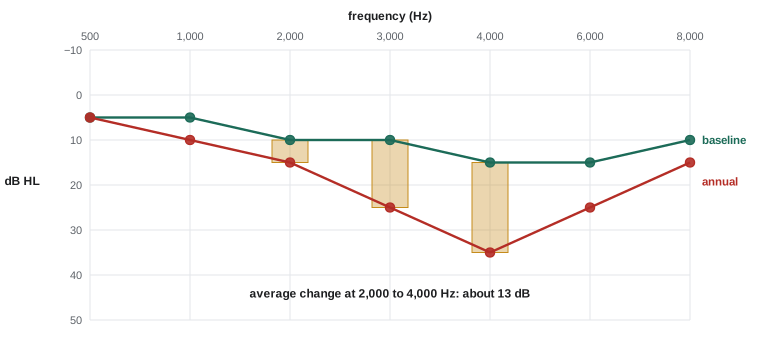
freqs = [500, 1000, 2000, 3000, 4000, 6000, 8000]

def shifts(baseline, current):
    return {f: c - b for f, b, c in zip(freqs, baseline, current)}

def average_shift_234(baseline, current):
    d = shifts(baseline, current)
    return (d[2000] + d[3000] + d[4000]) / 3

def hearing_level_234(current):
    c = dict(zip(freqs, current))
    return (c[2000] + c[3000] + c[4000]) / 3

worker = {
    "left":  {"baseline": [5, 5, 10, 10, 15, 15, 10], "annual": [5, 10, 15, 25, 35, 25, 15]},
    "right": {"baseline": [5, 5, 5, 10, 10, 15, 10],  "annual": [5, 5, 10, 15, 20, 20, 10]},
}
for ear, r in worker.items():
    avg = average_shift_234(r["baseline"], r["annual"])
    level = hearing_level_234(r["annual"])
    single = max(shifts(r["baseline"], r["annual"]).values())
    print(f"{ear:>5}: average shift at 2-4 kHz {avg:4.1f} dB, "
          f"largest single shift {single} dB, current average level {level:4.1f} dB HL")
    print(f"       10 dB average-shift criterion met: {avg >= 10}; "
f"25 dB average level reached: {level >= 25}") left: average shift at 2-4 kHz 13.3 dB, largest single shift 20 dB, current average level 25.0 dB HL
10 dB average-shift criterion met: True; 25 dB average level reached: True
right: average shift at 2-4 kHz 6.7 dB, largest single shift 10 dB, current average level 15.0 dB HL
10 dB average-shift criterion met: False; 25 dB average level reached: FalseIn this example, the left ear shows an average shift of about 13 dB at 2,000 to 4,000 Hz and a current average hearing level of 25 dB HL, so it meets both the 10 dB shift criterion and the 25 dB level used in US recordkeeping. The right ear shows a smaller change that does not meet the shift criterion but should still be watched. No age adjustment has been applied; doing so would reduce the calculated shift somewhat for an older worker.
Follow-up after a significant shift
A significant shift is an early warning. It should lead to a set of actions aimed at stopping further loss.
| Action | OSHA requirement or good practice |
|---|---|
| Retest | Optional retest within 30 days; the retest may be used if it does not confirm the shift |
| Notify the employee | In writing within 21 days of determining the STS |
| Protectors | Fit or refit with protectors, train and require their use; protectors must attenuate to 85 dBA |
| Refer | Refer for clinical audiological evaluation or otological examination where indicated, or if a medical pathology of the ear is suspected |
| Review exposure | Good practice: check the worker's current exposure and controls |
| Revise the baseline | Permitted when the STS is persistent, or when thresholds improve, as determined by the reviewer |
| Record | Enter on the OSHA 300 log if the criteria in 29 CFR 1904.10 are met |
Worked problem
Handling a significant shift
A 45-year-old forklift mechanic's annual test shows an average shift of 12 dB at 2,000 to 4,000 Hz in the right ear compared with his baseline from eight years ago. His noise exposure was assessed at 88 dBA Lex,8 four years ago, and he wears foam earplugs. He mentions that he started deer hunting two years ago. What should the program do?
Show solution
- Arrange a retest after a quiet period to confirm the shift and rule out a temporary threshold shift or test error.
- If confirmed, notify the worker privately in writing and explain the result.
- Review his current exposure: four years is a long time, and the maintenance shop may have changed. Consider a new dosimetry measurement.
- Fit test his earplugs and coach him on insertion; consider a different protector if his PAR is low.
- Discuss hunting: shooting without protection can cause sudden, permanent damage. Recommend electronic shooting protectors or plugs plus muffs.
- Have the reviewing professional consider referral, adjust for age if the program allows, and decide whether to revise the baseline.
Answer: Confirm, notify, reassess exposure, fit test and retrain, address hunting noise and refer as the reviewer advises. The shift may come from work, hunting or both; protection at work and off the job both matter.
Recording and reporting hearing loss
Under 29 CFR 1904.10, an employer must record a hearing loss case on the OSHA 300 log if an employee's audiogram shows a standard threshold shift in one or both ears, and the employee's total hearing level is 25 dB or more above audiometric zero, averaged at 2,000, 3,000 and 4,000 Hz, in the same ear. Age correction may be applied to the STS determination but not to the 25 dB test, and a retest within 30 days may be used. If a physician or other licensed health care professional determines that the hearing loss is not work-related or not aggravated by occupational noise, the case need not be recorded. Hearing loss cases are entered in a separate column of the log.
Workers' compensation for noise-induced hearing loss
State workers' compensation systems handle noise-induced hearing loss claims, with rules that differ widely in the degree of loss required, the formula for impairment and the treatment of age-related loss. Some states compensate only when the loss reaches a defined level in the speech frequencies, while others use a formula from the American Medical Association guides. Good baseline and periodic records help both the worker and the employer, because they show when and where hearing changed. Federal employees and longshore workers have their own compensation systems.
Confidentiality and counseling
Audiograms are confidential health records. The worker should receive a copy of each result and an explanation in plain language. The employer needs to know that testing was done, whether a significant shift occurred and what actions are needed, but not the detailed audiogram. Committees should see aggregate statistics only.
Counseling at the time of the test is one of the most effective parts of the program. A short conversation, showing the worker their own audiogram trend, explaining what any change means, checking protector fit and asking about leisure noise, connects the abstract risk to the individual. Workers who see their own notch beginning are much more likely to protect their hearing consistently.
Common mistakes
MistakeTaking baseline audiograms right after a noisy shift.
InsteadTake the baseline before exposure or after a quiet period of at least 14 hours, so temporary shifts do not distort it.
MistakeFiling audiograms without comparing them with the baseline.
InsteadCompare each test with the baseline using defined criteria and act on significant shifts.
MistakeTreating a significant shift as a paperwork event.
InsteadRetest, notify, review exposure, refit and retrain, address leisure noise and refer as needed.
MistakeUsing poorly calibrated audiometers or noisy test rooms.
InsteadCalibrate on schedule, perform daily checks and verify room background levels.
MistakeSharing individual audiograms with supervisors.
InsteadKeep results confidential; share only the information needed for follow-up and aggregate data for program review.
Summary and key terms
- Audiometric testing compares periodic pure-tone tests with a baseline to detect early, often unnoticed changes in hearing.
- Good tests need quiet rooms, calibrated audiometers, trained testers and a quiet period before the baseline.
- Testing frequency and requirements differ by jurisdiction; OSHA requires baseline and annual tests at or above 85 dBA.
- Significant shift criteria, such as the OSHA standard threshold shift of an average 10 dB at 2,000 to 4,000 Hz, trigger follow-up.
- Follow-up includes retesting, notifying the worker, reviewing exposure, refitting and retraining, considering other causes and referral.
- Recording and compensation rules vary: US employers record qualifying cases on the OSHA 300 log, and Canadian boards compensate noise-induced hearing loss under their own policies.
- Audiograms are confidential, and counseling at the time of testing is one of the most powerful parts of the program.
- Audiometric test
- A pure-tone hearing test that measures thresholds at standard frequencies.
- Baseline audiogram
- The reference test against which later results are compared.
- Periodic audiogram
- A follow-up test, usually annual or every two years, compared with the baseline.
- dB HL
- Decibels hearing level, the scale used on audiograms where 0 is average normal hearing.
- Standard threshold shift (STS)
- OSHA's definition of a significant change: an average shift of 10 dB or more at 2,000, 3,000 and 4,000 Hz in either ear.
- Age correction
- An adjustment for the hearing change expected from aging alone.
- Revised baseline
- A new reference audiogram set after a persistent shift or improvement.
- Audiometric zero
- The reference level of 0 dB HL, representing average normal hearing.
- Recordable hearing loss
- In the US, a standard threshold shift with an average hearing level of 25 dB or more at 2,000 to 4,000 Hz in the same ear.
- Audiometric technician
- A trained person who conducts hearing tests under professional supervision.
Practice problems
Work each problem on paper first, then reveal the answer to check.
Why must the baseline audiogram be taken after a quiet period?
Show answer
To avoid recording a temporary threshold shift, which would hide later damage.
Which test frequencies are typically used?
Show answer
500, 1,000, 2,000, 3,000, 4,000, 6,000 and 8,000 Hz.
What are the three main checks of audiometer accuracy?
Show answer
Daily functional checks, periodic acoustic calibration and exhaustive calibration.
Baseline thresholds at 2, 3 and 4 kHz are 10, 10 and 15 dB; current are 20, 25 and 30 dB. What is the average shift?
Show answer
(10 + 15 + 15) ÷ 3 ≈ 13.3 dB.
Does that shift meet the OSHA STS criterion?
Show answer
Yes, it is 10 dB or more, before any age correction.
Name four follow-up actions after a significant shift.
Show answer
Any four of retest, notify, review exposure, refit and retrain, consider other causes, refer, revise baseline and report.
What leisure activity commonly causes noise damage among workers?
Show answer
Recreational shooting, among others such as power tools, motorsports and loud music.
Why should counseling accompany each test?
Show answer
Showing workers their own results and checking protectors makes the risk personal and improves protection.
Who should see individual audiograms?
Show answer
The worker and the health professionals involved; the employer gets only necessary follow-up information.
Why do good audiometric records help in compensation claims?
Show answer
They show when and where hearing changed, helping both worker and employer.
Lesson quiz · 5 questions
Score 60% or more to complete this lesson.
Create a free account to save your progress, take quizzes and earn a certificate.