
HSE-216 · Lesson 8 of 12 · 25 min
Fire watch and post-work monitoring
The fire watch is the last line of defense in hot work. Even with combustibles removed, openings covered and the atmosphere tested, a spark can find something nobody noticed. The fire watch is there to see the first wisp of smoke or the first glow, put it out while it is small, and raise the alarm if it is not. Because sparks can smolder for a long time before they flame, the fire watch continues well after the work stops, and many programs add monitoring and a final inspection hours later. This lesson covers when a fire watch is needed, who can do it, what they do and how long it lasts.
When a fire watch is required
OSHA 1910.252 requires fire watchers whenever welding or cutting is done in locations where other than a minor fire might develop, including when combustibles are within 35 ft, when combustibles farther away could be ignited by sparks, when openings within 35 ft expose combustibles in adjacent areas or concealed spaces, or when combustibles are next to the opposite side of metal walls, partitions, ceilings or roofs. NFPA 51B requires a fire watch for hot work outside designated areas, and local fire codes add their own triggers. In practice, most permit systems require a fire watch for all hot work outside designated areas.
More than one fire watch may be needed. If the fire watch cannot see all the places where sparks may land, including the far side of walls, the floor below, ceiling spaces and roofs, additional watches are posted in those places. Large jobs or several simultaneous jobs may need several watches.
Who can be a fire watch
The fire watch must be trained and fit for the job. Codes and standards generally require that the fire watch:
- is trained in the use of the fire extinguishing equipment provided and has practiced using it;
- knows how to sound the alarm and call the fire department, and knows the site's emergency procedures;
- knows the hazards of the work and the area, including what was moved or covered and where the openings are;
- has no other duties that take attention away from watching for fire during the work and the required period afterward;
- has the authority to stop the hot work if conditions become unsafe.
The fire watch should not be the hot work operator. Operators wear dark filter lenses, focus closely on the weld and cannot see what happens behind them. Some jurisdictions and employers require the fire watch to hold a specific certificate; where they do, only certified people may act as fire watch. Fire departments in some cities also require certified fire watch personnel during impairments of building fire protection.
What the fire watch does
Before work starts, the fire watch walks the area with the operator or authorizing individual, confirms the precautions on the permit, checks the extinguisher's gauge and seal, and identifies the alarm and escape routes. During the work, the fire watch stands where they can see the work and the places where sparks are landing, watches continuously, keeps an eye on blankets and covers, and extinguishes any small fires immediately.
If a fire starts and is small, the fire watch puts it out and tells the operator to stop. If it cannot be put out quickly with the extinguisher, the fire watch raises the alarm, calls the fire department, warns others and leaves by a safe route. The fire watch should not try to fight a fire that is spreading beyond the first few seconds of extinguisher use; the priority is to get people out and get the fire department coming.
After the work stops, the fire watch remains in the area for the required time, checking all areas where sparks may have landed, including floors below, adjacent rooms, ceiling spaces and the far side of walls. Touching surfaces with the back of a glove, looking and smelling for smoke, and using a thermal imaging camera where available can find hidden heat. At the end, the fire watch signs the permit and reports to the authorizing individual.
How long the fire watch lasts
The required duration differs between codes and standards, and it has grown longer over time as investigators have documented fires that broke out after short fire watches ended.
| Source | Fire watch after work ends | Additional checks |
|---|---|---|
| OSHA 1910.252 | At least 30 minutes | None specified |
| NFPA 51B (2019 and 2024) | At least 1 hour; may be reduced to no less than 30 minutes in defined cases (2024) | Monitoring for up to 3 more hours as the PAI decides |
| NFPA 241 (construction) | 2 hours after torch-applied roofing and in some large timber construction | As specified |
| Insurer and employer programs | Often 60 to 120 minutes | Often a check 3 to 4 hours later |
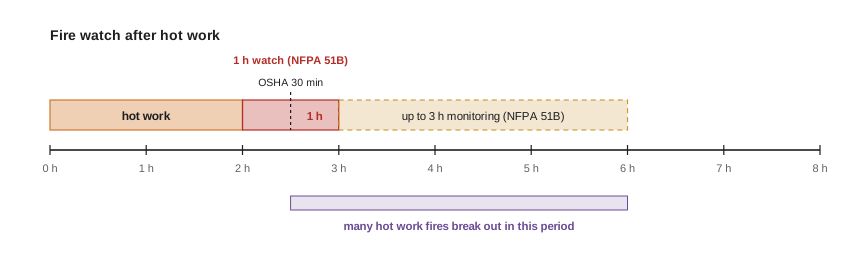
Why so long? Smoldering in dust, insulation, wood or upholstery can take an hour or more to develop into open flame. Insurance industry studies of hot work losses have found that many fires were discovered well after the workers left. A longer watch and a later check are cheap compared with the loss of a building. This is also why hot work should not be scheduled so late that the fire watch and later check would happen after everyone has gone home.
Monitoring and final inspections
After the fire watch ends, many programs require further monitoring or a final inspection. Monitoring can mean a person making rounds at intervals, or relying on a working automatic fire detection system, depending on the risk. The final inspection is a deliberate walk of the area, often by the authorizing individual, some hours after the work, to confirm there is no smoldering fire. On construction sites where the building has no working detection, security patrols or a temporary fire watch may be needed overnight after hot work late in the day.
Thermal imaging cameras have become affordable and are very useful for finding hidden hot spots in walls, roofs and stored goods. They do not replace looking and feeling, but they can see through smoke and show warm areas that the eye cannot. Some sites use wireless heat detectors placed around the work area, which alert a monitor if temperatures rise after the workers leave.
Worked problem
Planning the fire watch schedule
A contractor plans to weld in a warehouse from 1:00 to 3:30 p.m. The city fire code adopts NFPA 51B (2024), the permit authorizing individual has called for 2 hours of monitoring after the 1-hour fire watch, and the insurer requires a 90-minute fire watch. Staff leave at 5:00 p.m., and security patrols begin at 6:00 p.m. When must each step happen, and is the schedule workable?
Show solution
- Work ends at 3:30 p.m. The fire watch must last at least 90 minutes (the insurer's requirement exceeds NFPA 51B's 1 hour), so until 5:00 p.m.
- Monitoring then continues for 2 hours: until 7:00 p.m.
- Staff leave at 5:00 p.m., when the fire watch ends, so monitoring from 5:00 to 7:00 p.m. depends on security, who start only at 6:00 p.m.
Answer: There is a one-hour gap from 5:00 to 6:00 p.m. with no one assigned. Either start the work earlier, extend a trained fire watch until security arrives, or brief security to start early, and record the monitoring on the permit.
Common fire watch failures
Fire watches fail in familiar ways. The fire watch is given other jobs, such as fetching materials or helping the welder, and stops watching. The watch stands where they can see the welder but not where the sparks land. The watch leaves early because the shift ends or because nothing seems to be happening. No one checks the floor below or the room next door. The extinguisher is the wrong type, empty or out of reach. The watch has never used an extinguisher. The permit records a fire watch that never happened.
Each of these failures has a simple fix: assign the fire watch as a dedicated role, plan where they stand, schedule the work so the watch can be completed, train and practice, check equipment, and audit permits against reality. A fire watch who finds and puts out a small fire has done the job perfectly, and that event should be reported and investigated as a near miss, not hidden.
Where the fire watch should stand
Position matters as much as presence. The fire watch needs a clear line of sight to the work and to the places where sparks are landing, close enough to reach a fire within seconds but not so close that they are in the spark stream themselves. When cutting from height, sparks land below and to the sides; the fire watch may be better on the floor than on the platform. When working near a wall with combustibles on the other side, a second watch on the far side is often the only way to see a fire starting there. For long or complex jobs, the authorizing individual should mark the fire watch positions on the permit.
The fire watch also needs protection: safety glasses or a filter suitable for watching the arc indirectly, hearing protection where noise is high, flame-resistant clothing if they are close to the work, and a way to communicate with the operator, since welders wearing helmets and hearing protection may not hear a shout. A tap on the shoulder, a hand signal agreed in advance or a radio can be essential.
Fire watch records
Recording the fire watch is part of the control, not just paperwork. The permit should show who acted as fire watch, when they started and finished, the areas they checked and anything they found. If a small fire occurred, the record should say so and lead to a near-miss report. Auditors comparing fire watch records with work times often find the most important weaknesses in a program, as Lesson 12 shows.
Common mistakes
MistakeGiving the fire watch other tasks during or after the work.
InsteadThe fire watch must watch for fire only, for the whole required period.
MistakeEnding the fire watch as soon as the welding stops.
InsteadContinue for at least 30 minutes under OSHA and 1 hour under NFPA 51B, or longer if required.
MistakeWatching only the work, not where sparks can land.
InsteadPosition watches to see floors below, adjacent rooms, ceiling spaces and the far side of walls.
MistakeUsing a fire watch who has never operated an extinguisher.
InsteadTrain and practice with the actual extinguisher type provided.
MistakeTreating a small fire put out by the watch as a non-event.
InsteadReport it as a near miss and find out how the spark escaped the controls.
Summary and key terms
- The fire watch is the last line of defense against hot work fires.
- Additional watches are needed where one person cannot see all spark landing areas.
- The fire watch must be trained, have no other duties and have authority to stop work.
- The fire watch extinguishes small fires, raises the alarm for larger ones and leaves safely.
- OSHA requires at least 30 minutes; NFPA 51B requires 1 hour plus up to 3 hours of monitoring.
- Smoldering fires can take an hour or more to break out, so later checks matter.
- Schedule work so the full fire watch and later checks happen while trained people are present.
- Fire watch
- A trained person whose only job is to watch for and respond to fires during and after hot work.
- Post-work monitoring
- Continued checking of the hot work area after the formal fire watch ends.
- Final inspection
- A deliberate check of the area some hours after hot work to confirm there is no fire.
- Smoldering
- Slow, flameless burning that can later develop into open flame.
- Thermal imaging camera
- A camera that shows temperature differences, useful for finding hidden hot spots.
- Near miss
- An event that could have caused harm but did not, such as a small fire put out by the watch.
- Charged hose line
- A fire hose connected to a water supply and ready for use.
- Certified fire watch
- A fire watch who holds a certificate required by a jurisdiction or employer.
- Impairment
- A condition in which a fire protection system is not fully working.
- Security patrol
- Rounds made by security staff that can include post-work hot work checks if trained and briefed.
Practice problems
Work each problem on paper first, then reveal the answer to check.
How long must the fire watch continue after hot work under OSHA 1910.252?
Show answer
At least 30 minutes.
How long is the fire watch under NFPA 51B?
Show answer
At least 1 hour, plus up to 3 hours of monitoring as the PAI decides.
Why should the operator not be the fire watch?
Show answer
Their attention is on the work and their filter lens and helmet limit what they can see.
Name four qualifications or conditions for a fire watch.
Show answer
Trained with the extinguisher, knows the alarm procedure, knows the hazards, has no other duties, has authority to stop work.
When are additional fire watches needed?
Show answer
When one watch cannot see all places where sparks may land, such as floors below or adjacent rooms.
What should the fire watch do if a fire cannot be put out quickly?
Show answer
Raise the alarm, call the fire department, warn others and leave by a safe route.
Why have fire watch durations become longer?
Show answer
Investigations showed many fires broke out after short watches ended.
How can a thermal imaging camera help?
Show answer
It finds hidden hot spots in walls, roofs and stored goods.
Why should a small fire put out by the watch be reported?
Show answer
It is a near miss showing a spark escaped the controls.
Name three common fire watch failures.
Show answer
Other duties, poor position, leaving early, not checking adjacent areas, wrong or empty extinguisher, no training.
Lesson quiz · 5 questions
Score 60% or more to complete this lesson.
Create a free account to save your progress, take quizzes and earn a certificate.