
HSE-216 · Lesson 10 of 12 · 26 min
Welding health hazards: fumes, gases, radiation and PPE
Fire is not the only danger in hot work. Welders and the people around them breathe fumes and gases, are exposed to intense ultraviolet and infrared radiation, work with electrical equipment that can shock, handle hot metal that burns, and are often exposed to loud noise. Many of these effects are slow and invisible: lung damage, nervous system effects from manganese, cancers linked to hexavalent chromium and to welding fume itself. This lesson covers the main health hazards of hot work and how ventilation, work practices and personal protective equipment control them.
Welding fume
Welding fume is a mixture of very fine metal oxide particles formed when metal vaporizes in the arc or flame and condenses in air. The particles are small enough to reach deep into the lungs. The composition depends on the base metal, the filler metal or electrode, the coatings and the process. Mild steel fume is mostly iron oxide with some manganese; stainless steel fume contains chromium, including hexavalent chromium, and nickel; galvanized steel releases zinc oxide; old painted steel may release lead or cadmium.
In 2017 the International Agency for Research on Cancer classified welding fume as carcinogenic to humans (Group 1), based on evidence of lung cancer in welders. That classification applies to welding fume in general, not only to stainless steel. It means fume exposure should be kept as low as reasonably achievable, not just below a limit.
| Contaminant | Main sources | Health effects |
|---|---|---|
| Manganese | Most steel welding consumables, especially hardfacing | Nervous system damage resembling Parkinson's disease (manganism) |
| Hexavalent chromium | Stainless steel and chromium alloys, chromate coatings | Lung cancer, nasal ulcers, skin and respiratory sensitization |
| Nickel | Stainless steel and nickel alloys | Lung and nasal cancer, sensitization |
| Zinc oxide | Galvanized steel, brass | Metal fume fever: flu-like symptoms a few hours after exposure |
| Lead and cadmium | Old paints, coatings, some solders and brazing alloys | Lead poisoning; kidney and lung damage from cadmium |
| Ozone and nitrogen oxides | Formed by the arc, especially gas-shielded processes | Lung irritation, pulmonary edema at high levels |
| Carbon monoxide | Incomplete combustion, CO2 shielding gas breakdown | Headache, dizziness, death in enclosed spaces |
| Phosgene | Arc radiation breaking down chlorinated degreasing solvents | Severe delayed lung damage |
Exposure limits
OSHA's permissible exposure limits (PELs) are legal limits, but many are old. OSHA's PEL for manganese is a ceiling of 5 mg/m³, set decades ago, while the ACGIH threshold limit values (TLVs) are far lower: 0.02 mg/m³ for respirable manganese and 0.1 mg/m³ inhalable. For hexavalent chromium, OSHA's standard (29 CFR 1910.1026) sets a PEL of 5 µg/m³ as an 8-hour average, with an action level of 2.5 µg/m³ that triggers monitoring and medical surveillance; the ACGIH TLV is 0.2 µg/m³ inhalable. Many employers use the lower TLVs as their working targets because meeting only the old PEL does not prevent disease.
Worked problem
Comparing an exposure result with the limits
Air sampling on a welder working on stainless steel in a fabrication shop measures hexavalent chromium at 1.5 µg/m³ as an 8-hour time-weighted average. Compare it with OSHA's PEL of 5 µg/m³, the action level of 2.5 µg/m³ and the ACGIH TLV of 0.2 µg/m³. What should happen?
Show solution
- Against the PEL: 1.5 ÷ 5 = 0.3, so 30 % of the PEL. Against the action level: 1.5 is below 2.5.
- Against the TLV: 1.5 ÷ 0.2 = 7.5, so seven and a half times the TLV.
- The result is legally compliant with OSHA, but well above the level the ACGIH considers protective for a carcinogen.
Answer: The exposure meets OSHA's PEL but is far above the TLV for a known carcinogen. A responsible employer would install local exhaust or fume-extraction torches, review the process and consumables, and aim to bring exposure toward the TLV, using respirators only while controls are improved.
Ventilation and fume control
The best way to control welding fume is to capture it at the source before it reaches the welder's breathing zone. Local exhaust ventilation uses a hood, slot or nozzle close to the arc, connected to a fan and filter. Fume-extraction guns build the extraction into the welding gun. General ventilation, which dilutes fume across a room, is much less effective for the welder and is mainly a back-up.
OSHA 1910.252(c) requires mechanical ventilation where there is less than 10,000 cubic feet of space per welder, where the ceiling is lower than 16 ft, or in confined spaces, at a rate of at least 2,000 cubic feet per minute per welder unless local exhaust is used. Local exhaust hoods must maintain a capture velocity of at least 100 linear feet per minute in the welding zone at the hood's farthest working distance.
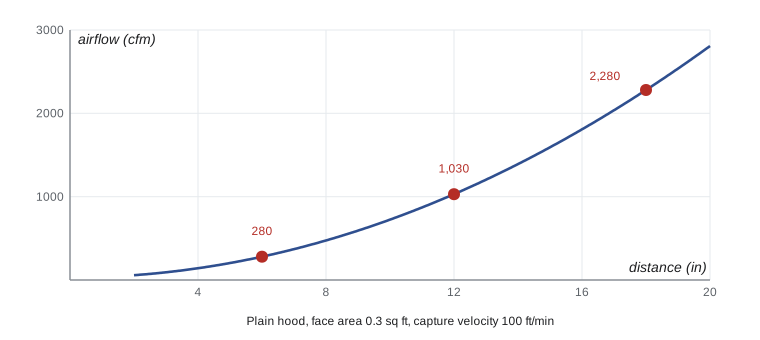
Capture velocity falls off sharply with distance from the hood, roughly with the square of the distance. A hood that captures well at 15 cm may do almost nothing at 45 cm. This is the most common reason local exhaust fails: the welder works too far from the hood, or the hood is not moved as the work moves.
Worked problem
How much airflow does the hood need?
A plain round hood with a face area of 0.3 sq ft is placed 12 in (1 ft) from a weld. The target capture velocity at the weld is 100 ft/min. A common estimate for a plain hood is Q = V × (10X² + A), where V is capture velocity, X is distance and A is hood face area. What airflow is needed?
Show solution
- 10X² = 10 × 1² = 10 sq ft.
- Add the face area: 10 + 0.3 = 10.3 sq ft.
- Multiply by the capture velocity: Q = 100 × 10.3 = 1,030 cubic feet per minute.
- If the welder lets the hood drift to 2 ft, 10X² becomes 40 sq ft, and Q would need to be about 4,030 cfm, almost four times as much.
Answer: About 1,030 cfm at 12 in. Keeping the hood close is far cheaper than buying a bigger fan.
Work practices matter too: keep the head out of the fume plume, weld with the plume rising away from the face, remove paint and coatings from the weld area before welding, never weld near chlorinated solvent degreasing, and choose processes and consumables that produce less fume where possible. In confined spaces, ventilation must be designed carefully, oxygen must never be used for ventilation, and air-supplied respirators may be needed.
Respiratory protection
Where ventilation cannot keep exposure low enough, respirators are needed as part of a program meeting 29 CFR 1910.134: selection based on the hazard and exposure level, medical evaluation, fit testing, training and maintenance. Filtering respirators for welding fume use NIOSH-approved particulate filters, such as N95 or P100, sometimes with ozone or acid gas protection. Powered air-purifying respirators built into welding helmets are popular because they are comfortable and provide higher protection. Respirators are the last line of defense and do not replace good ventilation.
Radiation: ultraviolet, visible and infrared
Welding arcs emit intense ultraviolet (UV), visible and infrared (IR) radiation. UV causes photokeratitis, known as arc eye or welder's flash: a painful inflammation of the cornea that feels like sand in the eyes, starting several hours after exposure. Repeated exposure can damage the lens and retina. UV also burns exposed skin like severe sunburn. IR heats the eyes and skin and contributes to cataracts. Bystanders can be injured by reflected and direct arc light, which is why welding screens and curtains are used.
Eye and face protection must meet ANSI Z87.1, and OSHA 1910.133 includes a table of minimum filter shade numbers by process and current, based on ANSI Z49.1 and AWS F2.2. Higher shade numbers are darker. A common approach is to start with a darker shade than needed and go lighter until the weld zone is visible without discomfort, without going below the minimum.
| Process | Current or thickness | Minimum shade | Suggested shade |
|---|---|---|---|
| Shielded metal arc (stick) | Less than 60 A | 7 | — |
| Shielded metal arc (stick) | 60 to 160 A | 8 | 10 |
| Shielded metal arc (stick) | 160 to 250 A | 10 | 12 |
| Gas metal arc and flux-cored | 60 to 160 A | 10 | 11 |
| Gas tungsten arc (TIG) | 50 to 150 A | 8 | 12 |
| Oxy-fuel cutting | Up to 1 in plate | 3 | 3 or 4 |
| Oxy-fuel welding | Up to 1/8 in | 4 | 4 or 5 |
| Torch brazing | — | 3 | 3 or 4 |
Electric shock, burns and noise
Arc welding uses electrical power. The open-circuit voltage of a welding machine is usually low enough to be safe in dry conditions, but in wet, hot or cramped conditions, sweat and damp clothing lower body resistance, and shocks become dangerous. A shock can also cause a fall from height. Precautions include dry gloves and clothing, insulating mats, keeping cables in good condition, connecting the work return lead close to the work, using voltage-reducing devices in high-risk locations and never coiling cables around the body.
Burns from spatter, slag and hot metal are the most common welding injuries. Flame-resistant clothing made of wool, leather or treated cotton, without cuffs or open pockets that catch sparks, protects the body. Synthetic fabrics can melt and stick to skin. Leather gloves, aprons, sleeves and safety boots, with trousers worn over the boots, complete the protection. Air carbon arc gouging and plasma cutting can exceed 100 dBA, so hearing protection is needed for many hot work tasks.
Health surveillance and long-term protection
For some welding hazards, OSHA standards require medical surveillance in addition to exposure control. The hexavalent chromium standard requires medical surveillance for workers exposed at or above the action level for 30 or more days a year, and the respiratory protection standard requires medical evaluation before respirator use. Workers' compensation systems in each state recognize some welding-related diseases. Keeping records of exposures, processes and materials helps workers make claims years later, when disease appears.
Helpers, fitters and other workers near welding are exposed to fume and radiation too, sometimes more than the welder, because they do not benefit from the welder's helmet or local exhaust positioned for the welder. Exposure assessments should include them, and screens, ventilation and work layout should protect everyone in the area, not only the person holding the torch.
Common mistakes
MistakeAssuming mild steel fume is harmless.
InsteadAll welding fume is classified as carcinogenic, and mild steel fume often contains manganese.
MistakeRelying on general room ventilation for the welder.
InsteadCapture fume at the source with local exhaust or fume-extraction guns, kept close to the arc.
MistakeWelding near chlorinated degreasing solvents.
InsteadUV from the arc can turn them into phosgene; keep degreasing well away and let parts dry.
MistakeChoosing the lightest filter shade to see better.
InsteadNever go below the minimum shade for the process and current.
MistakeWearing synthetic clothing for hot work.
InsteadWear flame-resistant wool, leather or treated cotton that will not melt onto skin.
Summary and key terms
- Welding fume is a mixture of fine metal oxides, classified as carcinogenic to humans since 2017.
- Manganese, hexavalent chromium, nickel, zinc, lead, cadmium, ozone, CO and phosgene are key hazards.
- OSHA PELs for some fume components are far higher than current ACGIH TLVs.
- Local exhaust close to the arc is the main control; capture falls off sharply with distance.
- Respirators supplement ventilation and need a full program.
- Arc radiation causes arc eye and skin burns; choose the correct filter shade and protect bystanders.
- Control shock, burns and noise with dry conditions, flame-resistant clothing and hearing protection.
- Welding fume
- Fine metal oxide particles formed when metal vaporizes and condenses during hot work.
- Manganism
- Nervous system damage from manganese overexposure.
- Hexavalent chromium
- A carcinogenic form of chromium released when welding stainless steel and chromium alloys.
- Metal fume fever
- A short flu-like illness caused by inhaling zinc oxide or other metal fumes.
- Occupational exposure limit
- A legal or recommended maximum airborne concentration of a contaminant.
- Threshold limit value
- An exposure guideline published by the ACGIH.
- Capture velocity
- The air speed needed at the source to draw contaminants into a hood.
- Local exhaust ventilation
- Ventilation that captures contaminants at the source.
- Photokeratitis
- Painful inflammation of the cornea from UV, also called arc eye.
- Filter shade number
- A number rating the darkness of a welding filter; higher numbers are darker.
Practice problems
Work each problem on paper first, then reveal the answer to check.
What did IARC conclude about welding fume in 2017?
Show answer
It is carcinogenic to humans (Group 1).
Which metal in stainless steel fume is a known lung carcinogen?
Show answer
Hexavalent chromium (and nickel).
What causes metal fume fever?
Show answer
Inhaling zinc oxide fume, often from welding galvanized steel.
Why should welding be kept away from chlorinated degreasing solvents?
Show answer
UV from the arc can turn the vapor into phosgene.
What is the most effective way to control welding fume?
Show answer
Local exhaust ventilation or fume-extraction guns that capture fume at the source.
What happens to required airflow when the hood-to-weld distance doubles?
Show answer
It roughly quadruples.
What is OSHA's PEL for hexavalent chromium?
Show answer
5 µg/m³ as an 8-hour TWA, with an action level of 2.5 µg/m³.
What is arc eye?
Show answer
Photokeratitis: painful inflammation of the cornea from UV, starting hours after exposure.
What is the minimum filter shade for stick welding at 60 to 160 A?
Show answer
Shade 8, with 10 suggested.
Why are synthetic fabrics unsuitable for welding?
Show answer
They can melt and stick to the skin when hit by sparks or spatter.
Lesson quiz · 5 questions
Score 60% or more to complete this lesson.
Create a free account to save your progress, take quizzes and earn a certificate.