
HSE-216 · Lesson 9 of 12 · 25 min
Compressed gas cylinders and oxy-fuel equipment
Oxy-fuel welding and cutting, and many other hot work processes, depend on compressed gases stored in cylinders: oxygen, acetylene, propane, propylene, natural gas, hydrogen, argon, carbon dioxide, nitrogen and gas mixtures. Each cylinder holds a great deal of energy. A full oxygen cylinder is pressurized to about 15 to 20 MPa (2,200 to 3,000 psi); if its valve is snapped off, it can become a projectile that punches through walls. Fuel gases can feed large fires and explosions. Oxygen makes everything burn faster. Acetylene is unstable under pressure. This lesson covers how to store, move, connect, use and shut down cylinders and oxy-fuel equipment safely.
Know the gases
Different gases bring different hazards. The cylinder label and safety data sheet identify the contents; color alone is not reliable, because cylinder colors are not fully standardized between suppliers.
| Gas | Main hazards | Key precautions |
|---|---|---|
| Oxygen | Not flammable but strongly supports combustion; oil and grease can ignite violently in oxygen | Keep oil and grease away; never use oxygen as compressed air, for ventilation or to dust clothing |
| Acetylene | Very wide flammable range; unstable under pressure; LEL 2.5 % | Do not use above 103 kPa (15 psi) gauge; store and use cylinders valve end up; limit withdrawal rate |
| Propane and propylene | Heavier than air; collect in low areas; LEL about 2 % | Do not store or use below grade or near drains and pits; check for leaks |
| Hydrogen | Very low ignition energy; invisible flame; lighter than air | Ventilate high points; leak test carefully |
| Argon, CO2, nitrogen, helium | Not flammable but displace oxygen; asphyxiation in confined or low areas | Ventilate; monitor oxygen in enclosed spaces |
Storing cylinders
Cylinders should be stored upright, secured against falling with chains, straps or racks, with valve protection caps in place when not connected. Storage areas should be well ventilated, dry, away from heat sources, exits, elevators and stairways, and protected from vehicle impact and tampering. Full and empty cylinders should be separated and marked.
Oxygen and fuel gas cylinders in storage must be separated so that a fire involving one does not quickly involve the other.
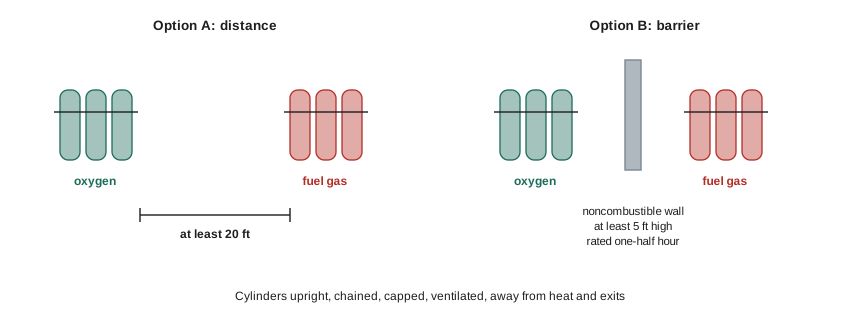
OSHA 1910.253(b)(4)(iii) requires oxygen cylinders in storage to be separated from fuel gas cylinders or combustible materials, especially oil or grease, by at least 20 ft, or by a noncombustible barrier at least 5 ft high with a fire-resistance rating of at least one-half hour. Fire codes and NFPA 55 also limit quantities of flammable gas stored inside buildings.
Storage rules do not apply to cylinders that are connected and in use on a cart or manifold, but those cylinders still need to be secured and kept away from the hot work, sparks and heat.
Moving and handling cylinders
Cylinders are heavy, awkward and easily damaged. They should be moved with a cylinder cart or hand truck designed for them, with the valve protection cap in place and the regulator removed unless the cart is designed to carry cylinders with regulators attached. Never roll a cylinder on its side, drag it, slide it, drop it, lift it by the cap, or use a magnet or sling to lift it unless a cradle designed for the purpose is used. When cylinders are carried in vehicles on public roads, transportation of dangerous goods rules apply: cylinders must be secured, the load ventilated, and documentation and placards provided where required.
Under the DOT Hazardous Materials Regulations, 49 CFR, some small quantities carried as materials of trade qualify for reduced requirements, but cylinders still need to be secured and transported with ventilation. Many fires and explosions have started in vans when a leaking fuel gas cylinder filled the closed cargo area and a light switch or cigarette ignited it.
Setting up oxy-fuel equipment
An oxy-fuel outfit consists of an oxygen cylinder and a fuel gas cylinder, a regulator on each, hoses, check valves, flashback arrestors and a torch with welding tips or a cutting attachment. Setting it up correctly prevents most failures.
- Inspect the cylinders, valves and threads for damage, oil and grease. Never use oil or grease on oxygen equipment.
- Briefly open and close each cylinder valve (crack it) to clear dirt, standing to the side and pointing the outlet away from people and ignition sources. Do not crack fuel gas valves near flames or sparks, and never crack hydrogen valves.
- Attach regulators that match the gas and the cylinder connection; oxygen and fuel connections have different threads to prevent mix-ups.
- Fit flashback arrestors and check valves, usually at the regulator outlet and often at the torch as well. Several provinces and states require flashback arrestors by law.
- Use hoses in good condition, color-coded green for oxygen and red for fuel gas, with the correct fittings. Do not use tape to repair hoses.
- Open cylinder valves slowly, with the regulator adjusting screw backed off, standing to the side of the regulator, not in front of it. Open acetylene valves no more than about one and a half turns, and leave any valve wrench on the valve so it can be closed quickly.
- Test all connections for leaks with a leak-detection solution approved for oxygen service, never with a flame.
Flashback and backfire
A backfire is a momentary burning back of the flame into the torch tip, with a sharp pop, after which the flame may go out or relight. A flashback is far more dangerous: the flame burns back through the torch and into the hose or even the regulator, often with a squealing or hissing sound. Flashbacks happen when gases mix in the wrong place, for example when oxygen flows back into the fuel line because of incorrect pressures, a blocked tip, or failing to purge lines before lighting.
Check valves stop reverse gas flow. Flashback arrestors stop a flame front from traveling back through the equipment, and many also include a thermal shutoff and check valve. Both must be installed in the right direction and inspected or tested at the intervals the manufacturer specifies. If a flashback occurs, shut off the oxygen valve on the torch, then the fuel valve, then the cylinder valves, and do not relight until the cause is found and the equipment inspected.
Acetylene: special rules
Acetylene becomes unstable and can decompose explosively when compressed above about 15 psi gauge (103 kPa), so it is stored dissolved in acetone within a porous mass inside the cylinder. OSHA 1910.253 prohibits generating, piping or using acetylene at pressures above 15 psig. Store and use acetylene cylinders valve end up so acetone does not enter the regulator and hose. If a cylinder has been lying on its side, stand it upright for the time the supplier specifies before use. Limit the withdrawal rate, commonly to no more than about one-seventh of the cylinder's contents per hour, or manifold several cylinders together for high flow. Copper and alloys with more than about 65 % copper must not be used in acetylene service because they can form explosive acetylides.
Worked problem
Checking an acetylene withdrawal rate
A cutting job needs about 50 cubic feet of acetylene per hour. The site's acetylene cylinders each hold about 300 cubic feet of gas when full. The supplier recommends drawing no more than one-seventh of a cylinder's contents per hour. Can one cylinder supply the job?
Show solution
- Maximum safe withdrawal from one cylinder: 300 ÷ 7 ≈ 43 cubic feet per hour.
- Required flow: 50 cubic feet per hour, which is more than 43.
- Two cylinders manifolded together could supply up to about 86 cubic feet per hour.
- As the cylinder empties, the allowed withdrawal rate based on remaining contents falls further, so even a partly full single cylinder would be worse.
Answer: One cylinder cannot safely supply the job; drawing too fast pulls acetone into the regulator and hose, damaging equipment and creating a fire hazard. Use a properly designed manifold of two or more cylinders, or a fuel gas with fewer withdrawal limits, such as propylene, if the process allows.
Using and shutting down the equipment
Light the torch with a friction lighter, never a match or cigarette lighter, following the manufacturer's sequence, usually fuel first and then oxygen. Keep hoses out of the path of sparks, slag and traffic, and away from sharp edges. Never leave a lit torch unattended or lay it down while lit. Keep cylinders at least several meters from the hot work, or shielded, so sparks and slag cannot reach them.
When work stops for a break or at the end of the job, close the torch valves, close the cylinder valves, bleed the lines and back off the regulator adjusting screws. Never leave gas in hoses inside closed spaces, such as tanks or confined spaces, during breaks; remove the torch and hoses or disconnect them at the cylinder, because a small leak can fill the space with fuel gas or oxygen while no one is there.
Inspecting hoses, regulators and torches
Oxy-fuel equipment wears out. Hoses crack, become brittle or are cut by slag and sharp edges. Regulators develop creeping pressure, cracked gauges and leaking seats. Torch valves leak and tips become clogged. A daily visual check before use should look for cuts, burns and worn spots on hoses, damaged fittings, cracked gauges and dirty or damaged tips. If a regulator's delivery pressure keeps rising with the torch closed, it is creeping and must be taken out of service. Equipment should be serviced by qualified technicians at the manufacturer's intervals, and flashback arrestors tested or replaced as the manufacturer requires.
Arc welding equipment needs similar care: inspect cables for damaged insulation and loose connections, keep the work return clamp clean and tight, and make sure welding machines are grounded and their covers in place. Damaged cables can cause shocks and arcs that start fires far from the intended work.
Common mistakes
MistakeStoring oxygen next to fuel gas cylinders without separation.
InsteadSeparate them by 20 ft or a noncombustible barrier at least 5 ft high with a one-half hour rating.
MistakeUsing oil or grease on oxygen fittings.
InsteadKeep oxygen equipment clean and oil-free; oil can ignite violently in oxygen.
MistakeUsing acetylene at high pressure or lying on its side.
InsteadKeep acetylene below 15 psig and use cylinders valve end up.
MistakeTesting for leaks with a flame.
InsteadUse an approved leak-detection solution.
MistakeLeaving torches and hoses in a confined space during breaks.
InsteadRemove or disconnect them so a leak cannot fill the space with gas.
Summary and key terms
- Compressed gas cylinders store large amounts of energy and can become projectiles if damaged.
- Identify gases by label and safety data sheet, not cylinder color.
- Store cylinders upright, secured, capped, ventilated and away from heat, exits and traffic.
- OSHA requires 20 ft or a 5 ft, one-half hour rated barrier between oxygen and fuel gases in storage.
- Set up oxy-fuel equipment with matching regulators, flashback arrestors, check valves and leak-tested connections.
- Acetylene must not be used above 15 psig and must be used valve end up with limited withdrawal.
- Shut down properly and never leave gas-filled hoses in confined spaces.
- Regulator
- A device that reduces cylinder pressure to a steady working pressure.
- Check valve
- A valve that lets gas flow in one direction only, preventing reverse flow.
- Flashback arrestor
- A device that stops a flame front traveling back through hoses and regulators.
- Backfire
- A momentary burning back of the flame into the torch tip, usually with a pop.
- Flashback
- A dangerous burning back of the flame into the torch, hose or regulator.
- Cracking a valve
- Briefly opening and closing a cylinder valve to blow out dirt before connecting a regulator.
- Acetylide
- An explosive compound that acetylene can form with copper, silver or mercury.
- Manifold
- A piping arrangement that connects several cylinders to supply a higher flow.
- Valve protection cap
- A cap screwed over a cylinder valve to protect it when the cylinder is not in use.
- Withdrawal rate
- The rate at which gas is drawn from a cylinder, limited for acetylene to avoid drawing out acetone.
Practice problems
Work each problem on paper first, then reveal the answer to check.
Why should cylinders not be identified by color alone?
Show answer
Colors are not fully standardized between suppliers; the label and safety data sheet identify the contents.
Why must oil and grease be kept away from oxygen equipment?
Show answer
They can ignite violently in oxygen.
What separation does OSHA 1910.253 require between stored oxygen and fuel gas cylinders?
Show answer
20 ft, or a noncombustible barrier at least 5 ft high with at least a one-half hour fire rating.
How should cylinders be moved?
Show answer
On a cylinder cart with the cap on, never rolled on their side, dragged, dropped or lifted by the cap.
What is the difference between a backfire and a flashback?
Show answer
A backfire is a momentary pop at the tip; a flashback burns back into the torch, hose or regulator.
What do flashback arrestors do?
Show answer
They stop a flame front traveling back through the equipment.
What is the maximum working pressure for acetylene under OSHA?
Show answer
15 psig.
Why must acetylene cylinders be used valve end up?
Show answer
So acetone does not enter the regulator and hose.
How should connections be leak tested?
Show answer
With an approved leak-detection solution, never with a flame.
What should be done with torches and hoses in a confined space during a break?
Show answer
Remove them or disconnect them at the cylinder so leaks cannot fill the space.
Lesson quiz · 5 questions
Score 60% or more to complete this lesson.
Create a free account to save your progress, take quizzes and earn a certificate.