
HSE-216 · Lesson 3 of 12 · 25 min
How hot work ignites fires and explosions
To control hot work fires, it helps to understand exactly how the heat gets from the torch or arc to the fuel. Investigators who study hot work losses keep finding the same few pathways: sparks and spatter that travel farther than anyone expected, slag that drops through openings to floors below, heat that is conducted along metal to the far side of a wall, and vapors or dusts that ignite instantly when they meet a spark. This lesson explains each pathway and the conditions that make it more likely.
Sparks, spatter and slag
Sparks are small particles of metal or abrasive heated until they glow. Spatter is molten metal thrown from a welding arc. Slag is the molten or solid residue left by cutting and some welding processes, often in large globules. All three carry heat away from the work. A single spark may contain very little energy, but it is hot enough to ignite fine, dry materials such as sawdust, lint, paper dust, cotton waste, dry leaves or the fluffy surface of some insulation. Larger globules of slag hold far more heat and can ignite wood, cardboard and plastics directly.
How far sparks travel depends on the process, the height of the work, the direction of the cut and any air movement. Welding throws spatter a few meters. Grinding sends a concentrated stream in one direction, often several meters. Oxy-fuel and plasma cutting blow molten metal out of the kerf with high-velocity gas and can scatter slag over 10 m on a level floor. When the work is above floor level, sparks fall and then bounce and roll, so the distance grows with height. This is why codes and standards define a protective zone around the work: 11 m (35 ft) in CSA W117.2, NFPA 51B and OSHA's rules, and 15 m in the National Fire Code of Canada.
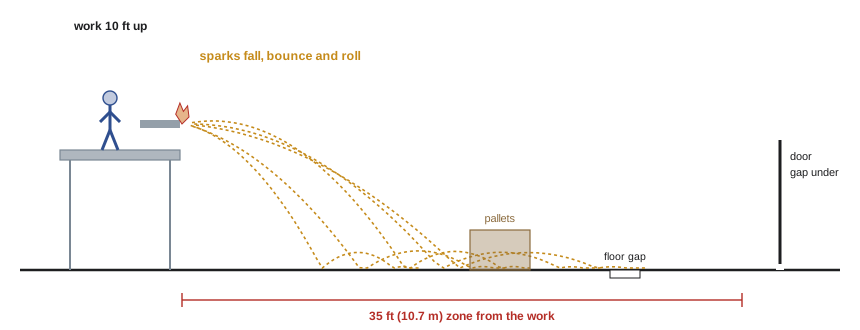
Sparks do not stop at walls and floors if there is a way through. They roll under doors, drop through floor openings, cable penetrations and gaps around pipes, slip between floorboards and fall down shafts and chutes. They can land on stored goods on the floor below or in a ceiling space full of dust. Every opening within the protective zone needs to be identified and covered or sealed before hot work starts.
Conduction and radiant heat
Not all hot work fires start with sparks. Metal conducts heat well, so welding or cutting a steel beam, pipe, duct or wall heats the metal well beyond the visible work. On the other side of a steel wall or deck there may be insulation, wood blocking, roofing materials or stored goods. Heat conducted through the metal can ignite them without any spark crossing the wall. Codes specifically require precautions when combustibles are on the opposite side of metal walls, partitions, ceilings or roofs, including checking the far side and posting a second fire watch there if needed.
Pipes are especially deceptive. A copper pipe heated with a soldering torch can carry enough heat along its length to scorch wood framing or ignite insulation inside a wall cavity. Steel pipe that passes through a wall can conduct heat to combustible pipe insulation on the other side. Long sections of ductwork can carry heat into ceiling spaces.
Radiant heat from a large flame, a big weld or a hot workpiece can ignite nearby materials or damage plastic pipes, cables and sprinkler heads. Hot workpieces placed down on a bench or floor can ignite dust, rags or packaging long after the arc is off. Recently welded or cut metal should be marked as hot, and some regulations require it.
Ignition of dusts, vapors and gases
Some fuels need far less energy to ignite than solid materials. Flammable gases and vapors from liquids, and many combustible dusts suspended in air, can be ignited by a tiny spark if the mixture is within its flammable range. The result may be a flash fire or an explosion rather than a slowly growing fire.
- A flammable gas or vapor mixed with air burns only between its lower explosive limit (LEL) and upper explosive limit (UEL). Below the LEL the mixture is too lean; above the UEL it is too rich, but it can become flammable if air gets in.
- Combustible dusts, such as flour, sugar, wood, grain, plastics, metals and many chemicals, can explode when dispersed in air in a confined space. A layer of dust on beams or equipment can be thrown into the air by a first small explosion, causing a much larger secondary explosion.
- Vapors can travel. Many vapors are heavier than air and flow along floors, into pits, sumps, drains and trenches, and can be ignited far from the source.
| Substance | LEL (% in air) | UEL (% in air) | Notes |
|---|---|---|---|
| Methane (natural gas) | 5.0 | 15 | Lighter than air |
| Propane | 2.1 | 9.5 | Heavier than air; collects in low spots |
| Acetylene | 2.5 | about 80 to 100 | Very wide range; unstable under pressure |
| Hydrogen | 4.0 | 75 | Very low ignition energy |
| Gasoline vapor | about 1.4 | about 7.6 | Heavier than air |
| Turpentine vapor | about 0.8 | about 6 | Found in pulp and paper residues |
Lesson 7 explains how to measure flammable atmospheres with a combustible gas detector, which reads in percent of the LEL, and why hot work is normally stopped well before any flammable mixture can form.
Hidden and concealed spaces
Many of the worst hot work fires start in spaces that nobody could see. Wall and ceiling cavities, the voids inside roof assemblies, raised floors, ductwork, pipe chases, insulated panels with foam cores and the spaces under stages and platforms can all hold combustible materials and dust. Fire can smolder and spread inside them, out of sight, until it breaks out somewhere else, often after the workers have left. Insulated metal panels with expanded polystyrene or polyurethane cores have been involved in serious fires when welding or cutting on or near them ignited the core.
Before hot work near a concealed space, the permit authorizing individual should find out what is inside it. If it cannot be inspected or made safe, the work should be moved, a different method chosen, or the space opened up and protected. A fire watch should be able to see or check the concealed space, which may need inspection openings or thermal imaging after the work.
Conditions that increase risk
Some conditions make every pathway more dangerous. The permit authorizing individual looks for them when deciding whether hot work can proceed and what precautions are needed.
- Impaired fire protection: sprinklers shut off, fire alarms disabled or detection bypassed. Codes generally forbid hot work in sprinklered areas while sprinklers are impaired, unless specific additional precautions are taken.
- Dry, dusty or untidy conditions, especially in woodworking, food, paper, textile and recycling facilities.
- Strong drafts or wind that carry sparks farther or fan smoldering fires.
- Work at height above combustibles or openings.
- Recently painted surfaces, coatings and adhesives that give off flammable vapor or burn readily.
- Construction and renovation, when fire protection is incomplete and combustible packaging, formwork and debris are everywhere.
- Time pressure, shift changes and end-of-day work, when the fire watch is most likely to be cut short.
Worked problem
How far could the slag travel?
A worker will cut steel brackets with an oxy-fuel torch from a scissor lift 13 ft above a warehouse floor. Pallets of cardboard are stored 30 ft away. A floor drain and a gap under a fire door are 20 ft and 43 ft away. The site follows NFPA 51B and OSHA's 35 ft rule. What needs protecting?
Show solution
- Cutting from height throws slag outward and down; it then bounces and rolls, so the 35 ft zone is a minimum.
- The pallets at 30 ft are inside the 35 ft zone: move them beyond 35 ft, or cover them with listed welding blankets if they cannot be moved.
- The floor drain at 20 ft could carry slag into a drain line that may hold vapors or debris: cover it.
- The fire door gap at 43 ft is outside 35 ft, but cutting from height can throw slag farther, and OSHA calls for a fire watch when combustibles more than 35 ft away could be ignited by sparks: seal the gap and check the room beyond.
Answer: Protect the pallets, cover the drain and seal the door gap, then post a fire watch who can see the whole area, including the far side of the door. If slag control is difficult, consider a cold cutting method instead, as described in Lesson 4.
Putting it together
Most hot work fires combine two or three of these pathways with a gap in the controls. Sparks find a gap under a door because no one sealed it. Heat conducts through a wall because no one checked the other side. Vapor from an empty tank ignites because no one tested inside it. Understanding the pathways turns the precautions in the following lessons from a checklist into common sense: you protect against sparks by distance, removal and covers; against conduction by checking the far side; against vapors and dusts by testing and cleaning; and against hidden fires by watching longer and checking again later.
How quickly a small fire grows
Fires started by hot work often begin as tiny glowing spots in dust or fabric. Once open flame appears, growth can be startlingly fast. A fire in a stack of cardboard or plastic crates can grow from the size of a hand to involving the whole stack in a few minutes, producing thick, toxic smoke that fills a room and hides exits. That is why the first minute matters so much: a fire watch with an extinguisher can put out a small fire in seconds, but the same fire left alone for five minutes may be beyond any portable extinguisher. Every pathway described in this lesson has the same answer at the end: someone trained, watching and ready, with the right equipment at hand.
Think of each hot work job as a search for pathways. Before lighting up, ask where sparks will fly, where they will land, where heat will conduct, what vapors or dusts could be present and what spaces cannot be seen. If you can name the pathway, you can usually close it.
Common mistakes
MistakeProtecting only the area right next to the work.
InsteadSparks and slag can travel 35 ft or more, especially from height; protect the whole zone.
MistakeForgetting the other side of a metal wall, deck or roof.
InsteadHeat conducts through metal and can ignite combustibles on the far side; check it and post a watch if needed.
MistakeIgnoring floor openings, gaps under doors and cable penetrations.
InsteadSparks roll through gaps into adjacent and lower spaces; cover and seal openings.
MistakeTreating a tidy floor as enough in a dusty plant.
InsteadDust on beams, ledges and in ducts can ignite or explode; clean overhead surfaces too.
MistakeDoing hot work while sprinklers are shut off.
InsteadCodes generally prohibit hot work in sprinklered areas while protection is impaired, unless special precautions are approved.
Summary and key terms
- Sparks, spatter and slag carry heat away from the work and can ignite fine, dry materials.
- Cutting and work at height send slag the farthest; the protective zone is 35 ft (10.7 m) in OSHA and NFPA 51B.
- Sparks pass through gaps, openings and penetrations into adjacent and lower spaces.
- Heat conducted through metal walls, pipes and ducts can ignite combustibles on the far side.
- Flammable gases, vapors and combustible dusts can ignite instantly when their mixture is in the flammable range.
- Concealed spaces such as cavities and roof assemblies can hide smoldering fires.
- Impaired fire protection, dust, drafts, height, coatings and time pressure all increase risk.
- Spark
- A small, glowing particle of hot metal or abrasive thrown from hot work.
- Kerf
- The slot cut through material by a torch, saw or plasma arc.
- Conduction
- Transfer of heat through a material, such as along a steel pipe or through a metal wall.
- Radiant heat
- Heat transferred by infrared radiation from flames or hot surfaces.
- Lower explosive limit (LEL)
- The lowest concentration of a gas or vapor in air that can burn; also called the lower flammable limit.
- Upper explosive limit (UEL)
- The highest concentration of a gas or vapor in air that can burn.
- Flammable range
- The range of concentrations between the LEL and UEL.
- Combustible dust
- Fine particles that can burn or explode when dispersed in air.
- Secondary explosion
- A larger explosion caused when a first explosion throws settled dust into the air.
- Concealed space
- A hidden void such as a wall cavity, ceiling space or roof assembly where fire can spread unseen.
Practice problems
Work each problem on paper first, then reveal the answer to check.
Which hot work process usually throws sparks and slag the farthest?
Show answer
Oxy-fuel, plasma or air carbon arc cutting, especially from height.
Why does working at height increase the spark zone?
Show answer
Sparks fall and then bounce and roll across the floor, traveling farther.
Name three openings that sparks can pass through.
Show answer
Gaps under doors, floor openings, cable and pipe penetrations, drains, shafts or chutes.
How can hot work start a fire on the other side of a steel wall?
Show answer
By conducting heat through the metal to combustibles touching the far side.
What is the LEL of propane?
Show answer
About 2.1 % in air.
Why are propane vapors a particular hazard in pits and sumps?
Show answer
Propane is heavier than air and collects in low spots.
What is a secondary dust explosion?
Show answer
A larger explosion caused when a first blast throws settled dust into the air.
Give two examples of concealed spaces.
Show answer
Wall cavities, ceiling spaces, roof assemblies, raised floors, ducts and insulated panel cores.
Why should recently welded metal be marked?
Show answer
It stays hot and can burn people or ignite materials it touches.
Name three conditions that increase hot work risk.
Show answer
Impaired sprinklers, dust, drafts, height, fresh coatings, construction and time pressure.
Lesson quiz · 5 questions
Score 60% or more to complete this lesson.
Create a free account to save your progress, take quizzes and earn a certificate.