
HSE-212 · Lesson 4 of 12 · 27 min
Guardrails, covers, safety nets and other passive protection
Passive fall protection protects workers without any action on their part. Once a guardrail is in place or a cover is secured over a hole, it protects everyone who comes near, including visitors, inspectors, new workers and the worker who is distracted or in a hurry. That is why regulations place guardrails and covers at the top of the order of protection, after elimination. This lesson explains the main types of passive protection, the dimensions and loads they must meet, and the mistakes that defeat them.
Guardrail systems
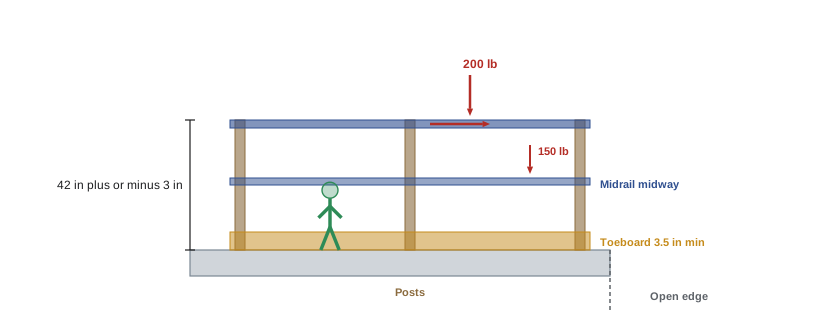
A guardrail system is a barrier along an unprotected edge, made up of a top rail, an intermediate rail or other infill, a toe board and posts. Guardrails can be permanent, as on mezzanines and rooftops, or temporary, as on construction floors and scaffolds. Temporary systems include wood rails nailed to posts, manufactured steel or aluminum systems clamped to slab edges or weighted bases, wire rope systems and mesh panels.
Each part has a job:
- the top rail stops a worker who walks or stumbles into the edge, and must be high enough that a person's center of gravity stays on the safe side;
- the intermediate rail, mesh or screen stops a worker from slipping under the top rail, for example after falling to their knees;
- the toe board stops tools, materials and feet from sliding off the edge, protecting workers below;
- the posts transfer the loads into the structure, and their spacing and anchorage control how strong the system is.
Dimensions and loads
| Element | OSHA requirement (1926.502(b) and 1910.29(b)) |
|---|---|
| Top rail height | 42 in ± 3 in above the walking-working surface |
| Top rail under load | Must not deflect to less than 39 in when the 200 lb test load is applied |
| Midrail | Midway between the top rail and the surface; or screens, mesh or members with openings no wider than 19 in |
| Top rail strength | At least 200 lb applied within 2 in of the top edge, outward or downward |
| Midrail strength | At least 150 lb applied in any outward or downward direction |
| Toeboards | At least 3.5 in high, withstand 50 lb, openings no more than 1 in |
| Rail material | At least 0.25 in thick to prevent cuts; wire rope flagged at least every 6 ft if used as a top rail |
| Covers | Support at least twice the maximum expected load, secured, and marked with the word HOLE or COVER |
Look at how the strength requirements work. A guardrail must resist a worker stumbling against it, leaning on it or falling against it, and the loads are applied at the weakest point, not just at a post. Long spans between posts reduce strength, so manufactured systems specify maximum post spacing and base anchorage. A guardrail that wobbles or bends when pushed by hand probably does not meet the standard.
Worked problem
Checking a top rail under load
A manufactured guardrail has a top rail installed at 41 in. When the 200 lb test load is applied outward at mid-span, the rail deflects 3.5 in. Does it meet OSHA's deflection limit?
Show solution
- Height under load = 41 in − 3.5 in = 37.5 in.
- OSHA requires the top rail to stay at or above 39 in under the 200 lb load.
- 37.5 in is below 39 in, so the system fails the deflection criterion, even though its installed height is within 42 ± 3 in.
- Fixes include closer post spacing, a stiffer rail, or raising the rail toward 45 in, following the manufacturer's instructions.
Answer: No. The rail drops to 37.5 in, below the 39 in minimum. Stiffen or reposition it.
Where guardrails are needed
Guardrails are used at the open sides of floors, roofs, mezzanines, balconies, platforms, ramps, walkways and scaffolds, around floor openings, and at the edges of excavations and pits where people work nearby. On construction projects, perimeter guardrails are installed as each floor is formed or poured. In buildings, permanent guardrails protect rooftop equipment, roof hatches, mezzanine edges and loading areas.
Openings for deliveries need special attention. A section of guardrail removed so that a crane or forklift can land materials is one of the most common sources of falls. Use gates that close automatically, pallet safety gates that keep a barrier on the worker side at all times, or a documented procedure that keeps workers out of the area and uses restraint while the opening is unprotected, and replace the rail as soon as the landing is complete.
Choosing and installing temporary guardrails
Manufactured temporary guardrail systems have largely replaced site-built wood rails on larger projects, because they install quickly, are tested to known loads and can be reused. Common types include posts clamped to the slab edge, posts bolted or cast into the concrete, posts set in weighted bases on flat roofs, and mesh panels that combine top rail, midrail and toe board in one unit. Each system comes with instructions that set the maximum post spacing, the required slab thickness or edge distance for clamps, the weight and number of bases, and the conditions under which it may be used, such as maximum roof slope and wind speed.
Installing temporary guardrails is itself work at an unprotected edge. Plan the sequence so that installers are protected, for example by installing posts from inside the slab edge, using travel restraint anchored well back from the edge, or installing the guardrail before the formwork is stripped. Check each post as it is installed, and check the completed system before other trades are allowed near the edge. A single missing post or a clamp tightened onto a thin slab edge can turn a guardrail into a false sense of security.
Site-built wood guardrails remain common on smaller projects. They must use sound lumber of the required size, nailed or bolted to posts that are properly secured, with no protruding nails or splinters on the top rail. Wood guardrails are easy to modify, which is both their advantage and their danger: workers can remove a rail to pass materials and forget to put it back.
Rooftop guardrails and hatches
On existing buildings, permanent guardrails often protect only part of a roof: around equipment, along access routes or at hatches. Roof hatches and ladder openings are a frequent source of falls, because a worker climbing out of a hatch can step backward into the open hole, or a hatch left open can be walked into. Hatch railing systems that surround the opening with a self-closing gate solve both problems. Where rooftop equipment sits close to an unprotected edge, a short run of permanent guardrail between the equipment and the edge is usually cheaper over the life of the building than repeated temporary measures for every service call.
Protective covers
Holes in floors and roofs, including those left for stairs, shafts, ducts, pipes and skylights, must be protected by guardrails or by covers. A good cover:
- is strong enough for every load that may cross it, including workers, materials and equipment;
- is secured so that it cannot be kicked, blown or pushed out of place;
- fully covers the opening with enough bearing on each side;
- is clearly marked so that nobody mistakes it for a loose sheet of plywood and lifts it.
Covers fail in predictable ways: an unmarked sheet of plywood is picked up and used elsewhere, a cover is moved for a task and not replaced, a thin cover sags under a loaded cart, or a cover is placed over a skylight that someone assumes is solid. Some sites paint covers a bright color and stencil a warning on them, so that they stand out.
Worked problem
Sizing a cover over a floor opening
A 4 ft × 4 ft opening on a construction floor must be covered. A pallet jack loaded to a total of 2,000 lb may cross it. OSHA requires covers to support at least twice the weight of employees, equipment and materials that may be imposed at any one time. What load must the cover support?
Show solution
- Maximum imposed load: the 2,000 lb pallet jack, plus perhaps a worker of about 250 lb with tools, so about 2,250 lb.
- Required capacity: 2 × 2,250 lb = 4,500 lb.
- The cover must support at least 4,500 lb, applied as wheel loads, with adequate bearing on all sides.
- Secure it, mark it HOLE or COVER, and consider a guardrail if traffic is frequent.
Answer: The cover must support at least 4,500 lb.
Safety nets
Safety nets catch falling workers below the work area. They are used where guardrails and personal fall arrest are impracticable, for example in bridge construction, steel erection and some roof and atrium work, and they protect several workers at once without any action on their part. Nets must be installed as close as practicable below the work surface, extend far enough beyond the edge to catch a worker who falls outward, have enough clearance below so that the net does not bottom out, and be inspected and tested.
OSHA's 1926.502(c) requires safety nets to be installed as close as practicable under the work surface and never more than 30 ft below it. Nets must extend outward from the outermost projection of the work surface by at least 8 ft when the net is up to 5 ft below, 10 ft when it is more than 5 ft and up to 10 ft below, and 13 ft when it is more than 10 ft below. Each net installation must pass a drop test with a 400 lb bag of sand 30 in in diameter dropped from the highest work surface, or be certified by a competent person. Mesh openings may not exceed 36 square inches or 6 in on any side, and debris must be removed as soon as possible and at least before the next work shift.
Other passive measures
Several other measures prevent falls without personal equipment:
- parapets of sufficient height at roof edges, which act as permanent guardrails;
- fixed walkways with handrails across roofs, linking access points to equipment;
- skylight screens and guards that can support a person;
- fencing and barricades around open pits and excavations;
- stair handrails and stair rails, covered in HSE-106;
- scaffold guardrails and platforms, covered in HSE-213;
- elevating work platforms with guardrails, covered in HSE-217.
Inspecting passive protection
Passive protection is only passive while it stays intact. Inspect guardrails and covers at the start of each shift on construction sites and after any event that could damage them: a delivery, a storm, a crane lift or a change of trades. Look for missing or loose rails, posts pulled away from the slab, toe boards removed, covers moved, unmarked or broken, and nets with tears, sagging or debris. Assign responsibility for replacing protection removed for a task, and make the person who removes it responsible for putting it back or for protecting the area until it is replaced.
Common mistakes
MistakeLeaving a section of guardrail open after a delivery.
InsteadUse gates or close the opening immediately; control the area and use restraint while it is open.
MistakeCovering a hole with an unmarked sheet of plywood.
InsteadUse a cover strong enough for all loads, secure it and mark it clearly.
MistakeAccepting a guardrail that bends easily when pushed.
InsteadGuardrails must resist the specified loads at the weakest point between posts.
MistakeForgetting toe boards on platforms above walkways.
InsteadToe boards stop tools and materials from falling on people below.
MistakeTreating a skylight as part of the roof surface.
InsteadGuard or screen skylights; most will not support a person.
Summary and key terms
- Passive protection protects everyone without any action by the worker.
- Guardrails have a top rail, an intermediate rail or infill, a toe board and posts.
- OSHA requires top rails at 42 ± 3 in, a 200 lb top rail load and toeboards of at least 3.5 in.
- Guardrails must resist loads at the weakest point between posts; wider spacing needs stronger rails.
- Covers must carry all expected loads, be secured and be clearly marked.
- Safety nets must be close below the work, extend beyond the edge and be tested or certified.
- Inspect passive protection every shift and after events that could damage it.
- Guardrail system
- A barrier of top rail, intermediate rail, toe board and posts along an edge.
- Top rail
- The highest horizontal member of a guardrail.
- Intermediate rail
- The rail midway between the top rail and the toe board.
- Toe board
- A low barrier at floor level that stops objects and feet from going over the edge.
- Protective cover
- A secured, marked cover over a hole that supports all expected loads.
- Safety net
- A net installed below a work area to catch falling workers.
- Parapet
- A low wall at the edge of a roof that can serve as a guardrail if high enough.
- Deflection
- How far a rail bends under load.
- Concentrated load
- A load applied over a small area, such as a wheel.
- Drop test
- A test in which a weighted bag is dropped into a net to prove it can catch a worker.
Practice problems
Work each problem on paper first, then reveal the answer to check.
Name the four parts of a typical guardrail system.
Show answer
Top rail, intermediate rail or infill, toe board and posts.
What is OSHA's top rail height?
Show answer
42 in ± 3 in.
Why does a guardrail need a toe board?
Show answer
To stop tools, materials and feet sliding off the edge onto people below.
List three features of a good cover.
Show answer
Strong enough for all loads, secured in place and clearly marked.
How strong must an OSHA cover be?
Show answer
At least twice the maximum load that may be imposed on it.
Why are delivery openings in guardrails so dangerous?
Show answer
Rails are removed for landing materials and often not replaced.
What is the maximum distance below the work for an OSHA safety net?
Show answer
30 ft.
When should passive protection be inspected?
Show answer
At the start of each shift and after any event that could damage it.
What is a pallet safety gate used for?
Show answer
Keeping a barrier on the worker side while materials are loaded at an edge.
Where are safety nets most often used?
Show answer
Bridge and steel construction and other work where guardrails and arrest are impracticable.
Lesson quiz · 5 questions
Score 60% or more to complete this lesson.
Create a free account to save your progress, take quizzes and earn a certificate.