
HSE-212 · Lesson 12 of 12 · 31 min
Programs, incident lessons and capstone: a rooftop fall protection plan
Individual pieces of fall protection, a guardrail here, a harness there, protect workers only when they are part of a system that is planned, maintained and enforced. This final lesson looks at how employers manage fall protection as a program, what investigations of real falls teach, and how to bring everything in the course together in a written fall protection plan for a typical rooftop job.
A managed fall protection program
ANSI/ASSP Z359.2, Minimum Requirements for a Comprehensive Managed Fall Protection Program, describes what a well-run program looks like and is widely used as a model, alongside OSHA's training and design requirements. Larger employers often write a formal program that covers every site; smaller ones may rely on site-specific plans. Either way, the elements are the same.
- a policy that commits the organization to eliminating fall hazards where possible and protecting workers where not;
- defined roles: a program administrator, competent persons who assess hazards, inspect equipment and supervise, qualified persons or engineers who design anchors and lifelines, and authorized workers who use the systems;
- hazard surveys of each site, building or project, identifying every fall hazard and the controls chosen;
- written procedures and fall protection plans for tasks and locations;
- equipment selection, purchasing standards and compatibility checks;
- inspection, maintenance, storage and retirement of equipment;
- rescue procedures, equipment and drills;
- training for each role, with records and refresher intervals;
- incident reporting and investigation, including near misses and arrested falls;
- regular program audits and management review.
Equipment care and retirement
Fall protection equipment is life-saving equipment, and it wears out. Build a simple system: issue harnesses to individuals where possible so that they fit and are cared for; inspect before each use; have a competent person inspect every item at least once a year, or more often in harsh conditions, and record the result on a tag or log; send self-retracting devices for manufacturer service or revalidation as required; store equipment clean, dry, away from sunlight, chemicals and sharp objects; and retire equipment that fails inspection, has arrested a fall, or has reached the end of the service life set by the manufacturer. Destroy retired items, for example by cutting webbing, so that they cannot drift back into use.
| Item | Before each use | Competent person | Retire when |
|---|---|---|---|
| Harness | Webbing, stitching, hardware, labels, fall indicator | At least annually, recorded | Damaged, has arrested a fall, end of service life |
| Energy-absorbing lanyard | Webbing, absorber pack, hooks | At least annually, recorded | Absorber deployed, damage, end of service life |
| Self-retracting device | Housing, line, hook, retraction, locking, impact indicator | Annually and manufacturer service or revalidation | Impact indicator shows a fall, fails function checks |
| Anchorage connector | Damage, corrosion, correct installation | At least annually, recorded | Deformed, cracked or overloaded |
| Permanent anchor | Visible damage, labels, corrosion | Engineer or manufacturer schedule, often annually | After a fall until recertified |
Lessons from incidents
The incidents below include a well-documented public case and several composite cases. The composites combine features from many investigations and are labeled as such; they do not describe a single real event.
Case 1: the Toronto swing stage collapse (public case)
On December 24, 2009, a swing stage carrying six workers collapsed on a balcony repair project at a Toronto apartment building. Four workers fell 13 stories and died, and a fifth was seriously injured; the sixth, who was tied off, survived. Investigations and the court cases that followed found that the stage was defective, it was overloaded, only two lifelines were available for six workers, and several workers lacked adequate training. The company and, later, the project manager were convicted of criminal negligence. The case led to sweeping reforms in Ontario, including mandatory Working at Heights training.
Lessons: every worker on a suspended platform needs an independent lifeline and anchor; equipment must be designed, inspected and loaded within its limits; supervisors must stop work when protection is missing; and the legal consequences of ignoring fall protection can be criminal.
Case 2: the skylight during a service call (composite case)
An HVAC technician was sent alone to service a rooftop unit on a single-story warehouse in winter. The roof had several plastic skylights, partly covered by snow. While carrying a toolbox back to the hatch, the technician stepped onto a skylight hidden under snow and fell 7 m to the concrete floor. The building owner had no roof plan showing skylights, the service company had no procedure for roofs with skylights, and the skylights had no screens.
Lessons: building owners should identify and protect skylights permanently with screens or guards; service companies should require a roof hazard assessment before rooftop work; snow must be cleared and skylights located before anyone walks across a roof; and workers should not work alone on roofs where a fall is possible.
Case 3: the arrest that did not stop in time (composite case)
A worker on a 4 m high mezzanine used a 1.8 m energy-absorbing lanyard attached to a beam clamp at foot level so that he could reach over the edge to guide a pallet. He slipped, fell, and the lanyard and absorber deployed fully, but he struck the floor below before the system stopped him. The fall protection system worked as designed; the design was wrong for the situation. A calculation like the one in lesson 9 would have shown that an anchor at foot level with a 1.8 m lanyard needed far more than the available clearance.
Lessons: calculate clearance before choosing equipment; anchor overhead where possible; use self-retracting devices or restraint where clearance is short; and do not allow work that requires leaning over an edge when a pallet gate or other passive control would remove the need.
Case 4: the vent pipe anchor (composite case)
A roofer installing flashing on a low-slope roof tied a rope lanyard around a plumbing vent pipe because the permanent anchors were on the other side of the roof. When he lost his footing near the edge, the pipe snapped at the roof line and he fell two stories. The crew had a horizontal lifeline in the truck but had not set it up because the job was expected to take an hour.
Lessons: never anchor to pipes, vents or conduit; plan anchor locations for every part of the job; set up the planned system even for short tasks; and supervise the use of fall protection, not just its presence on site.
Common threads
Across many investigations, the same contributing factors appear again and again: no hazard assessment, protection not provided, protection provided but not used, incorrect anchors, inadequate clearance, removed guardrails and unsecured covers, fragile surfaces not identified, poor training, workers alone, time pressure, and no rescue plan. Very few fatal falls involve a failure that no one could have foreseen. Most involve a gap between what the employer knew should happen and what actually happened on the day.
Writing a fall protection plan
A written fall protection plan records how a specific job will be protected. Regulations in many jurisdictions require one for certain heights or methods, and it is good practice wherever fall arrest or restraint is used. A typical plan includes:
- the location, task, dates, employer and the competent person responsible;
- the fall hazards identified, with heights and what lies below;
- the controls chosen for each hazard, following the hierarchy, and why higher controls were not practicable where relevant;
- the equipment to be used, with standards and capacities;
- anchor locations, types and strengths, and who certified them;
- clearance calculations for each fall arrest arrangement;
- procedures for installing, using, moving and removing the protection;
- the rescue plan, equipment and people;
- training and competency requirements for each worker;
- inspection arrangements and sign-off.
Capstone: a rooftop unit replacement
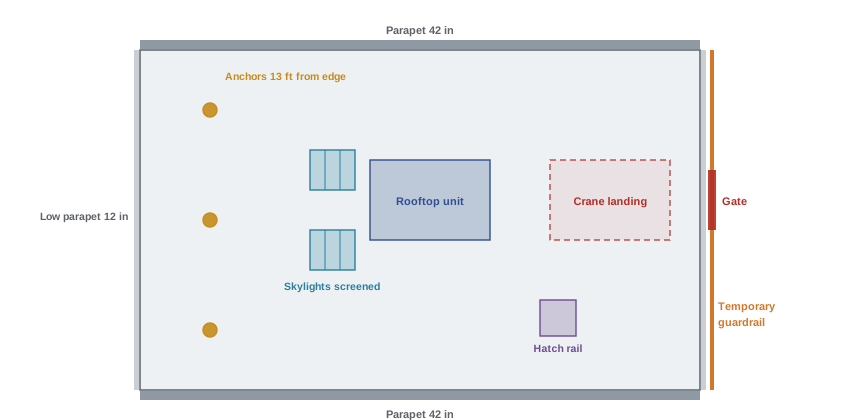
A mechanical contractor will replace a rooftop unit on a four-story office building. The roof is flat, about 100 ft × 65 ft, 46 ft above grade. A parapet 42 in high runs along the two long sides; the two short sides have a parapet only 12 in high. There are two skylights near the unit, a roof hatch reached by a fixed ladder from the top floor, and three permanent engineered roof anchors certified for 5,000 lb each, located 13 ft from one short edge. A mobile crane will lift the old unit off and the new unit on. The work will take two days. Draft the main elements of the plan.
Worked problem
Capstone step 1: hazards and controls
Identify the fall hazards and choose controls using the hierarchy.
Show solution
- Long sides: the 42 in parapet meets OSHA's guardrail height range, so these edges are protected passively. Check it is sound and keep workers from standing on it.
- Short sides: the 12 in parapet is not a guardrail. Install temporary guardrails along the short side where the crane lands loads, using weighted-base systems on the roof within the manufacturer's limits.
- Other short side: keep workers away using travel restraint from the permanent anchors, or extend the temporary guardrail if workers must work there.
- Skylights: install screens or secured covers marked COVER before work begins. They are next to the unit, where workers will step back while rigging.
- Hatch: install a hatch rail with a self-closing gate, or keep the hatch closed and guarded whenever it is not in use.
- Crane landing: use the guardrail with a removable gate section, opened only while a load is landed and with workers in restraint, then closed.
Answer: Parapets on the long sides, temporary guardrails and a gate at the crane landing, restraint from the permanent anchors, skylight screens and a hatch rail. Fall arrest is not needed for the main work if these controls are in place.
Worked problem
Capstone step 2: restraint and clearance checks
Workers who install the temporary guardrail along the short side will use restraint from the permanent anchors, 13 ft from that edge. The anchorage connector and hooks add 1.3 ft. Using a 3 ft margin, what is the longest lanyard? If instead a worker used a 6 ft energy-absorbing lanyard for fall arrest from the same anchor at roof level, how much clearance would be needed below the anchor, and is that available?
Show solution
- Restraint: maximum lanyard = 13 − 3 − 1.3 = 8.7 ft. Use fixed 6 ft lanyards, or adjustables locked at 8.7 ft or less. A worker installing posts at the edge would need to reach about 3 ft beyond the harness, so install posts from inside the line and slide them out.
- Fall arrest from a roof-level anchor: free fall = 6 + 5 = 11 ft, which exceeds an ordinary lanyard's design free fall and OSHA's 6 ft limit. Restraint is the right choice here.
- Clearance is not the problem on this roof, because the building is 46 ft high. The problem is the anchor position and the free fall. Restraint avoids the fall entirely.
Answer: Restraint lanyards of no more than 8.7 ft. Fall arrest from a roof-level anchor with an ordinary lanyard is unsuitable because of the 11 ft free fall.
Worked problem
Capstone step 3: rescue, training and sign-off
Complete the plan with rescue, training and inspection arrangements.
Show solution
- Rescue: because the main controls prevent falls, the rescue plan covers the guardrail installation phase. Keep a rescue kit at the roof with a pre-rigged lowering system, two trained rescuers on the roof whenever restraint is used near the edge, and confirm the local fire department's high-angle capability and response time as a backup.
- Training: every worker using restraint must have training under 1910.30 or 1926.503 as applicable, with a certification record, plus site-specific instruction on this plan, the anchors and the guardrail system.
- Inspection: a competent person inspects the temporary guardrails after installation and each morning; workers inspect harnesses and lanyards before use; the anchor certification and inspection date are checked before work starts.
- Coordination: the crane operator, signal person and roof crew agree on the landing procedure and gate opening; the building manager restricts roof access to the crew.
- Sign-off: the competent person signs the plan, reviews it with the crew at a pre-job meeting and updates it if conditions change, such as high wind or snow.
Answer: A complete plan: hazards and hierarchy-based controls, restraint calculations, rescue for the residual phase, training, inspection, coordination and sign-off.
Bringing it together
The capstone shows the course in miniature. The best plan for this roof barely uses fall arrest at all. Parapets, temporary guardrails, skylight screens and a hatch rail protect most of the work passively, restraint protects the short phase when guardrails are installed, and rescue is planned for what remains. Wherever you work at height, the same sequence applies: find the hazards, eliminate what you can, put physical barriers in place, restrain before you arrest, calculate before you choose, plan the rescue, train the people, and check that it all happens on the day.
Common mistakes
MistakeTreating fall protection as equipment rather than a program.
InsteadManage roles, surveys, procedures, inspection, rescue, training and audits together.
MistakeKeeping retired equipment in the gang box.
InsteadDestroy retired items so they cannot drift back into use.
MistakeInvestigating only falls that cause injury.
InsteadInvestigate arrested falls and near misses too; they reveal the same system failures.
MistakeWriting a plan that relies on fall arrest when guardrails are practicable.
InsteadApply the hierarchy; the best plans often use little or no fall arrest.
MistakeFiling the plan in the office.
InsteadReview it with the crew, keep it at the work location and update it when conditions change.
Summary and key terms
- Effective fall protection is a managed program, not a collection of equipment.
- Programs define roles, survey hazards, set procedures, control equipment, plan rescue, train and audit.
- Inspect equipment before each use and at least annually by a competent person; retire and destroy damaged items.
- Investigations show recurring causes: no protection, misuse, wrong anchors, short clearance, removed guardrails and no rescue plan.
- A written fall protection plan records hazards, controls, equipment, anchors, clearance, procedures, rescue and training.
- Good plans apply the hierarchy and often protect most work with passive controls and restraint.
- Plans must be reviewed with the crew, kept on site and updated as conditions change.
- Fall protection program
- An organization-wide system for managing fall hazards and protection.
- Program administrator
- The person responsible for running the fall protection program.
- Qualified person
- A person, often an engineer, with the knowledge to design fall protection systems.
- Authorized person
- A worker assigned and trained to use fall protection in an area.
- Hazard survey
- A systematic review of fall hazards at a site or building.
- Service life
- The period set by the manufacturer after which equipment must be retired.
- Near miss
- An event that could have caused a fall or injury but did not.
- Composite case
- An example built from features of many incidents, not one real event.
- Pre-job meeting
- A briefing in which the crew reviews the plan before work starts.
- Hatch rail
- A guardrail with a self-closing gate around a roof hatch.
Practice problems
Work each problem on paper first, then reveal the answer to check.
List five elements of a managed fall protection program.
Show answer
Policy, defined roles, hazard surveys, procedures and plans, equipment control; also rescue, training, investigation and audits.
Why should retired equipment be destroyed?
Show answer
So that it cannot drift back into use.
What were the key failures in the Toronto swing stage collapse?
Show answer
A defective, overloaded stage, too few lifelines, and inadequate training and supervision.
What should happen before walking on a snowy roof with skylights?
Show answer
Locate and protect the skylights and clear snow from the route.
Why did the arrest fail in Case 3?
Show answer
A foot-level anchor and long lanyard needed more clearance than was available.
What should replace the vent pipe anchor in Case 4?
Show answer
The planned horizontal lifeline or a properly located engineered anchor.
List six items in a fall protection plan.
Show answer
Hazards, controls, equipment, anchors, clearance calculations and rescue; also procedures, training and inspection.
In the capstone, why is the 12 in parapet not enough?
Show answer
It is far below guardrail height and would not stop a worker going over.
Why does the capstone use restraint rather than arrest at the short edge?
Show answer
The anchors are at roof level, so an arrest system would have an excessive free fall; restraint prevents the fall entirely.
When should a fall protection plan be updated?
Show answer
When conditions, tasks, equipment or crew change, such as wind or snow.
Lesson quiz · 5 questions
Score 60% or more to complete this lesson.
Create a free account to save your progress, take quizzes and earn a certificate.