
HSE-212 · Lesson 8 of 12 · 26 min
Anchors: certified, engineered and temporary
The anchor is the foundation of every travel restraint and fall arrest system. If it fails, nothing else matters. Anchors fail in fatal falls more often than most workers expect: a lanyard looped around a small pipe, a hook clipped to a guardrail, a temporary roof anchor nailed to sheathing instead of a rafter, a beam clamp on the wrong size of flange. This lesson explains what an anchor must be able to do, the strength requirements, the main types of anchors and how to choose and inspect them.
Anchor, anchorage connector and anchorage
The words are used loosely on site, but the standards distinguish them:
- the anchorage, or anchor, is the structure or element that holds the load, such as a steel beam, a concrete slab, a roof rafter or a column;
- the anchorage connector is the device that attaches the system to the anchorage, such as a beam clamp, a cross-arm strap, a concrete anchor, a roof anchor or a D-ring plate;
- the anchor point is the place on the connector where the lanyard, self-retracting device or lifeline is attached.
An anchorage connector rated for 22 kN or 5,000 lb is only as strong as the structure it is fixed to. A strong strap wrapped around a weak pipe is a weak anchor.
Strength requirements
OSHA sets anchor strengths in 1926.502(d)(15) and 1910.140(c)(13). Anchorages for personal fall arrest must support at least 5,000 lb per worker attached, or be designed, installed and used as part of a complete personal fall arrest system that maintains a safety factor of at least two, under the supervision of a qualified person. ANSI/ASSP Z359 uses similar values for non-certified and certified anchorages. The table summarizes the main values.
| Use | Requirement | Source |
|---|---|---|
| Personal fall arrest, non-engineered | 5,000 lb per worker attached | 1926.502(d)(15), 1910.140(c)(13) |
| Personal fall arrest, engineered | Safety factor of at least 2, under a qualified person | 1926.502(d)(15), 1910.140(c)(13) |
| Travel restraint | Commonly 1,000 lb, or 2 × foreseeable force | ANSI/ASSP Z359 guidance |
| Positioning | 3,000 lb, or 2 × foreseeable force | 1926.502(e), 1910.140(e) |
| Connectors (snap hooks, D-rings) | 5,000 lb minimum breaking strength, proof-tested to 3,600 lb | 1926.502(d), 1910.140(c) |
Why are anchors so strong when the force on the worker is limited to about 6 to 8 kN or 1,350 to 1,800 lb? Because the anchor must cope with the peak force, which is higher than the average, with dynamic effects, with off-axis loading, with wear and corrosion over time, with errors in installation and with the possibility that the energy absorber is wet, frozen or performs at the top of its range. The large margin is deliberate.
Worked problem
Comparing the two anchor strength options
Under OSHA, a personal fall arrest anchorage must support 5,000 lb per worker, or maintain a safety factor of at least two under a qualified person. A self-retracting device limits the maximum arresting force to 1,800 lb. What strength does each option require? What if two workers use the same anchor under the 5,000 lb option?
Show solution
- Fixed option: 5,000 lb per worker.
- Engineered option: 2 × 1,800 lb = 3,600 lb, but only if a qualified person designs and supervises the complete system.
- Two workers on one anchor under the fixed option: 2 × 5,000 lb = 10,000 lb.
- In practice, give each worker an independent anchor unless the anchor is specifically designed and marked for more than one worker.
Answer: 5,000 lb fixed or 3,600 lb engineered per worker; 10,000 lb for two workers on a fixed-option anchor.
Types of anchors
Anchors fall into a few broad groups.
Permanent engineered anchors
Permanent anchors are installed into a building or structure for repeated use, for example roof anchors for window cleaning and maintenance, anchor posts on rooftops, D-ring plates on steel, and engineered horizontal lifelines. They should be designed and certified by a professional engineer, installed according to the design, labeled with their capacity and intended use, and inspected and recertified at the intervals the engineer or manufacturer specifies. Building owners should keep drawings and certification records and give them to contractors who will use the anchors.
Temporary anchorage connectors
Temporary connectors are installed for a job and removed afterward:
- beam clamps and beam trolleys that grip the flange of a steel beam, sized for the flange width and thickness;
- cross-arm straps and anchor slings wrapped around a structural member, such as a column or beam;
- concrete anchors, such as reusable anchors placed in drilled holes and anchors cast into slabs;
- temporary roof anchors for wood-frame construction, fastened through the sheathing into a rafter or truss with the nails or screws the manufacturer specifies;
- counterweight anchors on flat roofs, which rely on weight and friction and must be used within the manufacturer's limits on roof surface, slope and distance from the edge;
- door and window jamb anchors, which brace across an opening and are rated only for the conditions the manufacturer states.
Each must be installed exactly as the manufacturer instructs. A roof anchor fastened only into sheathing, a beam clamp on a flange it was not designed for, or a counterweight anchor on a wet membrane may hold far less than its rating.
Structural members used directly
A competent person can sometimes use a structural member, such as a steel beam or a concrete column, as an anchorage with a suitable strap or connector, if they are confident it can carry the required load. Using a structure that has not been designed or assessed for the purpose is a judgment call that requires real knowledge of structures. When in doubt, ask an engineer.
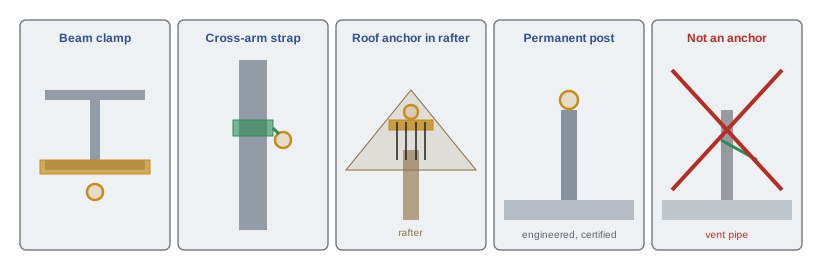
What not to use
Many fatal falls involve anchors that looked solid but were never designed for fall loads. Never anchor to:
- vent pipes, plumbing, conduit, sprinkler pipes or cable trays;
- guardrails, handrails or ladder rungs, unless they are specifically designed and rated as anchors;
- light fixtures, ductwork, roof hatches or skylight frames;
- rooftop equipment such as units, antennas or satellite dishes, unless designed as anchors;
- scaffold components, unless the scaffold is designed for it and the manufacturer or engineer allows it;
- the same anchor as another worker, unless the anchor is designed and marked for more than one person.
Anchor location
Where the anchor is placed matters as much as how strong it is. The best location is directly overhead, above the dorsal D-ring, because it:
- keeps free fall short, especially with a self-retracting device;
- reduces total fall distance and the clearance needed below;
- prevents or reduces swing falls;
- keeps the lifeline away from edges.
Anchors at foot level, common on roofs and decks, increase free fall, require leading edge equipment, and create swing hazards when the worker moves to the side. Anchors placed far from the work encourage workers to unhook or to use long lanyards. Plan anchor locations as part of the job, not as an afterthought.
Load direction and slings
Anchorage connectors and slings are rated for loads in particular directions. A strap wrapped around a beam and pulled along its length, or a sling with legs at a shallow angle, may carry far more force than the fall itself. When an anchor sling has two legs meeting at the attachment point, each leg carries more than half the load if the legs are spread apart.
Worked problem
Tension in a two-leg anchor sling
A two-leg anchor sling is wrapped around two points on a structure, and the legs meet at the D-ring at an angle of 60° from the horizontal on each side. A fall produces a peak force of 1,800 lb straight down. What tension does each leg carry? What if the angle is only 30°?
Show solution
- Each leg carries \( T = F / (2 \sin\theta) \).
- At 60°: \( T = 1{,}800 / (2 \times 0.866) \approx 1{,}040 \) lb per leg.
- At 30°: \( T = 1{,}800 / (2 \times 0.5) = 1{,}800 \) lb per leg, the full force in each leg.
- Shallow angles multiply leg forces. Keep sling legs steep, and follow the manufacturer's angle limits.
Answer: About 1,040 lb per leg at 60°, rising to 1,800 lb per leg at 30°.
Inspecting and recording anchors
Inspect temporary connectors before each use, like any other component. For permanent anchors, check before use for corrosion, damage, loose bolts, cracked welds, deformation and missing labels, and follow the engineer's or manufacturer's schedule for formal inspection and recertification, commonly every year and after any fall or suspected overload. Remove from service any anchor that has arrested a fall until an engineer or competent person has inspected it. Building owners should mark anchors with their capacity and use, keep a roof plan showing anchor locations, and share it with contractors.
Anchors for suspended access and window cleaning
Buildings that use suspended platforms, bosun's chairs or rope descent systems for window cleaning and facade work need permanent anchors designed for that use. OSHA's 1910.27 requires the building owner to inform the employer in writing, before a rope descent system is used, that each anchorage has been identified, tested, certified and maintained to support at least 5,000 lb in any direction for each worker attached, with inspection at least every year and recertification at least every 10 years. ANSI/IWCA I-14.1 covers window cleaning safety more broadly. Building owners must provide workers with information about the anchors before work begins.
Anchors in different structures
Concrete anchors depend on the strength of the concrete, the embedment depth, the distance from edges and other anchors, and whether the concrete is cracked. Wood anchors depend on the size and condition of the member and on fasteners reaching sound wood, not just sheathing. Steel anchors depend on the size of the member and the welds or bolts that connect it to the rest of the structure. Metal roof decks, in particular, are usually too thin to anchor into without a manufacturer-specific system that spreads the load across several ribs or connects to the structure below. Each material has its own failure modes, which is why permanent anchors are designed and certified by engineers.
Common mistakes
MistakeTying off to a vent pipe, conduit or handrail because it looks solid.
InsteadUse only anchors designed or assessed for fall loads.
MistakeFastening a temporary roof anchor only into sheathing.
InsteadFasten it through to a rafter or truss exactly as the manufacturer specifies.
MistakePutting two workers on one single-person anchor.
InsteadGive each worker an independent anchor unless the anchor is rated for more.
MistakeChoosing an anchor far from the work at foot level when an overhead point is available.
InsteadPrefer anchors overhead and close to the work to reduce free fall and swing.
MistakeUsing the two-times arrest force option without engineering.
InsteadLower anchor strengths apply only to systems designed and supervised by a qualified engineer or person.
Summary and key terms
- The anchor holds the system; if it fails, nothing else matters.
- The anchorage is the structure; the connector attaches to it; the anchor point is where the lanyard connects.
- Fall arrest anchors need 5,000 lb per worker, or a safety factor of two under a qualified person.
- Large margins cover peak forces, dynamic effects, wear and installation errors.
- Install temporary connectors exactly as the manufacturer instructs, into sound structure.
- Never anchor to pipes, conduit, vents, handrails or equipment not designed as anchors.
- Overhead anchors near the work reduce free fall, clearance and swing.
- Anchorage
- The structure or element that holds the load in a fall.
- Anchorage connector
- A device, such as a beam clamp or strap, that attaches the system to the anchorage.
- Anchor point
- The place where the lanyard or lifeline attaches to the anchorage connector.
- Certified anchorage
- An anchorage designed and certified by a qualified engineer.
- Beam clamp
- A connector that grips the flange of a steel beam.
- Cross-arm strap
- A webbing strap wrapped around a structural member to form an anchor point.
- Counterweight anchor
- A temporary roof anchor held in place by weight and friction.
- Maximum arresting force
- The highest force a system is designed to put on the worker in a fall.
- Sling angle
- The angle between a sling leg and the horizontal, which affects leg tension.
- Recertification
- Formal re-inspection and approval of an anchor at set intervals or after a fall.
Practice problems
Work each problem on paper first, then reveal the answer to check.
What is the difference between an anchorage and an anchorage connector?
Show answer
The anchorage is the structure; the connector attaches the system to it.
What fall arrest anchor strength does OSHA require without engineering?
Show answer
5,000 lb per worker.
Why are anchor strengths much higher than arrest force limits?
Show answer
To cover peak and dynamic forces, off-axis loads, wear and installation errors.
Name three things you should never anchor to.
Show answer
Vent pipes, conduit and handrails; also light fixtures and equipment not designed as anchors.
How should a temporary roof anchor be fastened?
Show answer
Through the sheathing into a rafter or truss with the specified fasteners.
Why is an overhead anchor location best?
Show answer
It shortens free fall, reduces clearance needed and prevents swing falls.
What is each leg tension in a two-leg sling at 45° under 1,800 lb?
Show answer
About 1,270 lb.
What must happen to an anchor that has arrested a fall?
Show answer
Remove it from service until an engineer or competent person inspects it.
What should building owners give contractors about permanent anchors?
Show answer
A roof plan with locations, capacities, intended use and certification records.
When may two workers share an anchor?
Show answer
Only if the anchor is designed and marked for more than one worker.
Lesson quiz · 5 questions
Score 60% or more to complete this lesson.
Create a free account to save your progress, take quizzes and earn a certificate.