
HSE-211 · Lesson 7 of 12 · 25 min
Physical hazards, engulfment and isolation
The air is not the only thing in a confined space that can kill. Workers have been buried by grain, drowned by water flowing into vaults, crushed by agitators, scalded by steam from a line someone opened upstream, electrocuted by damaged cables, and injured falling down ladders into tanks. This lesson covers the physical hazards of confined spaces and the most important control for many of them: isolating the space from everything that could flow, move or energize inside it.
Engulfment
Engulfment means being surrounded and captured by a liquid or a finely divided, flowable solid. Grain, sand, gravel, sawdust, coal, cement, flour, plastic pellets, fertilizer, sludge and water can all engulf a person. Death usually comes from suffocation as material fills the airway or compresses the chest, or from drowning.
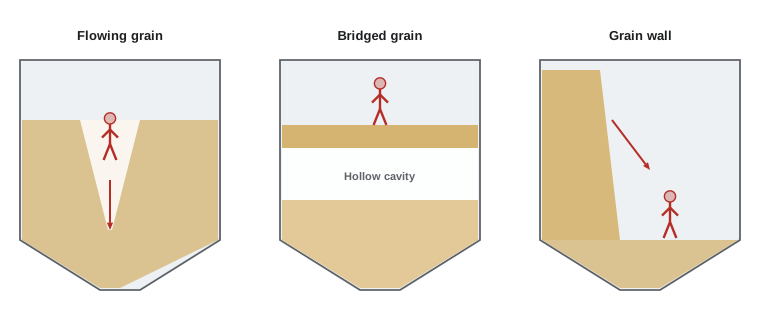
Grain bins and silos are the classic example. Three situations are especially dangerous:
- flowing grain: when an unloading auger or gravity outlet is running, grain flows down a funnel in the center of the bin. A worker standing on the grain can be pulled down into the flow and buried within seconds;
- bridged grain: spoiled or wet grain can form a crust that leaves a hollow cavity underneath. A worker walking on the crust can break through and be buried;
- grain walls: grain caked against the wall can stand vertically and collapse onto a worker trying to break it free.
Agricultural safety researchers commonly describe how quickly flowing grain traps a person: a worker can sink to the knees in a few seconds, at which point they cannot pull themselves out, and can be completely submerged in well under a minute. Pulling a partly buried person straight up is very difficult because of the pressure of the grain around them, and can injure them, which is why trained rescuers use rescue tubes or cofferdams to relieve the pressure before extraction.
Controls for engulfment include doing the work from outside (bin sweeps, vibrators, air cannons, long poles from the roof hatch); locking out all unloading equipment and the flow of material into the space before entry; never walking down grain to make it flow; using a body harness and lifeline attached to an anchor and tended by an attendant so the worker cannot sink; blocking or diverting material from entering; and keeping entry out of spaces with free-flowing material unless it is absolutely necessary.
OSHA's grain handling standard, 1910.272, prohibits walking down grain to make it flow, requires lockout of equipment that presents a danger, and requires a body harness and lifeline, or a boatswain's chair, when entering a bin from the top or when there is an engulfment risk.
Liquids and flooding
Liquids can engulf or drown a worker. Sewers and storm drains can fill quickly when rain falls upstream or a pump starts. Tanks can be filled by an open valve elsewhere in the process. Vaults can flood from a broken water main. Controls include isolating and blanking inlet lines, checking weather and upstream conditions, having an early-warning system where flooding could come from upstream, and planning an escape route that does not depend on the flooded section.
Worked problem
How fast could a vault flood?
A vault measuring 10 ft × 6.5 ft in plan contains a pipe that, if the isolation valve fails, could discharge water at 150 gallons per minute. How long would it take the water level to rise 4 ft, roughly the height at which an unconscious or trapped worker would be submerged?
Show solution
- Volume to fill = 10 × 6.5 × 4 = 260 ft³.
- One cubic foot is about 7.48 gallons, so 260 × 7.48 ≈ 1,945 gallons.
- Time = 1,945 ÷ 150 ≈ 13 minutes.
Answer: About 13 minutes. That may sound like plenty of time, but not for a worker who is injured, unconscious or tangled, and less if the flow is larger. A single closed valve is not enough isolation; the line should be blanked or disconnected, or double blocked and bled.
Entrapment and configuration
Some spaces trap people by their shape. Hoppers and bins with sloping sides that converge to a narrow outlet, tanks with internal baffles, and spaces with tight openings can wedge a worker or cause positional asphyxia, in which the body's position prevents breathing. A worker who slips into a cone-shaped bottom may be unable to climb back up the slope, and rescuers may be unable to reach them. Assessments must look at the inside shape of the space, the size of every opening, and whether an injured person could be lifted out in a stretcher or harness.
Moving parts and energy
Agitators, mixers, augers, screw conveyors, fans, paddles, rotating drums and pumps inside or connected to confined spaces can start unexpectedly, through automatic controls, by someone at a remote panel, or from stored energy. Every source of energy that could move equipment in the space, or release material or energy into it, must be isolated, locked out and verified before entry. HSE-210 Lockout and Hazardous Energy Control explains the lockout process in detail, including the types of energy, verification of zero energy and group lockout. For confined spaces, group lockout is common, because several entrants, attendants and trades may be involved.
Isolating lines: blanking, disconnecting and double block and bleed
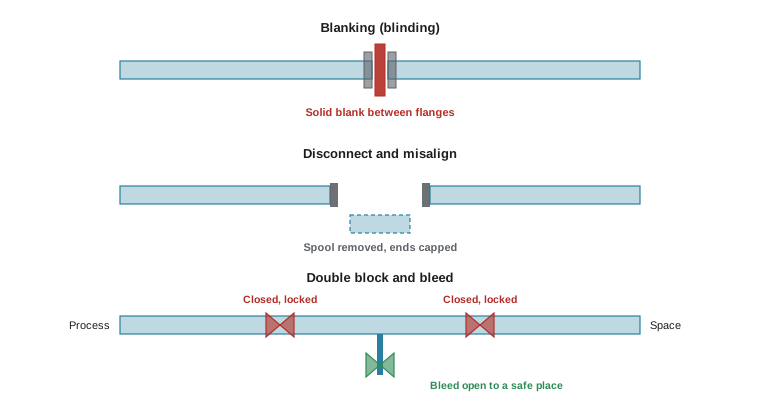
Pipes, ducts and chutes that enter a confined space can carry steam, hot water, chemicals, gases, product or inert gas back into it. Closing a single valve is generally not acceptable isolation for a line entering a confined space, because valves leak and can be opened by mistake. The accepted methods are:
- blanking or blinding: inserting a solid plate (a blank or blind) between flanges, rated for the line pressure, so nothing can pass;
- disconnecting and misaligning: removing a section of pipe or a spool piece and capping the open ends, so the line is physically broken;
- double block and bleed: closing and locking two valves in series and opening and locking a bleed valve between them to a safe location, so that any leakage past the first valve drains away instead of reaching the space.
Where a method other than these is used, most rules require a documented assessment showing it gives equivalent protection.
1910.146 defines isolation as blanking or blinding, misaligning or removing sections of lines, pipes or ducts, a double block and bleed system, lockout or tagout of all sources of energy, or blocking or disconnecting all mechanical linkages. ANSI/ASSP Z117.1 gives more detailed guidance on isolation methods.
Temperature
Confined spaces can be very hot or very cold. Tanks in the sun, boilers, ovens, kilns and spaces where steam or hot processes have just run can cause heat stress. Heat is made worse by protective clothing, respirators, poor ventilation and hard physical work. Signs of heat illness include heavy sweating, cramps, dizziness, confusion and collapse. Controls include allowing the space to cool, ventilating with cooler air, scheduling work for cooler times, rotating workers, providing water and rest breaks, and monitoring heat stress. Cold spaces, such as outdoor tanks in a Canadian or northern winter, freezers and refrigerated vessels, bring risks of cold stress and slippery ice. Hot surfaces and liquids can also cause burns.
Noise, lighting and visibility
Hard surfaces in tanks and vessels reflect sound, so tools such as grinders, hammers and blasting equipment can produce very high noise levels that damage hearing and make communication difficult. Hearing protection is often needed, and communication systems must still work with it. Poor lighting causes slips, trips and mistakes; lighting must be adequate and, where flammable atmospheres could develop, rated for the hazard. Low-voltage or ground-fault-protected lighting reduces electrical risk in wet metal spaces.
Electrical hazards
Confined spaces are often wet, metal and cramped, which makes electrical shock more likely and more dangerous. Portable tools and lights should be low voltage, battery powered or protected by ground fault circuit interrupters (GFCIs), and cords must be in good condition. Electrical equipment taken into a space where a flammable atmosphere could exist must be approved for that hazardous location. Vaults and manholes may also contain energized cables and equipment; work near them is covered in HSE-214 Electrical Safety Awareness.
Falls and falling objects
Many confined spaces are entered vertically through a manhole or hatch, often by ladder. Falls during entry and exit are a major cause of injury, and a fall from height into a tank can be fatal. Controls include fixed or securely fastened ladders, fall protection such as a full-body harness attached to a retrieval line or a self-retracting device, guarding the opening, and keeping tools and materials from falling onto workers below by using tool lanyards, buckets on lines and toe boards. HSE-212 covers fall protection.
Biological and other hazards
Sewers, wastewater plants, manure pits and food processing spaces can expose workers to bacteria, viruses and parasites. Old buildings and attics may contain bird and bat droppings, mold and asbestos. Spaces may contain sharp objects, needles, insects or animals. Good hygiene, gloves, protective clothing, vaccinations recommended by the employer's occupational health program and washing facilities are important controls.
| Hazard | Main controls |
|---|---|
| Engulfment by solids | Work from outside; lock out unloading and inflow; harness and lifeline; never walk down grain |
| Flooding or drowning | Blank or disconnect lines; watch weather and upstream flows; early warning; escape route |
| Entrapment | Assess the internal shape and openings; restrict entry to safe areas; plan rescue access |
| Moving parts | Lockout of all energy sources and verification (HSE-210) |
| Lines entering the space | Blanking, disconnecting or double block and bleed; avoid single-valve isolation |
| Heat or cold | Cool or warm the space, ventilate, schedule, rotate workers, water and breaks |
| Noise and poor visibility | Hearing protection, communication systems, adequate rated lighting |
| Electricity | Low-voltage or GFCI-protected tools and lights; approved equipment in flammable atmospheres |
| Falls and falling objects | Secure ladders, harness and retrieval line, guard the opening, tool lanyards |
| Biological | Hygiene, protective clothing, gloves, washing facilities |
Physical hazards often combine. A wet, dark, noisy tank with a sloping floor, a running agitator and a hot coating process is far more dangerous than any one of those hazards alone, because each makes the others harder to notice and harder to escape. The hazard assessment should therefore look at how hazards interact, for example how noise could hide an alarm or how heat stress could slow an escape, and the entry plan should address those combinations.
Common mistakes
MistakeWalking on grain to break up a crust or make it flow.
InsteadBridged and flowing grain can bury a person in seconds. Work from outside or use harness, lifeline and lockout.
MistakeIsolating a steam or chemical line by closing one valve.
InsteadBlank, disconnect or double block and bleed lines entering a confined space.
MistakeLocking out the main motor but not the feed conveyor or the agitator.
InsteadIdentify and lock out every energy source and material inflow, then verify.
MistakeUsing a standard mains-powered drop light in a wet steel tank.
InsteadUse low-voltage, battery or GFCI-protected equipment, rated for any flammable hazard.
MistakeForgetting how an injured person would be lifted out.
InsteadCheck every opening and the internal layout for rescue access before entry.
Summary and key terms
- Engulfment by grain, sand, sludge or water can kill in seconds; flowing grain, bridges and grain walls are classic traps.
- Never walk down grain; work from outside, lock out unloading and use harness and lifeline.
- Liquids can flood a space from upstream or through leaking valves.
- Converging shapes and small openings can trap workers and block rescue.
- All energy sources and moving parts must be locked out and verified (HSE-210).
- Lines entering a space are isolated by blanking, disconnecting or double block and bleed, not by a single valve.
- Heat, cold, noise, lighting, electricity, falls and biological hazards also need controls.
- Engulfment
- Being surrounded and captured by a liquid or flowable solid.
- Bridging
- Grain or material forming a crust over a hollow cavity.
- Blanking
- Inserting a solid plate between flanges to stop flow in a line.
- Double block and bleed
- Two closed, locked valves in series with an open bleed valve between them.
- Misaligning
- Removing or offsetting a section of pipe so the line is physically broken.
- Positional asphyxia
- Inability to breathe because of body position, such as being wedged in a narrow space.
- Ground fault circuit interrupter
- A device that cuts power quickly when current leaks to ground.
- Heat stress
- The total heat load on the body from the environment, work and clothing.
- Lifeline
- A rope or line attached to a worker's harness for retrieval or to prevent sinking or falling.
- Early-warning system
- A method to alert entrants to an approaching hazard such as upstream flooding.
Practice problems
Work each problem on paper first, then reveal the answer to check.
Name three materials that can engulf a worker.
Show answer
Grain, sand, sawdust, coal, cement, flour, pellets, sludge or water.
What is bridged grain?
Show answer
A crust of grain over a hollow cavity that can collapse under a worker.
Why is pulling a partly buried worker straight up dangerous?
Show answer
Grain pressure resists extraction and the force can injure them; rescuers use tubes or cofferdams.
List the three accepted ways to isolate a line.
Show answer
Blanking or blinding, disconnecting and misaligning, double block and bleed.
Why is a single closed valve not enough?
Show answer
Valves leak and can be opened by mistake.
How long to fill a 6 ft × 6 ft vault to 3 ft at 100 gallons per minute?
Show answer
108 ft³ ≈ 808 gallons; 808 ÷ 100 ≈ 8 minutes.
What does an internal configuration hazard do?
Show answer
Traps or wedges a worker, possibly causing positional asphyxia.
What lighting should be used in a wet metal tank?
Show answer
Low-voltage, battery or GFCI-protected lighting, rated for any flammable hazard.
Give two controls for heat stress in a tank.
Show answer
Let it cool, ventilate with cooler air, rotate workers, provide water and breaks.
Which course covers lockout in detail?
Show answer
HSE-210 Lockout and Hazardous Energy Control.
Lesson quiz · 5 questions
Score 60% or more to complete this lesson.
Create a free account to save your progress, take quizzes and earn a certificate.