
HSE-211 · Lesson 4 of 12 · 27 min
Atmospheric hazards: oxygen deficiency and enrichment
Most confined space deaths are caused by the air. Of the atmospheric hazards, the most basic is the wrong amount of oxygen. Too little oxygen can cause collapse in seconds and death in minutes, often with no warning at all. Too much oxygen turns ordinary materials into fuel and can make a small spark into a flash fire. This lesson explains how oxygen levels change in confined spaces, what happens to the body as oxygen falls, why enrichment is dangerous, and how to interpret an oxygen reading, including at altitude.
Normal air
Normal air at sea level contains about 20.9 percent oxygen by volume, about 78 percent nitrogen, about 0.9 percent argon and small amounts of carbon dioxide and other gases. The body does not respond to the percentage of oxygen directly. What matters is the partial pressure of oxygen: the share of the total air pressure contributed by oxygen. At sea level, where atmospheric pressure is about 101.3 kPa, the partial pressure of oxygen is about 0.209 × 101.3 ≈ 21.2 kPa.
Here \( x_{O_2} \) is the oxygen fraction by volume and \( P_{\text{atm}} \) is the total atmospheric pressure. Most gas detectors report the percentage by volume, so it is important to understand how that relates to what your body experiences. We come back to this when we look at altitude.
How oxygen is lost in a confined space
Oxygen levels in a confined space fall in two broad ways: oxygen is used up, or it is pushed out by another gas.
Oxygen is consumed by:
- rusting of steel, which can slowly use up the oxygen in a closed steel tank, vessel or ship's hold over days or weeks;
- bacterial action in sewage, manure, sludge, grain, wood chips and other organic materials, which also produces carbon dioxide, methane and hydrogen sulfide;
- fermentation, which consumes oxygen and gives off large amounts of carbon dioxide, for example in wine vats, silos and brewing tanks;
- combustion, from welding, cutting, heating with open flames or running engines;
- some coatings and chemicals that absorb oxygen as they cure or react;
- the people working in the space, slowly, in a very small and unventilated space.
Oxygen is displaced by:
- inert gases deliberately used to purge or protect equipment, especially nitrogen and argon, but also carbon dioxide and helium;
- gases that leak from process lines, cylinders, refrigeration systems or the ground, such as carbon dioxide, methane and refrigerants;
- fire suppression systems that discharge inert gases or carbon dioxide into a room or enclosure.
Displacement can be sudden. Nitrogen purging of vessels is a well-known cause of fatal incidents, because nitrogen is colorless, odorless, non-irritating and almost the same density as air, so it gives no warning and mixes readily. A single breath of nearly pure nitrogen can cause loss of consciousness within seconds, because it actually draws oxygen out of the blood in the lungs.
What low oxygen does to the body
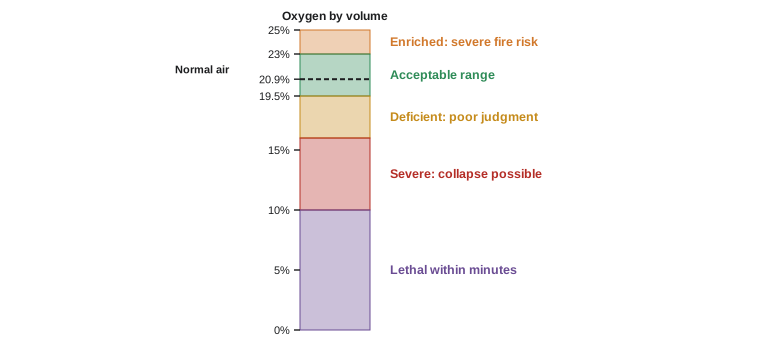
The effects of oxygen deficiency depend on the concentration, the time, the person's health and the work they are doing. The table gives a typical picture at sea level. The exact numbers vary between sources, and individuals vary widely, but the pattern is consistent: judgment and coordination fail before the person realizes anything is wrong.
| Oxygen (percent by volume, sea level) | Typical effects |
|---|---|
| 20.9 | Normal air |
| 19.5 | Minimum acceptable level in most rules; a sign that something has displaced or consumed oxygen |
| 16 to 19 | Faster breathing and heart rate, poor judgment, impaired coordination, early fatigue |
| 12 to 16 | Poor judgment and coordination, abnormal fatigue, emotional upset, possible fainting |
| 10 to 12 | Very poor judgment, lips turning blue, nausea, vomiting, inability to move or escape |
| 6 to 10 | Collapse, unconsciousness, convulsions; death within minutes |
| Below 6 | Unconsciousness after a breath or two and death within minutes |
There are two crucial lessons in this table. First, a person in an oxygen-deficient atmosphere usually cannot tell. Low oxygen does not cause a feeling of suffocation; that feeling comes from a build-up of carbon dioxide, not from a lack of oxygen. People in low oxygen often feel fine, even euphoric, until they collapse. Second, at very low concentrations there is no time to react. A rescuer who enters to help and takes a few breaths can collapse beside the first victim.
What a small drop in oxygen tells you
An oxygen reading of 19.5 percent may look close to normal. It is not. Because air is about 20.9 percent oxygen, any gas that displaces air also removes oxygen in proportion. If oxygen falls from 20.9 percent to 19.5 percent purely by displacement, the share of air that has been replaced by something else is:
Almost 7 percent of the atmosphere, or about 67,000 parts per million (ppm), is now some other gas. If that gas is nitrogen, the main danger is the oxygen loss. But if it is a toxic gas such as carbon monoxide or hydrogen sulfide, 67,000 ppm is many times the concentration that kills in minutes. If it is methane, 6.7 percent is above methane's lower explosive limit of about 5 percent. This is why an oxygen reading must never be read alone, and why gas detectors measure oxygen, flammable gases and toxic gases together. Lesson 6 explains the testing sequence.
Worked problem
How much gas has displaced the air?
An oxygen meter at the bottom of a pit reads 18.0 percent. Assuming the drop is caused by displacement only, what concentration of another gas is present?
Show solution
- Fraction of air remaining = 18.0 / 20.9 = 0.861.
- Fraction displaced = 1 − 0.861 = 0.139, or about 13.9 percent.
- In ppm: 0.139 × 1,000,000 ≈ 139,000 ppm.
- If the gas were carbon dioxide, 13.9 percent would be far above the short-term limits and could itself cause unconsciousness. If it were methane, it would be well above its LEL range of 5 to 15 percent.
Answer: About 14 percent, or roughly 139,000 ppm, of another gas. A reading like this means the space is extremely dangerous, whatever the gas.
Oxygen enrichment
Oxygen enrichment means more than the normal amount of oxygen. OSHA treats oxygen above 23.5 percent as a hazardous atmosphere.
Enrichment usually comes from leaking oxygen cylinders, hoses or torches, oxygen used to 'sweeten' the air in a space (a dangerous practice that should never be done), medical or process oxygen lines, or oxygen released by some chemical reactions. Even a small increase makes a big difference to fire behavior: materials ignite more easily, burn faster and hotter, and some materials that do not normally burn in air, such as some fabrics, will burn vigorously. Clothing saturated with oxygen can catch fire from a spark and burn intensely, and oxygen can remain trapped in clothing for some time after the person leaves the enriched area.
Never use pure oxygen to ventilate a confined space. Ventilation must use clean air from a safe source. Lesson 8 explains ventilation.
Oxygen and altitude
Because the body responds to the partial pressure of oxygen, a normal 20.9 percent reading at high altitude provides less oxygen than at sea level. Gas detectors that measure percentage by volume read about 20.9 percent in clean air at any altitude, but the air is thinner.
Worked problem
Oxygen at Denver's altitude
Denver is about 5,280 ft (1,609 m) above sea level, where typical atmospheric pressure is about 83 kPa. What is the partial pressure of oxygen in clean air, and what sea-level oxygen percentage gives the same partial pressure?
Show solution
- Partial pressure at altitude = 0.209 × 83 kPa ≈ 17.3 kPa.
- Equivalent sea-level percentage = 17.3 / 101.3 ≈ 0.171, or about 17.1 percent.
- So clean air in Denver supplies the body with roughly the oxygen it would get from 17.1 percent oxygen at sea level.
- A space in Denver that reads 19.5 percent on a detector supplies about 0.195 × 83 / 101.3 ≈ 16.0 percent sea-level equivalent.
Answer: About 17.3 kPa, equivalent to about 17.1 percent at sea level. At altitude, a reading at the bottom of the acceptable range leaves even less margin, especially for people doing heavy work.
People who live at altitude acclimatize, and regulations generally use the percentage by volume rather than partial pressure. But the example shows why a falling oxygen reading at altitude deserves even more caution, and why some employers set stricter limits for work at high elevations.
Carbon dioxide: a displacer that is also toxic
Carbon dioxide deserves special mention. It is produced by fermentation, decomposition, combustion and dry ice, and it is used in fire suppression and beverage systems. It is heavier than air (about 1.5 times as dense), so it pools in pits, cellars, tanks and the bottoms of silos. Unlike nitrogen, carbon dioxide is toxic in its own right at high concentrations. Exposure limits for an eight-hour day are typically 5,000 ppm (0.5 percent), and concentrations of several percent cause headaches, rapid breathing and confusion, while concentrations around 10 percent or more can cause unconsciousness quickly. A space can be deadly from carbon dioxide while the oxygen reading still looks only slightly low. Many standard four-gas detectors do not measure carbon dioxide, so spaces where it is expected need a detector with a carbon dioxide sensor.
Controls for oxygen hazards
The main controls for oxygen deficiency and enrichment are:
- identify the sources of oxygen loss or gain in the hazard assessment, including inert gas lines and fire suppression systems;
- isolate inert gas and oxygen lines by blanking or disconnecting them, not by closing a single valve (lesson 7);
- ventilate with clean air until oxygen is in the acceptable range, and keep ventilating during the entry (lesson 8);
- test before entry and monitor continuously, with the oxygen sensor close to the breathing zone and in the areas where gas could collect (lesson 6);
- never use oxygen to ventilate, and keep oxygen cylinders and hoses outside the space when not in use;
- where oxygen cannot be kept in the acceptable range, use supplied-air respiratory protection, such as an airline respirator with an escape bottle or self-contained breathing apparatus, with the additional precautions required for entering an atmosphere that is immediately dangerous to life or health.
Air-purifying respirators, such as cartridge or dust masks, do not supply oxygen and must never be used in an oxygen-deficient atmosphere.
Common mistakes
MistakeThinking you would feel short of breath if oxygen were low.
InsteadLow oxygen gives little or no warning; breathlessness comes from carbon dioxide build-up, not oxygen lack.
MistakeReading 19.5 percent oxygen as basically normal.
InsteadA drop of 1.4 points means almost 7 percent of the air has been replaced by another gas, which may be toxic or flammable.
MistakeUsing oxygen to freshen the air in a tank.
InsteadOxygen enrichment creates a severe fire risk. Ventilate only with clean air.
MistakeWearing a cartridge respirator in low oxygen.
InsteadAir-purifying respirators do not supply oxygen. Use supplied air where oxygen cannot be controlled.
MistakeAssuming a four-gas detector always measures carbon dioxide.
InsteadMany do not. Use a carbon dioxide sensor where it may be present.
Summary and key terms
- Normal air is about 20.9 percent oxygen; the body responds to the partial pressure of oxygen.
- Oxygen is consumed by rusting, decomposition, fermentation and combustion, and displaced by nitrogen, argon, carbon dioxide and other gases.
- Low oxygen impairs judgment before the person realizes it and can cause collapse within a few breaths at very low levels.
- A small drop in oxygen means a large concentration of another gas, which may be toxic or flammable.
- OSHA treats oxygen below 19.5 or above 23.5 percent as hazardous.
- Enrichment greatly increases fire risk; never ventilate with oxygen.
- At altitude, a normal percentage gives less oxygen, and carbon dioxide is both a displacer and a toxic gas.
- Oxygen deficiency
- An atmosphere with less oxygen than the acceptable minimum, usually 19.5 percent.
- Oxygen enrichment
- An atmosphere with more oxygen than the acceptable maximum.
- Partial pressure
- The share of total gas pressure contributed by one gas, which governs how much oxygen the body can take in.
- Inert gas
- A gas such as nitrogen or argon that does not support combustion and is used to purge or blanket equipment.
- Displacement
- The pushing out of air, and therefore oxygen, by another gas.
- Asphyxiant
- A gas that causes harm mainly by reducing the oxygen available to the body.
- Supplied-air respirator
- A respirator that provides breathable air from a cylinder or compressor rather than filtering the surrounding air.
- Air-purifying respirator
- A respirator that filters contaminants from surrounding air and does not supply oxygen.
- IDLH
- Immediately dangerous to life or health: an atmosphere that could cause death or prevent escape.
- ppm
- Parts per million by volume; 1 percent equals 10,000 ppm.
Practice problems
Work each problem on paper first, then reveal the answer to check.
What is the partial pressure of oxygen in normal air at sea level?
Show answer
About 0.209 × 101.3 ≈ 21.2 kPa.
Name three processes that consume oxygen in confined spaces.
Show answer
Rusting, decomposition or bacterial action, fermentation, combustion or curing coatings.
Why is nitrogen especially dangerous?
Show answer
It is colorless, odorless and non-irritating, so it gives no warning, and pure nitrogen causes collapse within seconds.
If oxygen reads 19.0 percent by displacement only, what share of the air is another gas?
Show answer
1 − 19.0/20.9 ≈ 0.091, about 9.1 percent or 91,000 ppm.
Why must an oxygen reading never be read alone?
Show answer
The displacing gas may be toxic or flammable at very dangerous concentrations.
Why is oxygen enrichment dangerous?
Show answer
Materials ignite more easily and burn faster and hotter, and clothing can trap oxygen.
What sea-level equivalent does 20.9 percent provide at 85 kPa?
Show answer
0.209 × 85 / 101.3 ≈ 0.175, about 17.5 percent.
Why does carbon dioxide collect in pits?
Show answer
It is about 1.5 times as dense as air.
What type of respirator can be used where oxygen cannot be controlled?
Show answer
A supplied-air respirator with escape provision or SCBA, with IDLH precautions.
Why should a feeling of well-being in a space not reassure anyone?
Show answer
Low oxygen can cause euphoria and impaired judgment before collapse.
Lesson quiz · 5 questions
Score 60% or more to complete this lesson.
Create a free account to save your progress, take quizzes and earn a certificate.