
HSE-211 · Lesson 8 of 12 · 27 min
Ventilation, purging and inerting
Ventilation is the main engineering control for confined space atmospheres. It removes contaminants, brings oxygen levels back to normal, keeps flammable gases well below their explosive limits and dilutes fumes and vapors produced by the work. Purging and cleaning remove hazardous contents before entry. Inerting does the opposite of ventilation: it deliberately removes oxygen to prevent fire, which makes the space unbreathable. This lesson explains how these methods work, how to estimate how long purging takes, and the common mistakes that make ventilation fail.
Cleaning and purging before entry
Before ventilation can do its job, the space should be emptied of as much of its hazardous contents as possible. Typical steps are:
- drain liquids and remove product, sludge and residues, from outside where possible;
- flush or wash the space, for example with water, steam or a cleaning solution, using spray nozzles from outside;
- purge the atmosphere by displacing it with air, water, steam or an inert gas, depending on the contents and the fire risk;
- test the atmosphere after purging and before entry.
Purging with steam or water can itself create hazards: steam heats the space, can generate pressure and leaves condensation that can trap gases; water may react with some residues. Purging a flammable atmosphere with air takes the mixture through its flammable range, so sources of ignition must be controlled and equipment must be suitable for flammable atmospheres. For this reason, highly flammable atmospheres are often purged first with an inert gas such as nitrogen, and only then with air, so the concentration never passes through the flammable range in the presence of oxygen.
Mechanical ventilation
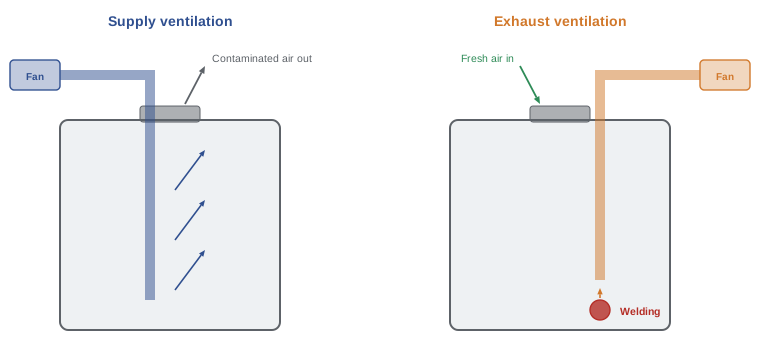
Natural ventilation, relying on open hatches and wind, is rarely enough for a confined space, and most rules require or strongly favor mechanical ventilation. Portable blowers driven by electric motors, compressed air or (outside and away from the opening) engines push or pull air through ducting. There are two basic arrangements:
- supply (blowing) ventilation pushes fresh air into the space through a duct, diluting contaminants and pushing them out through the openings. It is the most common method and delivers clean air to the work area if the duct outlet is placed near the workers;
- exhaust (extraction) ventilation pulls contaminated air out through a duct, drawing fresh air in through the openings. It is effective at capturing contaminants at their source, such as welding fume, especially when the duct inlet is placed close to where the fume is produced.
Often both are used together, with supply air brought in at one end and exhaust taken from the other, creating a flow through the work area.
Getting ventilation right
Ventilation only works if the air actually reaches the places where people work and contaminants collect. Good practice includes:
- take supply air from a clean location, away from vehicle exhaust, engine-driven equipment, process vents and the exhaust outlet of the same system, so contaminated air is not recirculated;
- place the supply duct outlet near the bottom of the space or near the workers, and the exhaust inlet near the contaminant source or at the opposite end, so air sweeps the whole space without short-circuiting straight from inlet to outlet;
- consider gas density: heavy gases such as hydrogen sulfide and solvent vapors collect low and may need low-level exhaust, while light gases such as methane collect at the top;
- keep ducting short, straight and undamaged; every bend, kink and extra length reduces airflow, and manufacturers' charts show how much;
- use blowers rated for the atmosphere: in a potentially flammable atmosphere, the fan, motor and any electrical equipment must be suitable for that hazardous location, and the system must be bonded and grounded to prevent static sparks;
- never ventilate with pure oxygen;
- keep ventilating continuously throughout the entry when the hazard could return, and retest after ventilation starts, because ventilation can stir up sludge and release gas.
1910.146 requires the employer to provide ventilating equipment needed to obtain acceptable entry conditions, and the alternate procedures in paragraph (c)(5) allow continuous forced-air ventilation as the only control for spaces whose only hazard is atmospheric. Under those procedures the forced air must be directed to ventilate the immediate areas where employees are or will be present, and must continue until all employees have left the space, with periodic testing to confirm conditions.
How long does purging take?
If fresh air is supplied at a constant rate Q into a space of volume V, and mixing is perfect, the concentration of a contaminant falls exponentially:
Real spaces are never perfectly mixed: corners, baffles and poor duct placement leave pockets of contaminated air. Industrial hygienists account for this with a mixing factor K, typically between about 3 for a simple, open space with good duct placement and 10 for a complicated space with poor mixing. Solving for time gives:
A useful rule of thumb follows from this. Reducing a concentration to one thousandth of its starting value (99.9 percent reduction) needs \( \ln(1000) \approx 6.9 \), or about seven air changes with perfect mixing, multiplied by the mixing factor in practice.
Worked problem
Purge time for a tank
A tank has a volume of 1,400 ft³ and contains 200 ppm of hydrogen sulfide. A blower delivers 700 cubic feet per minute (cfm) of fresh air into the tank through its ducting. How long will it take to reduce the concentration to 1 ppm, using a mixing factor of 3?
Show solution
- One air change takes V/Q = 1,400 / 700 = 2 minutes.
- Required reduction: C₀/C = 200 / 1 = 200, and ln(200) ≈ 5.3.
- Time = K × (V/Q) × ln(C₀/C) = 3 × 2 × 5.3 ≈ 32 minutes.
- After purging, test at all levels before entry, and keep the blower running during the entry because sludge may release more gas.
Answer: About 32 minutes of ventilation, followed by testing. The calculation is an estimate to plan the work; only test results decide whether entry may begin.
Worked problem
Accounting for duct losses
A blower is rated at 1,000 cfm with no ducting. The manufacturer's chart shows that with 25 ft of duct and two 90° bends, the delivered airflow falls to about 60 percent of the rating. A space of 1,900 ft³ needs at least 20 air changes per hour during work. Is the blower adequate?
Show solution
- Delivered airflow = 0.60 × 1,000 = 600 cfm = 36,000 ft³/h.
- Air changes per hour = 36,000 / 1,900 ≈ 19.
- The blower falls just short of the requirement.
- Shortening the duct, removing a bend or using a larger blower would meet it with a margin.
Answer: About 19 air changes per hour: slightly inadequate. Duct losses matter, so always use delivered airflow, not the nameplate rating.
Ventilation for hot work and coatings
Welding, cutting, grinding and coating in a confined space produce contaminants continuously, so ventilation must remove them as fast as they are generated. Local exhaust with the inlet close to the work captures fume before it reaches the welder's breathing zone; general supply ventilation alone may simply spread fume through the space. Coatings and solvents release heavy vapors that collect low, so exhaust is often taken from low points. Flammable vapor levels must be monitored continuously, and hot work must not start or continue unless flammables are at the very low limits set for hot work. Fire safety for hot work is covered in HSE-216.
Inerting
Inerting means filling a space or a piece of equipment with an inert gas, usually nitrogen, to reduce oxygen below the level at which fuel can burn. It is used when flammable materials cannot be removed, for example when work must be done inside a vessel containing catalyst or residues that could ignite, or when a vessel must be kept non-flammable while connected to a process. Inerted spaces typically contain only a few percent oxygen or less, which is immediately dangerous to life.
Entry into an inerted space is one of the most hazardous confined space activities. It requires:
- supplied-air respiratory protection with an escape supply, typically an airline respirator with an escape bottle or self-contained breathing apparatus, and backup systems;
- continuous monitoring of oxygen and of the inert gas supply;
- specialized training, procedures and supervision, often by specialist contractors;
- a dedicated rescue team at the space, equipped and ready to enter immediately, because an equipment failure leaves only seconds before unconsciousness;
- warning signs and controls to stop anyone else entering or standing at the opening, where inert gas may flow out and displace the air.
The area around an inerted vessel opening can also be dangerous. Nitrogen escaping from manholes, vents or open flanges has killed workers who were simply standing near the opening or leaned in to look.
| Method | Purpose | Key cautions |
|---|---|---|
| Cleaning and draining | Remove hazardous contents | Do from outside where possible; disturbing residues can release gas |
| Purging with air | Displace contaminants with air | Flammable mixtures pass through the flammable range; control ignition |
| Purging with inert gas | Remove flammables without oxygen | Leaves an unbreathable atmosphere; follow with air before normal entry |
| Supply ventilation | Dilute and push out contaminants | Clean intake, duct outlet near workers, account for duct losses |
| Exhaust ventilation | Capture contaminants at the source | Inlet close to the source; discharge to a safe place |
| Inerting | Prevent fire where flammables remain | IDLH atmosphere; supplied air, specialist procedures, standby rescue team |
When ventilation is not enough
Sometimes ventilation cannot bring the atmosphere to acceptable levels, or cannot keep it there reliably. Then the options are to postpone or redesign the work, to isolate and clean more thoroughly, or to use respiratory protection. Air-purifying respirators may be used only when oxygen is adequate, the contaminants and their concentrations are known and below the respirator's protection limits, and the atmosphere is not immediately dangerous. Supplied-air respirators are needed for oxygen-deficient, unknown or IDLH atmospheres, and their use in confined spaces brings extra requirements for training, fit testing, airline management, escape supplies and rescue. Respiratory protection is introduced in HSE-104; in confined spaces, it is always a last line of defense, never a replacement for testing, isolation and ventilation.
Finally, ventilation equipment itself needs care. Blowers and ducts should be inspected before use for damage, blocked inlets and torn duct sections, and electrical cords should be checked. Someone should be responsible for watching that the blower keeps running during the entry, because a stalled engine, a tripped breaker or a kinked duct can stop the airflow without anyone inside noticing.
Common mistakes
MistakePlacing the blower intake near a running truck or generator.
InsteadTake supply air from a clean location away from exhaust, vents and the system's own discharge.
MistakeUsing the blower nameplate rating to judge airflow.
InsteadUse the delivered airflow after duct length and bends.
MistakePurging and entering without retesting.
InsteadAlways test after ventilation and before entry, and keep monitoring.
MistakeLeaning into a nitrogen-inerted vessel to look inside.
InsteadInert gas flows out of openings; stay clear unless properly equipped and authorized.
MistakeRelying on general supply air to control welding fume.
InsteadUse local exhaust close to the work, plus monitoring.
Summary and key terms
- Clean, drain and purge the space from outside before entry, then test.
- Purging flammable atmospheres with air passes through the flammable range; inert gas purging avoids this but leaves an unbreathable atmosphere.
- Supply ventilation dilutes contaminants; exhaust ventilation captures them at the source.
- Clean intake, good duct placement, short ducts, rated equipment and continuous operation make ventilation work.
- Purge time ≈ K × V/Q × ln(C₀/C), with a mixing factor K of about 3 to 10.
- Inerted spaces are IDLH and need supplied air, specialist procedures and a standby rescue team.
- When ventilation cannot control the atmosphere, postpone, clean further or use respiratory protection as a last resort.
- Purging
- Displacing a space's atmosphere with air, water, steam or inert gas.
- Supply ventilation
- Blowing fresh air into a space to dilute and displace contaminants.
- Exhaust ventilation
- Pulling contaminated air out of a space, ideally from near the source.
- Air change
- Supplying a volume of air equal to the volume of the space.
- Mixing factor
- A multiplier for imperfect mixing, typically about 3 to 10.
- Short-circuiting
- Air flowing directly from inlet to outlet without sweeping the space.
- Inerting
- Filling a space with an inert gas to keep oxygen too low for combustion.
- Local exhaust ventilation
- Exhaust with the inlet close to a contaminant source.
- Bonding and grounding
- Connecting equipment electrically to prevent static sparks.
- Delivered airflow
- The airflow actually reaching the space after duct losses.
Practice problems
Work each problem on paper first, then reveal the answer to check.
Why is a highly flammable atmosphere often purged with nitrogen before air?
Show answer
So the mixture never passes through the flammable range in the presence of oxygen.
When is exhaust ventilation preferred?
Show answer
When contaminants such as welding fume can be captured close to the source.
Give three ways to make ventilation more effective.
Show answer
Clean intake, duct outlet near workers or low points, short straight ducts, rated equipment, continuous running.
How many air changes give about 99.9 percent reduction with perfect mixing?
Show answer
About 7, since ln(1000) ≈ 6.9.
A 1,000 ft³ space with 500 cfm supply, K = 4: time to cut 100 ppm to 1 ppm?
Show answer
4 × 2 × ln(100) ≈ 4 × 2 × 4.6 ≈ 37 minutes.
Why should the supply intake not be near a generator?
Show answer
Exhaust carbon monoxide would be blown into the space.
What oxygen level is typical inside an inerted vessel?
Show answer
A few percent or less: immediately dangerous to life.
Name two requirements for entering an inerted space.
Show answer
Supplied air with escape supply and backup, continuous monitoring, specialist procedures, standby rescue team.
When may an air-purifying respirator be used in a confined space?
Show answer
Only with adequate oxygen, known contaminants below its limits, and no IDLH conditions.
Why must the atmosphere be retested after ventilation starts?
Show answer
Ventilation can stir up residues and release gas, and pockets may remain.
Lesson quiz · 5 questions
Score 60% or more to complete this lesson.
Create a free account to save your progress, take quizzes and earn a certificate.